Category Archives: Natural heritage

Royal water (current status)

I have updated my page about Royal Canal feeders with some information provided by Nigel Russell of WI to the An Bord Pleanála oral hearing on the Royal water supply scheme.

Incidentally, the Department of Arts, Heritage and the Gaeltacht, WI’s parent department in RoI, was among the (few) objectors to the proposed abstraction of water from Lough Ennell, although it was in favour of ceasing to abstract water from Lough Owel [Inspector’s report pp11–12]. Indeed it seemed to have some reservations about the reopening of the Royal Canal, not on economic grounds but because “some important nature consideration issues need to be fully addressed”.

Royal water

The Royal Canal water supply applications have been approved by An Bord Pleanala. There were two separate applications [see here and here] but they were in effect treated as one. There are five PDFs available on each page and I haven’t read all of them yet. However, on a first glance, I note that:

2. The proposed development shall be operated as follows:

(a) Rates of abstraction from Lough Ennell to the Royal Canal shall be as specified  in the public notices and, in particular, shall not exceed 43,636 cubic metres of water in any 24 hour continuous period and subject to a total maximum abstraction of 6,586,363 cubic metres per annum.

(b) Abstraction from Lough Ennell to supply the Royal Canal shall cease when the  lake level reaches 79.325 mOD Malin Datum, being the crest level of Clonsingle weir, measured at Clonsingle weir by continuous monitoring.

(c) The fish pass at Clonsingle weir shall incorporate a minimum flow of 0.29m3/second.

(d) A minimum flow of 682 m3/day (0.5MGD), taken directly from Lough Owel, and excluding water from the fish farm, shall be retained in the original canal feeder.

Reason: In the interest of protecting the integrity of the Lough Ennell Special Area of Conservation and the ecological interest of the River Brosna and the canal feeder, and in the interest of protecting material assets at Lough Ennell and the River Brosna.

If I remember correctly, the amount of water available from Lough Ennell will not always provide enough (eg in a dry season) to keep the canal full. Still, this is a significant advance for Waterways Ireland and for Royal Canal enthusiasts.

Errina

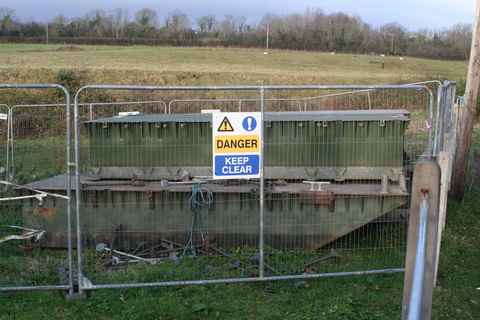
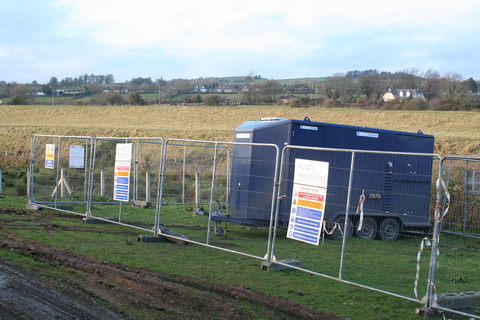
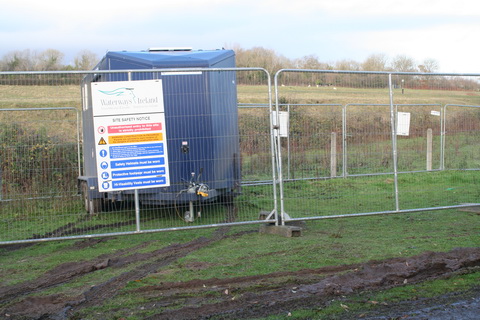
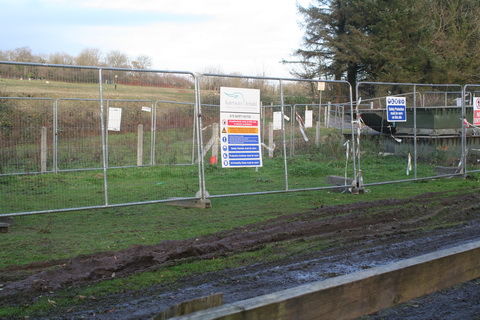
Waterways Ireland has parked a canteen trailer and some pontoons at Errina Bridge.

The compound, with Official Notices signed Rabbit

Pontoons

The canteen trailer


Another view of the canteen trailer

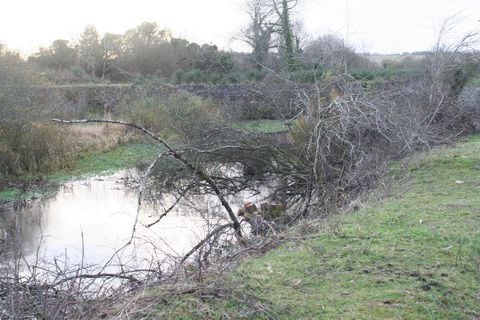
Evidence of tree cutting above Errina Lock, but that may not have anything to do with Waterways Ireland

The guardians of the lock


A Limerick/Shannon website

A new-ish site and project here.

Royal water

In April 2012 I wrote about the proposed supply of water from Lough Ennell to the Royal Canal. I said that

[…] the Lough Ennell proposal had to go to An Bord Pleanála. At any rate, two applications had to be made, one for the water abstraction and the other for the physical works. In practice, the two are being handled as one.

An Bord Pleanála asked Westmeath County Council for some more information; that has now been supplied and a decision is expected by 11 June 2012.

I have just checked An Bord Pleanála’s website for the two applications PW3005 (lodged 9 December 2011) and JA0030 (lodged 7 October 2011); both say:

Proposed decision date not available at this time.

I do not know why decisions are taking so long.

Dept Ag

Big it up for the Lands Branch (who knew?) of the Dept of Ag, which responded immesiately to tell me that the fishing rights in my garden are owned by the Central Fisheries Board, which is called something else these days, so we know it’s much more efficient.

If only the DeptAg folk in charge of Section 46 of the Merchant Shipping (Investigation of Marine Casualties) Act 2000 were as quick to respond as their Lands Branch colleagues.

Fishing rights

Looking at the deeds for my house today, I found that the Land Commission took the fishing rights for the land whereon the house is built.

At the moment, these rights are of little value as the house is near the top of a hill and surrounded by other houses and a graveyard. However, what with global warming and all that, it may be that there will be a rise in water levels and that the fishing rights will then be valuable.

Accordingly, I have written to the Department of Agriculture, which may be the successor to the Land Commission, to ask it to give me the fishing rights.


Save the newts: abandon the Clones sheugh!

Why has the proposed sheugh not yet been approved in Northern ireland? Because the Northern Ireland Environment Agency has been asking hard questions. WI has very kindly put the answers on its website.

The newts are going to be evicted, the stables may have to go but the Orange Hall won’t be affected. Hours of interesting reading.


Eeyore’s Gloomy Place

Here is an article, perhaps by Philip Dixon Hardy himself, from his Dublin Penny Journal of 1835. It is about the Bog of Allen, and the turfcutters living thereon, seen from the Grand Canal in 1835.

He visited a turfcutter’s hovel in the bog while stopped at a double lock about twenty miles from Dublin. What lock could that have been?

Note that Kildare is not among the counties mentioned in the article.

A Winn for the Grand

In today’s Sunday Business Post Jasper Winn, the paper’s Hardy Outdoor Correspondent, describes a five-day walk along the Grand Canal, from Harold’s Cross to Shannon Harbour. He did it in winter, camping out on the bank overnight despite its being so cold that the canal froze over, and finishing some of his days’ walks in the dark.

The SBP operates a paywall so you may not be able to see the page, but this is the link in case you want to try.