Category Archives: Non-waterway

Erne

As I understand it, the level of Lough Erne, and the occasional need to use its only lock, at Portora, are both determined by the operations of the Lough Erne hydroelectric scheme, although most of the lake, and the lock, are in Northern Ireland, while the hydroelectric stations, at Cliff and Cathaleen’s Fall, are both in the republic. The Erne scheme is less well known, and has been less often written about, than the Shannon scheme at Ardnacrusha, so it is good to note that two Ballyshannon men, Dessie Doyle and Brian Drummond, have written a book about the Erne scheme.

Unfortunately it is not clear from Messrs Lilliput Press’s website whether the book has already been published or is to appear some time in 2014. No publication date is given, but on the other hand it is not in the list of forthcoming books, but that list does not extend beyond November 2013. I would be glad to be able to carry reliable information, but I regret that I am unable to do so.

Draining Lough Derg

The ESB is currently letting more water down the old course of the Shannon, from Parteen Villa Weir through O’Briensbridge, Castleconnell and the Falls of Doonass. This channel gets the first 10 cubic metres per second from the Shannon; the next 400 go through Ardnacrusha and anything left over is sent down the old course.

The result is to help to reduce the water level on Lough Derg while raising it on the old course.

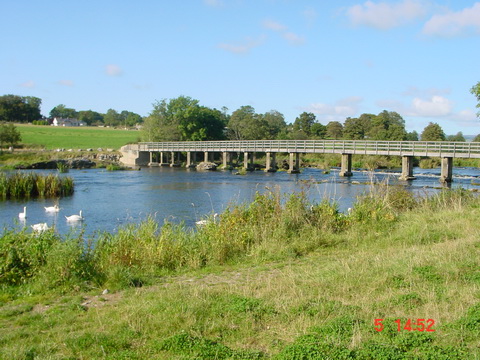
The footbridge in Castleconnell at normal summer level in 2002

The footbridge in Castleconnell at normal summer level in 2002

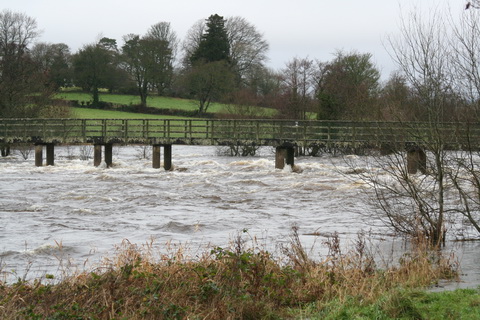
The footbridge on 1 January 2014

The footbridge on 1 January 2014

Before Ardnacrusha was built, the old channel took the entire flow of the Shannon, so it can take more than it has now.

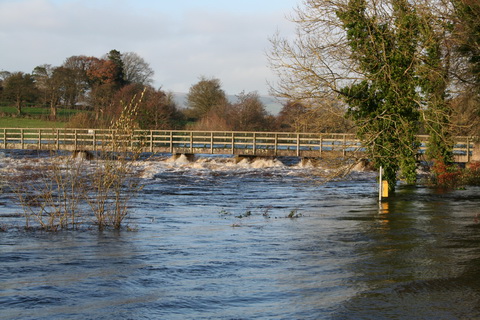
The footbridge in the floods of November 2009

The footbridge in the floods of November 2009

The level is still below that of 2009, when the land around the old channel flooded in several places. But much land is waterlogged: I saw yesterday that the upper reaches of the Nore, the Barrow and other rivers were in flood. And more rain is forecast.

Wouldn’t it be nice if some of that could be sent to Dublin instead? I see that some folk claim (on what looks like a website that hasn’t been updated for a while) that the evil Dublin folk want to extract 350 million litres of water from the Shannon every day; the original idea was to take it from Lough Ree but now it seems that Lough Derg is the preferred source.

Now 350 million litres sounds like a lot, but it’s 350 000 cubic metres per day, 14 583.3 per hour, 243.05 per minute, 4.05 per second, which is less than 1% of normal flow through the two channels draining Lough Derg. There’s a lot more at the moment, and the good citizens of Dublin are welcome to come down and fill their buckets. I suspect that Clare TD Michael McNamara has got things out of proportion.

Addendum: 350 million litres per day, over a lake whose area is 130 square kilometres, would lower the level of the lake (if my calculations are correct) by 2.69 millimetres. If no water entered the lake, the level would be down 983 mm after a year, ignoring evaporation and other abstractions and assuming that the Shannon and other tributaries no longer flowed in and that there was no rain.

Wind and eels

Interesting BBC story about a possible cause for the decline in the number of eels.

Money from the bog

To a small extent reclamation is now going on in Ireland; Mr M’Nab, of Castle Connell, county Limerick, has reclaimed 80 acres of the worst red bog, devoid of vegetation and 20 feet deep. It was drained, then coated with the subsoil, and the land which was not worth 2s 6d per acre is now worth 30s per acre.

Thus Robert Montgomery Martin in his Ireland before and after the Union with Great Britain third edition with additions; J D Nichols and Son, London; James McGlashen, Dublin 1848.

I have written here about Mr Macnab (that was how the spelling settled down) and his talent for extracting money from the bog at Portcrusha, which is between Castleconnell and Montpelier, Co Limerick. It seems that his achievements are still remembered — and emulated.

Incidentally, in the same work, published in 1848, Mr Martin refers to the

… large practical mind, great experience,  and Christian philosophy …

of Sir Charles Trevelyan.

Our Glorious Leader …

is to address, on Sunday night, anyone who watches television but doesn’t have a choice of television channels. There will be a medium term economic strategy too, promising a new and better future for all our people. But as Finfacts says:

… past experience coupled with signals so far, suggest that [the strategy] will be a promotional brochure for an international audience with some questionable claims and omissions. The expected plunge in services exports by as much as €50bn during the time horizon is not likely to be acknowledged.

There is an urgent need for a credible growth strategy that has an unvarnished assessment of the challenges with an honest analysis of strengths, weaknesses, opportunities and threats, using data that is free of the outsize impact of the foreign-owned exporting sector.

I wonder whether the strategy will include any sheughs.

Ballylongford (and Inishmurray/Cahircon)

SHANNON-RIVER. This is by far the most considerable river in Ireland, or perhaps in any known island, not only on account of its rolling 200 miles, but also of its great depth in most places, and the gentleness of its current, by which it might be made exceedingly serviceable to the improvement of the country, the communication of its inhabitants, and consequently the promoting inland trade, through the greater part of its long course, being navigable to a considerable distance, with a few interruptions only of rocks and shallows, to avoid which there are in general small canals cut, to preserve and continue the navigation.

Thus Wm Wenman Seward, Esq [correspondent of Thomas Jefferson], in his Topographica Hibernica; or the topography of Ireland, antient and modern. Giving a complete view of the civil and ecclesiastical state of that kingdom, with its antiquities, natural curiosities, trade, manufactures, extent and population. Its counties, baronies, cities, boroughs, parliamentary representation and patronage; antient districts and their original proprietors. Post, market, and fair towns; bishopricks, ecclesiastical benefices, abbies, monasteries, castles, ruins, private-seats, and remarkable buildings. Mountains, rivers, lakes, mineral-springs, bays and harbours, with the latitude and longitude of the principal places, and their distances from the metropolis, and from each other. Historical anecdotes, and remarkable events. The whole alphabetically arranged and carefully collected. With an appendix, containing some additional places and remarks, and several useful tables printed by Alex Stewart, Dublin, 1795. [Google it if you want a copy.]

Seward was one of many people who saw the Shannon as a valuable resource, even if they were vague on how it was to yield a return. I was reminded of that on reading the Strategic Integrated Framework Plan for the Shannon Estuary 2013–2020: an inter-jurisdictional land and marine based framework to guide the future development and management of the Shannon Estuary. The Introduction includes this:

The Shannon Estuary is an immensely important asset and one of the most valuable natural resources in Ireland and the Mid-West Region in particular — the fringe lands and the marine area both provide space and location for development, activities and opportunities to progress economic, social and environmental growth within the Region.

This report is an attempt to show how the estuary could deliver a return. The core point seems to be that a small number of areas are designated as “Strategic Development Locations for marine related industry and large scale industrial development”, thus protecting them from the attentions of the environmentalists: the whole of the estuary is a Special Area of Conservation and a Special Protection Area.

Almost all the Strategic Development Locations are already industrialied in some way:

  • Limerick Docks (in Limerick city)
  • Ballylongford (of which more below)
  • Tarbert (power station)
  • Aughinish Island (alumina)
  • Askeaton (Nestlé)
  • Foynes Island and land to the rear of Foynes (main port on the estuary)
  • Moneypoint (power station).

There is one more, Inishmurry/Cahircon (which is not boring), which is even more interesting because there is no industry there at present. It was used as a resting place for certain vessels, but it was also proposed as the site for an explosives factory. Perhaps the designation as a Strategic Development Location suggests that that proposal is not dead but merely sleeping.

Ballylongford is equally lacking in industry, despite activity at Saleen in the early nineteenth century. However, Shannon Development assembled a large landbank nearby; the report’s Executive Summary says:

The Ballylongford Landbank benefits from a significant deepwater asset and extant permission for a major LNG bank.

Here is the area in question. Note that the red oval is just to indicate the rough location; it does not show the boundaries of the landbank.

Ballylongford (OSI ~1840)

Ballylongford (OSI ~1840)

You can see a proper map and a marked-up aerial photo in Volume 1 of the report [PDF] on page 73 (77/174).

Shannon Development agreed to give a purchase option on a little uder half of the site to Shannon LNG Ltd, which proposed to build a liquefied natural gas terminal there, to be supplied by ship; much information is available here.

The Commission for Energy Regulation decided to introduce charges that would have increased Shannon LNG’s costs; the company took the matter to court but, yesterday, lost its case. The Irish Times report here will probably disappear behind a paywall at some stage; the Irish Independent report is here and the Limerick Leader‘s here (its photo shows Tarbert and Moneypoint; the Ballylongford site is off to the left).

If the Ballylongford development does not proceed, plans for economic growth on the Shannon estuary may prove to be for the birds.

My OSI logo and permit number for website

Sheughery

I wonder why Sinn Féin asks questions when it does. This one [h/t KildareStreet.com] seems to have been asked at a time that the minister might have welcomed.

Sandra McLellan [SF, Cork East]:

To ask the Minister for Arts, Heritage and the Gaeltacht the position regarding the Ulster Canal restoration project; the steps that must be taken to complete the project; the indicative timeline for the completion of the project; and if he will make a statement on the matter.

Jimmy Deenihan [FG, Kerry North/West Limerick] [the third para is the interesting one]:

As the Deputy will be aware, in July 2007 the North/South Ministerial Council (NSMC) agreed to proceed with the restoration of the section of the Ulster Canal between Clones and Upper Lough Erne. The then Government agreed to cover the full capital costs of the project, which were estimated at that time to be of the order of €35m.

It was always the intention that the Ulster Canal project would be funded from the Waterways Ireland annual allocations, as agreed through the annual estimates processes in this jurisdiction, as well as the deliberations of NSMC in relation to annual budgets. It was a key consideration throughout the process that the Ulster Canal project would be supported by a significant level of projected income from the commercialisation of certain Waterways Ireland assets. However, the economic downturn has had a negative impact on those plans.

I am continuing to explore all possible options to advance this project within the current fiscal constraints. In this regard, I established an Inter-Agency Group on the Ulster Canal to explore ways to advance the project and to examine possible funding options for it, including existing funding streams and the leveraging of funding from other sources. The Inter-Agency Group last met on 9th October and will meet again next week, on 9th December.

In the meantime, the Ulster Canal project is progressing on an incremental basis. Planning approvals have now been received for the project in both jurisdictions. Compulsory Purchase Order land maps are in preparation and consideration is being given to how the construction work and other technical aspects of the project will be structured once the necessary lands have been secured. The timeline for completion of the project will be determined when these preparatory steps have been completed.

I welcome these developments, which, I am sure the Deputy will agree, are a significant milestone for the project.

Hmm. The inter-agency group first met on 20 September 2012 and its second meeting was to take place in May 2013 or thereabouts. Now it’s going much faster, with meetings on 9 October and today, 9 December. Does this suggest that the group has found a pot of gold? Is there any link to the cancellation of SEUPB funding for the Narrow Water project?

And what has been going on in (and around) the North/South Ministerial Council? At its June 2013 meeting the Council approved or noted:

  • the business plan for 2012 (which had ended six months earlier)
  • the budget for 2012
  • the annual report for 2012
  • the draft accounts for 2012.

That suggests to me that there was either a major disagreement between the northern and southern ministers or a serious problem that rendered ministers unable to approve the WI budget and business plan until 18 months after the documents were required. Could it be that the northern minister, Carál Ní Chuilín [SF], like other NI politicians, had been looking for something from the waterways sector that hasn’t been delivered so far?

Note also that Jimmy Deenihan said

[…] consideration is being given to how the construction work and other technical aspects of the project will be structured once the necessary lands have been secured.

I understand that the design and construction of the Clones Sheugh was to be put out to tender but I wonder whether keeping the work in house might help WI to meet its increasing wage costs with a declining budget.


Ticking all the boxes

Sometimes an idea comes along that is just so good, so right, so advantageous on all counts that it is simply irresistible. This idea comes from the Americas, from the US Coast Guard. Adapted to the Irish inland waterways, and specifically to the Shannon, it could:

  • help to promote industry in recession-hit rural areas
  • create direct employment
  • help to stimulate indirect employment
  • promote Irish energy independence by reducing reliance on imported hydrocarbons
  • counter pollution of water-courses
  • reduce the number of heavy trucks using remote rural roads
  • use environmentally-friendly water transport, by barge along the Shannon
  • honour and promote the industrial heritage of Co Leitrim and the transport heritage of the Shannon
  • help to defray the costs of maintaining the Shannon Navigation
  • solve Dublin’s water supply problem, at least for non-potable water.

How could anybody resist?

The US Coast Guard has proposed that wastewater from fracking [PDF] should be transported by barge, rather than by truck or railway train, from the fracking sites to remote storage or treatment facilities. So, when fracking begins around Lough Allen, the wastewater could be carried down the Shannon by barge and, if necessary, pumped to Dublin.

It sounds like a winner to me.

No Newry is bad news

In October I wrote about a Northern Ireland Assembly debate on a proposed Newry Southern Relief Road. I said:

… the debate was remarkable for its demonstration of cross-party agreement: not so much on the desirability of public works (a desideratum of Irish politicians since the eighteenth century) as on the irrelevance of the Narrowwater bridge.

[…]

It must surely be unlikely that there will be two crossings of Carlingford or the Newry River [and canal] within a few miles of each other. But if one option, the Newry Southern Relief Road, helps to relieve Newry and Warrenpoint traffic and the other, the Narrowwater bridge, doesn’t do so, then the first option would seem to be the rational choice.

Yesterday, 12 November 2013, Martin McGuinness [SF, Mid Ulster] reported to the Northern Ireland Assembly on the recent plenary meeting of the North/South Ministerial Council. He and others expressed support for the Narrowwater project. This question is revealing:

Caitriona Ruane [SF, South Down]: Go raibh maith agat agus go raibh maith agat don LeasChéad-Aire as an ráiteas sin. I welcome the statement from the deputy First Minister. Does he agree that the Narrow Water bridge project is a very good project for everyone in the Louth/Down area, that the chambers of commerce are representing every single community — Kilkeel, Warrenpoint and Rostrevor — and that the project went through a very rigorous process in relation to the SEUPB and came out at the top of the competitive process?

She made no mention of Newry; nor did any other contributor to the debate.


Bolshevism, boats and bridges

The balance bridge crossing the canal, near Newcomen-bridge, as designed and erected under the superintendence of Mr Bindon Stoney, engineer of the Dublin Port and Docks Board, has been completed, and adds considerably to the facilities for carrying on the traffic. This bridge has been erected in substitution of a lift-bridge, constructed in 1872, but to which an unfortunate accident occurred in February, 1878.

Ralph S Cusack, Chairman, in the report of the Directors of the Midland Great Western Railway, 19 February 1879, quoted in the Freeman’s Journal 27 February 1879

In mid-October I mentioned that Maureen O’Sullivan [Ind, Dublin Central] had asked the unfortunate Jimmy Deenihan [FG, Kerry North/West Limerick, and minister for waterways] about Effin Bridge, the lifting railway bridge below Newcomen Bridge on the Royal Canal in Dublin. The bridge is lifted, to allow boats through, on [IIRC] one Saturday each month in the summer, making five lifts a year. Waterways Ireland says on its website [click Bridges if necessary]

The Newcomen Lift Bridge in Spencer Dock is owned and operated by Irish Rail, and requires a rail possession to be lifted. It can only be lifted for boats at limited prearranged times organised with Waterways Ireland. For details of opening times and to arrange passage contact the Eastern Regional Office on 01 868 0148.

Maureen O’Sullivan wanted

… a meeting of interests concerned with the operation of the lifting bridge with a view to devising a management and operational system that is less hostile to the use of the waterway as currently it is an impediment and discouragement to navigation on the Royal Canal and an obstacle to navigation-communication between the Royal Canal and River Liffey and between Royal Canal and Grand Canal at their eastern reaches […].

Jimmy Deenihan said

The bridge is operated by Irish Rail staff on a request basis at Waterways Ireland’s expense.

However, he wasn’t giving any hostages to fortune by making rash promises or even by commenting on whether the bridge was an impediment to navigation. But Ms O’Sullivan was undeterred: she returned to the topic with two written questions on 5 November 2013 and a priority question, no less, on 7 November 2013 [for certain values of “priority”]. On 5 November she asked two questions of Jimmy Deenihan

To ask the Minister for Arts, Heritage and the Gaeltacht further to Parliamentary Question No. 59 of 16 October 2013, the extent of railway track that needs to be closed by Irish Rail in order for a vessel on the Royal Canal, Dublin, to be given access between the First and Sea Levels of the Royal Canal; if there has been an assessment of whether the extent of track closure could be reduced to facilitate greater ease of navigation on the Royal canal; and if he will make a statement on the matter.

To ask the Minister for Arts, Heritage and the Gaeltacht further to Parliamentary Question No. 59 of 16 October 2013, if the option of a introducing a drop lock to replace the need of the lifting bridge has been considered since the establishment of Waterways Ireland or if that assessment was made by Waterways Ireland’s predecessors; the level of use of the sea level assumed in relation to the assessment; if the impact of the Spencer Dock Greenway was taken into account and vice versa, was account taken of the impact on the Greenway were the sea level to be made accessible to navigation by replacing the lifting bridge; if the assessment includes analysis of whether the effective re-opening of the sea level of the Royal Canal to meaningful levels of year-round traffic would be consistent with the EU’s commitment to the ‘protection and preservation of cultural heritage, in view of the fact that Dublin’s waterway’s heritage is part of the cultural infrastructure of Europe, contributing to economic attractiveness, job opportunities and quality of life; and if he will make a statement on the matter.

The ever-patient Mr Deenihan replied:

I am advised that the option of constructing a drop lock to replace the need for the lifting bridge at the location in question has been considered by Waterways Ireland but it was not deemed viable due to the estimated costs involved, given that the minimum cost for a drop lock to replace the bridge would be of the order of €5m. Work to install a drop lock at this location would also involve considerable temporary works, the extent of which would be unknown until ground conditions were assessed in detail.

I am also advised that there have been no assessments or analyses undertaken by Waterways Ireland in respect of the level of use or impact on the Spencer Dock Greenway.

I can inform the Deputy that the length of railway track disconnected from the rest of the loop line from the station when the bridge is in the ‘up’ position is approximately 16 metres. However, as the control and operation of the railway line in the vicinity of the lifting bridge lies entirely with Irish Rail, only it can indicate the extent of the permanent rail line that needs to be closed when the bridge is opened.

He might also have pointed out that €5m is more than WI’s entire capital budget, which is under €4m for all southern waterways for 2014. And if he were an argumentative chap, he might have pointed out that there is no evidence of a demand for

… the effective re-opening of the sea level of the Royal Canal to meaningful levels of year-round traffic …

and no evidence that it would be of any economic benefit to anyone, least of all the residents of Dublin Central, even if boats were travelling that way every day of the week.

He might, if he were an impatient sort of chap, have pointed to the idiocy of the “cultural heritage” argument: with one or two minor exceptions, pleasure craft were not part of the “cultural heritage” of the Royal but, even if they were, such “heritage” wouldn’t be worth millions that might be spent instead on bringing soup to the deserving poor of Dublin Central.

Ms O’Sullivan was back with more on 7 November, this time trying to get Leo Varadkar [FG, Dublin West] to get the National Transport Authority to include Effin Bridge and the Sheriff Street non-lifting bridge (not a Scherzer) included in a National Transport Authority study of “the management and movement of people and goods to, from and within Dublin city centre”. Ms O’Sullivan’s rather confused and confusing case seemed to be that there was a greenway, and there were walking and cycling routes along the canal, so a road bridge (that works perfectly well for carrying a road) and a railway bridge (that works perfectly well for carrying a railway) should be included  in the study because the canal has navigational potential.

Or something. She even managed to bring water polo [does she mean canoe polo?] into the argument.

As far as I can see, walking, cycling, road travel and rail travel — and even water polo — are not in any way adversely affected by the current arrangements, while the canal is of negligible importance in the movement of people and goods. Boating on the canal is a leisure activity for a small number of people who are sufficiently well heeled to own pleasure-boats; I am rather surprised to find that their interests are a matter of such concern.

As the expenditure on reopening the Royal Canal is a sunk cost, I am all in favour of making its use easier — provided that it can be demonstrated that (a) there is a demand for increased use, (b) such increased use will have benefits that outweigh the costs of any improvements and (c) no alternative investment offers better returns. As far as I can see, Ms O’Sullivan has demonstrated none of the three: indeed I see no evidence that she has even considered them.

What’s depressing here is the absence of any indication of a rational approach to capital spending on waterways. They’re still cargo: a magical source of wealth, that will bring peace and prosperity as long as we all believe in fairies and avoid facts, thinking and analysis.

No wonder the country is in a state of chassis.

Update 15 November 2013: some information about demand for passage under Effin Bridge.