Category Archives: Non-waterway

The agency model

I have been told that, until recent years, travel agents in Germany and elsewhere would buy packages of weeks on Irish hire-boatsa and then sell them on to their own clients. I have also been told that this “agency model” ceased to be used [or became less used], perhaps because of the growth of internet booking. And it has been suggested that this was one of the factors in the decline of the Shannon hire-boat trade, to which I have repeatedly drawn attention [most recently here].

I do not know whether this phenomenon has been documented or formally studied. If it has, I would be grateful if any reader can point me to the documents or studies. I would also welcome other Comments on the proposition.

Packaging and marketing

I mention it now because, when launching the Shannon Blueway project, the waterways minister Heather Humphreys said:

The launch of the Blueway will allow local businesses [to] capitalise on an increase in demand for transport, equipment hire, accommodation and entertainment.

I think that the Blueway is an excellent idea, but I am concerned about whether small local companies will be able to package and market it effectively to overseas tourists. If the long-established cruiser-hire-firms were or are finding effective marketing difficult, why would (say) a canoe- or bicycle-hire-firm in Drumshanbo find it any easier?

Marketing to anglers

There was an interesting discussion at the Joint Oireachtas Committee on Transport and Communications about “Depletion of Inland Fish Stocks and Impact of Estuary Poaching: Inland Fisheries Ireland” on 22 October 2014. Note in particular the contributions of Dr Ciaran Byrne from 10:25 onwards about how Inland Fisheries Ireland markets Irish angling to overseas anglers.

What struck me was not that IFI uses any particularly magical marketing methods but that it is dealing with a well-defined interest group: people who are committed to a particular activity and have invested heavily in it (buying rods and stools and nets and umbrellas and maggots and whatever else anglers use).

Identifying potential customers

Anglers form one segment of the market for inland waterways holidays, but the task of selling to other segments is harder if they lack a single compelling interest. Hence, no doubt, those rather demented attempts by Fáilte Ireland or Tourism Ireland to categorise potential customers as ‘Sightseers and Culture Seekers’, ‘Family & Loved Ones’, ‘Relaxers’ and ‘Outdoor Actives’. None of their interests strikes me as being exactly compelling: there are several countries where you can relax, engage in outdoor activities or look at sights.

What you really need is obsessive customers: folk, with money to spare, who are really interested in one thing. Then you entice them to your area and take their money from them: not, as Brian Ború would have done, by hitting them over the head and stealing it, but by selling them overpriced goods and services.

Lough Derg

If you don’t have obsessive customers, who are compelled by their inner urges to dangle maggots in your waters (or whatever else turns them on), then you might try offering a compelling attraction: something that is so interesting that folk put it on their to-do lists. Unfortunately, as Fáilte Ireland’s Lakelands Lough Derg Roadmap [PDF, 6.7MB; well worth reading] admits,

Lough Derg does not have suffient key attractions that act as a draw to the area.

The same thought has often struck me. As you drive around the lake, you see signs pointing towards it. But suppose you’re a casual tourist who hasn’t already booked an activity. When you get to the lake, about the only thing you can do is look at the water (which becomes less interesting after a while) or at the jolly people enjoying themselves on boats (ditto).

You can, in some places, go to a pub or eatery, but you don’t need to come to Ireland to do that. Or you can paddle. If you fish, you can fish, but I’m trying to think of things for non-anglers. In Killaloe, you can take a boat trip; in Dromineer, you can hire a sailing boat; in Mountshannon, you can visit Holy Island. But there is nothing you would come to Ireland for: nothing you can’t do in other places.

Roadmap remedies

The Roadmap proposes these remedies:

The following three key tourism products are proposed:

  • A Discovery Point and Trailhead at the Portroe lookout
  • A Lough Derg Canoe/Kayak trail
  • An enhanced offering and facilities at University of Limerick Activities Centre (ULAC).

Two additional tourism products are proposed:

  • Portumna eco-park (masterplanning required)
  • Publications to promote and support active enjoyment of Lough Derg and surrounds.

There is, alas, another set of categories of potential visitors:

The three market segments identified with the best potential for delivering international visitors to Lough Derg have been identified as Curiously Cultural, Great Escapers and Nature Lovers.

Other, less exploitable, market segments are identified too, but I can’t bring myself even to name them.

Finding the punters

I’d hate it to be thought that I was a marketing expert, but it seems to me that this segmentalisation is coming at things from the wrong end. In effect, it’s saying “We have these things; what sort of person might be induced to buy them?” Then you give each of those sorts of person a category and say that you’ve found your market.

But compare that with what the fisheries folk do. They can identify magazines that anglers read, maybe (for aught I know) television programmes they watch, trade shows they visit. Identification is easy: the titles will include words like “fishing” or “angling”.

But what magazines — other than those on the top shelf — have “Curiously Cultural” or “Nature Lovers” in the title? How do you track down “Great Escapers”? It seems to me that these categories might help you to tailor a message that is broadcast to large audiences through mass media: in such cases it doesn’t matter if you appeal to only 1% of the audience, provided that that audience is large enough. However, that’s not an option available to those with small budgets: they need cheaper marketing through channels that will provide much higher returns.

Small operators

And that’s where we come back to the fact that most of the potential tourism operators around Lough Derg are pretty small. Who is going to put together packages of activities that will appeal to the curiously cultural? I’m interested only in filling my B&B and you’re interested in hiring out bicycles. I’m happy to refer customers to you and vice versa, but are we going to get together to provide packages and to share our marketing budgets? There is a Lough Derg Marketing and Strategy Group, but it seems to be dominated by representatives of public sector bodies, and there is a limit to what they can do.

To compete on a European scale, what’s really needed is a large commercial organisation. I suggest, therefore, that the best thing to do would be to get Goldman Sachs to advise on how Lough Derg might be privatised.

Second-best would be the formation of a tourism cooperative.


Royal Canal water supply

On 26 November 2012 I noted that

The Royal Canal water supply applications have been approved by An Bord Pleanala. There were two separate applications […] but they were in effect treated as one.

There were conditions attached, but I concluded that

If I remember correctly, the amount of water available from Lough Ennell will not always provide enough (eg in a dry season) to keep the canal full. Still, this is a significant advance for Waterways Ireland and for Royal Canal enthusiasts.

So here we are, almost two years later, and the work of providing a supply from Lough Ennell to the Royal Canal, reckoned to be about a five-month job, has doubtless been long completed, no?

No.

The work has not yet started and Waterways Ireland will be lucky if it gets done within the next year.

As I understand it — and if, Gentle Reader, you have more information, do please leave a Comment below (your name can be kept out of public view if you like) — there are three sources of delay:

  • first, I understand that there is a technical issue about one of the conditions attached to the approval; it is felt that the condition is unworkable, but that getting it changed might take some time. I presume it’s one of the conditions 2(a) to 2(d) that I quoted two years ago and, looking at the proposed orders published in the press [PDF], I suspect it might be the requirement to maintain the lake level at or above 79.325 mOD Malin Datum. However, I don’t really know
  • second, Waterways Ireland took over Clonsingle Weir, at the outlet from Lough Ennell, by Compulsory Purchase. Owners of mills, who generate electricity from the Brosna, have submitted claims for compensation. I understand that an arbitration hearing, lasting four days, is scheduled to be help in May 2015
  • third, responsibility for the scheme has moved from Westmeath County Council to Irish Water. Which may have other things on its mind.

Irish Water has published its proposed Capital Investment Programme [PDF] but Appendix 1, the Investment Plan Project Summary, is in a separate file [PDF]. Category B is headed Review Scope and Commence Construction and it includes

Mullingar Regional Water Supply Scheme (G) … Lough Ennell Abstraction.

I can’t work out what “(G)” means. A few items are so marked; a few others are marked “(H)”; most items have neither.

The Capital Investment Programme [CIP] document says:

 The CIP is dominated by contractual commitments entered into previously by Local Authorities, and which have now transitioned to Irish Water. In the 2014-2016 period, Irish Water will fund these contracts to completion and bring forward programmes and prioritised projects to commence. At the same time, it will progress a large portfolio of projects that are at the planning and design stage, reviewing their scope, budgets and, where appropriate, timing to favour maximising the performance of the existing assets through intensified capital maintenance that might allow deferral of major capital investment.

Emphasis mine. So that raises the possibility that Irish Water will decide not to fund the abstraction scheme but will rather opt to pay for continued pumping.

It is, of course, quite possible that I have misunderstood these difficult matters, so I will be glad to hear from anyone with better information.

Incidentally, reviewing Irish Water’s documents suggests to me that there are people there who know what they are doing and who have the expertise to manage large and complex operations. That differentiates them from the politicians in government and opposition, few of whom (as far as I can see) have any experience of running anything more complex than a parish social.


DCAL and water recreation

Noting that the NI Department of Culture, Arts and Leisure [DCAL] has a Water Recreation Development Programme, I emailed the department to find out more:

I would be grateful if you could let me have a copy of your 2013-14 Inland Waterways Water Recreation Development Programme and of any subsequent equivalent programmes, policies or documents. I have been unable to find anything on your website.

I am grateful for the reply, which read:

[…] we wish to advise you that we do not have a formal Water Recreation Development Programme document. How the Water Recreation Development Programme is operated is that we apply each year for capital funding. If successful, we then go out to local authorities seeking to work in partnership with them and other public bodies to co or match fund appropriate and inclusive capital projects. Such projects should provide water related access: for example riverside paths, canoe steps or other similar facilities on public owned land which is free for the public to access and use.

The process we follow is when we receive details of the projects from local authorities we complete an assessment of the project taking into account the following criteria

  1. Does the project provide water access
  2. Are there funding or delivery partners
  3. How the project links to the community
  4. How will the project be maintained in the future
  5. Does it enhance or improve disability access
  6. How does it promote social inclusion.

If DCAL is content that these criteria are met we would then consider funding for the project.

During the 13/14 year we had a capital fund and we were able to support six projects; however due to budget constraints we do not have a capital fund this year 14/15.

The Water Recreation Development Programme appears to be distinct from the Water Recreation Programme covered here and to apply to waterways other than those managed by Waterways Ireland.

This site has what purports to be the department’s business plan for 2013–4. I expected to find it here on the DCAL site but that page seems not to have been updated for some years. If anyone can point me to a link on the DCAL site, I would be grateful for guidance.

I cannot, therefore, be certain that the purported plan is actually DCAL’s plan, but I quote it anyway.

DCAL Inland Waterways

In partnership with local authorities and the voluntary and community sector, DCAL continued to manage canal towpaths in 2012-13. In addition, under the Inland Waterways Water Recreation Development Programme, in conjunction with local councils the Department grant aided 6 projects which included a canoe slalom, interpretative signage and the installation of an outdoor exercise ‘Trim Trail’. These facilities are free for everyone to use and it is a stipulation of the Programme that projects address social exclusion. The Water Recreation Programme is continuing in 2013-14. Funding was also made available to the Lough Neagh Partnership to engage with local rural communities around the lough to explore how they could develop the cultural and leisure tourist potential of the Lough.

In 2013-14, key challenges include work towards registration of assets on the Lagan Canal and investigations into the provision of a safe system of navigation markers for Lough Neagh. DCAL will also be considering the outcomes of a study into the potential for re-opening the former Lagan Navigation.

DCAL’s target for y/e 31 March 2014 was:

By 31 March 2014, to fund at least 5 water recreation projects which provide accessible opportunities for all and target those experiencing poverty and social exclusion.

Its “opening allocations” for 2013–4 were:

  • Inland Fisheries and Waterways: current £5.87m, capital £0.17m
  • North/South Body – Waterways Ireland: current £5.42m, capital £0.25m.


Before Ardnacrusha

Waterworks sluices 06_resize


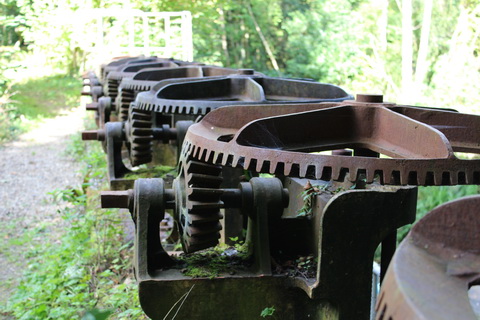
The power of the Shannon, falling 100 feet in 15 miles from Killaloe to Limerick, is nowadays tapped by the hydroelectric power station at Ardnacrusha. But in earlier times it did not go entirely unused. I have already written about the bleach mill at Doonass; here is a page about the other bleach mill, at Clareville, and about the water works in the same area. These works are on a stretch of the Shannon navigable only by cots (then) and kayaks and canoes (now).


Carpenters Road Lock in London

Carpenters Road Lock in 2003

Carpenters Road Lock in 2003

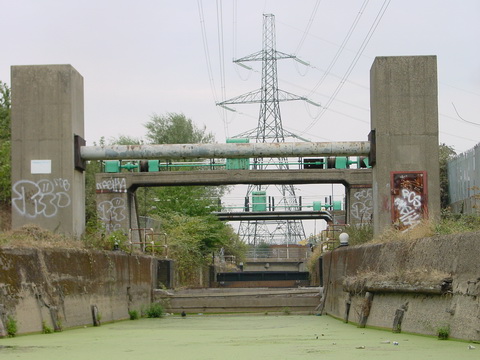
Here is a page about an art (craft?) project happening at Carpenters Road Lock on the Bow Back Rivers in London: the lock has changed quite a bit since I took the photo (above) in 2003.

I should warn you that the link is to a very long web page, but the section headings stay on top so you can move around. However, if you allow Javascript, you’ll find that two places on the page show those very annoying sequences of photographs that change automatically.

What I thought was most interesting was the set of events organised at the lock. Canals of Dublin organises canal walks in, er, Dublin, but what about Waterways Ireland having lockkeepers doing talks and demonstrations?

Here are some links to sites with more information about the Bow Back Rivers in London:

London Canals and associated blog

An extensive Wikipedia article with schematic diagram

A political view from Mick Hartley

London’s Lost Rivers on pre-Olympic scenery (black background makes the text hard to read but the photos are good)

The most informative page I found: a superb piece of work. Well done Richard Thomas, to whose Steamers Historical site I have a permanent link.

h/t celr

Urgent message for Athlone folk

If you’re anywhere near Athlone, hie thee to the Lough Ree Yacht Club at 8.00pm on Wednesday 22 October 2014 for the Old Athlone Society meeting. It features Paul Clements, who has just written a biography of Richard Hayward, author (amongst many other roles) of (amongst many other books) Where the River Shannon Flows, a book that should be in every Irish waterways person’s library.

The evening includes a showing of the film of the same name, which (though short) is highly evocative. WW2 was declared as the filming team reached Portumna. There is some very good footage of the Foynes flying-boats.

h/t gjb

Budget 2015

End of austerity?

Waterways Ireland’s southern money [85% of its current budget plus the full cost of capital work undertaken in the republic plus, according to this unicorn who has just dropped in, the full cost of the Clones Sheugh] comes from the Department of Arts, Heritage and the Gaeltacht under the heading of North-South Co-operation. The figures are subject to the approval of the North-South Ministerial Council.

Waterways Ireland accounts for the largest portion of the North-South Co-operation funding but the budget documents [PDF] don’t show the breakdown between WI and the languages body.

The 2014 estimate for current expenditure on NSCoop was €35,271,000; the 2015 figure is €34,870,000.

The 2014 estimate for capital expenditure (all but €119,000 for Waterways Ireland according to page 213) was €3,977,000; the 2015 figure is €3,487,000. Rather neatly, that’s 10% of the current expenditure figure. In 2008 WI got €11,000,000.

The total is 2% down on 2014.

The aim of the NSCoop programme

The aim of this Programme is to maintain, develop and foster North-South co-operation in the context of the implementation of the Good Friday Agreement and the St. Andrews’ Agreement.

Under this Programme, the allocation for 2015 will:

  • Through Foras na Gaeilge and the Ulster-Scots Agency, promote the Irish and UlsterScots language and culture; and

  • Through Waterways Ireland, maintain the waterways for some 15,000 registered boat users.

I noted last year that the department’s high-level programme activities were to include:

Development of inland waterways within the context of the implementation of the Good Friday and St Andrews Agreements.

I deduce, therefore, that development of inland waterways has been abandoned; the [more sensible] aim is now that of maintenance. Furthermore, I note that there is no mention of tourism or of non-boating waterways uses like those lauded by the minister the other day.

Capital “investment”

According to Table 1  Multi-Annual Capital Investment Framework 2015-2017 on page 211, Exchequer Capital Funding to the Department of Arts, Heritage and the Gaeltacht is to fall from €62 million in 2015 to €36 million in each of 2016 and 2017. The 2015 capital estimates are:

A – ARTS, CULTURE AND FILM €42,460,000
B – HERITAGE 6,916,000
C – IRISH LANGUAGE, GAELTACHT AND ISLANDS 8,717,000
D – NORTH-SOUTH CO-OPERATION 3,487,000

The allocations to the last three groups are small, so it looks as if the luvvies will be suffering the cuts. But the level of cuts is rather large; I wonder how that’s going to work.

A win for the luvvies

The departmental overview begins on page 45. On page It shows that Total Gross Voted Current Expenditure is to stay constant at €212 million in 2015, 2016 and 2017. Below that we read:

The multi-annual expenditure ceilings are binding and it will fall to the Department of Arts,Heritage and the Gaeltacht to deliver services within these agreed allocations for the period 2015-17. This includes responding to emerging expenditure pressures over that period without recourse to additional Exchequer allocations. To do so will involve commitment to ongoing reform and efficiency measures and reprioritisation of expenditure as appropriate.

And on page 46:

This funding will enable a significant level of services to be delivered in 2015. The funding provided reflects the Government’s commitment to the conservation, preservation, protection, development and presentation of Ireland’s heritage and culture and the promotion of the Irish language, support of the Gaeltacht and development of island communities.

No mention of waterways, or even of northsouthery, in that lot.

On page 47 we learn:

The 2015 current expenditure ceiling of €212m represents an increase of €4m over the REV 2014 allocation and €7m over the previously published expenditure ceiling.

The additional current expenditure funding in 2015 will be utilised to support existing services and fund initiatives to commemorate the foundation of the State.

So the previous talk of continuing savings has vanished; the department’s total budget is up by 4%, just under €10 million. What we are seeing is a reallocation within the department:

A – ARTS, CULTURE AND FILM up 11%
B – HERITAGE down 12%
C – IRISH LANGUAGE, GAELTACHT AND ISLANDS  up 1%
D – NORTH-SOUTH CO-OPERATION down 2%,

Why are the luvvies getting the loot?

All of this is from a quick perusal; more later as information emerges, in particular when the minister addresses the Dáil.

Barrow Line meets Barrow Navigation

Seen from the air, 1947. Several of Limerick too. What’s the boat at bottom left in this pic of Athlone? A search for “Ireland” gives 2642 results, which is more than I can go through. If you find anything interesting, I’d welcome a link, which I’ll add here.

Broadstone

You can visit the building on the weekend of 18 & 19 October 2014 as part of Open House Dublin. And there are other sites of industrial heritage and transport interest that will be open between 17 and 19 October.

Uninformative press release aboot thon sheugh

Plans to restore the Upper Lough Erne to Clones section of the Ulster Canal are being pursued by the Department of Culture, Arts and Leisure and the Department of Arts, Heritage and the Gaeltacht

it says here. The official NSMC version is here. No mention of the inter-agency treasure-seekers; perhaps the swag is in here:

Progress on the development of the new INTERREG V and PEACE IV Programmes for the period 2014 – 2020 was discussed. The Council noted that the draft Programmes had been submitted to the EU commission by the deadline of 22 September 2014.

I see that WI employee payments for pensions are going up:

16. Ministers also acknowledged the ongoing work in relation to reform of the North South Bodies Pension Scheme, including recently approved amendments to ensure the Scheme complies with employment legislation and best practice in both jurisdictions and to increase employee contributions.

Someone with a tin ear (perhaps someone who doesn’t do crosswords) wrote this:

driving a shift to public and more sustainable modes of transport and the potential for shared cross border public transport services in border areas.

Driving would be right, especially in Donegal. But what about parity of esteem?

development of cross border Greenways

Why no Orangeways?