Category Archives: Scenery

Piers and seed potatoes

I dare say you’ve observed, Major, how singularly little originality there is about Chief Secretaries. One of them, whose name is lost in the mists of antiquity, thought of piers and seed potatoes, and since then all his successors have gone on building piers and handing out seed potatoes. They never hit on anything original. Now if I was a Chief Secretary I’d strike out a line of my own. When I found I had to build something I’d run up a few round towers.

Thus the Rev J J Meldon, curate of Ballymoy, to Major Kent in George A Birmingham’s excellent Spanish Gold. (Birmingham was really Canon James Owen Hannay, who managed to annoy nationalist Catholics, which is always useful.)

Amongst the builders of piers were Alexander Nimmo and the Shannon Commissioners, whose works on the estuary included Saleen Pier.

The Irish Press Releases website has a page dated 17 April 2013:

Funding approved for Clare piers

Co. Clare, Ireland — 17 Apr. 2013 — Funding has been approved for various harbour and pier improvement projects in County Clare. Minister for Agriculture, Food and the Marine, Simon Coveney, T.D., today announced funds totalling 91,500 euro for projects at Ballyvaughan, Cappagh, Liscannor, Carrigaholt and Kilbaha harbours/piers.

“The safety works scheduled to take place at these harbours will have a hugely positive impact on the livelihoods of fishermen and other users of the piers,” explained Clare Senator Tony Mulcahy. He added: “These projects are central to ensuring the safety of all users of the piers. The continued upgrading of these piers is essential to the development of both industry and tourism in the respective areas.”

The funding announcement features allocations of €22,500 to Carrigaholt, €37,500 to Ballyvaughan, €9,000 to Kilbaha, and €11,250 to both Liscannor and Cappagh.

According to Senator Mulcahy: “The funding contribution from the Government covers 75% of the total cost of the relevant projects which include repairs to the pier wall in Ballyvaughan, the installation of a handrail to pier access, harbour wall and upgrade of visitor moorings at Carrigaholt, a complete remediation to the existing pier walls at Liscannor, repairs to the sea wall at Cappagh, and repairs to the harbour wall capping stones at Kilbaha.”

Carrigaholt, Kilbaha and Cappa[gh] are all Shannon Estuary harbour or piers; Cappa[gh] was extended by the Shannon Commissioners. This press release suggests therefore that, if the Chief Secretary’s successors cannot afford to build any new piers, they can at least afford some money to repair them. There is no news about seed potatoes (or, alas, about fodder).

Unfortunately I could find nothing about this topic either on the website of Senator Tony Mulcahy FG or on that of the Department of Agriculture and Technical Instruction, although I may have had the wrong search terms. However, some other (coincidentally. also Fine Gael) politicians have welcomed the planned spending of money on Glin pier [do look at all the pics], which seems to be used only for swimming, so perhaps there is a nationwide campaign of spending small amounts of money in many places — and getting local Fine Gael pols to announce it. Presumably it distracts attention from the shortage of seed potatoes.

The Minister for Ag is a member of Fine Gael.
 

More say he rose again

Last September, I noted that the excellent KildareStreet.com website had been crippled by a change to the software used on the Oireachtas debates website. Life is too short to be spent ploughing through the witterings of politicians (unless you’re being paid to do so, of course), so KildareStreet.com’s search facility was invaluable, as was its emailing of alerts when my chosen keywords were mentioned. That flow of information ended in September.

Happily, though, the KildareStreet.com folk did not give up, readers donated funds, the rebuilt parts of the site are being tested and, yesterday, I got my first alert in over six months. Here, then, is the news about the Clones Sheugh, as seen from Kildare Street.


Losing the head

Just for a change, I’ve put up a new header photo showing a Shannon 1. The photo was taken from Shannon Airport; you can see Ringmoylan Quay on the far side of the river and the beacon on the right is (I think) on the Horse Rock.

Quoth the raving …

… never! More? No, not if you mean Shannon-based fuel suppliers: I can’t find any more on the latest list.

Mark Twain and the Cammoge drownings of 1849

Mark Twain wrote:

There is something fascinating about science. One gets such wholesale returns of conjecture out of such a trifling investment of fact.

I have indulged in just such conjecture about the design of the ferry boat in use at Cammoge in 1849, crossing the outlet from Poulnasherry Bay, west of Kilrush on the Shannon estuary. The news reports of the time give very little information about the design of the boat, and the reliability of that information is questionable, which makes my speculation even more dangerous. Nonetheless, I thought it might be useful to set out some thoughts on the subject in the hope that other folk, who know more about the background, the location or naval architecture than I do, might be able to help to clarify the design.

News from the Suir

Some chap from Limerick has been quoted in the Nationalist (Clonmel) as supporting South Tipperary County Council’s proposed taking in charge of the towing-path between Carrick-on-Suir and Clonmel.

And Carrick-on-Suir River Rescue needs help raising funds to buy a premises.

The corncrake and the decline of religion

On 13 February 2013 the Irish Times reported that a farmers’ representative had told politicians that

Farmers in the Shannon callows are facing extinction along with the corncrake and wading birds […].

He wanted taxpayers’ money to be spent on stopping the river flooding its flood plain.

Back in the days when people believed in gods, they would have known what a flood meant: it was a message from a deity, telling them to stop whatever they were doing. On the Shannon, either people have stopped believing in gods or they are having some difficulty in interpreting the message, despite its having been delivered over and over again for hundreds of years. If it were interpreted properly, or even if landowners had a modicum of common sense, they would realise that they should either cease trying to earn a living along the banks of a river that floods regularly or adapt their expectations or their activities to take account of the floods (one thinks of rice paddies …).

In the years 2009–2011 net subsidies to agriculture in the Midland region were 114.4% of the operating surplus. For the Border, Midland and Western region as a whole, the figure was 110.4%. In other words, agriculture in those regions is, on balance, a form of outdoor therapy for landowners: it is not an economic activity, and there is no point in taxpayers’ spending any more money on it.


Wexford

Here is a great account of the development of Wexford Harbour, with a history of its shipping here.

The glory that was Greese

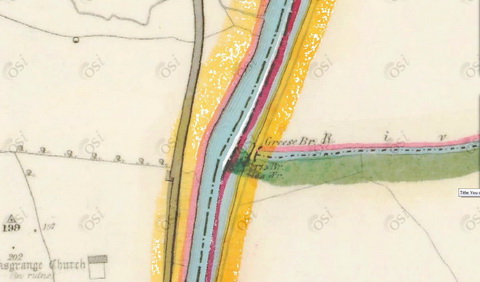
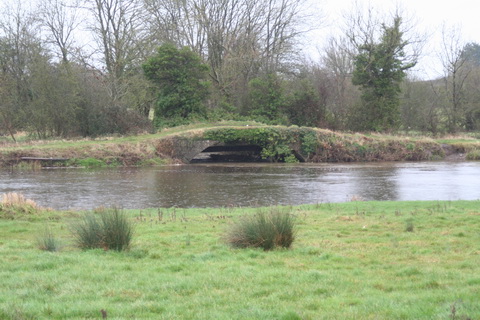
The River Greese is a tributary of the River Barrow, joining it below Maganey Lock. The photo is taken from the road on the west bank of the Barrow.

River Greese joins the Barrow 01_resize

The Greese joins the Barrow: the trackway passes over it on a bridge

You can locate it on the OSI map by zooming out from here; the extract below shows the confluence.

Greese_resize

The confluence

My OSI logo and permit number for website

Henn, cheese, pickles and Guinness

An Affecting Charge

The following case lately came for trial before Mr Henn QC, the new Recorder of Galway:— George Hamilton, who for twenty-five years had been in the employment of the Midland Great Western Railway Company as station-master, was indicted for stealing from a hamper some goods, the property of Sir Arthur Guinness, which were addressed to Cong, in the county Mayo. For some time a course of pilfering had been carried on, and the directors, in order to find out who were the guilty parties, employed two Dublin detectives, named Stookman and Healy, who arrived in Galway on Aug 31st, and, concealing themselves in the goods-store in empty barrels, remained on the watch all night. About one o’clock next morning they heard a noise, and observed the prisoner entering the place. Having satisfied himself that he was unseen, he took out his penknife and proceeded deliberately to cut the cords of the hamper and extract some of its contents. The detectives waited until he had taken out a bottle of vinegar, a bottle of pickles, and some cheeses, and then tied up the hamper again. They then issued from their hiding-place and seized him. He begged them for God’s sake to have mercy on his wife and family, and to leave the matter between himself and the manager, but they refused to do so, and, having called the police, gave him into custody. About twenty witnesses were examined for the prosecution, and among them the clerk of the goods store, who swore that it had been locked and the key left with the prisoner.

Mr M’Laughlin QC appealed to the sympathies of the jury, and, pointing out some alleged discrepancies in the evidence, pressed them, if they had a doubt that the prisoner took the articles with a guilty intent, to give him the benefit of it.

The Recorder, in his charge, showed that the discrepancies only proved the truth of the charge, and expressed the deep pain he felt at seeing in such a position a man who had held a respectable position, with a salary of £300 a year, and had young ladies whom he saw in court dependent upon him. He finally burst into tears.

The jury retired, and after three hours’ deliberation returned into court and stated that there was no chance of an agreement. His worship sent them back to their room, and, after being absent for another hour, they brought in a verdict of not guilty, which the Recorder stated he could not endorse, but characterised as monstrous.

The Leeds Times 12 October 1878

The Recorder, Mr Henn, was the father of T R Henn and later lived in Paradise. Sir Arthur Guinness, a stout fellow, was a descendant of this chap and had a small holiday house at Cong on Lough Corrib, where his family had many boats.