
Category Archives: Sea

The cost of parking a boat

On the east side of Dublin

Poolbeg: €280 per metre for a year plus membership; €20 a night for visitors.

Dun Laoghaire: €435 per metre with facilities for a year, €290 per metre without; €3.60 per metre per night for visitors.

Howth: €81 per metre per month; daily rate €3,20 per metre, minimum daily charge €20.

On the west side of Dublin

Grand or Royal Canal: current maximum €278 per year, irrespective of boat length, less than Dun Laoghaire charges per metre (for a berth with no facilities).

Admittedly you can go to more places from Dun Laoghaire (like, er, Holyhead), but on the other hand you can go boating from west Dublin in all but the most extreme conditions and there are more pubs along the way.
Drawbacks of canals

There was a proposal in the 1830s for a ship canal along the coast, outside the railway embankment, from Dublin to the asylum harbour at Kingstown. A preliminary report was provided by William Cubitt after the House of Commons Select Committee on the Dublin and Kingstown Ship Canal had reported in July 1833.

Henry E Flynn was opposed to the idea and, in his A Glance at the Question of a Ship Canal connecting the asylum harbour at Kingstown with the river Anne Liffey at Dublin &c &c &c [George Folds, Dublin 1834], dedicated to Daniel O’Connell, he wrote eloquently of the drawbacks of the proposal, which included this:

Be it remembered, that the whole coast from Ringsend to Merrion is the bathing ground for the less affluent classes of the Citizens; and hundreds get their bread by attending on and bathing the females who frequent it.

And are the patriotic Would-be’s who support a Ship Canal equally reckless of the health, the morality, and the existence of those persons? Would they have no objection to expose their mothers, wives, sisters and daughters to the immediate wanton gaze, the scoffs, the jeers, the immodest jest, the filthy exposure and indecent exhibitions which the most abandoned race of men [ie sailors] could find in their dissolute minds to perpetrate in their view, and within their hearing? And yet, all this must be the consequence of a Ship Canal in the immediate vicinity of the female baths and bathing ground along the line.

Happily, the canal was never built.

Join the elite while saving the nation

One of the most exclusive groups in Ireland is that of the boat-owners who pay Mineral Oil Tax on the diesel they use for private pleasure navigation. My own view is that, if you make payment of a tax effectively optional, most people won’t pay it. I have been providing supporting evidence for some time here, here, here and here, from which last I can say that there were 23 law-abiding boat-owners in Ireland last year (and 8816 boats registered on the Shannon, not to mention those based on other waters).

Clearly, this ridiculous system should be abolished: boats using diesel for private pleasure navigation should be forced to use non-marked fuel and pay the full non-rebated rate. Until that happy day comes, those who wish to join the respectable classes can download the return form for 2013 here [PDF]. Mineral Oil Tax on fuel used in 2013 is to be paid by 1 March 2014.

Who he?

Question 3651, put to George Halpin, Inspector of Works at the Ballast Board, Dublin, at a session of the House of Commons Select Committee on the Dublin and Kingstown Ship Canal on 16 July 1833, Daniel O’Connell in the chair:

Who is Captain Bligh?

A very eminent nautical surveyor. […]

I thought everyone would have known about Bligh: wasn’t he famous for his breadfruit?

Horace Kitchener and the peat briquette

I commented recently on the posthumous honour awarded to Kerryman Horace Kitchener, born at Ballylongford near Saleen Quay on the Shannon estuary. Part of the cost of building Saleen was paid by the College of the Holy and Undivided Trinity of Queen Elizabeth neare Dublin (whose present gaffer wants to change its name to something more snappy and brand-like, probably with an exclamation mark or a number in it (maybe he would like something modern: L33T or D00dz!, perhaps). The College of the Holy and Undivided Trinity of Queen Elizabeth neare Dublin owned large bogs in the area and sent turf to Limerick by boat.

Another turf connection has just come to my notice. Donal Clarke, in Brown Gold: a history of Bord na Móna and the Irish peat industry (Gill and Macmillan, Dublin 2010, but it is no longer on their website), says that in the 1850s Horace’s father experimented at Ballycarbery [which seems to be a long way from Ballylongford] “with the production of peat charcoal for se in the manufacture of gunpowder” and, in the process, discovered a way of making peat briquettes.

Not a lot of people (apart from Donal Clarke’s readers) know that.

Incidentally, Kitchener appears in this trip around the world with Irish waterways.

Dublin dockyards 1852

Hunt’s Universal Yacht List for 1852 has a small ad from Henry Teall.

Henry Teall,
Ship Builder,
Brunswick Dock Yard and Patent Slip, Dublin

Established 1841

H Teall, begs respectfully to inform the Owners of Yachts, that his Establishment maintains superior facilities for the Building and Repairing of Yachts to any other establishment in Dublin, having always an extensive supply of every requisite in the trade, and employing the best workmen in the port.

It lists these yachts built by Teall:

Brilliant, 8 tons
Rover, 18 tons
Marina, 20 tons
Fairy Queen, 12 tons
Belle, 60 tons
Circe, 20 tons
Trio, 53 tons.

A note on Marina says

This Yacht is of novel construction, the bow being extended sufficiently to set the jib without the bowsprit, giving a much finer entrance as well as allowing more beam.

Our yachting correspondent tells us that Yachts without bowsprits are now becoming common.

Hunt also lists yachts built by George Marchall, Ringsend, Dublin:

Atalanta, 27 tons
Foam, 17 tons
Eagle, 15 tons
Halcyon, 10 tons
Lord of the Isles, 14 tons
Spray, 14 tons
Daring, 17 tons
Kelpie, 18 tons
Swallow, 16 tons
Banshee, 10 tons
Emerald, 10 tons
Water Wyvern, 45 tons
Gipsy, 10 tons
Priestess, 12 tons
Syren, 16 tons
Cormorant, 15 tons
Avenger, 10 tons
Irish Lily, 80 tons

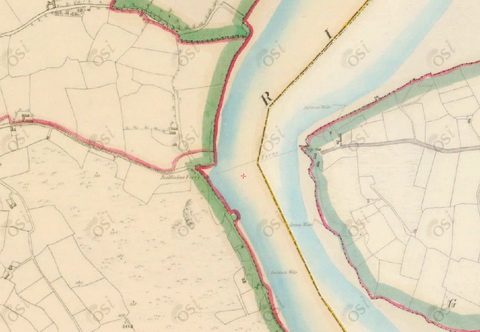
Ballinlaw ferry

A visitor to my page on the tidal Barrow is a descendant of ferrymen at Ballinlaw on the Barrow. He would like to find a photograph (or, presumably, other illustration) of the ferry boat and I would welcome more information about the service (eg when it ended).

Ballinlaw ferry (OSI ~1840)

Ballinlaw ferry (OSI ~1840)

If anyone knows of a possible source of information or illustration, I will pass it on to the enquirer.

Update January 2019: much information about Ballinlaw Ferry from Andrew Doherty here.

My OSI logo and permit number for website

A threat to an existing navigation

I have a page here about the River Maigue, one of Ireland’s oldest improved navigations. Incidentally, the river’s name is locally pronounced Mag, to rhyme with bag.

In 2009 I wrote to the Powers That Be to suggest that the (much to be desired) bypass of Adare, a major bottleneck on the N21 Limerick–Tralee/Killarney road, should pass to the south of the town, thus avoiding the interference with the navigation that would undoubtedly have resulted from a northern bypass. It was no doubt the strength of my case, and a recognition of the importance of the navigation, that caused the Powers to opt for a southern bypass. A proposed link to a proposed M20 Limerick–Cork motorway may have been a minor factor in their decision: as nobody was going to build a motorway to Kerry, Adare would piggyback on the motorway to Cork.

However, An Bord Pleanála overturned the decision [PDFs available here] because the M20 proposal was withdrawn. The Irish Cattle and Sheep Farmers’ Association is pleased because it wanted a northern bypass of Adare, to be linked to a new road from Limerick to the port of Foynes; its submission on the matter is here [PDF]. A Limerick ICSA chap has a letter to the editor about the Foynes link in the current issue of the Limerick Leader, although it’s not yet available online.

Now, this proposal has the drawback that it might actually be slightly sensible: a better road to Foynes might stop people agitating for a restoration of the railway line and enable a speedy ending of port activities in Limerick, thus removing large piles of scrap from the riverside. But have the ICSA not considered the damage to the turf-boat traffic to Adare if a road bridge is added to the railway bridge downstream of Adare?

Ballylongford man’s posthumous honour

Herbert Kitchener, born in Ballylongford near Saleen in 1850, shortly after the Shannon Commissioners completed their work, is to appear on a new UK £2 coin.

Wind and eels

Interesting BBC story about a possible cause for the decline in the number of eels.