Category Archives: shannon estuary

Limerick floods 1814

Limerick, Dec 1

On Thursday night, or at a very early hour on Friday morning, the most awful and terrific tempest from the south and west, that ever was remembered arose, and continued without intermission until between 11 and 12 o’clock yesterday — the river Shannon swelled to an unprecedented height, with a surf which caused it to overflow the country to an extent never before witnessed; there was no trace of the highest banks upon the river, and they are broken and prostrate every where we have as yet heard of — at the quays in this harbour, the several vessels drove from their moorings, and a large Norway ship, the Pax, a brig, the Caroline, and a sloop, the Elizabeth, were forced beyond Curragour Mills, near Thomond bridge, and with much exertion were saved from injury, by Mess Mallock and Graham, ship builders, with their men — the Messery, of Liverpool, at O’Neil’s quay, laden with rock salt, is thrown on her beam ends.

The falling of chimnies has caused several houses to be unroofed; Mr Bodkin’s family, in Bridge Street, were providentially saved, as the next chimney fell on the roof, which was blown in, destroyed the different rooms, and though a child slept in the attic story, and went through the two under floors, it was unhurt. Several trees have been torn up, garden walls blown down, and the whole of the parapet, from the House of Industry to the Revenue Building overturned. A new house in Glentworth Street was completely levelled with the ground. Thomond-bridge miraculously withstood the flood; the whole bridge was covered at one time, and the parapet presented the appearance of a wall built across the river.

We really fear that the accounts from the coast will be dreadful. Yesterday morning, between eight and nine o’clock, two sail boats were lost between Foynes Island and Ahanish, one was loaded with butter, and had nine passengers, all of whom were drowned; the other a turf-boat, the property of Mr O’Keefe, with three men on board, one of whom (Hurley) perished, and the other two were driven on shore by the violence of the waves, and were saved.

On Tuesday evening a large boat belonging to Denis Malcahy of this town, was driven on the rocks, off the shore of Kilkeran battery, the tide at the same time setting in with such rapidity that the boat filled with water, and one of the crew threw himself overboard and swam ashore, leaving two men and a boy on the wreck; when in this awful moment, one of the workmen belonging to Messrs Mackey and Ryan, plunged into the water and swam to the boat — made a raft of her oars and spars, to which he fastened a rope, and swam off to the length of it — the remaining crew clung round the raft, and in the presence of a number off shore, were towed in, and thus saved from a watery grave. Thomas Gleeson, a mason, was the person who so humanely ventured his life to save that of others, which Providence enabled him to effect.

Caledonian Mercury 24 December 1814. From the British Newspaper Archive run by Findmypast Newspaper Archive Limited, in partnership with the British Library.

Tepid baths

1823

KILRUSH HOTEL, AND TEPID BATHS

This Elegant Establishment is fitted up in a superior style for the accommodation of Visitors, on the reduced terms of last Season.

The House adjoining the Hotel, now occupied by Mrs Colonel Stammers, of Cahernelly, will be Let, from the 12th of June, for the remainder of the Season; it has ample accommodation for a large Family, who can be supplied with any thing they may require from the Hotel; they will also have the use of the Bathing Machines and Bathing Houses — from this House to the Tepid Baths there is a covered passage.

The Lady of the Shannon steam packet sails from Limerick for the Hotel, on Tuesdays, Thursdays and Saturdays, and returns on Mondays, Wednesdays and Fridays, making her passage in five hours.

Kilrush, May 15th, 1823

Dublin Evening Post 20 May 1823. From the British Newspaper Archive run by Findmypast Newspaper Archive Limited, in partnership with the British Library.

1829

[…] The hotel and baths, for which this Town was remarkable, have been suffered to go to decay — at least, are not occupied as such at present.

Limerick Evening Post 8 May 1829. From the British Newspaper Archive run by Findmypast Newspaper Archive Limited, in partnership with the British Library.

The crimefighting Shannon steamer

Limerick, May 26. This morning the Lady of the Shannon steam yacht towed up, in grand style, the Fox cutter, captured by the Vandeleur Revenue cruizer, Capt Hopkins, as stated in our last. She lies at the Custom-house quay, is a very fine vessel, clinker built, pierced for eight guns, which were thrown overboard, in chase, and is remarkably well found. Her cargo is supposed to consist of 1000 gallons of highly rectified Geneva, in 10 gallon casks — 20 hogsheads of tobacco, in bales and half-bales — and a large quantity of teas — amount not yet ascertained.

Public Ledger and Daily Advertiser 5 June 1818 [quoting Irish Papers]. From the British Newspaper Archive run by Findmypast Newspaper Archive Limited, in partnership with the British Library.

Why the Shannon floods

From the search terms used, it seems that many people are visiting this site with questions about Parteen Villa Weir, water levels, Shannon floods and so on. They are not this site’s primary focus, but some non-technical information might be of interest.

The best place to start is with this quotation from a former web page of the Shannon International River Basin District:

The Shannon International River Basin District is the largest in Ireland at more than 18,000 km2 in area. It covers the natural drainage basin of the Shannon river itself, stretching from the source of the River Shannon in the Cuilcagh mountains in Counties Cavan and Fermanagh to the tip of the Dingle peninsula in north Kerry. It also includes coastal parts of Kerry and Clare which drain to the sea. It flows through 18 local authority areas and is also an international RBD as a small portion of County Fermanagh in Northern Ireland drains underground to the Shannon Pot.

The district is about one fifth of the area of the island, one quarter the area of the state. Rain that falls on that area of land ends up in the Shannon (or in a few small rivers in Clare and Kerry that flow to the sea). Some goes to the Shannon estuary or its tributaries; most flows into the non-tidal Shannon, which means the river upstream of Limerick.

The nature of the Shannon

Ireland has been described as saucer-like, with a high rim and a low flat centre. It’s not entirely true, but there certainly is a very large central plain, and the Shannon flows down through the middle of that. And, because the land it flows through is flat, the river falls very little.

In 113 miles from Leitrim to Killaloe, the Shannon falls just over 30 feet; the navigation channel needs only five locks. [By way of contrast, the Thames has 45 locks over 135 miles; the Trent has 12 locks over 42 miles.] So extra rainwater allows the Shannon to spread out, covering a much wider area, and it takes time for that water to drain away downstream. But many of the rivers that flow into the Shannon have been subjected to drainage schemes, so they can get rid of their flood waters quickly … into the Shannon.

Why don’t they open [or close] the weirs?

There are some weirs on the Shannon, designed to keep a minimum depth in the river for navigation; there are also some natural obstacles that hold water back. But once the level has risen high enough, water simply flows over the top of the weir, and there is nothing useful anybody can do — apart, of course, from farmers’ representatives and politicians, who can always make use of a photo opportunity.

The bottleneck

Almost all the water that enters the non-tidal Shannon will eventually flow through Killaloe, the town at the southern end of Lough Derg [it’s on the west bank, in Co Clare; the east bank is Ballina, in Co Tipperary].

As James Robinson Kilroe wrote in 1907,

[…] we have the formidable barrier at Killaloe, naturally damming up a considerable depth of water in Lough Derg, and the river falling away southward by a series of rapids which correspond with drops in the canal, south of O’Briensbridge […], along an alternative course, possibly one used by a branch of the Shannon.

The diagrams with that article are worth a look.

In the twelve Irish (fifteen statute) miles between Killaloe and the tidewater at Limerick, the river falls about 100 feet: more than three times its fall from Leitrim to Killaloe. In the nineteenth century, the water level at Killaloe used to change by about eleven feet between summer and winter — even without storms.  The old Limerick Navigation, including the canal Kilroe mentioned, could drain only a small amount of water (which could put the navigation out of action); the rest went down the river’s original course through the Falls of Doonass.

The relief channel

Nowadays, the Falls of Doonass are a shadow of their former selves, and the water level through O’Briensbridge, Castleconnell and Plassey is much below its previous levels. I suspect that the older, larger trees along the river show the original level, with the newer, smaller trees having grown since the 1920s.

The cause was the construction of a relief drainage channel in the 1920s. This channel is controlled by a weir at Parteen Villa [not to be confused with Parteen].

Actually, of course, it’s not a relief drainage channel. The weir [sometimes referred to as the Hydro Dam] controls the flow of water to the original course of the Shannon [the right-hand or eastern channel, which gets the first 10 cubic metres of water per second] and the headrace for the hydroelectric power station at Ardnacrusha [the left-hand or western channel, which gets the next 400 cubic metres of water per second, 100 for each of its turbines]. The power station was built to use that 100-foot fall of the Shannon, concentrated between Killaloe and Limerick, to generate electricity.

But one effect of the construction of Ardnacrusha was to provide a channel, the power station headrace, capable of taking [at least] 400 cubic metres of water per second away from the original river channel, thus reducing the likelihood of flooding.

Cumec

Water experts talk about cumecs: a cumec is a flow of one cubic metre, or 1000 litres, of water per second. And a cubic metre of water weighs about one [metric] tonne, which is roughly the same as an imperial ton. So one cumec is one ton of water per second, which is a lot.

It was said, on 8 December 2015, that the ESB, using Parteen Villa Weir, had released 315 cumec down the original course of the Shannon on the previous day and had increased that to 375 cumec. If the Ardnacrusha headrace was getting 400 cumec, then the amount of water being discharged from Lough Derg and the upper Shannon had doubled.

Floods

As far as I can see, the Shannon has always flooded. The 2009 floods affected some nineteenth century houses, which I guess would have been flooded even worse before Ardnacrusha was constructed. However, I suspect that more houses have been built on the flood plain since then. But I don’t see that there is any way to prevent Shannon floods.

Envoi

There is a good article in the Irish Times of 9 December 2015; it will no doubt disappear behind a paywall at some stage.

Here is an ESB infographic about the Shannon.

Water charges

I see from the blatts that Limerick [City & County] Council had a “metropolitan district meeting” recently to discuss how the Shannon might be used to “attract tourism and offer water activities”. I thought it did have such activities: I’m almost sure I’ve seen people in boats, people fishing and so on. But the councillors want something sexier and they intend to pester the unfortunate folk in Waterways Ireland about it.

One Paul Kelleher, described as “(AAA)”, wants an “an Oxford/Cambridge style boat race between UL and LIT” and, alas, “a water bus, with tours down as far as Foynes.”

Unfortunately, since the Lord Lieutenant enjoyed a trip from Limerick to Foynes via Kilrush in 1856, many of the villa residences, mansions and other gentlemen’s seats have become unoccupied and demonstrations of loyalty are unlikely to greet the municipal water bus. Of course any such vessel will be enormously expensive to run, will have a short season and only a few years of popularity and will lose a lot of money. If it were likely to be profitable, private enterprise would already be offering such a service; it isn’t, so a subsidy or some form of sponsorship would be required.

Perhaps Irish Water could sponsor it from its surplus income.


Shannon traffic figures to May 2015

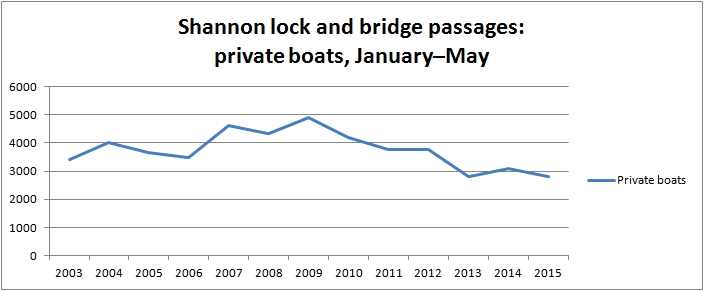
I am grateful to Waterways Ireland for letting me have the Shannon traffic figures for the first five months of 2015. All the usual caveats apply:

  • the underlying figures do not record total waterways usage (even for the Shannon) as, for instance, sailing, fishing or waterskiing on lakes or river stretches, which did not involve a passage through a lock or Portumna Bridge, would not be recorded
  • the passage records would not show, for instance, a change in the balance of types of activities from those in larger cruising boats to those in smaller (sailing, fishing, waterskiing) boats
  • figures like these will not necessarily be representative of those for the year as a whole. The winter months, January to March, see little traffic in any year; for April, May and June, the weather can have a large influence on the amount of activity especially, I suspect, in private boats.

On the other hand, the figures do include the Shannon’s most significant tourism activity, the cruiser hire business. And they are our only consistent long-term indicator of usage of the inland waterways.

The big news is that there is an increase in the amount of hire-boat traffic and a decrease in the amount of private traffic. [Personal observation suggests very little activity on Lough Derg, apart from the sailing bods.]

Shannon traffic Jan to May 2015 all boats

All boats. Note the slight increase in total traffic — or is it a dead-cat bounce?

Shannon traffic Jan to May 2015 hire boats

The increase comes from hire-boat traffic …

Shannon traffic Jan to May 2015 private boats

… as private-boat traffic is down on last year

Shannon traffic Jan to May 2015 compared with 2003

Nonetheless, hire-boat traffic is still close to 40% of what it was in 2003, with no sign of a major recovery

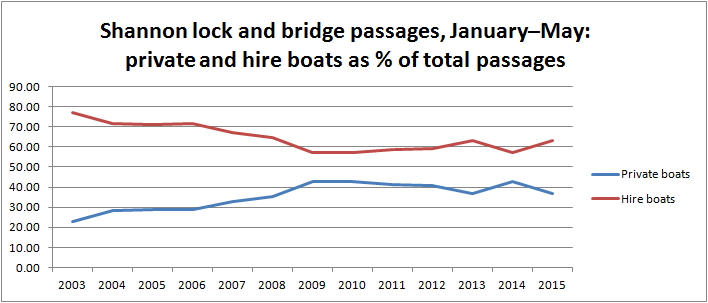
Shannon traffic Jan to May 2015 private -v- hire

But, at least for April and May, hire boats are the major users of the Shannon

In January, 18 boat passages were recorded, 9 of them at Portumna Bridge. There were 20 passages in February and 362 in March. Is there any point in keeping the Shannon open throughout the winter?

In the first five months, 11 boats used Sarsfield Lock, the sea-lock in Limerick. There were 88 passages through Pollboy Lock on the River Suck. On the Lough Allen Canal, 96 boats went through Battlebridge Lock, 95 through Drumleague and only 38 through Drumshanbo. These branches can’t be paying their way.


The ESB and eels

A minister speaks [or at least reads out a script prepared by other people].

I see that

The independent Standing Scientific Committee on Eels sets targets of quantities to be transported annually.

Which would be nice, if transporting eels were an end in itself. But the object is surely to increase the eel population, and I note that the minister had nothing to say on that subject. Nor did he tell John McGuinness what the stock of eels was. So we have no idea whether all this activity is achieving anything, and responsibility is diffused amongst the members of an Standing Scientific Committee on Eels, none of whom seem to have any stake in the matter.

This is a clear case for privatisation: sell the eels and the fishing rights to people [cooperatives, as on Lough Neagh?] who will have an interest in managing the populations of eels, rather than in managing the numbers trapped and transported.

The minister also introduced a red herring about compensation, which he wasn’t asked about. By my reckoning he answered only half the question, and even that credits him with answering the ritual invocation “if he will make a statement on the matter”.

ESB and the Shannon

I wrote here that I had written to the ESB, on 27 May 2015, to ask about navigation on the Shannon from Castleconnell downstream. One month later, I have not yet received a reply.

I did hear this weekend that ESB had contacted certain boat-owners to inform them that they were not to moor to the ESB embankments between Portumna and Meelick. As a riparian landowner, ESB is no doubt within its rights, but it would be interesting to know how much of the bed of the Shannon it claims to own in that area.

I have still not been able to find out, from the ESB, the clearance under its high-voltage lines crossing the Shannon (and other navigations). I gather that the ESB works on the principle that, if it provides no information, it can’t be blamed if owners of masted vessels electrocute themselves, whereas if it did provide information it might be sued. Strange that a public sector body should have such a blasé attitude to the prospect of the electrocution of the citizenry.

Perhaps if I asked questions under the Access to Information on the Environment Regulations 2007/2011 I might get replies.


Riverfest in Limerick

Riverfest is an annual, er, happening in Limerick. I don’t know much about it: I’ve never been because I dislike both crowds and festivals and it would take something remarkably interesting to outweigh my dislike and persuade me to attend any part of the thing. I took notice of this year’s event only because I wanted to find out what streets would be closed to traffic; the festival organisers did not, alas, think to provide a map showing the closures.

I have only two other comments on the event:

  • the brochure [PDF] mentions a workshop called “Craft a River” but doesn’t say what, or indeed where, it is
  • in a city whose history is so intertwined with that of the food industry, and which has, in the Milk Market, the best Irish market outside Cork, it seems ludicrous to import a “continental market” instead of showcasing local producers.

But I acknowledge that I am not really entitled to comment; Brian Leddin, on the other hand, has a better informed view.

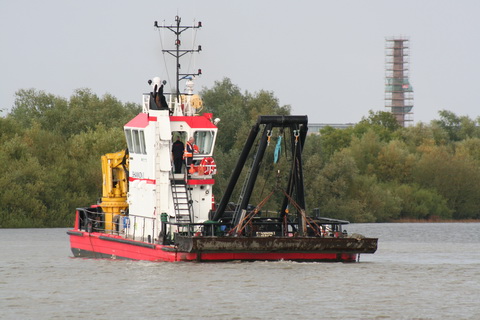
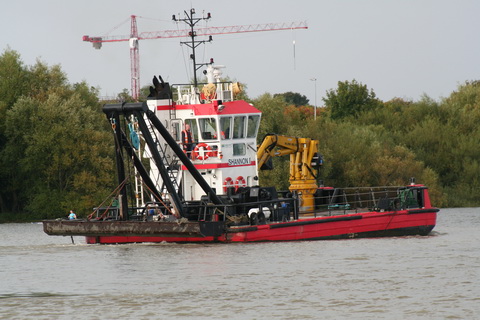
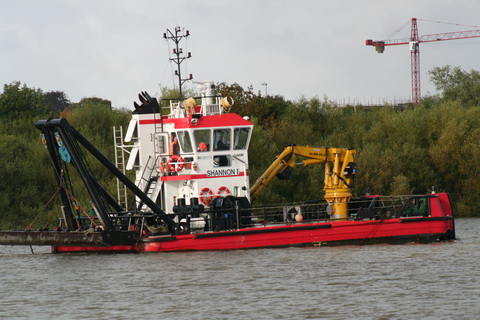
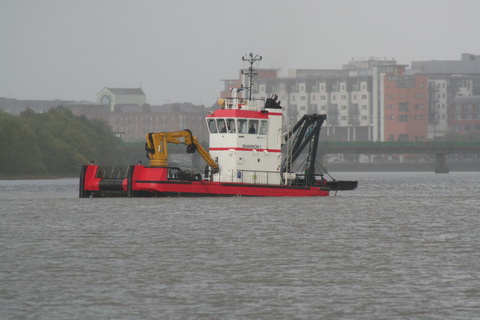
The Shannon One

Copy of IMG_4546_resize

Heading down the estuary past Shannon Airport

Limerick Port dredger Shannon I 3_resize

Working in Limerick

Limerick Port dredger Shannon I 4_resize

Almost as much kit as WI’s Swiss Army Knife

Limerick Port dredger Shannon I 5_resize

The big crane, though, is not part of the kit

Limerick Port dredger Shannon I 7_resize

Great view from the cab … er, wheelhouse

Limerick Port dredger Shannon I 11_resize

Pusher bow?

Limerick Port dredger Shannon I 1_resize

Limerick in the background

Limerick Port old dredger Curraghgour II 3_resize

Shannon 1’s predecessor Curraghgour II