
Free the Black Bridge
Here is a page about a cot race at Plassey in 1851.
Posted in Ashore, Built heritage, Canals, Charles Wye Williams, Economic activities, Engineering and construction, Extant waterways, Forgotten navigations, Industrial heritage, Ireland, Irish inland waterways vessels, Natural heritage, Non-waterway, Operations, Politics, Restoration and rebuilding, Scenery, Shannon, Sources, The fishing trade, Tourism, Water sports activities, waterways, Waterways management
Tagged Annaghbeg, Black Bridge, Blackwatr, boats, bridge, canal, Castletroy, Clare, cot, floods, flow, Ireland, Killaloe, Limerick, lock, Lough Derg, Mulcair, O'Briensbridge, Operations, Plassey, Shannon, vessels, water level, Waterways Ireland
Dr Jim Stageman has made a painting from a photo of John Weaving on a whiteboard in an American hospital. Click here; you’ll probably have to work through the gallery of thumbnails [there are seven] below the main picture to get to JW.
Younger folk may wish to know that the photo was also the basis of a painting used in a film.
After opening Lough Derg, we passed by Holy Island, with its ruins and round tower looming in the distance. The island contains about twenty acres, and so valuable are the feed derivable from the host of penitents who repair to do their stations on the Holy Isle, that the ferry, between it and the main, is rented for a considerable annual sum.
JK [Sir James Emerson Tennent Bart]Letters to the North, from a Traveller in the South Hodgson, Belfast; Milliken and Son, Dublin 1837
On Thursday evening, the body of a fine female child was found sewed up in a bag on the banks of the canal near Killaloe. A man was taken up on suspicion of being the murderer, but was subsequently liberated. A verdict of murder against some person or persons unknown was returned at the inquest which was held.
Limerick and Clare Examiner 10 November 1847
Posted in Canals, Extant waterways, Ireland, People, Shannon
On Saturday, a party of the Revenue Police, stationed at Killaloe, detected an illicit still at full work at Mountshannon, in the County of Galway. They destroyed a quantity of potale and singlings, and brought away the still, worm, and head, which they lodged in the King’s Stores, Limerick, yesterday. The party also captured several men employed on the works, whom they transmitted to Ennis jail.
Waterford Mail 15 March 1840 quoting the Limerick Star
Posted in Ashore, Economic activities, Extant waterways, Industrial heritage, Ireland, Operations, Shannon, Waterways management
Tagged Clare, Galway, Ireland, Lough Derg, Mountshannon, Operations, potale, Shannon, singlings, still, waterways
On Tuesday morning, Mr Ounsel, of Portland near Portumna, left Killaloe at 6 o’clock, to walk down the bank of the Canal to O’Brien’s Bridge, there to meet the packet boat — he took with him a long gun for the purpose of shooting ducks. As no account could be had of him at O’Brien’s Bridge, it was supposed he fell into the river, and in the course of the day a hat, and a book belonging to him were found on the shore; there is no doubt but he has met a watery grave — to-day several boats are searching for the body.
Clonmel Herald Wednesday 3 February 1830 quoting Limerick Chronicle Saturday 30 January 1830
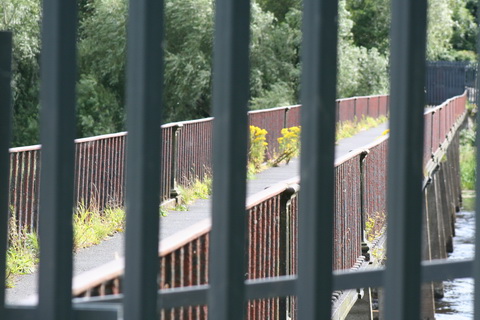
The Black Bridge at Plassey has long had a place in the hearts of Limerick people. It was damaged in the floods of 2009 and has been closed to the public ever since. Limerick Council says it can’t afford to repair it. Limerick Council is, as far as I can see, in breach of the terms of its lease of the bridge from the Department of Finance; the Department of Finance could, but has chosen not to, insist that the Council repair the bridge.
In the meantime, the Minister for Finance, for reasons best known to himself, wants a new, er, iconic footbridge in Limerick city and is prepared to spend €6 million of taxpayers’ money, via Fáilte Ireland, on a structure that can scarcely avoid blocking some of the finest views in the city.
Now, the Limerick Leader tells us, the ghastly edifice is to cost almost €18 million: €6 million from the Minister for Finance (who represents Limerick), €4 million to be borrowed and €7.8 million from the leprechauns’ pot of gold under the thorn bush. Or somewhere. Even Fianna Fáil councillors think this is insane, which is saying something.
This ridiculous proposal should be abandoned immediately and a much smaller sum should be spent instead on repairing the Black Bridge as part of a European Route of Industrial Heritage.
The Minister’s €6 million is a gift-horse that should not only have its teeth inspected: it should be taken out and shot and its carcass sent to the burger factory.
Posted in Ashore, Built heritage, Canals, Charles Wye Williams, Economic activities, Engineering and construction, Extant waterways, Industrial heritage, Ireland, Natural heritage, Non-waterway, Operations, People, Politics, Restoration and rebuilding, Scenery, Shannon, Sources, Steamers, The cattle trade, Tourism, waterways, Waterways management
Tagged Black Bridge, bridge, canal, Department of Finance, ERIH, floods, flow, Ireland, Killaloe, Limerick, Limerick city, Limerick Council, Limerick Leader, lost, Lough Derg, Minister for Finance, Operations, Plassey, Shannon, waterways, Waterways Ireland
Martin McGuinness [SF] was asked recently, in the Northern Ireland Assembly, about blueways:
Leslie Cree [UUP]: It was interesting to read that Waterways Ireland has developed this first blueway in the Carrick-on-Shannon area. Can he share with us if, in fact, Waterways Ireland has developed any projects for the Erne waterway itself?
Mr McGuinness said:
These projects are under ongoing consideration by Waterways Ireland, as the development of blueways and greenways could add to our tourist potential. It is clear from how greenways have been used, particularly in the west of Ireland, that they have huge health benefits for those now walking and cycling and involved in physical activity.
There is a proposal for another greenway from Derry city to County Donegal. Blueways and greenways offer important tourist potential, and it is exciting to see that Waterways Ireland is considering the linkage in the Leitrim area and how it can be extended to Lough Erne.
But, if I might remind TPTB, not everybody likes walking, cycling and physical activity; not everybody is going to be rolling around in a kayak or paddling a canoe. There are older folk, there are those who rightly view exercise with the gravest of suspicion and there are those whose interests simply lie elsewhere.
It is for such folk that I have developed the Greyway [TM] concept. It’s the same as a blueway or a greenway but without the sweating or the lurid dayglo clothing.
The basic idea is that you form a “route” or “way” as a marketing concept to get more people using your existing assets. Your expenditure is low: research, product development, marketing and information provision rather than infrastructure; self-guided rather than staffed user experiences. Direct income might be low too, although there may be ways to extract cash from users; there might also be spin-off opportunities for other providers. [All my usual reservations about small-scale providers apply here too.]
There might be Greyways catering for
You need a theme to attract people: “come and walk/drive the X Greyway and see all the lovely/interesting Ys”. No doubt there are several possible values for Y: bunnies, trees, fish, bogs, hills …. But the main thing that Waterways Ireland has to sell, and that it does not currently sell, is its industrial heritage. The Shannon, in particular, exists as an improved navigation only because of (a) steam, (b) the British industrial revolution, (c) Irish agriculture and (d) low politics. And industrial heritage is something that interests some at least of the older folk. Package it into routes and sell it for grey pounds, euros or dollars.
There is all sorts of interesting stuff along the Shannon, mostly just lying there, and it should be put to work. The most concentrated section is along the old Limerick Navigation, from Limerick to Killaloe: for instance, last time I looked seven of the original twelve milestones were still present. [The distance was 12 Irish miles, approx 24 km or 15 statute miles.] It’s a walkable route and it includes
But there could also be driving tours along the middle Shannon, between Portumna and Athlone, where there is lots to see, and from Lanesborough upwards. Shannon Harbour might eventually house a museum ….
What I’m suggesting is that Waterways Ireland should designate the Shannon as the first route (as opposed to site) in Ireland within the European Route of Industrial Heritage [ERIH] framework. ERIH’s website includes descriptions of the route system and of anchor points, which may be too advanced for present use, but why not a European Theme Route in Transport and Communication? Ireland might even make a case for the use of advanced (or at least interesting) transport technology (steamers) in carrying agricultural produce to industrial markets.
Furthermore, if CIE were to cooperate, the railways might be brought in too, and the livestock trade, and Dublin Port, and a regional route linking to Liverpool and the railway to Manchester ….
There is an interesting story to be told about the Shannon and its links to the east coast and beyond; its industrial heritage could be used to attract tourists and entertain natives.
Posted in Ashore, Built heritage, Canals, Charles Wye Williams, Economic activities, Engineering and construction, Extant waterways, Foreign parts, Industrial heritage, Ireland, Irish inland waterways vessels, Non-waterway, Operations, Rail, Restoration and rebuilding, Sea, Shannon, shannon estuary, Sources, Steamers, The cattle trade, Tourism, waterways, Waterways management
Tagged Athlone, canal, Clare, department of arts heritage and the gaeltacht, Dublin, ERIH, estuary, Fergus, Grand Canal, greyway, industrial heritage, Ireland, Killaloe, Limerick, lost, Lough Derg, O'Briensbridge, Royal Canal, Shannon, steamer, vessels, waterways, Waterways Ireland
In a piece about developments in steam propulsion in 1829, I mentioned Sir James Anderson’s contract with the Irish Post Office to carry the mails on the roads of Ireland in “coaches impelled by steam”.
The Farmer’s Magazine for July to December 1838 reproduced, on pages 201–211, an article from the Cork Southern Reporter headed “A visit to Sir James Anderson’s Steam Carriage”. Amidst outpourings of national pride at this Irish invention, the “Steam Drag, or Carriage for Common Roads”, praise for Sir James and his father John [who was a Scot], maunderings about the plight of the horse and admiration for Sir James’s Buttevant Castle, we learn that Sir James
[…] spent two apprenticeships and a fortune in building 29 unsuccessful carriages to succeed in the 30th.
There is even a small amount of information about the machine itself:
The “Drag”, or steam engine, is not like those hitherto attempted; it is a machine to do the work now done by horses. The vehicle by which the passengers are conveyed is to be attached to it […].
If the drag broke down, horses could pull the passengers the rest of the way. Fuel to haul 30 passengers and their luggage at 15 mph was expected to cost not more than 4d a mile. The drag’s “broad cylindrical wheels” would act as rollers, helping to preserve rather than damage the roads. Travellers could look forward to breakfasting in Cork and dining in Dublin.
We understand the Irish Company is now forming, and all arrangements making for a commencement in this county as soon as carriages can be made.
STEAM CARRIAGE AND WAGGON COMPANY,
FOR THE CONVEYANCE OF
GOODS AND PASSENGERS ON THE MAIL
COACH ROADS OF IRELANDAPPLICATION for Shares to be made by letter (post-paid), addressed to the Directors, at the Temporary Office of the Company, 47, Lower Sackville-street, Dublin, where Prospectuses and every information may be obtained.
J GREY PORTER ATTHILL, Sec
According to the 1835 Report from the Select Committee on Orange Lodges in Ireland [HC 1835 (377) XV 1; Google version here], J Grey Porter Atthill was then Master of the Lisnarric [Lisnarick] District Orange Lodge in County Fermanagh, near Castle Archdale, meeting at Ardes [Ardess?] near the post town of Resh [recte Kesh, I imagine].
Steam Carriages on Common Roads
Extract of a letter from a gentleman who accompanied the Steam-carriage from Dublin, on its experimental trip.
Kilbeggan, Oct 11, 1841
You are aware that it was our intention to have taken our new steam carriage to Ballinasloe fair; but finding that the boiler was not sufficiently stanched for a long journey, having only just issued from the workshop, we determined to make an experimental trip along the same line with the old carriage — one intended entirely for drawing conveyances for luggage and goods, at the rate of four to six miles an hour — to enable us to see where proper stations could be established, and to try the machine in every way, and at every speed, during this extraordinary inclement weather, on this hilly road.
We certainly set forth under most inauspicious circumstances; but feeling assured of the power and efficiency of the machinery, no matter on what description of ground, we fearlessly departed, and we have tested the carriage to the very utmost, yet without even deranging or straining a single screw. We have certainly achieved a great undertaking, and incontestibly proved the superiority of the patent of Sir J C Anderson and Mr J Rogers, especially on bad roads, against heavy hills, in rains unprecedented, and without having one station for water along the entire line.
When the steam-carriage left Dublin it rained in torrents, and has never ceased to do so since our departure on Tuesday afternoon. The hill at Chapelizod was ascended with ease, without a check of any kind; and the very steep descent going into Lucan, on the old road, was descended at a walking pace, without drags of any kind, and the engine afterwards ran on and drew up short at the Percy Arms, to the utter astonishment of all the village. From thence to Maynooth the journey was in the dark, and the incessant rain rendered the water in the ditches wholly unavailing, by making it muddy — so that the supply was absolutely obtained by bucket-fulls, at a distance often of two or three hundred yards.
The rain continuing in almost a perfect deluge on the following morning, it was considered only common justice to the men not to proceed, especially as the Duke of Leinster and the gentlemen connected with the College of Maynooth were desirous of inspecting the carriage, which they subsequently did in the midst of pelting rain, and expressed themselves delighted with the machinery and various ingenious movements. Indeed, the Duke of Leinster treated us with the utmost courtesy and condescension, and in the afternoon, on meeting us in the Park, personally took us through some of the beautiful grounds, and showed us his princely mansion of Carton.
On Thursday we again set forth — again in the midst of heavy rain — and immediately on leaving Maynooth had to pass through the flood, which extended along the road for about 300 yards, and about a foot deep. This was effected gallantly, and curious and interesting in the extreme was the effect of the carriage proceeding through the water. Hundreds of persons, notwithstanding the inclemency of the weather, came down to witness this feat, and expressed their gratification at the successful issue by deafening cheers. The impression was, that the fire would be extinguished, and it is only right that I should mention that young Lord Otho Fitzgerald, who came down early to see us off, rode into every part of the water to show us the depth, and to be ready to ride back for horses, which, entirely from himself, he kindly and most considerately proposed to do, in case of the fire being put out.
The floods being out to this extent furnishes some notion of the state of the roads, but it is almost impossible to describe the trying condition of the whole line. It is, indeed, lamentable to see corn, hay, potatoes, and every description of agricultural and garden produce floating about. The residents of Maynooth say that for eighteen years they have not known the floods so high, or the country in such a saturated state.
From Maynooth the carriage proceeded to Kinnegad, through Kilcock and Seafield, passing over two bridges of a rise of one in fifteen, and one in ten feet. At the latter the mud was so deep, and the ground beneath so soft, that the carmen were unable to go on, and were compelled to put up altogether. These were surmounted without check or hindrance, although in the latter there was a very sharp turn, independent of the great rise.
From Kinnegad to Tyrelspass was the most difficult part of the line, from the softness of the roads (newly macadamised) and continuous rise, independent of the great hill of Gillabonine, about three quarters of a mile long, with a rise in parts of one in ten, one in fifteen, and averaging one in twenty-two feet. On the summit hundreds of persons assembled to witness what could be done, and fully impressed with a belief that the carriage could never get up. To their evident astonishment, however, the carriage ran up at about four or five miles an hour, taking a direct line from bottom to top. It was received at the summit with immense cheering, and commenced the descent — which is even more precipitate than the rise on the other side — in a quiet walk, to show the power of withholding the speed at pleasure, no matter how sudden the fall may be.
Below the middle of the hill the speed was increased, and we ran into Tyrelspass at the rate of twenty-five miles an hour, and drew up short at the inn door. Coming down the hill an incident occurred which may be mentioned as showing the command of the conductor over the carriage: when at the greatest speed, a pig dashed across the road. Mr Rogers, who was conducting, instantaneously checked the speed, and, altering the direction of the carriage, avoided the animal with the utmost ease. This astonished the people above all things.
A similar circumstance occurred at Rochfort Bridge, where a greyhound ran close to the wheel. Mr Rogers immediately stopped, and the whole population (for every body was out) expressed their astonishment and admiration by an unanimous cheer.
A letter
The following letter, from Mr Rogers, has been received since the above was in type:—
The rain continued incessantly the next day, we were stormstaid at Kinnegad, but ceased the following; we started for Tyrelspass, having to ascend the famed hill of Guineabawn, a mile long, and varying from one in twenty to one in ten. As usual, this hill was also crowded by the inhabitants, who cheered us as we passed it, at a speed of four to five miles per hour, descending the opposite side at a walk, and subsequently entering the town on its flat and firm road, at a speed of at least fifteen miles an hour.
Here the excitement was so considerable that we were obliged to remain some time to gratify the people, and in consequence darkness came on before we reached Kilbeggan, at the entrance of which the steersman, not seeing his way, ran one of the wheels off the road, when the wheels sunk, but after some little delay, the carriage was backed out and steamed into the town, accompanied by almost all the inhabitants. Every window was illuminated to welcome us in, and, amidst the most joyous cheers, we reached the yard of Messrs Mullins, brewers, who kindly came to offer it for our use, and to whom our entire party are much indebted for their warm-hearted hospitality and attention.
But here I fear my narrative must end, for here we found the first supply of Ballinasloe coke. Being desirous to show the powers and command of the engine to the inhabitants who had so kindly received us, we delayed a day, but on getting in our fire, found at once its total inefficiency. We, however, ran through the town at a slow speed, proving the management and power up a stiff hill in the Main-street, but it was impossible to proceed on our journey.
Steam can no more be had from bad fuel, than condition and mettle from bad oats. A steam-carriage may as well attempt a journey to Galway and keep time, without relays of coke and pure water on the road, as a mail-coach attempt it without relays of horses, oats, and pure water too; but still I may, perhaps not too proudly, say, that more has been done to prove the undoubted capability and durability of steam carriages than ever has yet been accomplished.
We have journeyed here amidst incessant rain — the roads saturated till the carriers’ traffic was stopped — the whole line to this, covered so much with broken stones, that one wheel of the carriage was rarely, if ever off it, while the other ploughed its way through mud some inches deep; hills met us at elevations pronounced impossible of ascent, and which in the present age may be considered barbarisms; barbarisms, indeed, where horses are made I may say, to pant out their very lives in ascending them.
“Pure water” we had none, for the elements conspired to give us mud; and I need scarcely say in this enlightened age that pure water is an essential to the proper working of the locomotive engine — at least every engineer well knows that without it the most injurious effects arise. Since we started we have not had it half a dozen times; and yet our engine and boiler are at this hour as perfect as the day we set out.
It has been said of common road locomotives, “they come out with the butterflies and go in with them”. We have come out in the storm, and passed over the heaviest and worst roads in the country, when not a vehicle was to be met — and yet we are uninjured one particle, and are “driven in” alone by want of proper fuel.
Pardon the length of what I have called “a short narrative”; but I think I am not wrong in believing that the advancement of any science will find amongst your readers an interest sufficient to excuse my perhaps too minute description. Let me add, that, although the weather would have driven most men to their houses, the party of directors &c who accompanied our expedition, remained to prove and test the carriage to the last moment, suffering every hardship from the weather. If, in naming Messrs Mansell, Reardon, and Williams; also Mr Maunsell, the Company’s solicitor, and Mr Motley, an English engineer, who accompanied them, I may be thought to have needlessly eulogised what I believe they considered to be their duty, they will, I think, excuse it, when I give their names also as witnesses of what I have thus stated for the information of the public.
I have the honour to be, sir, your faithful servant,
Jasper W Rogers
I outlined the company’s November 1841 Plan [Jasper W Rogers Plan proposed by Sir James C Anderson Bart and Jasper W Rogers CE for establishing Steam Carriages for the conveyance of goods and passengers on the mail coach roads of Ireland; also a proposed system for repair of the roads by means of a Road Police, and for telegraphing Nicholas Walsh, Dublin 1841] here. In the same month the Dublin University Magazine had a two-page ad for the new company, headed
Steam Carriage and Waggon Company,
for the conveyance of goods and passengers
on the mail-coach roads of Ireland.
There were ten Patrons and Honorary Directors: four marquises [Downshire, Donegal, Sligo, Ely, all KPs], two earls [Mountcashell, Bandon] and four barons [Arden, Muskerry, Riversdale, Cremorne]. The Directors were:
The Managing Director was John Jemison Esq, Drumcondra Hill, and the Directing Engineer Jasper W Rogers Esq CE, Nottingham Street. The auditors were George Hatchell Esq, The Priory, Rathfarnham, and Henry Dwyer Esq, Upper Mount Street. Counsel were Richard Wilson Green, Christopher Copinger and Charles Granby Burke; solicitor was Robert Maunsell, London law Agent W Mosson Kearns, Secretary J Grey Porter Atthill (Barrister) and bankers Messrs Ball & Co in Dublin and Messrs Coutts & Co in London. The company had local directors and agents in Cork, Limerick, Galway, Waterford, Wexford, Belfast, Londonderry, Enniskillen, Dundalk, Athlone, Westport and Ennis.
The ad said:
The practicability of running Steam Carriages upon common roads, with a degree of rapidity far beyond the utmost speed of horses in draught, and at one-half to a third less cost, has long since been made evident by the report of a Committee of the House of Commons, after a most minute and searching inquiry; and has now been confirmed by the Carriage built at Manchester by Sir James C Anderson Bart, for the Steam Carriage and Waggon Company of England, and those built at Newcomen Bridge Works, upon the same principle for this Company, by Jasper W Rogers Esq, the partner of Sir James Anderson, which for some time past have been publicly shown and tested in every way in the streets and neighbourhood of Dublin, as well as by the late experimental trip of about sixty English miles along the Galway road, against heavy hills, through even floods, in rains unprecedented.
It quoted from the account given in the Galway Vindicator and from that paper’s laudatory comment, concluding with an invitation to buy shares.
On 2 November 1841 the company issued its Report of the Steam Carriage and Waggon Company of Ireland, another short document. This showed William W Mansell as Managing Director and John Jemison as an ordinary director. It also listed 32 local agents.
It is a report from Mansell about the setting up of the company. It said that two drags had been built and tested: one was for goods and luggage, the other for passenger carriages. It reported the favourable impressions of Mr Motley, the Liverpool engineer, and described the trip to Tyrrellspass. Some additional information:
From the time we left Dublin not a single horse took fright, nor did any accident even of the most trivial nature occur […].
Independent of the unusually severe and unseasonable weather, about 76,000 sheep, 13,300 horned cattle, besides a great number of horses, independent of the regular traffic, have passed over this line of road, going and returning from the [Ballinasloe] fair, which it is needless to say tended greatly to render the roads more difficult for the Steam Carriage.
None of the persons in charge of turnpikes asked us to pay any thing excepting at Kilbeggan; but when we begged to know what we were drawn by, the man soon shrunk back.
Mansell recommended opening the Galway road as soon as possible, with enough vehicles “to supply the wants of communication”. He had been corresponding with people along the line and, with Mr Reardon, had inspected it as far as Ballinasloe, to which a new, shorter and more level road from Athlone was planned; a new road of 1½ miles had already been made between Horseleap and Moate. Thomas Bermingham, who had favoured a railway to Galway, now supported the company’s plans and had agreed to become a director.
Mansell gave an interesting sidelight on the reaction of the mail-coach operators:
The Nenagh Guardian is the only paper which has attacked us; but the nature of its remarks is strong evidence indeed of the manner this undertaking is making way, and arise wholly from interested persons. A gentleman from Nenagh voluntarily wrote to our Secretary on this subject, saying: ‘It so happens that the only Reporter and chief Editor the Guardian has, is the Stage Coach Agent of Messrs Bourne, the owners of the turnpikes and coaches on the Limerick and Dublin line of road; and as the Messrs Bourne have already been most illiberal monopolists, and as they apprehend serious consequences to themselves, and advantage to the public, from the success of the Company — after, I presume, trying their feelers elsewhere — they could not succeed in enlisting any Journal in their dirty work but an obscure venal publication.’
I should mention that the writer who thus apprises us of the management of the Messrs Bourne is not a Shareholder, nor, indeed, acquainted with any person connected with the Company, further than being a gentleman of standing and high character. The monopoly of Messrs Bourne expires in about three years and a-half.
[Note: Bournes had been partners with John Anderson [Sir James’s father] on the Dublin to Cork mail coaches.]
Various nobles and gentlemen had supported the idea. Coach-operators wanted to buy or lease steam carriages; they included Mr W Staunton of Killiney, who
[…] is desirous of having a Carriage to draw ten tons for supplying Limerick with pure water.
There had been applications for 5179 shares, but few from Galway, Cork or Limerick, all of which would benefit from the operation.
Mansell said that six steam carriages would be enough to work 100 miles of road, whereas on a railway the same distance would require 100 engines: there were over 40 on the 32 miles between Liverpool and Manchester and over 120 on the 110 miles between London and Birmingham.
The Company had expected to sell 3000 shares and to supply 7 carriages for the Dublin to Limerick route and the same for each of the lines from Dublin to Galway, Sligo and Londonderry; 2,500 shares and 6 carriages would serve Dublin to Belfast and 2000 shares and five carriages each for Dublin to Waterford and Dublin to Wexford. It had not yet issued its prospectus in England but expected extensive support there.
Anderson and Rogers had spent over £60,000 perfecting Locomotive Carriages.
The Galway Vindicator had two relevant items on 8 December 1841: both of them written by the indefatigable Thomas Bermingham of Caramana, Kilconnel, Co Galway. The shorter was a letter to the editor; it permitted him to print the longer, a letter to the Guardians of the [Poor Law] Unions of Galway, Loughrea, Tuam, Athlone and Ballinasloe and to the other inhabitants of counties Roscommon and Galway.
It seems that Bermingham was less than completely convinced of the virtues of the Steam Carriage and Waggon Company’s locomotive carriages. He felt that they should run on a line of their own, a level road from Athlone via Ballinasloe to Galway, with branches to Tuam and Loughrea. Then, if the venture failed, the line could be converted to a railway, using either horse or steam power. The building of the road would provide employment to the poor and its completion would assist the prosperity of the port of Galway.
Bermingham reckoned the cost of the road at £1000 a mile for 80 miles; he allowed £6000 to connect Mutton Island to the mainland and rounded it up to £100000 to provide for station-houses. He thought that the Board of Works should provide 40% of the cost as a free grant and the rest as a loan at 5%.
Canal, road and rail were, it seems, vying for Ballinasloe’s traffic. The canal got there first but the railway took over from 1851 (and the line to Galway passed just south of Thomas Bermingham’s house). Did road-going locomotive carriages ever successfully serve that, or any other, town?
In 1902 Rhys Jenkins, in Motor cars and the application of mechanical power to road vehicles [T Fisher Unwin, London; J Pott & Company, New York], wrote [pp68–69]:
Anderson, however, nine years later [1838], came out as an inventor himself with a new boiler. The Steam Carriage and Waggon Company was formed to build carriages on his plans, and a number were made in the years 1839 and 1840 in Dublin and Manchester, and carriages were to be seen at work in both places. There are glowing accounts of the success obtained at experimental runs, but the scheme very soon fell through.
I would be glad to hear from anyone who can fill in the details or point to a source that does so.
Posted in Ashore, Canals, Economic activities, Engineering and construction, Extant waterways, Foreign parts, Ireland, Non-waterway, Operations, People, Politics, Rail, Roads, Shannon, Sources, Steamers, The cattle trade, Tourism, Uncategorized, Weather
Tagged Athlone, Ballinasloe, Bourne, brewers, Buttevant, Carton, Castle Archdale, Chapelizod, coaches, coke, Cork, Crofton Moore Vandaleur, Dublin. Carriage, duke of leinster, fair, Galway, Galway Vindicator, goods, Horseleap, horses, Ireland, Irish Post Office, J Grey Porter Atthill, Jasper Rogers, John Anderson, John Jemison, Kesh, Kilbeggan, Kilcock, Kilconnel, Kilrush, Kinnegad, Limerick, Lord Otho Fitzgerald, Loughrea, Lucan, mail-coach, mails, Manchester, Maynooth, Messrs Mullins, Midland Great Western Railway, Moate, Motley, Nenagh Guardian, Newcomen Bridge Works, oats, Orange Lodge, passengers, road police, roads, Rochfort Bridge, Seafield, Sir James Anderson, stage coach, steam, Steam Carriage and Waggon Company of Ireland, steam drag, Thomas Bermingham, Tuam, turnpike, Tyrrellspass, waggon, water, William W Mansell

 Irish waterways history