Category Archives: Sources

The Daly news

In 1849 the Grand Canal Company decided to begin operating a cargo-carrying service on its own canal, initially from Dublin to Naas and from Dublin to Kilbeggan, both destinations on branch lines. According to Ruth Delany, Naas was included because

[…] Daly of Sallins, the only trader to Naas, had announced his intention of withdrawing the service which he was operating at a considerable loss.[1]

It may be the same Daly of Sallins who had leased the Grand Canal Company’s hotel in Sallins after the lease to the Great Southern & Western Railway ended in 1847. Delany says that the Daly family

[…] looked after the maintenance of sections of the banks and trackways for the company under contract and later became the horse contractors for the company’s trade boats.[2]

By 1870, however, the Grand Canal Company had ended that arrangement:

The haulage of the boats by their own horses had been a great success. It had been done at a much less rate, and more efficiently, than was done before by contract.[3]

It is possible that the company used contractors for some of its work some of the time, perhaps to supplement its own resources in busy seasons. A report to the company’s half-yearly meeting in August 1888 included these items>

[…] £103 for a new roof to their stables at Shannon Harbour. […] their horsing account for 52 horses at £669. They had during the last half year replaced several horses worn out in the service by new purchases. Their stud was never in a better condition than at present. […] They had succeeded in obtaining savings in new haulage contracts […].[4]

In February 1890, a new company chairman, Mr William F De V Kane JP, reported that Mr T J Daly, of Sallins, had been appointed inspector and clerk of works to the company engineer, Mr Mulvany, at a salary of £150 a year and travelling expenses;

[…] and the directors were confident that by this appointment an improvement in the management of horses in the country as well as economy would be secured.[5]

Perhaps that Daly was related to the other Dalys. I would welcome further information about the Daly family of Sallins.

Sources

[1] Ruth Delany The Grand Canal of Ireland David & Charles, Newton Abbot 1973

[2] ibid

[3] Report to Grand Canal Company half-yearly meeting 26 February 1870 in Dublin Evening Mail 26 February 1870

[4] Freeman’s Journal 20 August 1888

[5] ibid
Tepid baths

1823

KILRUSH HOTEL, AND TEPID BATHS

This Elegant Establishment is fitted up in a superior style for the accommodation of Visitors, on the reduced terms of last Season.

The House adjoining the Hotel, now occupied by Mrs Colonel Stammers, of Cahernelly, will be Let, from the 12th of June, for the remainder of the Season; it has ample accommodation for a large Family, who can be supplied with any thing they may require from the Hotel; they will also have the use of the Bathing Machines and Bathing Houses — from this House to the Tepid Baths there is a covered passage.

The Lady of the Shannon steam packet sails from Limerick for the Hotel, on Tuesdays, Thursdays and Saturdays, and returns on Mondays, Wednesdays and Fridays, making her passage in five hours.

Kilrush, May 15th, 1823

Dublin Evening Post 20 May 1823. From the British Newspaper Archive run by Findmypast Newspaper Archive Limited, in partnership with the British Library.

1829

[…] The hotel and baths, for which this Town was remarkable, have been suffered to go to decay — at least, are not occupied as such at present.

Limerick Evening Post 8 May 1829. From the British Newspaper Archive run by Findmypast Newspaper Archive Limited, in partnership with the British Library.

Lough Derg rally magazines

Thanks to Michael Geraghty for this link to an online archive of Lough Derg Rally magazines. The link takes you to a Google Drive page, but you do not need to sign in or to have a Google account in order to see the material.

Eccentricity by steam

Folk interested in eccentric early steam inventions, such as that described on my page about chain haulage, might also be interested in the invention of Captain George Beadon RN, as described on the invaluable Grace’s Guide site.

Her late Majesty Queen Victoria, by the Grace of God of the United Kingdom of Great Britain and Ireland Queen, had the foresight to acquire a photograph of Captain Beadon’s vessel and to make it available on tinterweb.

Captain Beadon’s route to London took him through Keynsham: that’s K-E-Y-N-S-H-A-M.

Tralee Ship Canal

The principal export trade of Tralee is in grain, cattle, and pork; they are sent to Cork by land. The harbour is exceedingly bad and dangerous, and, at the time of my visit, a ship-canal was in process of cutting from the bay. By some men of intelligence and experience, a railway was considered preferable.[1]

[1] Jonathan Binns The Miseries and Beauties of Ireland Longman, Orme, Brown and Co, London 1837

Mr Mullins’s steamer

Here is a little information about the steamer Cupid, which was owned or used by the contractor Bernard Mullins on the Shannon in the 1840s.

Launch at Messrs Bewley and Webb’s yard

The first of two new steel canal boats which the above firm are building for the Grand Canal Company was successfully launched on Wednesday.  These boats are 60 ft long by 13 ft 2 in beam, and 5 ft 9 in depth of hold, and are designed to carry forty tons on a light draught of water. They are of improved design and construction, and expected to tow very easily. The Canal Company have expressed themselves well pleased with the time of delivery and workmanship, and it is to be hoped no more orders of this kind will go across the water in future. The firm appear to us to be well able to deal with the work of the port. The ss Magnet, of the Tedcastle Line, which had an extensive overhaul at this yard, we believe, gave every satisfaction, and had a most successful trial trip a few days ago. It is to be hoped that more of our local steamship companies will follow the lead of Messrs Tedcastle, and have their work done in Dublin.

The Freeman’s Journal 1 September 1893. From the British Newspaper Archive run by Findmypast Newspaper Archive Limited, in partnership with the British Library.

Some context here.

A Grand Canal mystery

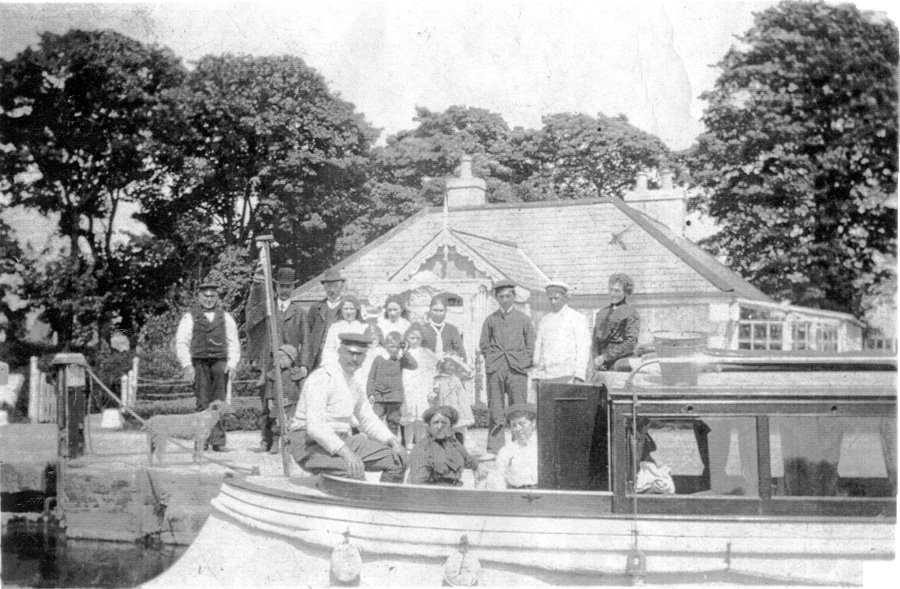
Passenger boat over lock1

Boat at Lowtown

Alan Lindley has very kindly sent me, and permitted me to publish, this photograph.

It was taken at Lowtown lock, on the Grand Canal, in 1911 or 1912.

Alan says that the man on the left of the group — with cap, waistcoat and watch-chain, and with a dog standing in front of him — is the lock keeper, Murtagh Murphy, the great-grandfather of the present incumbent, James (Jimmy) Conroy. Murtagh was born in Ballycowan, near Tullamore, Co Offaly, in 1849 and, after working on a Grand Canal Company boat, married a Kildare girl and took the job at Lowtown.

The boat had been described as a passenger flyboat but, as the Grand Canal Company had ceased carrying passengers in 1852, that seems unlikely. And the boat looks much more like a pleasure vessel than a working boat.

If the Grand Canal Company had an inspection launch, this might be it, but I have found nothing to indicate that it did. The boat does, though, seem to have been designed for canal travel: it seems (from the twenty feet or so we can see) to have straight sides and to be well equipped with fenders. It might therefore have been designed to travel on the canals (as well as on other waters).

At least one director of the Grand Canal Company, Henry Samuel (aka Harry Samuel) Sankey, of Fort Frederic, Virginia, Cavan and of 64 Wellington Road, Dublin, did have a launch or pleasure craft on the canal, the Aja, which you can read about here. Incidentally Mr Sankey, who died on 5 December 1925, directed “that no Roman Catholic shall take any benefit” under his will.

Further information about the boat and the people shown in the photograph, and about Mr Sankey’s launch, would be very welcome; please leave a Comment below.

A canal caterpillar?

Robertson’s chain propeller system on the Bridgewater and Grand Canals in 1859 and 1860.

Transhipment

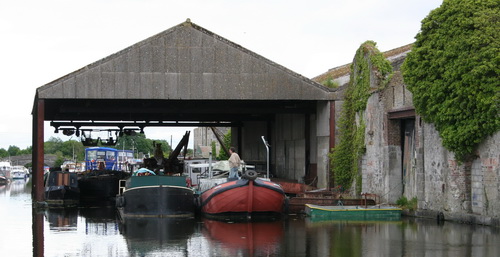
At the Grand Canal Company’s half-yearly meeting on 22 February 1890, a Mr Geoghegan

[…] said he had heard from a gentleman interested in the trade between Dublin and Limerick that it often took six days for Guinness’s porter to be carried by canal from the former of these cities to the latter. The cause of this he believed was the necessity for trans-shipment at Shannon Harbour.

The Chairman disagreed:

As to the delays at Shannon Harbour there had been some, but he believed these had been caused by floods and storms in the river.[1]

The company had commissioned Mr E Lloyd, engineer and general manager to the Warwick and Birmingham Canal Company, to inspect the Grand Canal and to advise the board. It was estimated that his survey would cost between £100 and £120. The chairman accepted that there were

[…] many matters […] which demanded immediate steps, and these entailed considerable outlay. It has been evidenced that before the property of the company could be stated to be in a thoroughly satisfactory condition some further exceptional outlay would be advisable from time to time.[2]

At the next half-yearly meeting, held on 23 August 1890, the chairman said that the company was considering investing in a more rapid transhipment system “from our barges to the Shannon steamers” at Shannon Harbour, in accordance with Mr Lloyd’s suggestion.[3]

Shannon Harbour June 2008 02_resize

The transhipment shed at Shannon Harbour in June 2008, before its canopy was removed

I do not know whether the transhipment shed at Shannon harbour, and the gantry mechanism on which goods could be loaded and unloaded under cover, was built on Mr Lloyd’s suggestion. It would be interesting to know more of the building’s history.

Sources


[1] The Freeman’s Journal 24 February 1890

[2] ibid

[3] The Freeman’s Journal 25 August 1890

From the British Newspaper Archive run by Findmypast Newspaper Archive Limited, in partnership with the British Library.