Category Archives: Sources

Lusmites rejoice

P J Norris commented here on the need for a walkway across Meelick Weir. The excellent KildareStreet.com tells us that the drought will end, as a Dáil written answer on 22 October 2013 showed.

Michael Kitt [FF, Galway East] had asked the Minister for Arts, Heritage and the Gaeltacht

… when it is proposed to reopen the walkway which spans the weir on the River Shannon in Meelick, County Galway; if funding has been provided for this work; if his attention has been drawn to the fact that this is an important local and tourist amenity; and if he will make a statement on the matter.

Jimmy Deenihan [FG, Kerry North/West Limerick] said

I am informed by Waterways Ireland that it is currently preparing a submission for planning permission to construct a new walkway over the River Shannon at Meelick. Indeed, environmental studies are underway to support the planning application.

I must advise the Deputy that construction work may only commence when all necessary permits have been received. It is Waterways Ireland’s intention to undertake works at the weir during 2014, subject to the appropriate statutory approvals being granted and financial resources being available.

Financial resources, eh? Perhaps a coin- (or note-)operated toll-gate on the walkway would be best.

Fun for anoraks

Lots of info on the WI website:

I liked the bit on this page:

Enforcement

Boats in non-compliance with the bye-laws will enter an enforcement process. Enforcement is undertaken by Authorised Officers and will begin with a notification in the form of a sticker and if non-compliance continues may result in the ​craft being removed from the navigation at the owners cost.

I wonder about investing in a crane company.


Like the Mary Ellen Carter …

rise againJust a few weeks ago the depth was around 1.7m at Athlone weir, about 7″ above the navigational minimum. But today the depth is over 2.4m and, with staff gauge zero at 35.360m above Poolbeg datum, the water level is 37.760 m above Poolbeg datum.

DUKWs

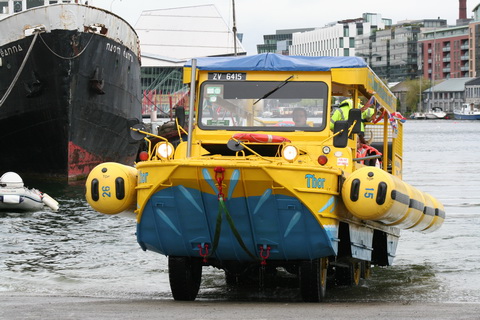
In June 2013 I reported on the sinking of a DUKW in Liverpool, the second of the year, and in September on the fire aboard a DUKW in London. Oddly enough, it seems that the two accidents had a common element: the foam added inside the hulls to improve buoyancy.

The UK’s Marine Accident Investigation Branch has found that the DUKWs in the Liverpool fleet had not been fitted with enough foam to provide 110% buoyancy, enough to keep the vessel afloat when flooded. MAIB’s tests on the Liverpool vessels

… raised serious questions about whether the operators of DUKWs could fit sufficient foam internally to comply with the current requirement for 110% buoyancy without compromising the safe operation and the practical day to day maintenance of these vehicles.

The “safe operation” part affected the London vessels. In July 2013, a DUKW had to be towed in after a drive shaft universal coupling failed when it overheated and ran dry of lubrication: engine bay temperatures were too high because of the volume of foam inserted. And a report commissioned by the London Fire Brigade into the September fire concluded that:

… the most likely cause of fire was the action of the rotating drive shaft (or other moving parts) on the oil contaminated surfaces of the buoyancy foam blocks.

MAIB has issued a safety bulletin [four-page PDF] with this conclusion:

The MAIB identified significant difficulties in fitting a DUKW with the volume of foam required to meet the buoyancy standards set out in MSN 1699 (M). Further, the nature of these old amphibious vessels, specifically their weight in relation to their size and the complexity of their propulsion arrangements, makes it difficult for operators to comply with the standards applicable to more conventional craft by solely using internal foam buoyancy. An alternative standard, ensuring that DUKWs have the necessary level of damage survivability, therefore needs to be established if they are to be operated safely.

It has recommended that the Maritime and Coastguard Agency should

… ensure that the means used by DUKW operators to achieve the required standard of buoyancy and stability for their vessels does not adversely impact on their safe operation. Furthermore, these vessels should not be permitted to operate until satisfactory levels of safety can be assured under all feasible operating conditions.

The Maritime and Coastguard Agency’s website doesn’t seem to be working, but there is a BBC report here quoting an MCA person as saying

We will not be permitting the vessels to operate until we are satisfied that the necessary safety measures have been achieved.

VikingSplash DUKW in Dublin

VikingSplash DUKW in Dublin

All of this may help to explain why the VikingSplash DUKWs operating in Dublin are fitted with additional external buoyancy.

Northsouthery minus northsouthery

I noted here what the Minister for Arts, Heritage and the Gaeltacht had to say about Waterways Ireland’s budget — or at least that portion of it paid by the RoI government — for 2014. The minister listed WI’s “core activities and targets” and various other things it should be doing:

  • promoting increased use of the waterways resource for recreational purposes
  • developing and promoting the waterways
  • attracting increased numbers of overseas visitors
  • stimulating business and regeneration in these areas
  • increasing recreational access along the routes of waterways
  • keeping the waterways open for navigation during the main boating season.

Note that WI is not expected to promote, engage in or achieve anything in the realm of northsouthery. That’s slightly odd when it receives [the larger] part of the northsouthery budget of the minister’s department.

WI’s budget: the minister speaks

I wrote here about the implications of the RoI 2014 budget for Waterways Ireland. The minister, Jimmy Deenihan [FG, Kerry North/West Limerick], spoke about it in the Dáil on Wednesday 16 October 2013 [h/t KildareStreet.com]. At the end of his lengthy contribution he said:

I am committed to developing North-South co-operation within the broader arts, heritage and commemorative activities of the Department as well as through the funding of North-South bodies. A provision of €38.3 million will be made available to support the two North-South implementation bodies, An Foras Teanga, comprising Foras na Gaeilge and the Ulster-Scots Agency, and Waterways Ireland. The provision will enable Waterways Ireland to deliver on its core activities and targets, which include keeping the waterways open for navigation during the main boating season and promoting increased use of the waterways resource for recreational purposes. This expenditure should also assist in developing and promoting the waterways, attracting increased numbers of overseas visitors and stimulating business and regeneration in these areas. Capital funding of almost €4 million will be made available to Waterways Ireland to facilitate the ongoing maintenance and restoration of Ireland’s inland waterways, thereby increasing recreational access along the routes of waterways.

The Government has reaffirmed its commitment to continuing to make progress, to improving the economy, to exiting the bailout, and to helping to create jobs. The Department and the sectors it represents will make a significant contribution to this work over the course of 2014.

I pointed out last year that Waterways Ireland is part of northsouthery and that, at budget time, we don’t get a breakdown of the northsouthery budget between An Foras Teanga and Waterways Ireland. In 2011, WI got roughly 60%, but I don’t know what happened after that. Here’s what I thought was happening last year:

Current spending (WI)

2010 Estimates: €25 585 000
2011 Estimates: € 24 335 000
2012 Estimates: €22 929 600 (60% of €38 216 000)

Capital spending (WI)

2008 Estimates: €11 000 000
2009 Estimates: €10 300 000
2010 Estimates: €8 000 000
2011 Estimates: €6 000 000 (or €6 002 000)
2012 Estimates: €4 500 000 (or €4 502 000) (100%)

In his speech, above, the minister said that northsouthery is going to get €38.3 million and that Waterways Ireland is to get capital funding of €4 million. However, the €4 million is included in the €38.3 million. The expenditure report [PDF; see page 160] gives these details:

  • for 2013 northsouthery had €36 210 000 of current spending; for 2014 it will get €34 425 ooo
  • for 2013 northsouthery had €4 080 000 of capital spending (all, or almost all, of which was for Waterways Ireland}; for 2014 it will get €3 958 000
  • the overall budget for northsouthery is down 5%.

We can calculate that the capital budget is down about 3%; the much larger current budget is down 5%. If WI gets 60% of the total, its current expenditure contribution from RoI will be €20 655 000, down over €2 000 000 from the previous year and about €5 000 000 since 2010, and its total current expenditure (85% RoI, 15% NI) will be €24 300 000.

The other interesting part of the minister’s speech is what WI is expected to do:

  • promoting increased use of the waterways resource for recreational purposes
  • developing and promoting the waterways
  • attracting increased numbers of overseas visitors
  • stimulating business and regeneration in these areas
  • increasing recreational access along the routes of waterways.

That should keep them busy. But I omitted one activity:

  • keeping the waterways open for navigation during the main boating season.

Emphasis mine, but does this mean that winter boating (at least if it involves staff time, eg at locks) will become a thing of the past?

 

Maureen O’Sullivan and Effin Bridge

A knowledgeable written question [h/t KildareStreet.com] from Maureen O’Sullivan [Ind, Dublin Central] about the Effin Bridge over the Royal Canal at Newcomen Bridge:

To ask the Minister for Arts, Heritage and the Gaeltacht if he will identify the parties concerned with the operation of the lifting bridge which occupies the site of the original first lock on the Royal Canal Newcomen Bridge, Dublin 1; the factors that contribute to the status of the lifting bridge; if he will convene a meeting of interests concerned with the operation of the lifting bridge with a view to devising a management and operational system that is less hostile to the use of the waterway as currently it is an impediment and discouragement to navigation on the Royal Canal and an obstacle to navigation-communication between the Royal Canal and River Liffey and between Royal Canal and Grand Canal at their eastern reaches; and if he considers the lifting bridge could be re-engineered as a dropping bridge.

The minister, Jimmy Deenihan [FG, Kerry North/West Limerick], responded:

I can advise the Deputy that the parties concerned with the operation of the lifting bridge over the railway line close to Newcomen Bridge are Irish Rail and Waterways Ireland. The bridge carries the rail line from Connolly Station to the lower line link to the docks area. The bridge was procured and installed by Waterways Ireland’s predecessors. The bridge is operated by Irish Rail staff on a request basis at Waterways Ireland’s expense. The option of introducing a drop lock to replace the need of the lifting bridge has been considered but not deemed viable due to the cost estimate involved.

Note that the question was about a “dropping bridge” but the answer was about a “drop lock”.

The answer suggests that the number of lifts each year is a function of the number of requests made by Waterways Ireland; it would be interesting to know whether that it actually so. If it is, then WI’s budget [cut again] is probably the ultimate determinant; if Irish Rail has a say in the matter, its operational needs may influence the decisions.

I cannot think of any cost-effective solution. I am not convinced that the bridge in itself discourages navigation.


Up with this sort of thing

Folk interested in the history of the Shannon before 1850 may like to know of a talk …

The smart green technology of the 1830s: the Shannon steamers and the definition of Ireland

… to be delivered to the Thomond Archaeological and Historical Society on Monday 4 November 2013. It’s in Room T.1.17, TARA Building, Mary Immaculate College, Limerick, at 8pm.

A related topic …

Charles Wye Williams and the Anglo-Irish Trade

… will be discussed in one of the papers at the Eighth [British] Waterways History Conference on Saturday 26 October 2013 at the University of Birmingham. Leave a Comment below if you would like contact information for the conference.

Water levels in Athlone

At time of writing, the depth of water at Athlone Weir is 1.7m. “Staff gauge zero is 35.360m above Poolbeg datum”, which means the water level is 37.06m OD (Poolbeg). According to Bob Cullen’s 2002 article for Inland Waterways News [PDF], “The minimum navigation level in Lough Ree is 36.88m OD”, so if the level drops another 0.18m, about 7 inches, there may be a WI Marine Notice.

It seems that the dropping of the level of Lough Ree is intended to provide a buffer against flooding in the area from Athlone downstream to Meelick. According to Brian Hayes “A meeting between the ESB, Waterways Ireland and the Office of Public Works to review the interim operating regime is due to take place shortly.” [I have asked Waterways Ireland for a report on the meeting.]

But, if we are to believe the Dublin Evening Mail, the Shannon Commissioners took a rather more robust attitude to flooding downstream of Athlone: steamers [and PR] came first.

The modernisation of Sinn Féin

I have criticised Sinn Féin’s obsession with the cutting-edge transport technology of the eighteenth century, the canal, and particularly with the proposed reconstruction of the Clones Sheugh. I am therefore glad to report that the party has now moved on to more modern transport technology: that of the early nineteenth century, in the form of the railway.

In a written question on 15 October 2013, Caoimhghín Ó Caoláin [SF, Cavan-Monaghan, home to the Clones Sheugh] asked the unfortunate Minister for Transport, Tourism and Sport

… if he intends to apply for funding under the Trans European Network–Transport (Ten-T) 2014-2020 for the development of a rail network linking [London*]Derry to Limerick, Shannon and Cork, or any part thereof, along a western arc corridor; and if he will make a statement on the matter.

I presume that it took the minister’s civil servants some little time to answer; they would have had to recover from ROTFL [as the young folk say nowadays]. When they recovered, they penned this response to be delivered by the saintly Leo Varadkar [FG, Dublin West, who has enough problems on his hands without extending railways but who has the virtue of a lack of interest in sports]:

As I have indicated to the House previously, I have no plans to develop a so-called “Western Arc” rail line from Cork to Belfast as this would require both the re-opening of the remaining phases of the Western Rail Corridor and also the development of new rail lines to connect with the rail network in Northern Ireland. It should also be noted that the Northern Ireland Executive has no plans to provide such new rail lines. The Government’s policy in relation to the funding of capital projects to 2016, including the development of rail and road links, is set out in the “Infrastructure and Capital Investment 2012-16: Medium Term Exchequer Framework”. Due to the overall reduction in funding for transport infrastructure the priority to 2016 is to protect investment made to date and to maintain safety standards. The limited funding available over and above this priority will only be provided for projects which are affordable, meet overall transport objectives and deliver the best return in terms of economic recovery and job creation.

I would draw the Deputy’s attention to the Programme for Government and in particular the commitment that: “We will insist that major capital projects are subjected to proper cost-benefit analysis and evaluation, improving future productivity and growth prospects, and that the value-for-money obtained is significantly enhanced compared to the most recent period.”

The Irish Rail commissioned AECOM/Goodbody “2030 Rail Network Strategy Review” examined the potential for new and re-opened lines and it did not recommend the development of a rail link between Sligo and [London*]Derry or between Donegal and [London*]Derry. Likewise its predecessor, the “Strategic Rail Review” in 2003 did not recommend such rail links. The performance of Phase 1 of the Western Rail Corridor between Ennis to Athenry to date has been very disappointing even allowing for the recession. Given the pressure on the public finances there are no funds for new subsidies or to develop new rail links in any part of the country. Moreover CIE is in a precarious financial situation and is dependent on continued bank funding. For all the reasons outlined above, the Government has no plans to further extend the heavy rail network. In these circumstances the question of applying for Ten-T funding to develop a rail line between Cork and Belfast via Shannon, Limerick and [London*]Derry does not arise.

Phew.

But Mr Ó Caoláin cannot have expected any other answer, so I wonder why he wasted civil service time by asking his question. Perhaps he has been inspired by the shade of Arthur J Balfour and hopes to kill northern Home Rule with southern kindness?

* “[London]” inserted in the interests of parity of esteem and intelligibility to unionist readers.