Category Archives: Sources

Steam on the Grand Canal 1877

Freeman’s Journal 25 April 1877

ANOTHER SUSPICIOUS DEATH

Yesterday Henry L Harty, Esq, county coroner, held an inquest on the body of Patrick Savage, aged 75, who was found drowned in the Grand Canal at Portobello on Monday. The jury found that deceased was found drowned, having a fracture of the skull and jaw, and four ribs; but there was no evidence to show how the injuries were caused. One of the witnesses, named James Rea, of Reilly’s Cottages, Clanbrassil-street, said that previous to his seeing the body floating, a canal boat passed down the canal, and also a small steamer. This, the coroner said, might have caused the injuries.

Competition arrives

The number of Shannon-side operations holding Marked Fuel Traders’ Licences [XLS] has doubled since last week: Ciaran Fallon of Rooskey is joined by Quigley’s Marina at Killinure. Congratulations to Brian Quigley.

So there are now two licence-holders on the Shannon. Still no sign of IBRA members (save that Quigleys supplies Waveline) but no doubt they will appear soon.

E&OE: the list now covers 170 pages and I may have missed someone. If so, sorry; let me know and I’ll post the information.

L+M Keating again

Here are some photos of recent L+M Keating projects.

Dublin

Dublin City Public Libraries have some nice photos available online. The section on the Port of Dublin includes 1926 aerial photos of the Guinness wharf and of Spencer Dock (not busy) and Grand Canal Dock (including the section beyond the railway line, now filled in). There is also a photo of a steam barge at the Guinness wharf. In the Commercial Dublin section, I saw two businesses beside the Grand Canal, Ever Ready Batteries at Portobello and Gordon’s Fuels at Harold’s Cross.

Locaboat licences

Locaboat tells us that

All the countries of Europe have agreed to facilitate access to hire-boats which are duly equipped and certified, and operate in tourist areas where there is little commercial shopping [presumably “shipping”].

In France, Germany [list of areas], Ireland, Holland, Poland and the Venice Lagoon Locaboat has received permission from the local authorities for their boats to be hired without licence. Initial instruction, both theoretical and practical, is given at the point of embarkation, enabling you to quickly master your boat and grasp the essential rules of navigation. You will then be given a licence that is valid for the duration of your stay.

When you’re starting from Ketzin in Germany, however, a boating licence is obligatory. This is not valid for citizens from countries that don’t have a boating license (e.g. Great Britain or Denmark).

This suggests that Ireland does have a boating licence, which is the first I’ve heard of it.

On its English-language front page, incidentally, Locaboat bigs up the fact that licences are not required in Poland:

Licence free hiring now also in Poland

Good news: Due to a new regulation, since 1st August 2010 a boating license is no longer required for our boats in Poland! Now a barge trip in the natural paradise of the Masurian Lake District becomes even more attractive.

And very nice it looks too. I wonder whether the Polish lakes have provided extra competition for the Irish.


Ireland needs promissory notes

                                                                                        Chamber of Commerce, Limerick
10th March 1826
Right Honble Earl of Limerick
 
My Lord
By desire of the Directors of the Chamber of Commerce, I have the honour to forward to Your Lordship a petition to the House of Lords from that Body, praying that the proposed measure of prohibiting the issue of promissory notes payable on demand for sums under five pounds may not be extended to Ireland. The Directors request that you will please to present it and give it your support, if your opinion on the subject coincides with theirs.
 
I have the hon …
John McNamara, President
 
(A like letter to Mr [Thomas Spring] Rice [MP], with a Petition to the House of
Commons)
 

From the Limerick Chamber of Commerce letter book page 89.

The diesel monopoly

I wrote here about the Revenue Commissioners’ new Marked Fuel Trader’s Licence. In brief, anyone selling marked fuel oil [green diesel] has to pay €250 to get a Marked Fuel Trader’s Licence and must also make monthly returns to Revenue of all “oil movements”. I thought, but I wasn’t sure, that this applied to marinas and others selling fuel for private pleasure navigation; as far as I could see at the time, none of those selling fuel along the Irish inland waterways had registered.

I have two pieces of news about that.

First, the Revenue Commissioners have confirmed that the new scheme does apply to sales of marked fuel for private pleasure navigation: in other words, those selling green diesel for boats along the inland waterways should all be registered under the scheme.

Second, I am happy to say that there is now at least one registered seller: Ciaran Fallon of Rooskey Craft & Tackle at Rooskey Quay. (There may be others that I haven’t spotted; you can check the latest list of Licensed Marked Fuel Traders here.) For the moment, then, Rooskey Craft & Tackle seems to have a monopoly of the legal supply of marked fuel on the Irish inland waterways.

Finally, on a somewhat related matter, here is the form [PDF] for making mineral oil tax returns for 2012. The numbers of returns received so far have been 38 in 2009, 41 in 2010 and 22 in 2011.

The Fergus estuary

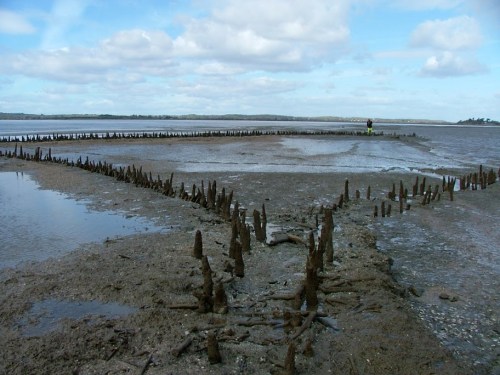
I have a page about the Fergus estuary here with links from that page to others about places on the estuary (including Paradise).

Mediaeval fishweir at the Boarland Rock in the Fergus Estuary © Dr Aidan O’Sullivan, UCD 2008

Mediaeval fishweir at the Boarland Rock in the Fergus Estuary © Dr Aidan O’Sullivan, UCD 2008

The UCD School of Archaeology has, for many years, been investigating the Fergus estuary and has found remarkable evidence of settlement and activities on the estuary stretching back to the Iron Age (about 100 BCE) and the Bronze Age (almost 800 BCE). Read about the project here and see more photos of mediaeval fishweirs and earlier artefacts here.

The photo above is used in accordance with the terms set out here.

Mountshannon

In the Foreword to his latest book, Portraits of Mountshannon (East Clare Heritage, Tuamgraney 2012), Ger Madden writes of the changes to Mountshannon since 1993:

The Aistear, the children’s playground, the pre-school building, the floating jetties at the harbour, additional restaurants and shops have been hugely positive and successful. The same cannot be said for housing. Ten years of reasonable prosperity for some, has resulted in new private holiday homes built on the fringes of the village and others planned. They are not associated with the needs of the community. The majority of the owners have not the slightest interest in the history, culture or welfare of the community they have chosen to display their wealth.

Any such owners wishing to develop an interest in the history of Mountshannon could not do better than to start with Ger’s book. It’s A4 landscape, with an aerial colour photo of Mountshannon on the front and a map on the back. Inside, the foreword gives a brief overview of Mountshannon’s history. Then follow 52 pages, each with a black and white photo and each covering a building, a tree or a place of interest in and around Mountshannon. Their locations are shown on the map on the back cover.

But, although architectural information is provided, the book is not about the buildings per se. Each page is a window into Mountshannon’s history and, together, they provide a rich account of the place and its people over the centuries. Part of the interest is in the fact that buildings you might pass by without noticing turn out to have interesting stories attached to them. Nor are they all about the distant past: I was glad to see that Mountshannon’s more recent claim to fame, as the last telephone exchange in the country to be automated, was recognised here (although I suppose that too may seem like the distant past to younger readers).

I highly recommend the book. If you’re in the area, you’ll probably know better than I where to get copies; if you’re not, you might ask East Clare Heritage.

Ger runs boat trips to Holy Island during the summer.


Around the world with Irish waterways

Yesterday was one of those days: I managed to track down sources for several pieces of information I’ve been hunting for some time, but in the process I came across a few interesting links, from Gordon of Khartoum to the War between the States.

The starting point was William Watson, manager of the Inland Department and later Chairman of the City of Dublin Steam Packet Company. He worked with Robert Mallet on the design of an innovative boat for use on Irish inland waterways. Robert Mallet married a Cordelia Watson in 1831. (I thought that might be a daughter of William of the CoDSPCo but it’s pretty clear from the excellent Mallett Family History site that that was not so.)

One of Mallet’s inventions was a large mortar designed for use in the Crimean War. And one of Mallet’s sons, John William Mallet, went to the USA and became professor of chemistry at the University of Alabama. He joined the Confederate forces, rising to the rank of lieutenant-colonel in the artillery and superintendent of the Confederate ordnance laboratories.

Meanwhile Watson’s son Charles Moore went east rather than west. Colonel Sir Charles Moore Watson KCMG, CB, MA, of the Royal Engineers, Watson Pasha, was a general in the Egyptian Army and Governor-General of the Red Sea Littoral. Watson’s base was at Suakin on the Red Sea. The Dubliner was succeeded in that post by a Kerryman, Horatio Herbert Kitchener, from Ballylongford near Saleen on the Shannon Estuary, on which the City of Dublin Steam Packet Company operated.

Watson was “Gordon’s principal friend in Egypt”:

It is certain that Watson was, above all others, the one man in Cairo whom Gordon cared about most, and that he was the last to see Gordon off when he started [for Khartoum].

Gordon died at Khartoum; the relief expedition, led by another Irishman, Sir Garnet Wolseley, arrived two days too late.

A younger brother of Sir Garnet, Frederick Wolseley, went to Australia. His Sheep Shearing Machine Company made a brief expedition into the manufacture of motor-cars, under one Herbert Austin, who later founded his own company. Austin and Wolseley both ended up in British Leyland Motor Corporation, which made diesel engines, some of which were marinised and used in boats on the Irish inland waterways … which brings us back to where we started.