
So what lock is this then?
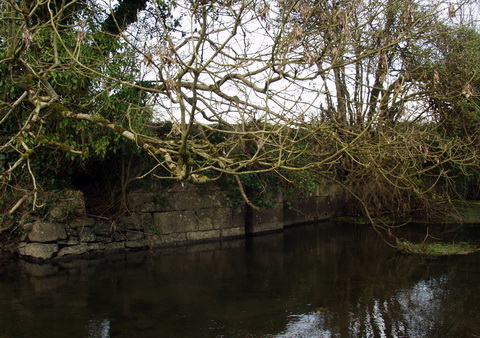
Yes, it’s abandoned. Yes, it’s in Ireland.
The answer is here.
Posted in Ashore, Built heritage, Drainage, Economic activities, Engineering and construction, Forgotten navigations, Industrial heritage, Ireland, Operations, People, Politics, Sources, The turf trade, waterways, Waterways management
Tagged boats, bridge, canal, harbour, Ireland, Lough Key, Rockingham, Shannon, vessels, waterways, workboat
I have uploaded an old article of mine based on an interview with Willie Leech of Killucan, whose father ran the last trading boats on the Royal Canal.
Posted in Economic activities, Extant waterways, Industrial heritage, Ireland, Irish inland waterways vessels, Operations, People, Sources, The turf trade, waterways
Tagged boats, bog ore, bridge, canal, Cloncurry, flyline, gas company, Grand Canal, horse, Ireland, Killucan, L T C Rolt, Leech, Royal Canal, Summerhill, timberhead, town gas, trackline, tug, vessels, waterways
No, not the one in Cork: the one in North Tipperary.

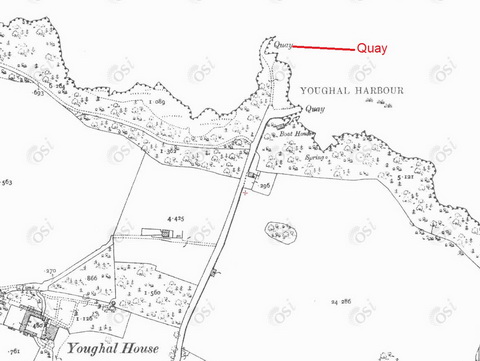
Youghal Quay ~1900
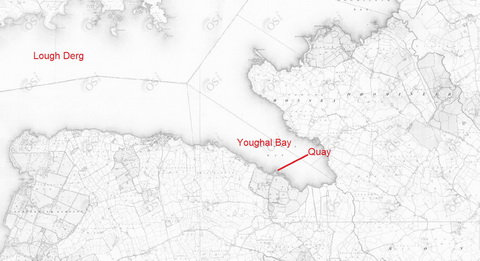
Youghal Quay and Bay ~1900
Formerly used for landing turf from the west side of Lough Derg, Youghal Quay is now a swimming area.
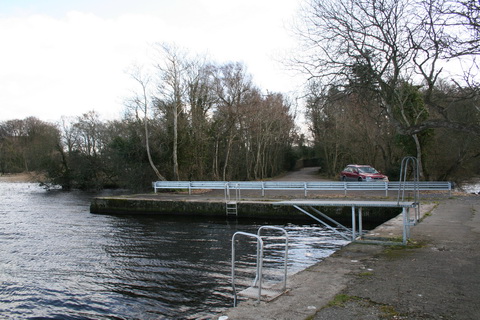
Ladder and diving board. Note the barrier at the landward end
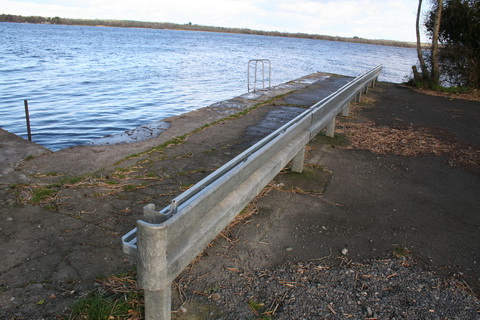
The business end of the barrier
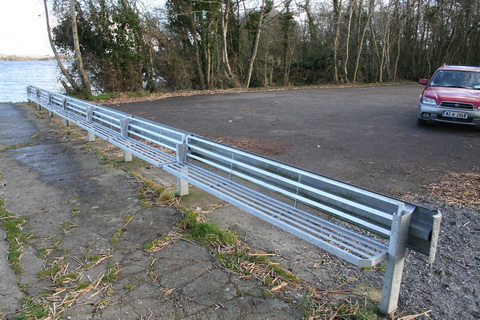
The other side supports a seat
Nice idea.
A poem by Sir Aubrey de Vere, father of the more famous Aubrey Thomas de Vere. The family estates were at Curraghchase, now a forest park, on the south side of the Shannon estuary and now best known as the home of Caroline Rigney, producer of some of Ireland’s best bacon. Sir Aubrey’s wife was one Mary Rice, of the Mount Trenchard family, one of whose members had a major role in the development of the Shannon in the 1840s.
How beautiful the tints of closing even!
The dark blue hills, the crimson glow of heaven,
The shadows purpling o’er the wat’ry scene,
Now streaked with gold — now tinged with tender green;
And yon bright path that burns along the deep,
Ere the sun sinks behind his western steep,
Soft fades the parting glory through the sky,
Commingling with the cool aerial dye;
While every cloud still kindling in the beam,
In mirrored beauty prints the waveless stream,
Light barques, with dusky sails, scarce seen to glide,
Bend their brown shadows o’er the glowing tide;
And hark! at intervals the sound of oars
Comes, faint from distance, to the silent shores,
Blent with the plaintive cadence of the song
Of boatmen, chanting as they drift along.
But see the radiant orb now sinks apace —
Gradual and slow, he stoops his glorious face;
And now — but half his swelling disk appears —
And now, how quickly gone! he scarcely rears
One burning point above the mountain’s head —
And now, the last expiring beam has fled.
The “light barques” probably included some turf boats.
There are more poems by Sir Aubrey here.
Posted in Ashore, Built heritage, Charles Wye Williams, Economic activities, Engineering and construction, Extant waterways, Ireland, Irish inland waterways vessels, Irish waterways general, Natural heritage, People, Politics, Restoration and rebuilding, Scenery, Shannon, shannon estuary, Sources, The turf trade, Tourism, waterways, Waterways management, Weather
Tagged bacon, boats, Clare, Curraghchase, de Vere, Dublin Penny Journal, estuary, Limerick, Shannon, waterways, workboat
Just as Killaloe is to have a new bridge, so too is Limerick. Or perhaps more than one …. This page (on a site whose ownership I do not know) has a map of proposed routes for the proposed Limerick Northern Distributor Road, which is to provide a northern bypass of Limerick. You can read about it on the websites of the promoters, Limerick County Council, Clare County Council and Limerick City Council. You can download stuff. And you will be pleased to hear that there are to be consultations (only not many of them).
This road is to be built in two phases, the first covering the area from west of the city to Parteen and the second from there to the old Dublin road (N7 as was, now demoted to the status of boreen). There are (or were) several options for each section, but the decision to cross the navigation at the Ardnacrusha tailrace, between the power station and the existing bridge, seems to be set in, er, concrete: that is, it seems, where the ESB wants it.
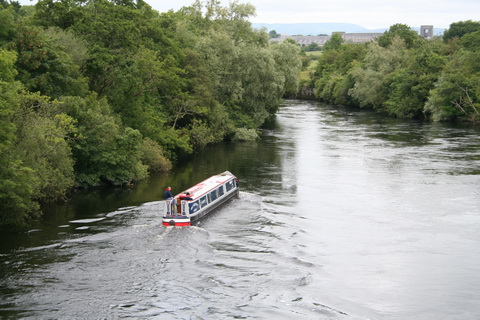
Ardnacrusha and the tailrace seen from the existing bridge at Parteen
The current consultation is about Phase 2, south-east from Parteen. There are several possible routes.
Two of them, B1 and B2, would cross the Shannon downstream of Plassey and the Black Bridge; they would not cross the Plassey–Errina Canal. It would be important to ensure that they did not further damage the towing-path and its artefacts on the Limerick side.
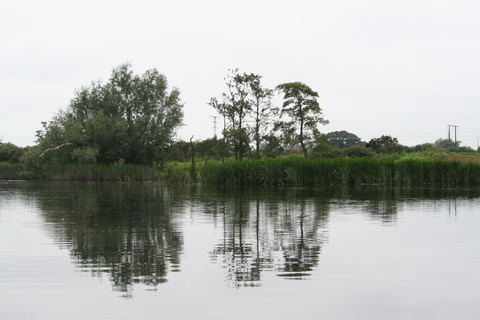
The west bank below Plassey
Four other routes — C1, D1, D2 and E1 — would cross the Plassey–Errina Canal between Gillogue and Wooden Bridge; they would cross the non-navigable Shannon upstream of Plassey, between there and a point just above the confluence of the Mulcair. C1 seems to run very close to Gillogue Lock, although that may be an effect of the scale of the route markings.
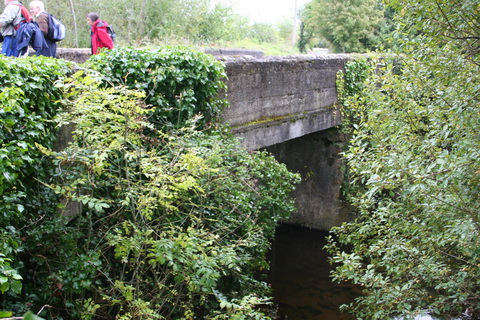
Woodenbridge (which isn't)
I am sure that the ESB will look after the interests of the existing navigation (through Ardnacrusha) and that Waterways Ireland will look after those of the former navigation (the river to Plassey and the canal thence to Errina). However, it might be worthwhile lobbing in a comment to TPTB, first to sttress the heritage value of the abandoned navigation and second to suggest that a new road near Plassey might improve rather than diminish access to that area.
One final thought: this new road seems likely to put the final nail in the coffin of the Limerick Tunnel under the Shannon estuary downstream of Limerick. I very much enjoy using the tunnel, but many folk are deterred by the charges and they drive through the city instead — or, worse, cross the Shannon at O’Briensbridge. As a result, revenue is less than expected, so the traffic guarantee mechanism means that the National Roads Authority has to compensate the tunnel operators.
So now that a new, free, presumably fast road is to link the east and west sides of the city, what will happen to the numbers of vehicles using the tunnel and to the taxpayers who are ultimately paying the compensation? They’ll pay more. The tunnel is on a national primary route, so it’s the NRA’s problem, whereas the new bypass is a regional or local route, which is in the hands of the local authorities.
=p-po-
Posted in Ashore, Built heritage, Charles Wye Williams, Economic activities, Engineering and construction, Extant waterways, Forgotten navigations, Industrial heritage, Ireland, Irish waterways general, Natural heritage, Non-waterway, Politics, Scenery, Shannon, The cattle trade, The turf trade, waterways
Tagged boats, bridge, canal, Clare, Errina, ESB, Gillogue, Ireland, Killaloe, Limerick, Limerick tunnel, lock, Lough Derg, Montpelier, O'Briensbridge, Operations, Plassey, road, Shannon, vessels, water level, waterways, Waterways Ireland, Woodenbridge
Brigid Maguire’s Tales on the Co Kildare Online Electronic History Journal.
This morning, on the wireless, I heard two people opposing the use of fracking to find gas around Lough Allen in Co Leitrim. Neither of them was convincing. One started by objecting to big multinationals being given licences to investigate the resources available; it is not clear that there was any ban on small native companies or workers’ cooperatives (or soviets of workers, peasants and soldiers) applying for licences, and presumably they could use traditional Irish implements like sleans if they wanted to.
The general line of argument adopted by the objectors was that anything that could go wrong would go wrong, probably all at the same time, wiping out the whole of Irish agriculture (some of which is not in Leitrim) and, er, eco-tourism. There would, the objectors seemed to suggest, be no preventive or mitigating measures and no insurance and the full cost of every accident would be borne by the residents of the area.
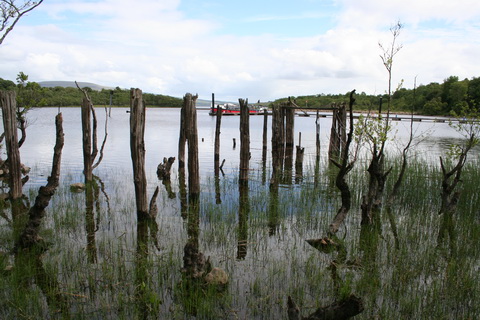
Remains of a pier at the brickworks, Spencer Harbour, Lough Allen
But the bit that really annoyed me was the depiction of the area as one of rural seclusion. Yet Lough Allen had canals, railways, coal mines, dams, iron works and brick works.
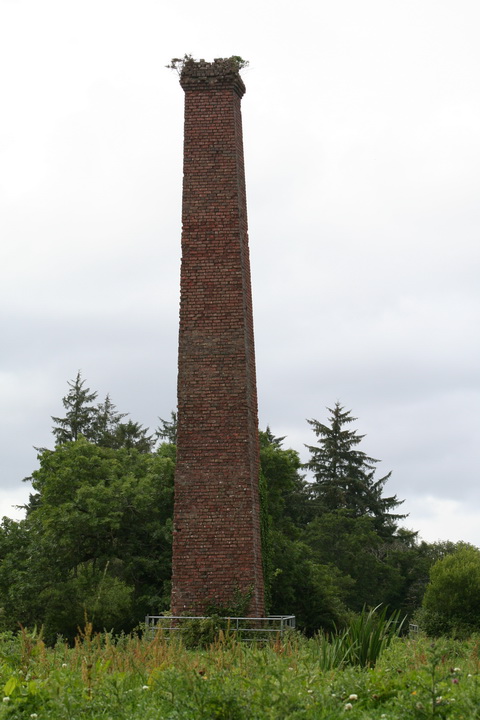
Spencer Harbour on Lough Allen
The very canal linking Lough Allen to the
rest of the Shannon Navigation owes its very existence to the desire
to carry coal from around Lough Allen to Dublin. And one of the most best tourism initiatives in the area, the Arigna Mining Experience, recognises that heritage.
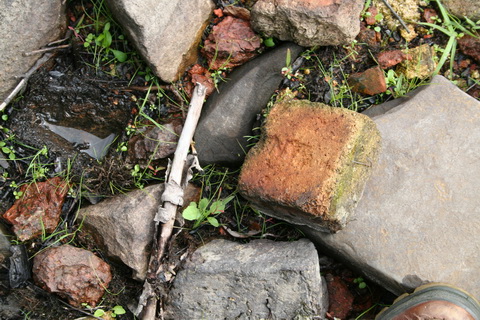
Part of a brick
Insist on proper assessment and management of risk by all means, but don’t exaggerate it — and don’t ignore Leitrim’s industrial heritage.
Posted in Ashore, Built heritage, Economic activities, Engineering and construction, Extant waterways, Industrial heritage, Ireland, Irish waterways general, Natural heritage, Non-waterway, Operations, People, Politics, Rail, Scenery, Shannon, The turf trade, Tourism, Water sports activities, waterways, Waterways management, Weather
Tagged Arigna, boats, bricks, canal, Clare, coal, dam, ESB, fracking, gas, industry, Ireland, iron, jetties, lock, Lough Allen, Operations, Shannon, Spencer Harbour, vessels, waterways, workboat
The Kildare Archaeological Society’s programme for 2012 is available on the Co. Kildare Online Electronic History Journal website (which, incidentally, has a useful RSS feed). Its Heritage Week outing in August 2012 is waterway-based:
Sunday 26th August, 3.00 pm – Heritage Week Outing
Robertstown, the Grand Canal and Lowtown Lock
Guided walk by Karen Gorey.
Meet at the Holiday village Car Park, Robertstown. No Charge.

 Irish waterways history