Castleconnell, in Co Limerick, is on the section of the River Shannon that includes the (broadly defined) Falls of Doonass. That section was bypassed by the Plassey–Errina Canal, one of the five parts of the Limerick Navigation, which navigation was largely abandoned after the construction of the Shannon hydroelectric power scheme in the 1920s. After that, vessels used the headrace, lock and tailrace of the Ardnacrusha power station to pass between Lough Derg and Limerick.
On 27 May 2015 I noted a statement by the Limerick and District Anglers Association about the Castleconnell section of the Shannon:
Therefore canoeists who enter this section of river without permission are trespassing.
Cots
That section of river was not, as far as I can tell, navigated by cargo-carrying vessels; it would be surprising had they been able to do so, even downstream. However, it was navigated by narrow cots. Lady Chatterton in her Rambles in the South of Ireland during the year 1838 [Vol II Saunders and Otley, London 1839], wrote
We have passed the last few days at Doonass, a beautiful place near the rapids of the Shannon. The sound of those rushing and falling waters was most soothing and melodious, as heard from the house, which is situated at some distance, in a beautiful park, sloping down to the river.
I walked several times on its banks to enjoy the splendid sight, and to watch some people who were fishing for salmon. It made me quite nervous to see the boats shoot some of the falls, knowing that unless they had kept exactly the right course, they would have been inevitably dashed to pieces.
In A Week at Killarney [Jeremiah How, London 1843] Mr & Mrs Samuel Carter Hall wrote
Castle Connell, a village about six miles from the city [of Limerick], is perhaps unrivalled in the kingdom for natural graces; and immediately below it are the Falls of Doonas, where the river rushes over huge mountain-rocks, affording a passage which the more daring only will make, for the current — narrowed to a boat’s breadth — rushes along with such frightful rapidity, that the deviation of a few inches would be inevitable destruction. [*]
This, although the most remarkable of the falls, is succeeded by several others, between Castle Connell and Limerick — the whole scene, however discouraging to the political economist, as presenting a picture of wasted strength, being delicious in the highest degree to the lover of natural beauty.
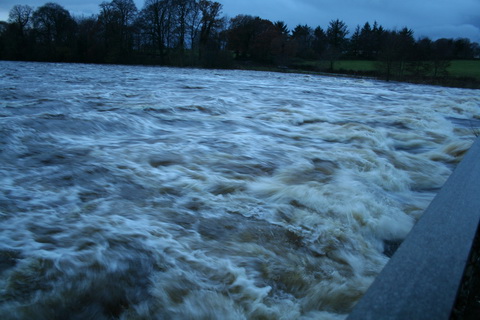
The river at Castleconnell by night in the floods of 2009
[*] We cannot easily forget our sensations of mingled alarm and enjoyment, while rushing along this course — at night, but by the light of a brilliant moon; it was exciting to the highest degree. We had confidence in our helmsman (if so we must term the man with the paddle-rudder he held in his hand); yet every now and then the voyage was a startling one, and the danger quite sufficient to shake stronger nerves than ours. He had nothing to do but to keep a keen eye upon the rocks at either side, and guide his “cot” by pushing aside a wave with a strong arm, so as to keep in the centre of the current; and he did so with wonderful accuracy.
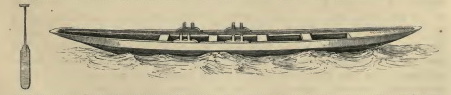
The Halls’ sketch of a cot
We were afterwards convinced that there was in reality no more peril than there would have been upon the Thames; for the boatmen are so skilful and so well-practised, that they govern their boats with absolute certainty.
The boats are flat-bottomed (for often the stream is not above a few inches deep), narrowed, and squared at the stem and stern. The paddle is a piece of flat wood, about three feet long, increasing from the handle to the breadth of about ten inches; only one is used, which the man changes from side to side according to the direction in which he desires to proceed — using it alternately to advance the boat, and as a helm to steer its course. We refer more especially to the boats used by the fishermen, in which the oars are seldom resorted to; for they are pushed up the stream by a long pole, and the current takes them down it without an effort.
And who can forget the stirring scene in L A Hall’s short story “Which was the bravest?” [in The Magnet Stories for Summer Days and Winter Nights Groombridge and Sons, London, no date, but my copy was a Christmas present in 1862, albeit not to me] in which Herbert, the English youth, falls over when attempting to pole a cot up the river at Castleconnell? The boatman, Lawlor, speaks:
“Sure the young gintleman wanted to try what stuff the Irish poles were made of, and small blame to him if the Irish rock and the Irish ash were too hard for him.”
This was all the work of a moment, during which Lucius [Herbert’s cousin, who lives near Doonass], well accustomed to the Shannon navigation, manfully stemmed the torrent with his single pole.
Not many Etonians could manage that nowadays, I imagine. But then there may not be as many Etonians around Doonass.
The Shannon Navigation
Note that L A Hall [of whom both Google and I are largely ignorant] used the term “Shannon navigation”. I had initially assumed that the Limerick Navigation Company, in its several manifestations, would have had no interest in this stretch of river and that therefore the Shannon Commissioners, and their successors the Board of [Public] Works and, now, Waterways Ireland would not have acquired any interest in its navigation.
I thought that there might have been a public right of navigation, as outlined by Douglas Caffyn, but that in any case such a right had been protected by the beneficence of Her late Majesty Victoria, by the Grace of God of the United Kingdom of Great Britain and Ireland Queen, who caused Her ministers to insert this provision in the Shannon Navigation Act 1839 [CAP LXI An Act for the Improvement of the Navigation of the River Shannon 17th August 1839]
XXXVI. And be it enacted and declared, That the said River Shannon is and for ever hereafter shall be, to all Intents and Purposes a public navigable River; and that all the Queen’s liege Subjects may have and lawfully enjoy their free Passage in, along, through, and upon the said River Shannon, with Boats, Barges, Lighters, and other Vessels, and also all necessary and convenient Liberties for navigating the same, without Let, Hindrance, or Obstruction whatever, on paying such Rates, Tolls, and Duties as are by this Act appointed to be paid, and complying with such Rules, Orders, Regulations, and Bye Laws as shall be made by the said Commissioners under the Provisions of this Act: Provided always, that nothing herein contained shall be construed to exempt any Person or Thing from the Payment of any Tonnage, Quayage, Rateage, or other Dues payable under an Act passed in the Fourth Year of the Reign of His late Majesty King George the Fourth, intituled An Act for the Erection of a Bridge across the River Shannon, and of a Floating Dock to accommodate sharp Vessels frequenting the Port of Limerick, and of an Act passed in the Fourth and Fifth Years of the Reign of His late Majesty King William the Fourth, intituled An Act to amend an Act passed in the Fourth Year of the Reign of His late Majesty King George the Fourth, intituled “An Act for the Erection of a Bridge across the River Shannon, and of a Floating Dock to accommodate sharp Vessels frequenting the Port of Limerick”, or from Compliance with any Rules or Regulations imposed or to be imposed by the Commissioners appointed under the said Two last-mentioned Acts.
There is one possible complication in the same act:
XXXIX. And be it enacted, That the said Commissioners shall, within Six Months from the passing of this Act, or at such other Time or Times as shall seem to them most expedient, fix and determine the Limits of the said River Shannon, and such of the Rivers aforesaid, or Parts thereof, as shall be improved under this Act, as to them shall seem expedient, within which all the Powers and Authorities by this Act given to the said Commissioners for the Care and Conservancy of the said Rivers respectively shall and may be exercised; and a printed Notice giving such Description of the Limits so fixed, with such Map or Plan thereof as to the said Commissioners shall seem expedient, shall be posted on each Toll House on or near the said River Shannon, and such of the Rivers aforesaid as to them shall seem expedient, and at every Place where a Table of the Tolls or Rates to be taken on the said River respectively shall be posted, and at such other Places as to the said Commissioners shall seem expedient.
The limits were set out in maps and minute books, which are listed in Schedule E of the Third Report of the Commissioners for the Improvement of the Navigation of the River Shannon published in 1842 [I don’t think that report is available online]. I’ve never seen the maps and minute books and so I don’t know whether they say anything about navigation on the relevant stretch of river, but the list includes:
Map 2 Map of part of the Shannon and the Canal, from Arthur’s Ferry to Castleconnel and World’s End (County of the City of Limerick, Counties of Limerick and Clare); Minute Book pages 7 to 11 inclusive; also 14 to 21 inclusive […]
Map 2B Plan and Sections of Clareville, or Prospect Mill-dam (County of the City of Limerick, County of Clare); Minute Book pages 9, 10, and 11
Map 2C Plan and Sections of Doonass Salmon-cribs, and of Water Park Bleach Mill-dam (Counties of Limerick and Clare); Minute Book pages 9, 10, 11, and 12
Map 3 Map from World’s End to Killaloe (Counties of Clare, Limerick, and Tipperary); Minute Book pages 11 & 12; also 21 to 26 inclusive; also 30 to 32 inclusive.
Apart from Map 2, those seem to be about water (mill) rights and salmon rather than about navigation, but I hope to check that with Waterways Ireland. The Commissioners may have decided that the Castleconnell stretch of the river lay outside the limits of the Shannon, and that navigation thereon was not therefore protected by the provisions of Section XXXVI. Even then, though, a public right to navigate may have continued to exist. On the other hand, the Commissioners’ limits may not have affected navigation on this stretch of river.
It is also possible that some later enactment affected navigation.
the ESB
An entire series of enactments, from the Shannon Electricity Act 1925 onwards, empowered either the Minister for Industry and Commerce or the Electricity Supply Board [ESB] to do various things connected, more or less, to the construction and operation of the hydroelectric power station at Ardnacrusha. Under the 1925 act, for instance, the minister was empowered [inter alia] to
3. […] (b) impound, hold up, divert, take, and use the waters of the River Shannon and any river or stream tributary thereto and any lake, pond, or canal thereon or connected thereto;
(c) embank, dam, dredge, deepen, widen, straighten, divert, and otherwise alter the River Shannon or any river or stream tributary thereto;
(d) embank, dam, dredge, alter the level of, and otherwise affect any lake, pond, or other water on or connected directly or indirectly with the River Shannon;
(e) remove, or alter, repair, construct, and maintain such sluices, weirs, dams, embankments, and other works as may be necessary for or incidental to the doing of any of the things mentioned in the foregoing paragraphs […].
Under the Electricity (Supply) Act 1927 the minister was empowered to prohibit navigation during construction; blocking off the river with Parteen Villa Weir probably made that easy to enforce. The Board was also empowered to prohibit navigation after taking over the works:
(3) When the handing over of the Shannon works to the Board under this Act is completed the Board, notwithstanding any such enactment as aforesaid, may by order, for the purposes of the operation of the Shannon works or of the exercise of any of the powers or the performance of any of the duties or functions conferred and imposed on the Board by or under this Act prohibit navigation in or upon the River Shannon or any particular part thereof specified in such order for such limited period of time specified in that behalf in such order as may be required by the Board for the purposes aforesaid.
That came before the ESB got the fisheries rights, so I can’t see that it’s relevant to any restriction of navigation in the interests of fisheries.
I searched the splendid Irish Statute Book for both Acts and Statutory Instruments with combinations of terms like Shannon, electricity, navigation, salmon and fishery. I then read — well, searched and skimmed — every relevant enactment I could find. I am not a lawyer, but it seemed to me that the only enactment under which the ESB might restrict, or have restricted, navigation, by kayaks or canoes or anything else, on the Shannon through Castleconnell, is the Shannon Fisheries Act 1935, of which more below.
Just for completeness, I should say that the Shannon Fisheries Act 1938 includes this section:
3.—Nothing in this Act shall operate to prejudice or affect any right of the Commissioners of Public Works in Ireland in relation to the navigation of the waters of the River Shannon.
That’s a useless provision, I think, because if the Commissioners of Public Works lost anything it was under the 1935 Act; the 1938 Act did nothing to restore any rights lost under the 1935.
Finally, the Electricity (Supply) (Amendment) Act 1945 allows the ESB to prohibit navigation but it doesn’t seem to apply to the Shannon: only to rivers on which power stations were to be built after 1945.
The Shannon Fisheries Act 1935
The most important part of the act is Section 9 (1) (d) but 9 (2) (a) may also be of interest:
(1) It shall be lawful for the Board to do all such things, carry out all such transactions, and fulfil all such functions as shall be necessary or proper for or incidental or ancillary to the due performance of the duties in relation to the Shannon fisheries imposed on the Board by this Part of this Act, and in particular and without prejudice to the generality of the foregoing powers, it shall be lawful for the Board to do all or any of the following things, that is to say:—
[…]
(d) terminate, restrict, or otherwise interfere with, either permanently or temporarily and either compulsorily or by agreement, any easement, way-leave, water-right, fishing right, or other right over or in respect of any land or water;
[…]
(2) Nothing in this section shall operate to authorise the Board—
(a) to do anything compulsorily without paying compensation therefor […].
Implementation
In order to check my conclusion, I emailed the ESB fisheries department on 26 May 2015:
I note that you say that canoeists and kayakers must seek your permission to use the Shannon at Castleconnell. I would be grateful if you could tell me:
(a) the legislation (Acts or Statutory Instruments) empowering you to make that stipulation
(b) the details of the Board decisions making it and
(c) the details of the stipulation itself. Does it, for instance, apply only to kayaks and canoes or are other vessels, and non-vessels such as jetskis or hovercraft, covered too?
The fisheries department very kindly replied on the same day:
Please note that ESB is not seeking to prevent kayakers or canoeists from using the river but as we operate the stretch of the Shannon River in Castleconnell as a private salmon fishery we are obliged to consider the interests of the anglers who use the fishery and pay to do so.
Since we introduced the requirement for kayakers to contact ESB Fisheries when intending to use the river at Castleconnell, no kayaker has been refused permission.
The legislation empowering ESB to regulate activity on the Shannon is contained in the Shannon Fisheries Act 1935 – Section 9.1 (D).
If you wish to discuss the matter please contact [name and telephone number redacted].
I prefer to have records of such discussions so I replied by email on 27 May 2015:
[…] I should say that I have no interest or stake in either angling or canoeing/kayaking per se. My interest is in the management of the Shannon, and in particular in navigation thereon, past and present.
[…] my interest in the navigation of the Shannon from Castleconnell downstream was excited recently by some comments by anglers on what kayakers might or might not do. Accordingly, I searched the Irish Statute Book database for all Acts and Statutory Instruments dealing with the ESB, the Shannon and salmon fisheries. I read every Act or SI I found on those subjects.
I found nothing to indicate that the right to navigate the Shannon, from Castleconnell downstream, had been extinguished or that the ESB had been appointed as a navigation authority with the right to control navigation; I note that the ESB makes charges for boats on some other fisheries but not on the Shannon.
I acknowledge of course that there may be documents I have not seen and that I may have missed or misinterpreted something in those I did read.
ESB> Shannon Fisheries Act 1935 – Section 9.1 (D)
That was the only enactment I found under which I thought the ESB could take any action that affected navigation. Indeed the section appears to allow the ESB to use helicopter gunships to deter poachers if it so desires.
However, that is an extremely broad enactment, and I have not found, in the Irish Statute Book or anywhere else, any information about these matters:
- what strategic decisions the Board has made on this subject, or what decision-making powers it has conferred on its fisheries staff
- in the implementation of that Section, what decision-making process the ESB followed and how it consulted citizens (other than anglers)
- whether the Board has actually decided to “terminate, restrict, or otherwise interfere with, either permanently or temporarily and either compulsorily or by agreement, any easement, way- leave, water-right, fishing right, or other right over or in respect of any land or water”
- if it has so decided, what the details of the decision are: details both of its making and of its application
- how such decision is consonant with other legislation
- how the decision was promulgated and where the details can now be found
- what appeal and compensation mechanisms have been set up to enable the Board to meet the provisions of Section 9.2 (a)
- what case law exists on the subject.
I have also been unable to find any enactment providing that citizens are obliged to obey any such decision or that any action can be taken against them if they decide to ignore it.
Let me say again that I acknowledge that my inability to find information doesn’t mean that it does not exist. However, I would have expected that, in any case where my [presumed] rights [eg to navigate] were affected, the relevant regulations would be readily available and the authority under which they were made would be clear. I would therefore be grateful if you would let me have the details, which I would like to publish on my website.
I sent that two weeks ago today; I have not yet had a response.
My current understanding
I acknowledge that the ESB has the right to ban navigation on the Shannon through Castleconnell if it wants to do so. I also acknowledge that it is possible that it has done so and even that it may have taken its decision validly and in accordance with the principles of natural or constitutional justice.
However, the ESB has not yet shown that it has taken that decision and done so validly and in accordance with the principles of natural or constitutional justice. I have found no evidence that it has and, in two weeks, the ESB has not provided any. All we have to go on is a pair of unsupported assertions, one by the Limerick and District Anglers Association [whose concept of trespass I do not understand] and the other by the ESB fisheries department, saying that would-be navigators must contact them, but without citing any authority for that demand.
As matters stand, I see no reason why that demand should be complied with. But, again, I acknowledge that I do not have full information.






 Irish waterways history