
Category Archives: Waterways management

A Grand Canal mystery

Passenger boat over lock1

Boat at Lowtown

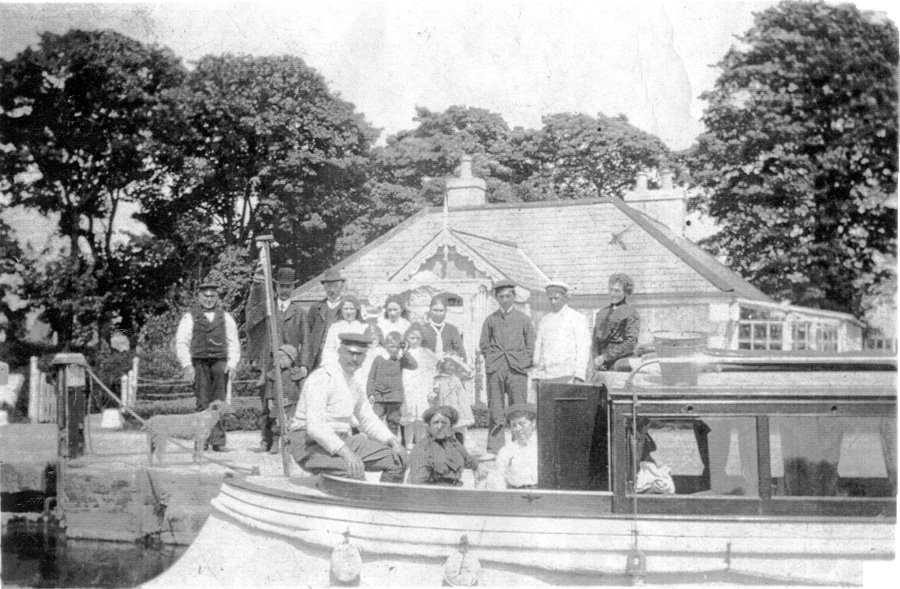
Alan Lindley has very kindly sent me, and permitted me to publish, this photograph.

It was taken at Lowtown lock, on the Grand Canal, in 1911 or 1912.

Alan says that the man on the left of the group — with cap, waistcoat and watch-chain, and with a dog standing in front of him — is the lock keeper, Murtagh Murphy, the great-grandfather of the present incumbent, James (Jimmy) Conroy. Murtagh was born in Ballycowan, near Tullamore, Co Offaly, in 1849 and, after working on a Grand Canal Company boat, married a Kildare girl and took the job at Lowtown.

The boat had been described as a passenger flyboat but, as the Grand Canal Company had ceased carrying passengers in 1852, that seems unlikely. And the boat looks much more like a pleasure vessel than a working boat.

If the Grand Canal Company had an inspection launch, this might be it, but I have found nothing to indicate that it did. The boat does, though, seem to have been designed for canal travel: it seems (from the twenty feet or so we can see) to have straight sides and to be well equipped with fenders. It might therefore have been designed to travel on the canals (as well as on other waters).

At least one director of the Grand Canal Company, Henry Samuel (aka Harry Samuel) Sankey, of Fort Frederic, Virginia, Cavan and of 64 Wellington Road, Dublin, did have a launch or pleasure craft on the canal, the Aja, which you can read about here. Incidentally Mr Sankey, who died on 5 December 1925, directed “that no Roman Catholic shall take any benefit” under his will.

Further information about the boat and the people shown in the photograph, and about Mr Sankey’s launch, would be very welcome; please leave a Comment below.
And the prize goes to …

… Niall Galway, who identified the Cong Canal. bjg

Athlone 1889

To the Editor of the Athlone Times 24/8/1889

Dear Sir

I understand that the Athlone Board of Guardians passed a resolution at a recent meeting in favour of the drainage of the Shannon. May I ask, is it the object of these enlightened gentlemen to destroy the navigation of 240 miles passing through our country, which no law can ever restore; or can it be possible they so far despair of the future traffic of the country under the management of their Parliament, in College Green, as to feel warranted in doing away with such a natural and beautiful highway for trade.

I happen, myself, to be in a position to judge the agricultural part of the question, and after the experience of 25 years of the lands which are subject to the Shannon flooding, I have no hesitation in saying that the meadows are greatly improved, and I may mention that in no way could these lands be more profitably farmed than by meadowing.

To the Athlone people, it seems to me a matter of the greatest importance, or do they realise that their beautiful river is about to be turned into a mere cesspool, their traffic to be left at the mercy of the railway companies, and their boating excursions on their fine lake to be made almost impossible, as this drainage will create such a current at the opening of the lake that it will require their strongest efforts to force a boat against it, and even after overcoming this difficulty, they would have little to look at but white shores and barren rocks.

I remain, Mr Editor, Faithfully yours… R D Levinge, Carnagh

Thanks to Vincent P Delany for this.

Transhipment

At the Grand Canal Company’s half-yearly meeting on 22 February 1890, a Mr Geoghegan

[…] said he had heard from a gentleman interested in the trade between Dublin and Limerick that it often took six days for Guinness’s porter to be carried by canal from the former of these cities to the latter. The cause of this he believed was the necessity for trans-shipment at Shannon Harbour.

The Chairman disagreed:

As to the delays at Shannon Harbour there had been some, but he believed these had been caused by floods and storms in the river.[1]

The company had commissioned Mr E Lloyd, engineer and general manager to the Warwick and Birmingham Canal Company, to inspect the Grand Canal and to advise the board. It was estimated that his survey would cost between £100 and £120. The chairman accepted that there were

[…] many matters […] which demanded immediate steps, and these entailed considerable outlay. It has been evidenced that before the property of the company could be stated to be in a thoroughly satisfactory condition some further exceptional outlay would be advisable from time to time.[2]

At the next half-yearly meeting, held on 23 August 1890, the chairman said that the company was considering investing in a more rapid transhipment system “from our barges to the Shannon steamers” at Shannon Harbour, in accordance with Mr Lloyd’s suggestion.[3]

Shannon Harbour June 2008 02_resize

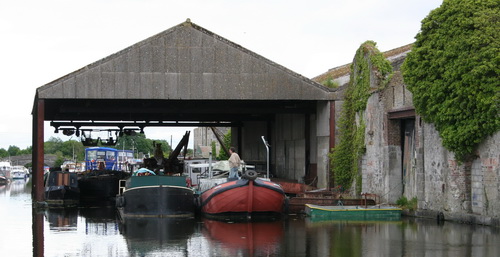
The transhipment shed at Shannon Harbour in June 2008, before its canopy was removed

I do not know whether the transhipment shed at Shannon harbour, and the gantry mechanism on which goods could be loaded and unloaded under cover, was built on Mr Lloyd’s suggestion. It would be interesting to know more of the building’s history.

Sources


[1] The Freeman’s Journal 24 February 1890

[2] ibid

[3] The Freeman’s Journal 25 August 1890

From the British Newspaper Archive run by Findmypast Newspaper Archive Limited, in partnership with the British Library.

Thon Sheugh and WI’s budget

A Sinn Féin MLA, whose party colleague is one of two ministers responsible for Waterways Ireland, has expressed concern about WI’s financial position:

Phil Flanagan: Is the [North South Ministerial] Council aware of the stark financial difficulties facing Waterways Ireland as a result of not only sustained budget cuts but the currency fluctuation because of the weakened euro? Let me point out some of the figures: compared with 2013, the 2014 budget was down by €290,000; and, in 2015, it was down by €875,000, solely because of the weak euro. Was that matter discussed? What potential solutions may ensure that Waterways Ireland is returned to a sustainable financial footing?

I had not realised the extent of the problems caused by the euro.

Replying, Martin McGuinness — also Sinn Féin — said

The fluctuation of the euro was not discussed at the meeting.

Obviously, it does represent a serious challenge, given the fact that the euro has been very weak over recent times. I note that it has strengthened over recent days. Certainly, on foot of the Member highlighting this, we can give it further consideration.

Mr McGuinness went on to provide some information about Saunderson’s Sheugh (which we’re pretending is the Ulster Canal):

It is important to point out that the work of Waterways Ireland is nearing completion, including the dredging of the River Finn between Upper Lough Erne — that will be of interest to the Member — and Castle Saunderson as part of phase 1 of the restoration of the Ulster canal.

Design plans for the new bridge at Derrykerrib are also at an advanced stage. I understand that there are some contractual issues with the site that, combined with high water levels, have led to delays.

However, Waterways Ireland is working with local councils and other interested parties to secure EU funding under the INTERREG sustainable transport programme. The proposed greenway would run from Smithborough village to the Monaghan town greenway and on to Armagh. The point that the Member raised is important and will be considered by the Council.

Given that that was irrelevant to the question, I presume that Mr McG wanted to get this information on the record.

I would like to know more about the “contractual issues with the site”. I do hope they won’t mean that we miss getting photos of the northern and southern ministers, wearing yellow hard hats and lifejackets, claiming credit for the work. After all, there is an election coming up.


Trade boats

Relatively little has been published about the horse-drawn cargo-carrying trade boats used by the Grand Canal Company in the latter half of the nineteenth century, before it adopted semi-diesel engines. Here is some information and some speculation about the subject, but there is much that is not clear.

The disappointed steamer

For one brief moment it seemed that the humble steamer Ballymurtagh might have a glittering future as a passenger vessel. Alas, it was not to be.

Closing the Grand Canal

The excellent Co Kildare Online Electronic History Journal has a reprint here of a 1959 article about the ending of commercial carrying on the Grand Canal. And putting “canal” in its search engine reveals lots more of interest.

FPP (lapsed)

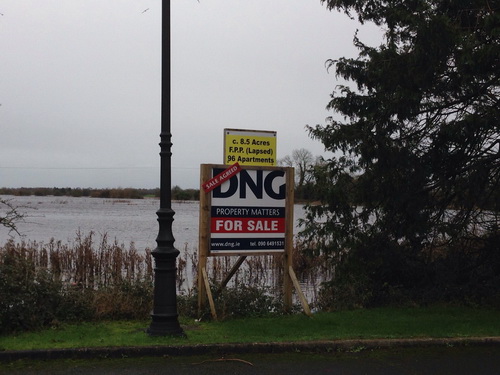
I mentioned flooded fields, zoned for housing, here. Michael Geraghty has very kindly sent on this photo, taken recently in Athlone.

Athlone Michael Geraghty 01_resize

FPP (lapsed)

How nice to have a waterfront apartment. Though it may be a bit much to have it waterback, waterside, watertop and waterbottom as well.

If there is an award for sales skills amongst auctioneers, I wish to nominate Messrs DNG.

For certain values …

In the Irish Times of 5 January 2016 Fintan O’Toole has an article headed “Genuine local democracy part of the solution to flooding“. He points out that

  • in 2004 the Irish Times property supplement showed a photograph [we are not told whether it was part of an ad or advertorial or of a critique of property development] showing a sign advertising for sale a flooded field that had been zoned for residential use
  • in 1997 a resident of Clonmel detailed how the town’s natural flood defences had been destroyed
  • in 1999 a man in Ennis blamed the flooding of his house on the granting of too many planning permissions
  • in 2000 3500 Clonmel residents objected to building on flood plains
  • nitwitted local councillors didn’t care.

He concludes that

As flooding gets worse, we will have to spend enormous amounts of money on engineering solutions. But in fact one part of the solution doesn’t cost any money at all. It’s called listening. Or, to give it its political title, it’s called genuine local democracy. Top-down, very expensive technocratic measures may have to be part of the response. But they will only work in a political culture that has eyes to look at the land and ears to listen to what people know about it.

Well, up to a point, Lord Copper. The article provides no evidence that a majority of the citizens — in any local authority area, Dáil constituency or other political unit — shares the erudite and enlightened views of those who write letters to, or columns in, the Irish Times. In fact, given that the citizens have, over more than one hundred years, continued to elect large numbers of nitwits to the local authorities and, for almost a century, to the Dáil, it seems unlikely that democracy — genuine, local or otherwise — will ever produce the right answers.

Which may explain why so much power now resides elsewhere, in the hands of experts and courtiers, and why elected representatives are reduced to throwing the occasional tantrum, providing tea and sympathy and making empty promises that then come back to haunt them.