The amazing success of Harbour Flights

I have written before about Harbour Flights, which operated a seaplane (floatplane) at Mountshannon on Lough Derg and conducted trial flights hither and yon. I was a little confused about whether Harbour Flights was “fully operational” but its redesigned web page (there were once several pages) carries the impressive news that the company has been so successful that it has ceased operations, at least temporarily.

But it will be back, and instead of operating a single aircraft, which was actually owned by somebody else, it will have a veritable fleet “operating from [sic] destinations nationwide” and will be “fully operational again”, which suggests that it was fully operational before. I wonder how many of the “50 new Irish jobs” were created when it reached that point.


Lough Derg floods: a book

If you happen to have €1400 or so to spare, you could buy Henry Trench’s 1879 book called Shannon Floods. Lough Derg level. The 25 Miles North from Killaloe with a double-page map and seven coloured plates. I have no connection with the seller — and no €1400 either, so I won’t be buying it.

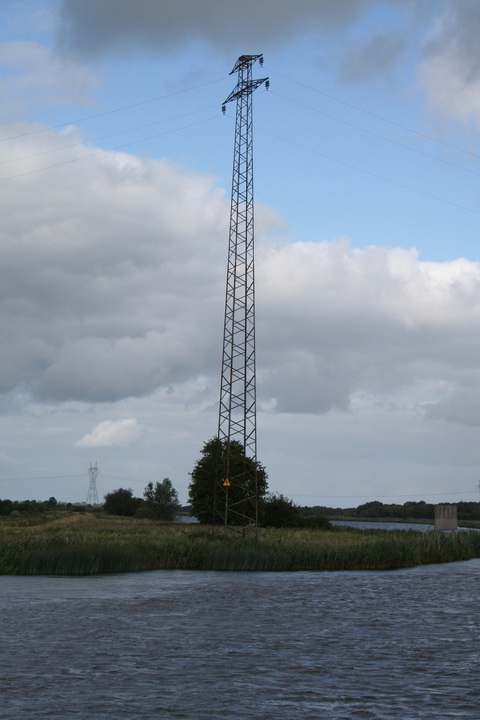
A new concept in electricity transmission

Lower pylons 2_resize

We read on the Clare FM website:

The Government says it is not realistic or financially feasible to run new electricity pylons underground.

Well, yes, I’d imagine there’s something in that. Although I don’t quite see why anyone would want underground pylons. I knew some folk wanted underground electric cables, but hadn’t realised they wanted the pylons buried too.

Personally, I’m all in favour of pylons: I like them, and would like to see more of them. I don’t understand why a row of nice pylons should be thought to make scenery less, er, scenic. It might make scenery less like a pre-industrial idea of scenery, but that’s a good thing; big it up for Stephen Spender.

And think of the industrial heritage value in the future: as well as old canals and railways, folk will come to photograph pylons; indeed some people already do so.


Slightly Foxed

WI says today, of its sale of surplus barges:

The ” Fox” workboat/barge currently located at Roosky has been withdrawn from the Sale .

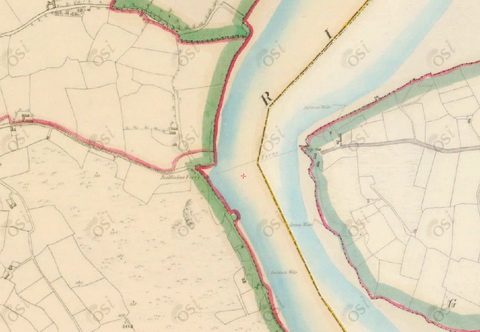
Ballinlaw ferry

A visitor to my page on the tidal Barrow is a descendant of ferrymen at Ballinlaw on the Barrow. He would like to find a photograph (or, presumably, other illustration) of the ferry boat and I would welcome more information about the service (eg when it ended).

Ballinlaw ferry (OSI ~1840)

Ballinlaw ferry (OSI ~1840)

If anyone knows of a possible source of information or illustration, I will pass it on to the enquirer.

Update January 2019: much information about Ballinlaw Ferry from Andrew Doherty here.

My OSI logo and permit number for website

Clashganny Lock on the Barrow

I would be grateful if anyone could explain the holding tank at Clashganny. Waterways Ireland’s water-level gauge [Flash thingy; takes ages to load] at Clashganny is named “Clashganny Holding Tank”.

A threat to an existing navigation

I have a page here about the River Maigue, one of Ireland’s oldest improved navigations. Incidentally, the river’s name is locally pronounced Mag, to rhyme with bag.

In 2009 I wrote to the Powers That Be to suggest that the (much to be desired) bypass of Adare, a major bottleneck on the N21 Limerick–Tralee/Killarney road, should pass to the south of the town, thus avoiding the interference with the navigation that would undoubtedly have resulted from a northern bypass. It was no doubt the strength of my case, and a recognition of the importance of the navigation, that caused the Powers to opt for a southern bypass. A proposed link to a proposed M20 Limerick–Cork motorway may have been a minor factor in their decision: as nobody was going to build a motorway to Kerry, Adare would piggyback on the motorway to Cork.

However, An Bord Pleanála overturned the decision [PDFs available here] because the M20 proposal was withdrawn. The Irish Cattle and Sheep Farmers’ Association is pleased because it wanted a northern bypass of Adare, to be linked to a new road from Limerick to the port of Foynes; its submission on the matter is here [PDF]. A Limerick ICSA chap has a letter to the editor about the Foynes link in the current issue of the Limerick Leader, although it’s not yet available online.

Now, this proposal has the drawback that it might actually be slightly sensible: a better road to Foynes might stop people agitating for a restoration of the railway line and enable a speedy ending of port activities in Limerick, thus removing large piles of scrap from the riverside. But have the ICSA not considered the damage to the turf-boat traffic to Adare if a road bridge is added to the railway bridge downstream of Adare?

A former British inland waterways campaigner has died

See here and here.

Erne

As I understand it, the level of Lough Erne, and the occasional need to use its only lock, at Portora, are both determined by the operations of the Lough Erne hydroelectric scheme, although most of the lake, and the lock, are in Northern Ireland, while the hydroelectric stations, at Cliff and Cathaleen’s Fall, are both in the republic. The Erne scheme is less well known, and has been less often written about, than the Shannon scheme at Ardnacrusha, so it is good to note that two Ballyshannon men, Dessie Doyle and Brian Drummond, have written a book about the Erne scheme.

Unfortunately it is not clear from Messrs Lilliput Press’s website whether the book has already been published or is to appear some time in 2014. No publication date is given, but on the other hand it is not in the list of forthcoming books, but that list does not extend beyond November 2013. I would be glad to be able to carry reliable information, but I regret that I am unable to do so.

Draining Lough Derg

The ESB is currently letting more water down the old course of the Shannon, from Parteen Villa Weir through O’Briensbridge, Castleconnell and the Falls of Doonass. This channel gets the first 10 cubic metres per second from the Shannon; the next 400 go through Ardnacrusha and anything left over is sent down the old course.

The result is to help to reduce the water level on Lough Derg while raising it on the old course.
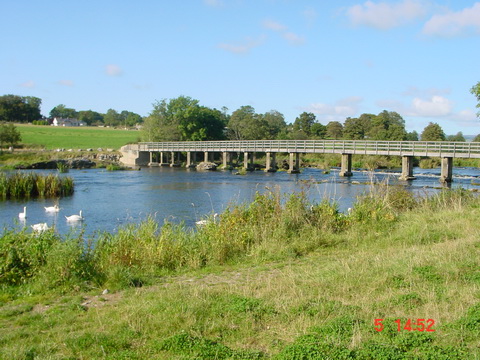
The footbridge in Castleconnell at normal summer level in 2002
The footbridge in Castleconnell at normal summer level in 2002

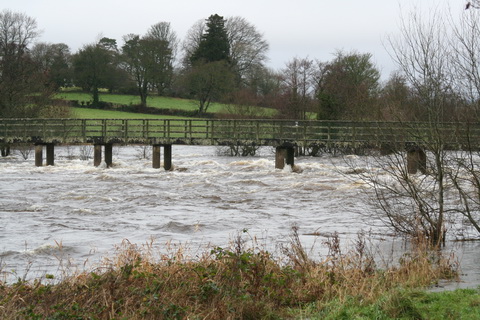
The footbridge on 1 January 2014

The footbridge on 1 January 2014

Before Ardnacrusha was built, the old channel took the entire flow of the Shannon, so it can take more than it has now.
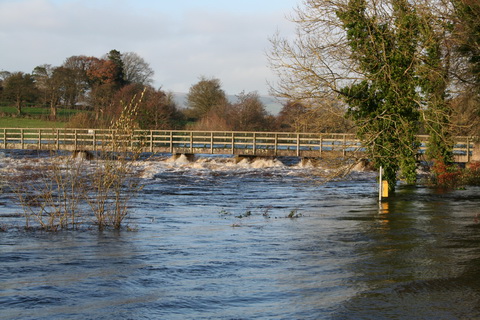
The footbridge in the floods of November 2009

The footbridge in the floods of November 2009

The level is still below that of 2009, when the land around the old channel flooded in several places. But much land is waterlogged: I saw yesterday that the upper reaches of the Nore, the Barrow and other rivers were in flood. And more rain is forecast.

Wouldn’t it be nice if some of that could be sent to Dublin instead? I see that some folk claim (on what looks like a website that hasn’t been updated for a while) that the evil Dublin folk want to extract 350 million litres of water from the Shannon every day; the original idea was to take it from Lough Ree but now it seems that Lough Derg is the preferred source.

Now 350 million litres sounds like a lot, but it’s 350 000 cubic metres per day, 14 583.3 per hour, 243.05 per minute, 4.05 per second, which is less than 1% of normal flow through the two channels draining Lough Derg. There’s a lot more at the moment, and the good citizens of Dublin are welcome to come down and fill their buckets. I suspect that Clare TD Michael McNamara has got things out of proportion.

Addendum: 350 million litres per day, over a lake whose area is 130 square kilometres, would lower the level of the lake (if my calculations are correct) by 2.69 millimetres. If no water entered the lake, the level would be down 983 mm after a year, ignoring evaporation and other abstractions and assuming that the Shannon and other tributaries no longer flowed in and that there was no rain.