
The [non-]Royal Lough Ree Yacht Club

Devoted as this site is to the memory of Her late Majesty Victoria, of the United Kingdom of Great Britain and Ireland Queen, Defender of the Faith, Empress of India, we are always gratified to find evidence of Loyalty to Crown and Empire. Along the Shannon, we are never surprised to find such evidence around Lough Derg (at least in North Tipperary), but we had not realised how well-affected the good people of Lough Ree were towards Royalty, even after the foundation of the Irish Free State and its succession by the state of Ireland.

On 28 October 1947 the Lough Ree Yacht Club wrote to Her Majesty’s Under Secretary of State at the Home Office in London SW1:

Sir

I have been looking over some old papers belonging to this Club.

There was some discussion among members about trying to get it raised to the status of “Royal”.

I should be greatly obliged if you would let me know what would have to be undertaken and what cost would be involved. Also would a club in this country be eligible.

This Club which was founded prior to 1836 is the second oldest in Ireland.

A Home Office Minute of 6 November 1947 said:

The whole of Lough Ree is in Eire and it would seem desirable in the first place to refer the letter to the Commonwealth Relations Office on the question of procedure.

In this country freshwater Yacht Clubs are not now granted the title Royal.

Send a copy semi-officially to the Commonwealth Relations Office for observations regarding procedure.

That was done on 13 November 1947. The covering letter said (amongst other things):

There has been no grant of the Royal Title to a fresh water sailing club in England since 1887 when the practice relating to the grant of the Title Royal was not stabilised.

I wonder whether you could let us have particulars about this club; its membership, reputation, and the number of yachts it owns with their tonnage. We should also welcome any suggestions relating to procedure on the assumption that the application will be pursued.

The Commonwealth Relations Office replied to the Home Office on 6 December 1947 with these (amongst other) paragraphs:

I enclose a copy of a note, prepared in July last year, on the general principles covering the grant of the title “Royal” in the various Commonwealth countries.

You will no doubt appreciate that in the case of Eire, difficulty would arise in the application of these principles. It would appear, however, from paragraph III of the enclosed note that consideration would only be given to applications from institutions similar to the Club in question if exceptional circumstances exist.

We feel that in this particular case no indication should be given in any reply which you may make to the Club of the likelihood or otherwise of any application meeting with success, and that they should only be informed that, being in Eire, the matter should be raised through the appropriate authorities in Eire.

On 17 December 1947 the Home Office wrote to the Club saying:

With reference to your letter of the 28th October last regarding the procedure and the cost involved in making an application for the grant of the title Royal to the Lough Ree Yacht Club, I am directed by the Secretary of State to say that as the Club is in Eire, the matter should be raised through the appropriate authorities in Eire.

Ireland at the time had a Fianna Fáil government, led by George de Valero Éamon de Valera, who was not known for being well-affected towards Crown and Empire.

On 29 April 1948 the Club responded to the Home Office:

Sir

Referring to your letter of 17th December 1947.

We have been in communication with the Irish Government + I enclose their reply, from which I understand that they will not interfere either for or against. I sent their letter to the UK Representative + enclose his letter also.

As the Irish Government has not refused permission for the Club to be raised to the status of Royal would His Majesty therefore be gracious enough to confer on the Club the Title of Royal.

On 10 May 1948 the Home Office replied:

With reference to your letter of the 29th April as to the application for the grant of the title Royal to the Lough Ree Yacht Club, I am directed by the Secretary of State to say that as the Club is situated in Eire, the Secretary of State for the Home Department has no jurisdiction in the matter, and can add nothing to the letter addressed to you on the 21st April, by the United Kingdom representative to Eire.

The enclosures to your letter are returned herewith.

The return of the enclosures has deprived us of the opportunity to see exactly what the Irish government and the UK representative said to the Club.

By then, the Irish general election of 4 February 1948 had returned the First Inter-Party government, led by John A Costello and with Seán MacBride, leader of Clann na Poblachta, as Minister for External Affairs. The Republic of Ireland Act was signed into law on 21 December 1948, depriving the King of Ireland of his last functions in the former Free State — and depriving the Lough Ree Yacht Club of its last chance to acquire the Title Royal.

It would be interesting to know what Seán MacBride, who had been boating on Lough Ree since the 1930s, thought of the Club’s application.

The story is not included in the brief history on the Club’s website or in the more extensive history included in the booklet produced for the LRYC/Waterways Ireland Classic Boats Regatta in 2007, but I have not seen Lough Ree Yacht Club: a memoir, published in 1970.


Shannon passage times 1838

Estuary

Kilrush to Limerick 4 hours

Tarbert to Limerick 3 hours

Clare[castle] to Limerick 3.5 hours

Limerick Navigation

Limerick to Killaloe:

  • iron passenger boat 2.5 hours
  • timber passenger boat 3.5 hours
  • trade boat 6 hours.

Shannon

Killaloe to Portumna:

  • passenger steamer 6 hours
  • steamer towing lumber boats 8 hours.

Portumna to Shannon Harbour:

  • 6 hours.

Shannon Harbour to Athlone:

  • 8 hours.

Source: Railway Commissioners second report Appendix B No 6.

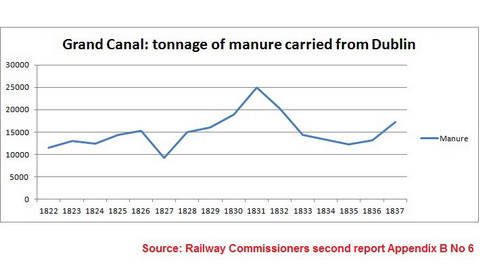
Keeping Dublin tidy

Fertilising the countryside

Fertilising the countryside

Erie warning: stuck with a sheugh

New York is a place in the Americas. There is a town of that name and there is also a state, whose economic development in the nineteenth century was assisted by the development of a canal, about which you can learn more on this excellent site. There is a trail along the canal that can be walked or cycled.

The canal is run by the New York State Canal Corporation, which is a subsidiary of the New York State Thruway Authority [a thruway is, it seems, a sort of road]. The canal loses money (naturally). The Thruway Authority sought to increase tolls; the State Controller said it should save money and improve management instead. Inter alia, it should

Commission an independent analysis of the Canal System to examine ways to streamline operations, seek new funding streams, and develop a realistically attainable vision for its future role in the upstate economy.

In his full report [Assessment of the Thruway Authority’s  Finances and Proposed Toll Increase [PDF] Office of the New York State Controller August 2012], the Controller said that

[…] the New York State Constitution forbids the Legislature to sell, abandon or otherwise dispose of the canals […]

but that

[…] choices regarding operational control and financial support for the Canal System are policy matters to be determined by the Governor and the Legislature.

His summary said that

Additional factors in the Thruway Authority‟s current weakened condition include the Authority‟s responsibility for financing and operating the State‟s Canal System as a result of legislation enacted two decades ago. The Canal System has consumed more than $1.1 billion of Thruway resources in the ensuing period. Contrary to the original legislative intent, responsibility for supporting the canals has diminished the Authority‟s ability to pursue its core mission. Moving the Canal System into the Thruway Authority was intended, in part, to stimulate tourism and economic development along the historic
canal corridors. This goal, too, has been elusive; boating activity on the canal has  declined substantially under Thruway control.

Later in the report he said

Second, the Authority‟s financial resources and organizational expertise, along with the then-newly created Canal Recreationway Commission, would position the underused Canal System to improve its facilities and marketing such that new users would be attracted from around the country, and even around the world.

Neither of these hoped-for outcomes has occurred. The Thruway Authority has invested more than $1.1 billion in the Canal System, and this drain of toll resources has also contributed to the deterioration of the Authority’s financial condition over the past decade. Meanwhile, despite major investments and new amenities, pleasure-craft activity on the Canal System in recent years is down by nearly one-third since the period immediately before the Thruway Authority assumed control.

The local media seem to take a somewhat more informed interest in their sheugh than do those in these parts:

Ireland and the United Kingdon could avoid finding themselves in these difficulties by refusing to recreate any more sheughs.


A wet winter?

Today’s Irish Times reports on yesterday’s launch of a report called Ireland’s climate: the road ahead [92.9 Mb 103 page PDF here]. The report predicts:

  • Daytime summer temperatures to rise by up to 2°C
  • Lowest winter night-time temperatures to rise by 2-3°C
  • Milder winters to reduce cold-related mortality rates
  • Wetter winters and drier summers
  • Increase in frequency of heavy precipitation event.

Chapter 10 “Climate change and catchment hydrology” covers river flows.

Met Éireann’s report on summer 2013 [2 page PDF] is available here; rainfall was down [on the 1981–2010 average] at all stations except Valentia; temperature was up everywhere and so was sunshine. So perhaps we’ll have a wet winter to look forward to.

Who saved Clonmacnoise?

It seems possible that, at some stage in the late eighteenth century, there was a plan that would probably have destroyed Clonmacnoise.

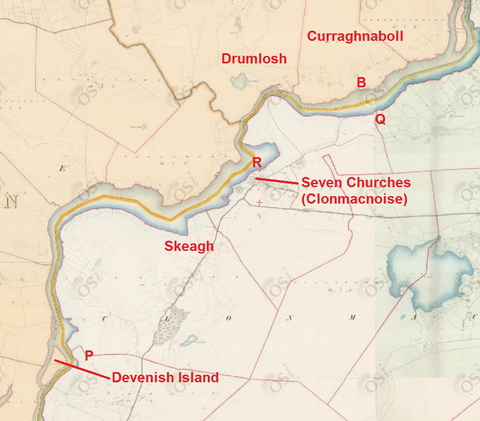
There exists A Map of the River Shannon from Athlone to Killaloe, Surveyed by John Killaly 1795, which contains much of interest. I do not have permission to reproduce it here, but here is the section around Clonmacnoise from the ~1840 OSI 6″ map.

Clonmacnoise OSI ~1840

Clonmacnoise OSI ~1840

I have marked on the map some of the placenames used by Killaly.

The legend reads:

[…]

B. Ford least water 4F 6J [which I take to mean 4′ 6″]

[…]

From Q to P the proposed Canal is ¾ Mile shorter than the River.

From Q to R [the proposed Canal] is ¾ Mile shorter than the River.

It seems therefore that, in 1795, someone was considering shortening the Shannon by digging one of two possible canals to cut off peninsulas along the east bank. Given the narrowness of the stretch between the esker and the river, I suspect it would have been impossible to dig either of them without destroying Clonmacnoise.

I would like to know more about the proposal and about why it was abandoned.

Incidentally, some folk prefer the spelling Clonmacnois but the Placenames Database of Ireland uses Clonmacnoise.

My OSI logo and permit number for website

Chambers, pots

Folk knowledgeable about canal engineering and artefacts might be able to contribute to a current discussion, over at the Helpful Engineer’s website, of the Four Pots overflow and the side chambers at Lock 16 (Digby Bridge) on the Grand Canal.

Water levels

Waterways Ireland is warning of low water levels on Lough Ree. You can see here how the level at Athlone Weir has changed over the past 35 days.

Landing pills

They had two of them on the Slaney.

Naas

An account of the official opening of the Naas Branch (County of Kildare Canal) in 1788.