Tag Archives: Barrow

Politician asks sensible question shock

The invaluable KildareStreet.com tells us of this written Dáil question and answer on 4 February 2015:

Martin Heydon [FG, Kildare South]: To ask the Minister for Arts, Heritage and the Gaeltacht if her attention has been drawn to concerns regarding the lack of dredging on the lateral canals of the River Barrow and overgrown vegetation which is making navigation difficult; her plans to improve this situation; and if she will make a statement on the matter.
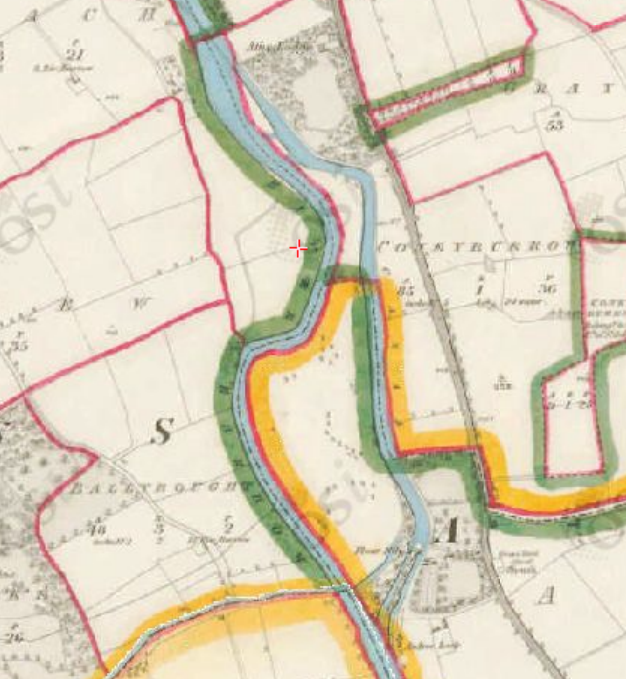
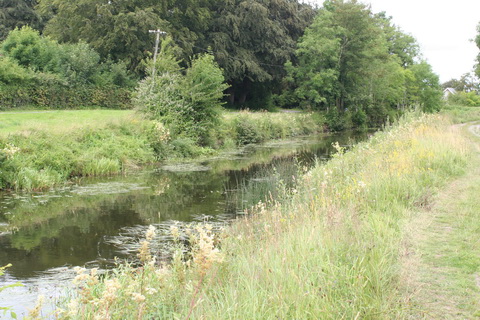
The lateral canal at Ardree on the Barrow

The lateral canal at Ardree on the Barrow [OSI ~1840]

Heather Humphreys [FG, Clones Sheugh]: I am advised by Waterways Ireland that, as the Barrow Navigation is wholly situated within the River Barrow and River Nore Special Area of Conservation (SAC), due regard must be given to the provisions of the EC (Birds and Natural Habitats) Regulations 2011. These require a rigorous assessment to be carried out to assess the impacts of any work on the protected species and habitats, prior to any works being undertaken.

If the impacts cannot be screened out and a Stage II assessment is required, a full planning application must be made. In addition, the Fisheries Consolidation Act 1959 (as amended) prohibits any in-stream works, such as dredging, during the spawning season from October to June.

I am informed by Waterways Ireland that dredging on the lateral canals of the Barrow Navigation was historically done during the winter months but that this is not now possible. However, Waterways Ireland is working with Inland Fisheries Ireland to formulate procedures which would allow work to be carried out in accordance with the relevant legislation. In addition, Waterways Ireland is continuing to work with all relevant agencies to ensure that as much work as possible is carried out on the Barrow within the time constraints which exist.

I have been assured by Waterways Ireland that it remains fully committed to the development of the Barrow Navigation in line with its statutory remit.

This question produced useful information, whereas some TDs seem to ask questions only as a way of assuring their constituents of their undying love and devotion. See, for instance, Brendan Smith, who has asked the same question at least three times.

Note that the short dredging season presumably applies to other rivers that are within SACs, such as the River Shannon at Plassey.

My OSI logo and permit number for website

Boat Trade on the Barrow

BOAT TRADE

Dublin to and from Waterford
CALLING AT ROSS AND GRAIGUE

The Public are respectfully informed that the Boats of the BARROW NAVIGATION COMPANY call regularly each week to and from the above-mentioned Towns, say on the Mornings of MONDAY and THURSDAY, at Three o’Clock, making TWO deliveries weekly at each end.

The Company having selected Men of the besst characters as Masters of their Boats, they engage the safe delivery of all Goods forwarded, and hope by moderate charges and dispatch to give satisfaction.

GOODS FOR ENGLAND AND SCOTLAND to be forwarded by these Boats, should be directed to the Agents of the Company.

Goods can be forwarded by careful carriers to the following towns, viz:

FROM FROM FROM Waterford
Graigue To
To Ross Carrick-on-Suir
Borris Clonmel
Innistiogue To Dungarvan
Thomastown Dunmore
Enniscorthy Ballyhack
Wexford Tramore

For further particulars, apply to the Company’s Agents

Mr JOHN KELLY, Grand Canal Harbour, Dublin

Mr JOHN M’DONNELL, Custom-House Quay and Lower Thomas-street, Waterford

Mr M W CARR, New Ross

Mr M RYAN, Graigue

Or to the Secretary of the Company, P D LaTOUCHE, Esq, Castle-street, Dublin

Waterford Chronicle 4 November 1854

Tourism and beer

According to Padraig Cribben of the Drinks Industry Group of Ireland [which seems to include the brewers of the beers we don’t drink],

[…] the latest figures I have seen show that 35% of foreign tourists do not move outside Dublin. That creates a massive challenge. That challenge is being addressed, initially through the Wild Atlantic Way, but even if one looks at the figures for that, my understanding is that while it was very successful last year, two thirds of all visitors to the Wild Atlantic Way were domestic visitors. There is still a great deal of scope there and it will pay more dividends over time.

There is an initiative due to happen in 2015 which is being broadly termed “south and east” and involves a trail from the Boyne Valley through to the heritage centres in the south east. In 2016 or thereabouts, a whole waterways section will relate to the Shannon and the canals to increase the dispersal.

Jolly good, but why is the drinks industry announcing this? Whose initiatives are these? Who else is involved? More info and links welcome, please.

By the way, Mr Cribben also said

The other point to make is that the Irish pub is unique. It is not just unique here, it has been replicated around the world.

I’m still trying to work out what “unique” means there.

Folk seeking interesting Irish beer should start with the Beoir directories.

Taking the pills

St John’s and other pills are discussed on this page, where I said

The term is associated with south-western England and Wales but it is also found in south-eastern Ireland.

Reading Hugh Conway-Jones’s excellent Working Life on Severn & Canal: reminiscences of working boatmen (Alan Sutton, 1990), I noted this:

By the time you got to Avonmouth, the tide was more than half-ebbed out and the dock gates were closed. So the tug took you round into the Old Entrance (what we called the Old Way), and you tied up there alongside the pier. As the tide ebbed, the barges lay on the bottom and then you could get your head down for a nice sleep while the tug went off to Portishead to anchor in the pill there.

I’m not sure whether this Pill is the one the boatman had in mind: although the two places, Portishead and Pill, are often mentioned together, it seems a bit far away to be regarded as Portishead’s pill. Further information welcome — and sightings of any other pills from either side of the Severn.

Incidentally, the sort of traffic and conditions Conway-Jones wrote about seem to be similar to those on the Barrow and Suir estuaries (allowing for their smaller scale).


The River Shannon and its Shrines

One of the Shannon books that are listed on the IWAI website but that I’d never seen is J B Cullen’s The River Shannon and its Shrines, which the IWAI list says is

Dublin. C.T.S. of Ireland. 1909. p.p.107. Green boards. Prof. illus.

IWAI also lists J E McKenna Lough Erne and its Shrines published by the Catholic Truth Society of Ireland in 1909, and it provides a link to a downloadable copy of what is a short work of 32 pages.

How many pages?

In 2004 that learnéd bibliophile Michael Slevin also provided a list of books being sold by Healy Rare Books, which included

J.B. Cullen. The River Shannon and its Shrines. Dublin. Browne & Nolan. n.d. Disbound. p.p.28. Illustrated.

I mention this because I have recently acquired a copy matching that description (though, I suspect, not at Healy prices). The number of pages is indeed 28 rather than the 107 mentioned on the IWAI listing. So were there two books with the same title by J B Cullen? My copy concludes with the words

At Killaloe may end the notice of the Upper Shannon and its Shrines.

That is followed by

[The Story of Saint Senanus, which is to follow, will introduce the remaining Sanctuaries of the hallowed and majestic River.]

It seems possible, therefore, that Cullen wrote more than one piece on the Shannon; perhaps they were originally published in the Catholic Truth Society magazine and then assembled to provide a 107-page book. The National Library suggests that there may have been four pieces.

I would be glad to hear from anyone who knows more about this — and to get copies of any other sections that may exist.

Athlone

Here is an extract from Cullen about Athlone.

To-day Athlone presents a picture of greater interest than many of our Irish cities or towns. Its normal population is some ten thousand inhabitants, but its importance as a military station often swells this aggregate. This latter circumstance gives a very distinct feature to Athlone. The town is generally bright and gay with the parade of military, and joyous with the strains of martial music, while ever and anon the practice of artillery keeps the echoes of the Shannon busy recalling — in our peaceful days — the stirring memories of the warring past.

The book was published in 1909: the army is that of His late Majesty King Edward VII.

Shannon -v- Erne

McKenna’s Erne book has a practical tone: it mentions the “finely-equipped paddle-steamer Lady of the Lake” but says

We prefer a modest little steam launch for the purpose of our present excursion.

Assuming we have a few quid to spare, of course. But Cullen says nothing about how the traveller is to get around. He has clearly been on the water (he visited several islands — and even Lough Forbes, which is not easy to see by road) but also travelled by land to Kilronan, Edgeworthstown and Roscommon. It would be interesting to know how and when he made his journeys.

Despite its title, his book[let?] displays an interest in military as well as in religious sites and history, but there is nothing about contemporary waterways usage or traffic.

J B Cullen

From searching tinterweb, I conclude that John Bernard Cullen may have attended Mungret College in Limerick [PDF; mostly irrelevant] and had a brother called James who was a Jesuit, co-founded the Rosbercon Choir, lived at Bawnjames House near New Ross, was a founding committee member of the Catholic Truth Society of Ireland, contributed to the Parnell National Tribute and wrote lots of light historical articles. In 1886 two of his daughters, aged 3 and 13, drowned in an ornamental pond in his gardens.

I would welcome more information.

As far as I can tell he was dead before 1933 and his work is therefore out of copyright; accordingly I provide a PDF [5.3 MB] below.

The River Shannon and its Shrines

A puzzle in waterways history

According to the Lagan Canal Trust,

The Lagan Navigation also forms part of a wider all Ireland waterway network. This network of waterways once traversed through the towns and cities of Ireland delivering goods and produce, helping to shape the economic fortunes of the country.

I would be grateful for information about any goods or produce that were ever carried from the Shannon, or from the Royal or Grand Canals or the River Barrow via the Shannon, through the Junction Canal in the Ballinamore & Ballyconnell Drainage District [later called the Ballinamore & Ballyconnell Canal and later still the Shannon–Erne Waterway] and then the Ulster Canal to Lough Neagh or any of the waterways connected therewith. Or, of course, in the opposite direction.

As far as I can tell, outside the sales blurbs written by engineers seeking employment and waterway owners seeking subsidies, there was never a connected all-Ireland waterways network; nor was there ever any need or demand for such a thing.

Any more than there is now.


Luddite loons

I have commented from time to time on the reluctance of some Irish folk to move beyond the technologies of the eighteenth century. Thus we find Shinners wanting canals all over the place and folk in Leitrim determined that, if Ireland has oil and gas, they must never be used. [That’s the Leitrim that had both a coal and an iron industry, by the way, as well as hydroelectricity, railways, a brickworks and a dockyard, to name but a few industries that come to mind.]

The latest target of the ire of the Luddites is that newfangled invention, the bicycle. Waterways Ireland might like to provide for folk to cycle along the trackway on the Barrow Navigation; some folk want to keep the dreaded bicycle, and presumably its Lycra-clad users, away from the trackway along which they like to walk.

Happily, some sane folk have written letters to the blatts and IndustrialHeritageIreland has a sensible comment.

I presume that the Luddites insist that the grass be cut using scythes, thus creating much local employment.

Saving canals

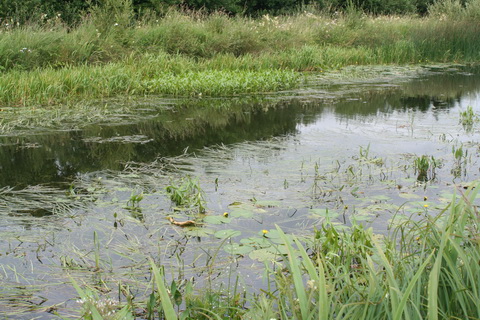
Barrow Line 20140721 03_resize

Barrow Line 1

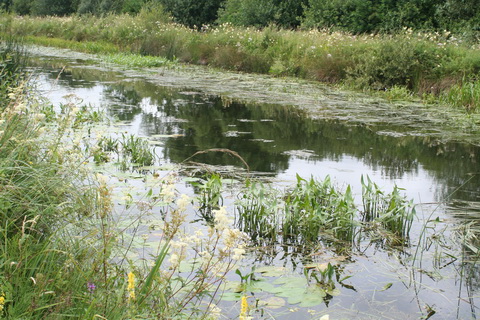
Barrow Line 20140721 06_resize

Barrow Line 2

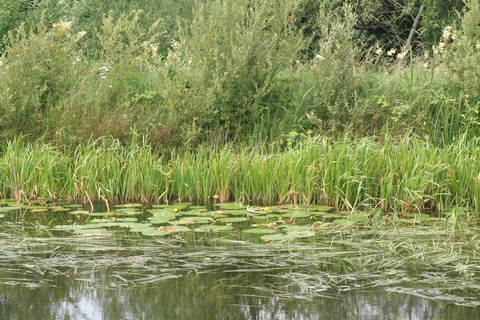
Barrow Line 20140721 08_resize

Barrow Line 3

Barrow Line 20140721 09_resize

Barrow Line 4

When I get a moment, I must find out how many boats have been down that way in this warm, sunny July, the peak of the holiday season. The warmth will have encouraged the vegetation, but I suspect relatively few boats have been through. And only two boats entered the Royal through Dublin in July, even though two openings were offered.

Apart from giving artistic verisimilitude to an otherwise bald and unconvincing narrative about the value of the canal tourist industry and the abiding love of boaters for the canal, using canals helps to keep the weed down.


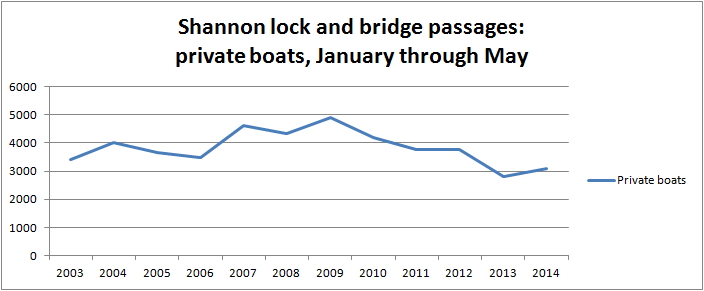
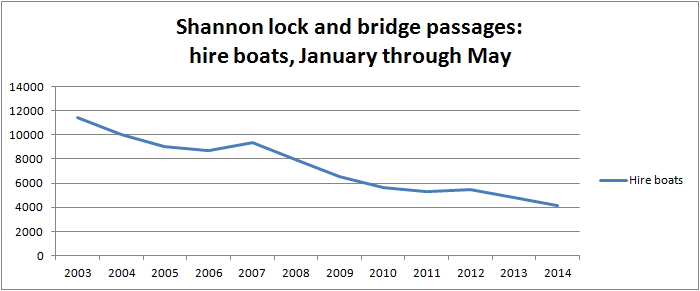
Shannon traffic to May 2014

I am grateful to Waterways Ireland for letting me have copies of the recorded numbers of boat passages through Shannon locks and Portumna Bridge for the first five months of 2014. All the usual caveats apply:

  • the underlying figures do not record total waterways usage (even for the Shannon) as, for instance, sailing, fishing or waterskiing on lakes or river stretches, which did not involve a passage through a lock or Portumna Bridge, would not be recorded
  • the passage records would not show, for instance, a change in the balance of types of activities from those in larger cruising boats to those in smaller (sailing, fishing, waterskiing) boats
  • figures like these, for a small number of months, will not necessarily be representative of those for the year as a whole. The winter months, January to March, see little traffic in any year; for April and May, the weather can have a large influence on the amount of activity especially, I suspect, in private boats.

On the other hand, the figures do include the Shannon’s most significant tourism activity, the cruiser hire business. And they are our only consistent long-term indicator of usage of the inland waterways.

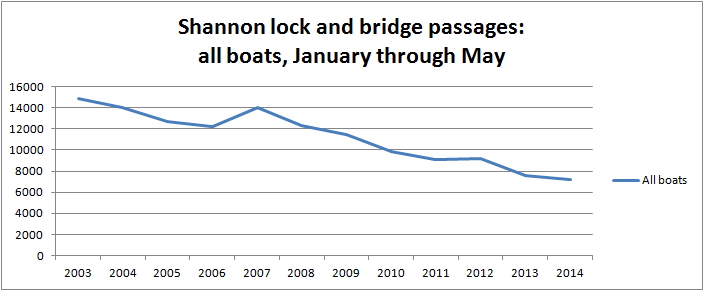
Shannon passages May 2014 01


The total amount of traffic continues to decline.

Shannon passages May 2014 02

Private-boat traffic is still below its average for the period but increased slightly on the same period of the previous year [but see the third caveat above].

Shannon passages May 2014 03


Hire-boat traffic is just over one third of its 2003 level.

Shannon passages May 2014 04


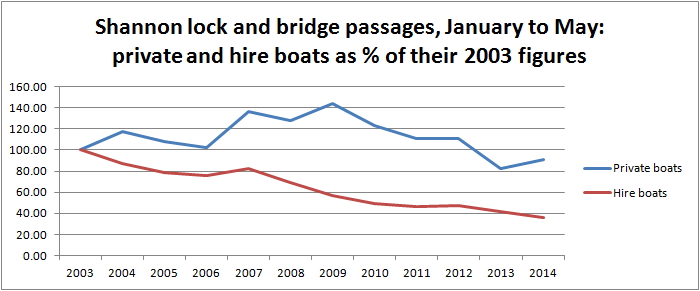
Since 2003, both private and hired traffic have fallen, from the highest figures attained within the period, by about 60% of the 2003 figure. But private traffic first rose by 40% of the 2003 figure, so it is now only about 20% below that figure. Hire traffic has fallen pretty consistently since 2003.

Shannon passages May 2014 05


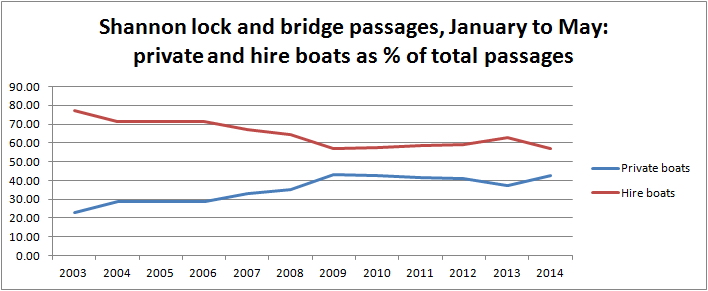
Hire traffic is usually greater than private traffic between April and October (roughly speaking), but the gap is closing.

Carál Ní Chuilín, NI’s [SF] waterways minister, said the other day:

Waterways Ireland delivered a presentation to Ministers entitled ‘Ireland’s Inland Waterways — Building a Tourism Destination’. The presentation provided an overview of the progress that Waterways Ireland is making in placing waterways and the waterway experience at the centre of the tourism offering in Ireland and internationally.

And a good thing too, but the waterways need new water-based tourism products to complement, and perhaps to replace some of, the hire-boat cruising business. Opening new waterways — Royal Canal, Longford Branch, Ulster Canal, Kilbeggan Branch or anything else — is a waste of money until demand, domestic and visitor, private and hired, exceeds existing capacity.


Bernard Durkan TD

I have sent this email to Bernard Durkan, a Fine Gael TD for Kildare North:

Greetings.

It is reported that, in the Dáil on 6 March 2014, you said:

“The canal restoration that has taken place over the past 50 years was largely done through voluntary effort. While Waterways Ireland has an involvement in upgrading the canals, and it has a responsibility that we all respect, cognisance should be taken of the huge voluntary effort in the restoration of the canals.”

I would be grateful if you could tell me the evidence for your assertion. How did you measure restoration and the respective contributions of volunteers and of Waterways Ireland and its predecessor bodies?

Best wishes
bjg

I may confess that I think he’s talking through his hat, but I will read his evidence with interest.