Tag Archives: canal

Waterman, spare that tree!

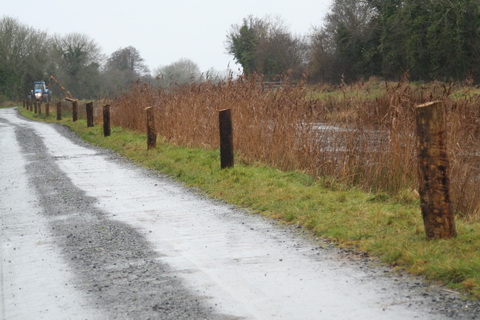
I and others have commented on WI’s cutting of trees along the banks of the Grand Canal. One aspect that didn’t strike me until today is that, if you didn’t remove waterside trees, you wouldn’t be able to insert new mooring posts.

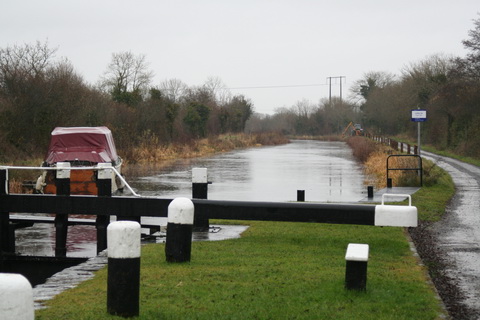
Above Lock 34

Above Lock 34

Looking back up from the lock

Looking back up from the lock


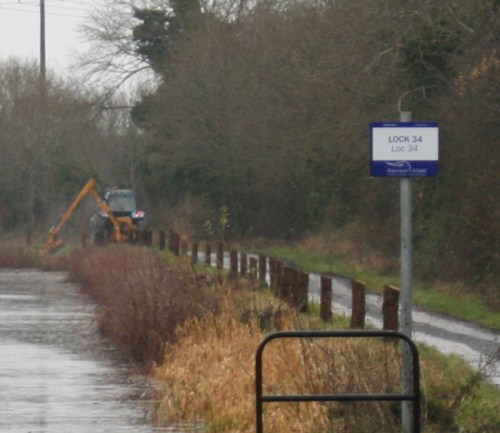
Close-up of reed-cutting tractor

Close-up of reed-cutting tractor


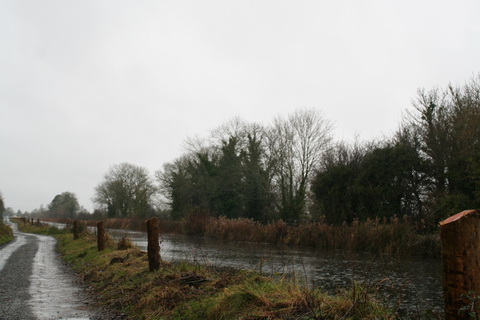
Below Lock 34

Below Lock 34

Compared with the old black and white bollards, the new lack a certain je ne sais quoi, but I suppose they could be painted if people paid up.

Southron sheughs

For reasons now lost in the mists of time, I forgot to draw the attention of Learned Readers to an exchange in the Dáil on 18 April 2012, which was reported on the invaluable KildareStreet website as well as on the Oireachtas site. Jack Wall, a Labour TD for Kildare South, asked this question:

Question 702: To ask the Minister for Arts, Heritage and the Gaeltacht the position regarding the canal system under Waterways Ireland; the plans the agency has for the development of the canals; the number of lock keepers in the system; if there are any vacancies; if so, when same will be filled and the mechanism that will be adopted to do so; if the agency has any plans to refurbish existing systems that are not in use at present; if the agency has any plans to increase the number of berthings on the canals and if so, in which areas; if the traffic on the canals has shown a percentage increase over each year for the past three years; and if he will make a statement on the matter. [18431/12]

Now, that’s a bit of a portmanteau question. I wonder whether Jack Wall was prompted to ask about lock keepers but not quite well enough briefed to ask follow-up questions. The minister, Jimmy Deenihan, gave a four-paragraph answer, and I’m going to break it up so that I can discuss each element individually.

Waffle

The minister’s first paragraph was background music:

Since its formation in 1999, Waterways Ireland has continued to upgrade the facilities on the canals through the capital allocations under the National Development Plans. The canals system has benefited extremely well during that time, particularly with the number of additional mooring and landing spaces that have been made available. The provision of further mooring space will be dependent on available finance and priorities over the coming years.

I’m going to move the third paragraph up and deal with it next.

Lockkeepers

The minister said:

I am informed by Waterways Ireland that there are 20 lock keepers employed at present on the Grand Canal and Barrow Navigation. A number of staff have retired recently and decisions on their replacement will be taken having regard to the business needs of the organisation. I understand that Waterways Ireland is not planning to recruit lock keepers at this time. Any posts filled will be either by internal transfer or external recruitment, depending on the particular circumstances.

Although the minister mentions the Royal Canal elsewhere in his answer, and the question certainly does not exclude the Royal, the minister doesn’t mention it in this paragraph. In fact, there are several things the minister doesn’t mention:

  • that there are no lockkeepers on the Royal
  • that agency staff have been employed
  • that, far from considering recruiting replacement lockkeepers, Waterways Ireland might be considering reducing their numbers, or at least assigning some of them to other duties, perhaps on the Royal.

Now, I’m not saying that any of those actualities or possibilities is necessarily a bad thing. In fact, given the virtual absence of lockkeepers on the Canal & River Trust’s English and Welsh canals, it’s hard to see why the Irish canals, with much lower traffic, need so many.

But my point here is that a TD, and especially a Labour Party TD (haven’t they something to do with supporting workers?), might be presumed to be interested in the aspects that the minister did not mention. The minister’s answer was true but incomplete.

For the 2011 election Fine Gael published a document called Reinventing Government, with section headings on “More Open and Transparent Policy-Making Processes” and “New Systems of Openness and Transparency”. Where are they?

Stop digging

Here is the minister’s second paragraph:

My Department’s 2012 capital allocation for Waterways Ireland is €4.5m. This will facilitate continued investment in the development and restoration of the inland waterways. The main thrust of the refurbishment of the waterways over the next few years will be focused on the re-opening of the Ulster Canal from Upper Lough Erne to Clones. However, Waterways Ireland is also undertaking feasibility studies on the Kilbeggan Branch of the Grand Canal and on the Longford Branch of the Royal Canal. These are due to be completed by the end of 2013.

AAAARRRGGGH!

They’re thinking of digging even more sheughs!

Look. I know that engineers love to have excuses (and money) to do engineering: all that kit, wellies and hard hats, muck-shifting and the satisfying feeling that you are bringing joy (and tourists) to a small town. But it’s a waste of time and money. And there is absolutely no point in doing feasibility studies: what you want are cost-benefit analyses. Pretty well every single canal ever built with public funding in Ireland has been a waste of money and there is no reason to believe that relining the canals to Longford and Kilbeggan will be any better. I mean, look at the Naas Branch: very scenic, but hardly anyone ever goes there other than in convoy.

What you want to do is to explain, politely, to the TDs of Longford and Kilbeggan that they can have canals only if they will agree to having all other public services (including the drinking-water supply) cut off. But of course both Kilbeggan and Longford already have ways of attracting tourists. Kilbeggan has a distillery while Longford has an absence of signposts, especially to Athlone, thus causing motorists to drive around in ever-decreasing circles until they imitate the oozlum bird.

I mean, the canal age is over; this is the age of the camper van.

Traffic

Here is the minister’s final paragraph.

I am informed that boat traffic numbers on the Grand Canal and Barrow Navigation have remained fairly constant over 2009 and 2010. In 2011 the numbers increased by 30% following the re-opening of the Royal Canal and the fact that access was available to the Tall Ships event in Waterford.

Now this is really interesting, for three reasons:

  • first, Waterways Ireland keeps telling me that it cannot produce any usage figures for the canals and the Barrow. So on what traffic numbers are the minister’s statements based?
  • second, note that the basis of comparison between the earlier years (2009 and 2010) and the later (2011) is not clear. The Royal was not officially open during the earlier years, although there was some traffic. Was it counted? And does the 2011 figure that shows the 30% increase include Royal figures (in which case it would be an invalid comparison) or not (in which case the few boats doing the complete triangular route caused a huge increase in traffic)?
  • third, note that the minister does not give any actual usage figures. Could it be that they are very small?

What the canals and the Barrow need is action to increase the amount of traffic, especially in summer (when few people travel because of weed and sometimes water shortages) and winter (when few travel because it’s miserable). Adding extensions only spreads the existing traffic more thinly over a larger number of destinations. When you get to the stage of having traffic jams at locks, you can begin to think about extra destinations. Until then, put the shovels away.

Budget

Vast wodges of bumpf from the government’s budget site, with non-searchable PDFs, god rot ’em. An initial look suggests these points:

  • the Dept of Arts, Heritage and the Gaeltacht’s total allocation to northsouthery, which includes waterways, will be down 6% next year
  • current spending on northsouthery will be down from €38 244 000 to €36 178 000. Waterways Ireland gets the biggest wodge of that, about 60% [see my comment last year] in 2011; I guess that the cuts will be shared pro rata, but I can’t be sure
  • WI’s capital expenditure allocation will be reduced from €4 500 000 to €4 071 000, which may go towards shovels for thon sheugh
  • decisions on northsouthery have to be agreed by the NSMC [Irish government and NI executive].

More as I plough the pile, but the summary (to nobody’s surprise) is less spending on waterways. Maybe Éanna should have pushed ….

WI has won an award

WI has won the Public Sector Award from the [Dublin] Docklands Business Forum. The award is for

[…] its active contribution to the Docklands Summer Festival, the South Docks Festival, Tall Ships Festival and Docklands community life throughout 2012.

With docklands moorings becoming available, WI may have a chance of retaining its award next year.

Incidentally, we learned earlier this week about music at the Box in the Docks; the Public Sector Award press release has more information about the Box:

Waterways Ireland owns and manages a multipurpose centre in the Basin which is used as a Visitor Centre during the summer season and provided a linchpin for the festival and events as well as community activity such as the Waterways Ireland Community Choir.

And we hear a rumour that models are being built ….

By the way, WI is compiling its events guide for next year: get your event in to them by 25 January 2013.

Christmas caption competition

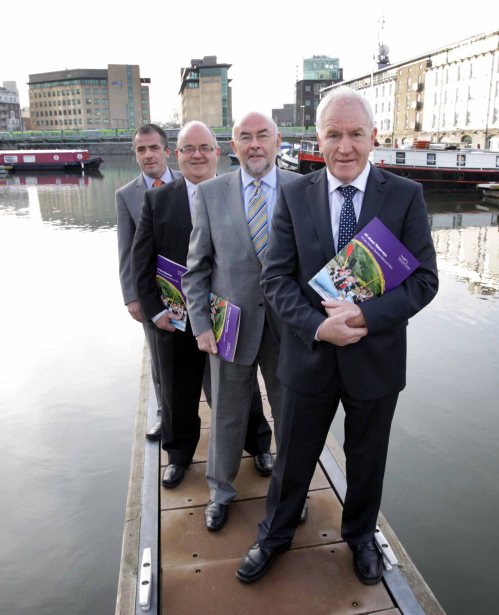
The usual prize of a glass of something or other [and I know the last two prizewinners still have a claim on me] for the best non-libellous caption for this photo, taken today at the launch of WI’s education programme for primary school children. I understand that the materials on WI’s e-learning page are complemented by “an off-line teachers resource pack”, which is what the besuited ones are clutching.

No lifejackets. Photo courtesy of Waterways Ireland, who are not to blame for my decision to use it for a caption competition

Starting at the back, the four chaps are Éanna Rowe, Waterways Ireland’s Marketing Honcho; John Martin, Heid Fector o’ Waterwyes Airlin [as we say in Ulster Scots]*; Ruairi Quinn, Minister for Education and Skills; Jimmy Deenihan, Minister for Arts, Heritage and the Gaeltacht but, on the other hand, a strong personal supporter of the Lartigue Monorail, which is a point in his favour.

Update 4 December 2012: the press release is now on the WI site.

* In its 2008 Annual Report, Waterways Ireland was, in Ulster Scots, Watterweys Airlann on the cover but Watterwyes Irelan in the Foreward bae the Cheif [sic] Executive, who signed himself as Chief [sic] Executive. By 2009, though it was still Watterweys Airlann on the cover, it was Waterwyes Airlan in the Foreward bae the Chief [sic] Executive, who signed himself as Heid Fector, a title I rather like. By 2010, though the cover remained unchanged as Watterweys Airlann, the body was Watterwyes Airlan in the Foreward, but the Heid Fector title had been dropped, alas, and John Martin was Chief Executive in two languages.

But 2008 was not the Heid Fector’s first appearance: in 2007 John Martin signed himself thus, though the foreword was called Twarthy words bae tha heid yin and the body was referred to in the text as Wattherweys [sic] Irelan.

Back in 2006, the foreword was Innin wi tha Heid Fector, and the body was Watterweys Airlann, with an accent, which I can’t reproduce, over the first e. That was the same as in 2005; in both years John Martin signed himself as Heid Fector.

I’m not sure whether I prefer Heid Yin or Heid Fector, but either seems better than Chief or Cheif Executive. But the real problem is the difficulty that this inconsistency causes for us eager students of Ulster Scots. I realise that change is inevitable in a thriving, developing language or dialect, but perhaps the cross-border bodies could give a lead in standardising the vocabulary and spelling.

More mooring locations on the canals

From a WI presser received this afternoon:

The second set of locations offering the E.M.P include the Floating Moorings on the Grand Canal Dock beside the Waterways Ireland Visitor Centre on which a permit will be offered until March 2013. Additionally extended mooring locations will also be opened on the Grand Canal near Lock 34 in Co Offaly, Pike Bridge in Co Kildare and Abbeyshrule in Co Longford. The full details of the locations including the GPS co-ordinates, the Application Form and Guidance Notes will be available on www.waterwaysireland.org from the 3rd December.

Update 4 December 2012: the press release is now on the WI site.

Ireland’s most popular waterways artefact?

The search term most often used to find this site is Ardnacrusha, which scores 1655, almost twice as many as the next term, the generic Waterways (875). But other variants occur too: Ardnacrusha Lock is at position 3 (768), Ardnacrusha power station 18 (274), ESB Ardnacrusha 21 (225), Ardnacrusha ESB 33 (169), Ard na Crusha 43 (140), Ardnacrusha hydroelectric power station 58 (120), Ardnacrusha dam 86 (89); Parteen Weir is at 14 (369).

Thus I deduce that Ardnacrusha is by far the most popular artefact on Irish inland waterways.

Here is the full top twenty.

1 Ardnacrusha 1,655
2 Waterways 875
3 Ardnacrusha lock 768
4 Wooden boat 728
5 Skies 613
6 Athlone 573
7 Strancally castle 483
8 Lough Erne 480
9 Homemade boat 460
10 Wooden boats 453
11 Irish waterways history 451
12 Boats 448
13 Irish waterways 393
14 Parteen Weir 369
15 Flying Fifteen 344
16 Homemade boats 333
17 Pioner Multi 301
18 Ardnacrusha power station 274
19 Johnstown Co Kilkenny 247
20 Ormond Castle 237

Most hits on this site come from searches rather than links.


WI finances

Robin Evans, chief executive of the Canal & River Trust, was interviewed in the December 2012 issue of Waterways World. CART, a charitable trust, has taken over from British Waterways in England and Wales, but not in Scotland.

Robin Evans pointed out in the interview that, whereas waterways in Scotland get 98% of their funding from the state, CART’s English and Welsh waterways get only 35%. Amongst other things, CART is seeking donations and getting people to volunteer as lockkeepers and in other roles.

I’ll bet the Irish government is looking on with interest.

Boats to return to Corbally Branch

Well, canoes, but better than nothing.

PS for “upstream” read “downstream”, as far as I can see.

Royal water (current status)

I have updated my page about Royal Canal feeders with some information provided by Nigel Russell of WI to the An Bord Pleanála oral hearing on the Royal water supply scheme.

Incidentally, the Department of Arts, Heritage and the Gaeltacht, WI’s parent department in RoI, was among the (few) objectors to the proposed abstraction of water from Lough Ennell, although it was in favour of ceasing to abstract water from Lough Owel [Inspector’s report pp11–12]. Indeed it seemed to have some reservations about the reopening of the Royal Canal, not on economic grounds but because “some important nature consideration issues need to be fully addressed”.