Tag Archives: Portumna

Canal carrying 1846: the Grand Canal

Isaac Slater’s Directory[i] of 1846 lists those carrying goods on inland waterways. Most of the carriers on the Grand Canal, which runs from Dublin to the River Shannon with various branches, claim to serve a modest number of places, but Thomas Berry & Co have a very lengthy list. So long is their list that it will require two maps to show all the places they served, with a third map for the rest of the carriers.

Note that the maps are from the 25″ Ordnance Survey map of around 1900 rather than the 6″ of around 1840: I used it because it was clearer, but it shows features (eg railway lines) that were not present in 1846.

There may be some cases where I have misidentified a destination; I would be grateful to have my attention drawn to such cases.

Click on a map to get a slightly larger version.

Thomas Berry & Co
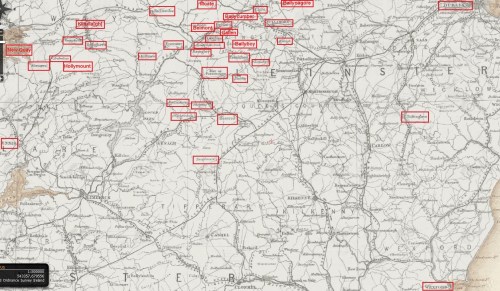
Thomas Berry & Co midland and south routes

Thomas Berry & Co midland and southern destinations (OSI)

The canal runs from Dublin, at the top right, left (roughly west) through Tullamore to Shannon Harbour, where it meets the river; there was an extension to Ballinasloe on the far side of the Shannon. Berrys served places along the canal and several others fairly close to it, but it looks to me as if there were three routes by road beyond that:

  • via Banagher (which has a bridge across the Shannon) to Eyrecourt and Killimor
  • from Ballinasloe to Loughrea and district and then south-west to Ennis in Co Clare
  • perhaps from Tullamore to Birr [Parsonstown], Roscrea (including Shinrone, Cloughjordan and Borrisokane) and Templemore.

There are also two outliers for which I can think of no plausible explanation: Baltinglass and Wexford. Perhaps their inclusion was a mistake. Certainly Berrys, like John M’Cann & Sons on the Royal Canal, seem to have had extensive road networks (perhaps using car-owning subcontractors?) to supplement their water-borne routes, but I don’t see why they would take on a route no part of which could sensibly have been conducted by inland navigation.

The next map shows the north-western destinations served by Berrys.
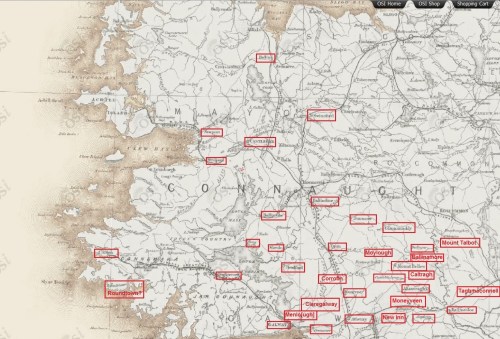
Thomas Berry & Co western routes

Thomas Berry & Co north-western destinations (OSI)

You can see that their network covered much of County Roscommon and went almost as far west into County Galway as it was possible to go; it also extended northwards into County Mayo.

I have not attempted to check what industries might have made these towns and villages worth serving. Berrys certainly seemed keen to take as much as possible of the traffic from west of the Shannon towards Dublin — excluding such of it as went by the Royal Canal: it is interesting to compare these maps with that for M’Cann on the Royal.

Finally, note that along the canal itself Berrys listed only destinations towards the western (Shannon Harbour) end: it seems likely that the roads took the valuable traffic from the eastern end into Dublin. There were no doubt turf boats taking fuel in from closer to Dublin, but they were not general carriers.

Other carriers

Now for the rest of the carriers.
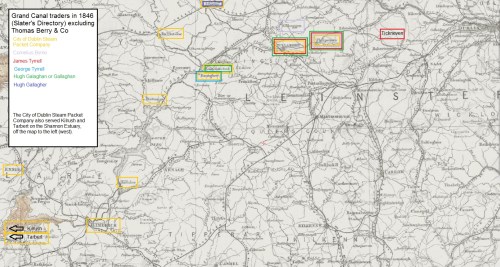
Grand Canal carriers 1846 excl Thomas Berry

Grand Canal carriers 1846 excluding Thomas Berry (OSI)

I have included the Shannon here as well as the Grand Canal; however I have covered the Barrow Line of the Grand Canal, as well as the navigable rivers Barrow, Nore and Suir, in a separate post. Of the carriers listed here, only the City of Dublin Steam Packet Company [CoDSPCo] (which employed horses to pull its boats on canals) ventured on to the Barrow Line, serving Portarlington and Mountmellick.

Berrys and the CoDSPCo were by far the largest firms on the Grand. I don’t know the size of the Berrys fleet, but the CoDSPCo had 52 barges in addition to its Shannon (and Irish Sea) steamers. Note that only on the middle Shannon, around the junction with the Grand Canal, and at Ennis did the two firms serve the same destinations: the CoDSPCo seems to have had the lower Shannon trade to itself.

With one exception, all the carriers, including Berrys, had Dublin depots at Grand Canal Harbour, James St; the Grand Canal Docks at Ringsend, joined to the Liffey, were not mentioned.

The exception is Hugh Gallagher, whose only listed destination was Athlone. It would be interesting to know how he served Athlone: whether by road or by water and, in the latter case, whether he used a steamer. I do wonder whether Hugh Gallagher might be the same person as the Hugh Galaghan (also Gallaghan) who served Philipstown [now Daingean], Tullamore and Shannon Harbour.

George Tyrrell is another who is listed with but a single destination, Banagher, whereas James Tyrrell is listed as serving Tickneven, Philipstown, Tullamore — and Edgeworthstown, which must be a mistake as it is closer to the Royal Canal.

Finally, Cornelius Byrne is shown as serving two destinations: Philipstown and Kilbeggan (which has its own branch off the main line of the canal).

Other information

A little extra information is available from the entries for towns other than Dublin in the Directory:

  • Naas has its own branch from the main line of the canal, but the directory says that “TO DUBLIN, there are Boats, as occasion require, but they have no fixed periods of departure.”
  • Edenderry also has its own branch, short and lock-free, but there is no mention of its being served by trade boats
  • Kilbeggan, with a longer, leakier, lock-free branch, was served by the CoDSPCo’s and Thomas Byrne’s boats travelling to Dublin three times a week. Is this Thomas Byrne related to the Cornelius Byrne mentioned above? It seems that Byrne went only eastward for only the CoDSPCo’s boats went westward (to Shannon Harbour, Ballinasloe and Limerick) two or three times a week
  • at Banagher, Fleetwood Thomas Faulkner of Main Street was the CoDSPCo agent; a downstream steamer left Shannon Harbour after the [passenger] boat from Dublin arrived and called at Banagher’s Bridge Wharf; an upstream steamer from Limerick called every afternoon at 3.00pm and met the night boat travelling to Dublin by the Grand Canal. I presume that this happened on every day except Sunday.

More

As far as I know, little has been written about the carrying companies, especially those of the nineteenth century. I would be glad to hear from anyone who can correct, supplement or comment on this information.

My OSI logo and permit number for website


[i] I Slater’s National Commercial Directory of Ireland: including, in addition to the trades’ lists, alphabetical directories of Dublin, Belfast, Cork and Limerick. To which are added, classified directories of the important English towns of Manchester, Liverpool, Birmingham, Sheffield, Leeds and Bristol; and, in Scotland, those of Glasgow and Paisley. Embellished with a large new map of Ireland, faithfully depicting the lines of railways in operation or in progress, engraved on steel. I Slater, Manchester, 1846
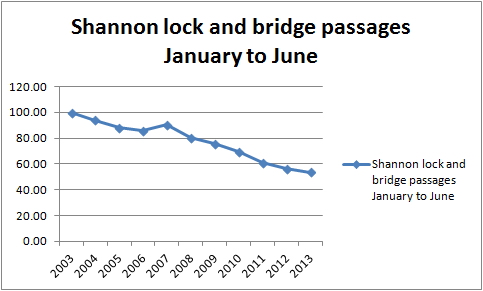
Shannon traffic to June 2013

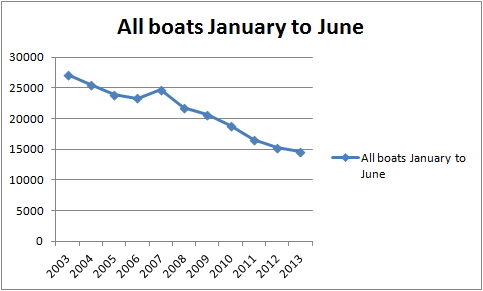
The figures for Shannon lock passages to the end of June 2013 are now available. The decline continues, though perhaps more slowly.

Shannon traffic Jan to June percent

Shannon lock and bridge passages January to June as percentages of the 2003 number

The usual caveats apply: the underlying figures (kindly supplied by Waterways Ireland) do not record total waterways usage because, for instance, sailing, fishing or waterskiing on lakes or river stretches, which did not involve a passage through a lock or Portumna Bridge, would not be recorded. The passage records are our only consistent long-term indicator of usage of the Shannon but they would not show, for instance, a change in the balance of types of activities from those in larger cruising boats to those in smaller (sailing, fishing, waterskiing) boats. It is quite possible, therefore, that overall usage might be increasing while long-distance cruising was declining.

Shannon traffic Jan to June private

Shannon lock and bridge passages by private boats January to June

As it happens, the figures show a small increase over 2012 in passages by private boats. I suspect that July’s warm weather will spur a further increase.

Folk living in Ireland, whether owners or prospective hirers, are likely to be able to react quickly to better (or worse) weather by doing more (or less) boating; folk living abroad may be less able to change their holiday plans. Accordingly, July’s weather might (I’m speculating here) mean an increase in passages by private boats and by boats hired by Irish residents; it might not lead to an increase in hiring from abroad.

Traffic in hired boats continued to decline in June.

Shannon traffic Jan to June hire

Shannon lock and bridge passages by hired boats January to June

That decline outweighed the small increase in private traffic, leading to an overall decline in the first six months as compared with the same period in 2012, which itself continued the pattern set in 2007.

Shannon traffic Jan to June all

Shannon lock and bridge passages by all boats January to June

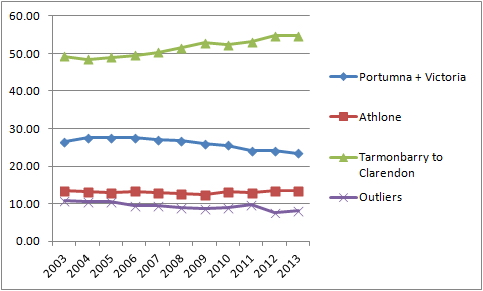
I wondered whether the figures might show any change in the geographical distribution of activity. WI’s reports don’t show separate figures for private and hired boats for the individual locks, but it seems to me that the hire business is becoming more concentrated on northern waters, from Lough Ree upwards. If that is so, then there might be an increase in the proportion of passages through the northern locks, from Tarmonbarry upwards, and a decrease in the proportion passing through Portumna Bridge and Meelick (Victoria) Lock.

I put the WI reporting stations in four groups:

  • Portumna + Meelick
  • Athlone
  • Tarmonbarry, Clondra, Roosky, Jamestown (Albert), Knockvicar (Clarendon)
  • the also-rans: the three locks leading to Lough Allen, Pollboy leading to Ballinasloe, the Limerick sea-lock (Sarsfield).

The figures suggest that the distribution is indeed changing, but gradually rather than dramatically. Athlone’s figures are pretty steady, the outliers are declining slightly and Portumna + Meelick are declining a bit more; the northern locks (Tarmonbarry to Knockvicar) are taking the gains. Comments or alternative interpretations welcome.

Change by region

Lock passages by group

The figures for 2013 are for the six months January to June; those for other years are for twelve months.

The locks could of course be grouped in other ways, and I may try some of them in future months.

Buying diesel

The Revenue Commissioners’ latest list of holders of marked fuel trader’s licences doesn’t seem to have any new names on it. So, as far as I can see, there are no licensed sellers on the Grand Canal, the Royal Canal, the Barrow, the Shannon–Erne Waterway or that part of the Erne in the republic. There are seven licensed sellers on the Shannon, with none north of Carrick-on-Shannon or south of Portumna. The seven licensed sellers are (north to south):

  • CarrickCraft, Carrick-on-Shannon
  • Emerald Star, Carrick-on-Shannon
  • Rooskey Craft & Tackle, Rooskey Quay
  • Hanley’s Marina, Ballyleague (opposite Lanesborough)
  • Quigley’s Marina, Killinure, Lough Ree
  • CarrickCraft, Banagher
  • Emerald Star, Portumna.

If I’ve left anybody out, please let me know and I’ll correct my error.

Note that the requirement for a licence includes anyone delivering green diesel, or keeping it for delivery, so that purporting not to charge for the diesel makes no difference.

All this excitement …

… can’t be good for me.

Last week Their Excellencies the Revenue Commissioners published two versions of their list of holders of marked fuel trader’s licences, the second [.xls] dated St Valentine’s Day. I was so excited I almost spilt my Ovaltine.

And what’s more, there are now two more candidates for haloes and wings. Step forward Emerald Star Portumna and Carrick-on-Shannon, becoming the fourth and fifth members of the Elect and lengthening the stretch of the Shannon where green diesel can legally be sold. No sign of anyone in Belturbet, though, and I can think of a couple of other places on the Shannon where it would be nice to be able to buy diesel, but we don’t want too much excitement all at once.

L+M Keating again

Here are some photos of recent L+M Keating projects.

Keeping Galway dry

A page about the ESB pumping stations on the embankments above Portumna.

Power play

The ESB owns or controls certain parts of Hayes Island, in the middle of Portumna Bridge, on the Shannon at the upper end of Lough Derg. Many boats moor to the island: some had long-standing agreements with ESB and others had indirect arrangements. ESB has now, by posting a notice on a gate, given the boat-owners 21 days to remove their boats. It seems that the ESB was officially unaware that it had boats moored on its land, although it certainly made agreements with some of the boaters and it supplied electricity to others.

I have asked the ESB press office for information but it has not yet replied.

ESB cuts

My spies (who are everywhere) tell me that the ESB has issued notices to owners of some boats moored at Hayes’s Island, Portumna, telling them to remove their boats within some short period. At least one owner has a long-standing legal agreement with the ESB, although it does allow ESB to issue short notice.

Further information would be welcome.


Contractors

L & M Keating, contractors, are currently working on Portumna Bridge, Killaloe flood gates and Shannon Harbour houseboat moorings. Some info and pics here, with links to info on some projects.

The Lion and the Lizard

They say the Lion and the Lizard keep
The courts where Jamshyd gloried and drank deep

(Edward FitzGerald The Rubaiyat of Omar Khayyam)

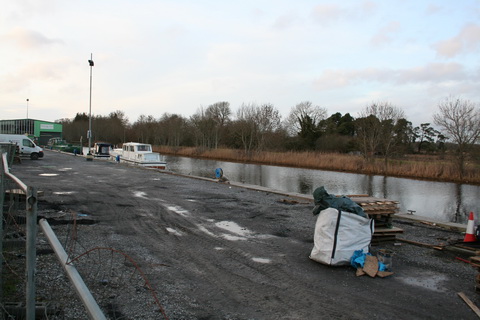
Emerald Star Portumna: boats were moored to finger jetties along this quay

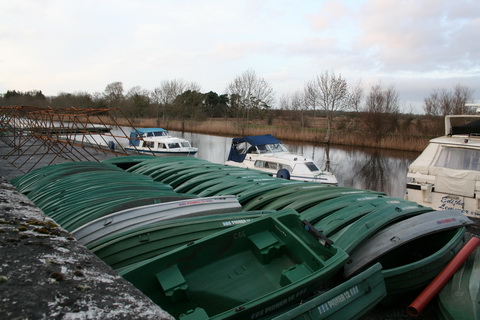
Emerald Star dinghies