Tag Archives: Shannon

Rescue services

With the VHF on Channel 16, I can hear the Coast Guard but not (usually) the boats talking to them. As a result, I get one side of the conversation and have to piece the story together from that.

One day, the Coast Guard acknowledged a message from a private boat which had reported a cruiser aground at a named part of Lough Ree. The Coast Guard didn’t have a map of the lake and didn’t know where that was [why not?] but it seemed that the private boat was able to explain matters. It was also able to say, in response to questions, that three people were visible on board and that one was wearing a lifejacket or buoyancy aid.

The Coast Guard, after a while, reported that it had asked the Lough Ree RNLI lifeboat to go to the rescue, gave an estimate of when it would get there and asked the private boat to remain on station. The private boat evidently agreed to do so.

Some time later the Coast Guard reported that the lifeboat was on its way.

And some time later again the Coast Guard called the lifeboat and told them they were being stood down and could return to base, as the hire firm was arranging for a boat to be sent to the rescue. The private boat was told that it could leave the scene.

If I were the skipper of the private boat, I would be very pissed off and, next time I saw a boat aground, I’d be inclined to ignore it. That would not be good.

The problem here is that there are two competing rescue services. The official service [PDF] is the one that was called into operation by the private boat, which did the right thing in reporting the grounding. And the system worked perfectly after that.

It should be noted that a private boat cannot know what, if anything, is happening through the unofficial rescue service operated by hire companies on the Shannon: “unofficial” in that its boats are not Declared SRUs (Search and Rescue units), the hire firms (and IBRA) are not listed as Irish Search and Rescue Organisations and their operations are not coordinated by the Coast Guard.

According to the Carrick Craft Captain’s Handbook [PDF/Flipbook]

You will be given breakdown and emergency telephone numbers when you check in.

It also says

Running aground

In all cases immediately contact your hire boat base for advice using the number provided. In the interests of safety do not accept an offer of help from a passing boat. If needed, assistance will be quickly available either from your hire boat company or one of the associate hire boat companies who may be located closer to you. Your hire boat company will alert the necessary authorities to deal with any incident that may arise.

The bit about not accepting help from passing boats is OK, I suppose, until the water reaches your ankles.

But I suspect that the advice to hirers is based on experience: groundings are probably the most common form of accident, it is unlikely that the boat will sink, it is likewise unlikely that anyone will have been injured and it is probable that a dory or other workboat will be able to make any necessary checks and repairs, haul the boat off and admonish the crew.

However, there may be an element of self-interest in this too: if the hire firms look after these incidents themselves, they won’t find them covered in press releases from voluntary rescue bodies, with videos shot by boat-mounted cameras. I have heard it said that some folk — including private boaters — feel that rescuers’ press releases give the wrong impression of the inland waterways, suggesting that they are more dangerous than they really are, especially given that few rescues involve any threat to life. [That’s something I’ve heard, not my own view.]

It is entirely possible that I misunderstood, and have thus misrepresented, what was happening. But if I haven’t, it seems to me that there is a problem in the relationship between the official and unofficial rescus systems for hire boats. If hire company staff, who are paid for the job, can rescue afflicted boats, without having to impose on the volunteer rescue services, then that’s a good thing. But it would not be good to have private boaters ignore all hire boats in trouble because, some day, the trouble might be serious.

I do not know whether the hire firms and the Coast Guard have discussed these matters and reached some understanding or produced some protocol about when the firms will call in the official services. If they haven’t, it might be nice if they did.

And, in individual instances, the firms might tell the Coast Guard, and ask them to broadcast the fact, that there is a boat aground and that they’re on their way, perhaps asking private boats to keep an eye out just in case. Everyone with VHF will hear the news, but that’s still more private than having press releases and videos on websites.

 

Sewage

Having a boat with a holding tank and no bypass system, we take a keen interest in the availability of pump-outs on the Shannon. We used that at Dromineer before heading upriver, but then found that:

  • that at Castle Harbour, Portumna, seemed to have disappeared, probably as part of the harbour renovations; no doubt it will return eventually
  • that at Banagher was not working. There was no notice to say so and the Waterways Ireland patroller who visited the harbour was not aware of the fact. We notified WI but a repair team did not arrive
  • that at Shannonbridge was blocked by a private cruiser. A hire-boat tried to use the pump-out but the hose would not stretch to any position other than that occupied by the private boat. The hire-boat folk even tried to tie their boat to span the gap between the cruiser and the boat behind it, but the hose would not stretch far enough
  • at Athlone the pump-out on an outside hammerhead pontoon had been disconnected as the berth was now allocated to a trip boat. There was a pump-out at the inner end of the pontoon fingers but, while it might be possible to get in safely, getting out would have been pretty well impossible without hitting someone else’s boat.

We were not inconvenienced by this: we went to Quigley’s at Killinure and got pumped out there. But I was struck by the fact that the only other boats we saw trying to use the pump-outs were hire boats, so I looked at the Carrick Craft Captain’s Handbook [PDF/Flipbook] where I found, on page 8, that hirers are given pretty definitive advice about using their holding tanks and the pump-outs:

All boats are equipped with holding tanks for sewage. Tanks should only be emptied at pump-out stations. It should be noted that it is illegal to dispose of sewage overboard. Never moor alongside pump-out stations for longer than required to empty the holding tank.

There is more detailed advice on page 26.

The poor benighted foreigners take all of this seriously, not realising that, in Ireland, illegality is no reason not to do something — an instance perhaps of what Brian Lucey called a “preference for discretion“. But the point is that those I saw were taking considerable trouble to obey the Irish laws and were being frustrated in doing so. It seems unfair that they should waste an hour or so in trying to get a pump-out — or should endanger themselves in trying to get near the pump.

Some suggestions:

  • hirers might be advised to use the facilities at IBRA bases as much as possible, but not to rely on being able to do so on change-over day
  • Waterways Ireland patrollers might check the condition of pump-outs (and other harbour facilities) when checking boat numbers; they might report to the appropriate engineers
  • keeping pump-out locations free at all times would be a waste of space, but they might have markings asking boaters to move when someone does want to use the facilities
  • the operators of the Athlone marina might be asked to put a pump-out on an outside berth.

Oh, and folk might be advised not to swim in harbours ….

Weather

I had not realised that the times of the Met Éireann inland lakes weather forecasts, broadcast by the Coast Guard on VHF, had been changed. The times are now

06:15
10:15 repetition
13:15
16:15 repetition

MRCC Dublin, to whom I am grateful for confirming the new times, says

Standby on VHF Channel 16 for your local working channel.

In bygone days the Lough Derg and Lough Ree forecasts were five minutes apart, but now the initial call on Channel 16 is at the same time everywhere.

I found the new 10:15 broadcast to be particularly convenient.

Forecast format

However, one aspect in which I thought the Met Éireann forecasts (also available here) less useful than those from other sources (eg Windguru) is the absence of a forecast for wind gusts. On several occasions this year, the gusts were (a) almost continuous and (b) much stronger than the forecast wind speed. They thus had more influence on our trip planning than did the base wind speed. It would be nice if Met Éireann, and thus the Coast Guard, could include a forecast for gusts.

Hire boats

The hirers’ training materials I mentioned here give good advice about rough weather on lakes but, after seeing several hire boats cross Lough Ree in weather that kept us in harbour, I wondered whether the lakes forecasts are readily available to hirers. If they’re not, perhaps they could be transmitted daily by text message?

I should stress that I did not hear of any accidents caused by stress of weather, but some folk may have had uncomfortable trips.


A distinguished visitor to the Shannon

Dwarkanauth Tagore, of Calcutta, the distinguished and princely East Indian, who is making a tour of the United Kingdom, arrived in this city, on Tuesday evening with his suit [sic], in an elegant drag with four horses, and he put up at Cruise’s hotel.

The native Prince merchant partook of a dejeune at Killaloe on Tuesday. The City of Dublin Steam Company placed all their vessels on the Upper Shannon, at his command, and they were gaily decorated with flags, in compliment to the distinguished stranger, who left Limerick this day on a visit to Killarney Lakes, and is expected to call at Derrynane, the seat of Mr O’Connell.

Dwarkanauth Tagore dined and slept at Lord Rosse’s, on Monday night, where he examined the prodigious telescope — drove to Banagher, on Tuesday morning, and embarked on board the Lansdown [sic] steamer, proceeded through Victoria Locks Meelick, accompanied by Colonel Jones, and Mr Rhodes CE, also by Mr Howell, Secretary to the Dublin Steam Company. He was much pleased with the new works at Meelick, and also with the operations of a diver in a helmet, who exhibited the mode of using that apparatus.

The dejeune on board the Lansdown was provided by the Steam Company. Several ladies and gentlemen came up by the Lady Burgoyne to join the party of [at?] Portumna in the Lansdown. After partaking of the good cheer, they had dancing and music on deck till they reached Killaloe, much to the amusement of the stranger guest, who felt edlighted, not only with the scenery of the lake, but also with the company of the ladies.

Limerick Reporter 5 September 1845

From the BNA

Boat handling

One of the things that struck me, on our annual tour of inspection of the transpontine regions, was that most hire-boat skippers were very good at handling their boats.

The weather was very windy (more on that anon) and, on several days, we thought it too gusty for safe manoeuvring, but we watched hirers coming in to the various harbours. I don’t recall any of them making a mess of it, despite the wind, and some were remarkably skilful in challenging conditions. A family of Cheshire dairy farmers, experienced on the English narrow canals, were particularly impressive.

I had a look at the CarrickCraft/Waveline/Cruise-Ireland online training materials and I thought they were very good. [I haven’t looked at those of other hire firms: they may have equally good materials.] So was the Captain’s Handbook [PDF to Flipbook], which contains this excellent advice:

Take your time and carry out all manoeuvres slowly and deliberately. If you have the chance, watch a barge captain handling his barge. He is never in a hurry.


Oberkommando der Wehrmacht and O’Briensbridge

Boogie on over to the splendid David Rumsey Historical Map Collection and put

ireland shannon

in the search box. All going well, you’ll get a set of 14 pages published by Generalstab des Heeres (the German Military High Command) in 1940, with drawings, maps, photos and a page of text about the Shannon. The set includes Clonmacnoise (no doubt because the Wehrmacht intended to go there on pilgrimage), Foynes and, in particular, Ardnacrusha, O’Briensbridge, Parteen Villa and Killaloe.

Industrial railway enthusiasts may also be interested.

And the collection includes many photos of British ports and other installations.

Delegated authority in the ESB

Just over a year ago, in June 2015, I wrote — at some length — about the right to navigate the Shannon through Castleconnell, Co Limerick. A member of the staff of the ESB fisheries department told me

The legislation empowering ESB to regulate activity on the Shannon is contained in the Shannon Fisheries Act 1935 – Section 9.1 (D).

That accorded with my own untutored understanding: according to Section 9 (1) (d) the Board is empowered to

(d) terminate, restrict, or otherwise interfere with, either permanently or temporarily and either compulsorily or by agreement, any easement, way-leave, water-right, fishing right, or other right over or in respect of any land or water[.]

However, I responded to the ESB pointing out that the existence of a power does not prove that the power has been exercised, much less that it has been exercised validly. I asked for information on (inter alia)


[…] what strategic decisions the Board has made on this subject, or what decision-making powers it has conferred on its fisheries staff […]

whether the Board has actually decided to “terminate, restrict, or otherwise interfere with, either permanently or temporarily and either compulsorily or by agreement, any easement, way- leave, water-right, fishing right, or other right over or in respect of any land or water”

if it has so decided, what the details of the decision are: details both of its making and of its application [.]


The Act gave the ESB a power, but the power has to be exercised properly and there must be a record of the making of the decision. I have had no reply to my queries, and my working hypothesis is therefore that the ESB has not validly terminated, restricted or interfered with the right to navigate the Shannon at Castleconnell. If I receive evidence to the contrary, I will of course change my view.

One part of the problem is that the Act gives the power to the Board and, in my view, employees of the Board cannot of themselves decide to exercise that power unless the Board has validly delegated the power to them. The fisheries department cannot close the navigation unless the Board explicitly gave them the power to do so.

A case at the Court of Appeal, reported in the Irish Times today [11 July 2016: the article may disappear behind a paywall at some stage], seems to support that view [although I am not a lawyer: please consult your own legal advisers]. The relevant paragraph is

The board was entitled to delegate the power to issue wayleave notices to its chief executive but was not entitled to “sub-delegate” to the chief executive power to authorise such other persons as he deemed appropriate to issue wayleave notices, Mr Justice Brian Cregan held. Any such persons had to be directly authorised by the board.

I suggest that the same may apply to fisheries and navigation. If the navigation at Castleconnell was validly terminated, restricted or interfered with, either the Board took that decision itself or it explicitly delegated the power to do so to the fisheries department (or someone else). In either case, there should be a Board minute on the matter and it should be possible for the fisheries department to cite that minute.


Gunboats at Banagher

The gun boats — extraordinary affair

From our own correspondent, Dublin, Dec 11

You may remember a statement I sent last week, respecting the arrival of the Penelope war steamer, with six gun-boats of formidable calibre, which were sent down by the Grand Canal to Banagher, in order to guard the pass across the Shannon between Leinster and Connaught. A letter which I have seen this morning, from that place, announced that the gun-boats reached their destination, but, strange to say, no one can be induced to come forward and take charge of them. All persons in authority, who had been applied to, disavowed all responsibility regarding them; and an application has been made to the Castle on the subject, to ascertain what is to be done with these formidable gun-boats. The wisest course would be to take them back to the dock-yard from whence they have been imported.

Morning Chronicle 13 December 1843

From the BNA

Castle-Connell Regatta

To take place on 1st and 2nd Oct, 1850

First days race

£        s        d

1st For all Four Oared Gigs                                                5        0        0
Entrance                                                                                0       10        0
Second boat to save entrance money

2nd For all First Class Cots                                                3        0        0
Entrance                                                                                0        5        0
Second Boat                                                                          0      15        0

3rd For all Fishing Cots to be rowed down stream and polled back with 2 Polls
First Boat                                                                              2       10        0
Second do                                                                             0       15        0
Entrance Each                                                                     0         2        6

4th For all Cots to be paddled down River with 2 Paddles and polled back with 2 Polls
First Boat                                                                              1       10        0
Second Boat                                                                         0         7        6

Second Day’s Race

First — For all Four Oared Gigs                                       4        0        0
Entrance                                                                                0        2        6
Second Boat to save Entrance Money

Second — For all Fishing Cots to be rowed with
two oars and a paddle                                                        2        0        0
Second Cot                                                                           0       10        0
Entrance                                                                               0         2        6

Third Race — For all Fishing Cots to be rowed
down the river with two oars and paddled
and polled back with two poles                                       1        10        0
Second Boat                                                                        0        10        0
Entrance                                                                              0          2        6

Fourth Race — For all Fishing Cots with
one paddle                                                                           1          0        0
Second Boat                                                                        0          5        0
Six to start or no race

NB No Race for any of the above Plates, unless 3 Boats start.

The decision of the Stewards to be final in all cases, and by whom the distance on the river will be laid out.

Boats for the First Race to start at Ten o’Clock precisely, and to be entered at Mr Wilson’s before Ten o’Clock each day.

An Ordinary at Wilson’s Hotel each day.

There will be a Ball at the Old Assembly Rooms, of which further notice will be given on Saturday.

Stewards

Sir Richard De Burgho, Bart
Colonel Vandeleur
Captain Wyndham 1st Royals
S Vansittart 1st Royals
A Vincent Esq
A W Heard Esq

Limerick and Clare Examiner 25 September 1850

From the British Newspaper Archive run by Findmypast Newspaper Archive Limited, in partnership with the British Library.


The mystery of Mr Worrall

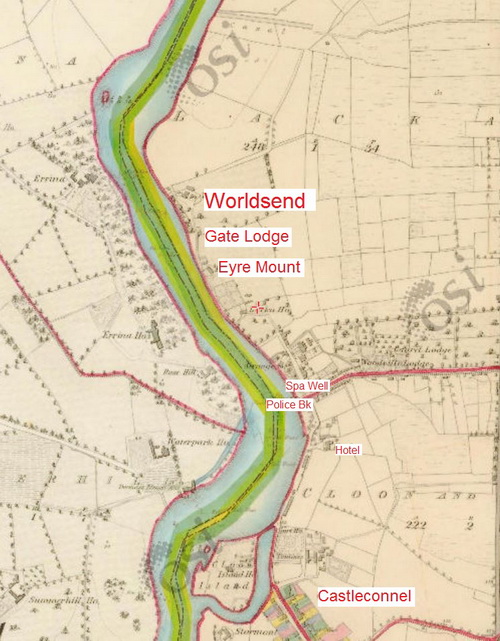
Castleconnell and Worldsend, Co Limerick (OSI 6" ~1840)

Castleconnell and Worldsend, Co Limerick (OSI 6″ ~1840)

The authors of a book called Village by Shannon, about Castleconnell, Co Limerick, say that the area of Worldsend, at the northern end of Castleconnell, derives its name from Worrall’s Inn, an establishment operated by a Mr Worrall in the early eighteenth century.

That may be so, but the book’s accounts of river-borne traffic — to a quay at the inn — do not seem to accord with what is known about the history of the Shannon navigation, and in particular of the Limerick Navigation between the city and Killaloe. Here are some of the problems.

My OSI logo and permit number for website