Tag Archives: Shannon

The [non-]Royal Lough Ree Yacht Club

Devoted as this site is to the memory of Her late Majesty Victoria, of the United Kingdom of Great Britain and Ireland Queen, Defender of the Faith, Empress of India, we are always gratified to find evidence of Loyalty to Crown and Empire. Along the Shannon, we are never surprised to find such evidence around Lough Derg (at least in North Tipperary), but we had not realised how well-affected the good people of Lough Ree were towards Royalty, even after the foundation of the Irish Free State and its succession by the state of Ireland.

On 28 October 1947 the Lough Ree Yacht Club wrote to Her Majesty’s Under Secretary of State at the Home Office in London SW1:

Sir

I have been looking over some old papers belonging to this Club.

There was some discussion among members about trying to get it raised to the status of “Royal”.

I should be greatly obliged if you would let me know what would have to be undertaken and what cost would be involved. Also would a club in this country be eligible.

This Club which was founded prior to 1836 is the second oldest in Ireland.

A Home Office Minute of 6 November 1947 said:

The whole of Lough Ree is in Eire and it would seem desirable in the first place to refer the letter to the Commonwealth Relations Office on the question of procedure.

In this country freshwater Yacht Clubs are not now granted the title Royal.

Send a copy semi-officially to the Commonwealth Relations Office for observations regarding procedure.

That was done on 13 November 1947. The covering letter said (amongst other things):

There has been no grant of the Royal Title to a fresh water sailing club in England since 1887 when the practice relating to the grant of the Title Royal was not stabilised.

I wonder whether you could let us have particulars about this club; its membership, reputation, and the number of yachts it owns with their tonnage. We should also welcome any suggestions relating to procedure on the assumption that the application will be pursued.

The Commonwealth Relations Office replied to the Home Office on 6 December 1947 with these (amongst other) paragraphs:

I enclose a copy of a note, prepared in July last year, on the general principles covering the grant of the title “Royal” in the various Commonwealth countries.

You will no doubt appreciate that in the case of Eire, difficulty would arise in the application of these principles. It would appear, however, from paragraph III of the enclosed note that consideration would only be given to applications from institutions similar to the Club in question if exceptional circumstances exist.

We feel that in this particular case no indication should be given in any reply which you may make to the Club of the likelihood or otherwise of any application meeting with success, and that they should only be informed that, being in Eire, the matter should be raised through the appropriate authorities in Eire.

On 17 December 1947 the Home Office wrote to the Club saying:

With reference to your letter of the 28th October last regarding the procedure and the cost involved in making an application for the grant of the title Royal to the Lough Ree Yacht Club, I am directed by the Secretary of State to say that as the Club is in Eire, the matter should be raised through the appropriate authorities in Eire.

Ireland at the time had a Fianna Fáil government, led by George de Valero Éamon de Valera, who was not known for being well-affected towards Crown and Empire.

On 29 April 1948 the Club responded to the Home Office:

Sir

Referring to your letter of 17th December 1947.

We have been in communication with the Irish Government + I enclose their reply, from which I understand that they will not interfere either for or against. I sent their letter to the UK Representative + enclose his letter also.

As the Irish Government has not refused permission for the Club to be raised to the status of Royal would His Majesty therefore be gracious enough to confer on the Club the Title of Royal.

On 10 May 1948 the Home Office replied:

With reference to your letter of the 29th April as to the application for the grant of the title Royal to the Lough Ree Yacht Club, I am directed by the Secretary of State to say that as the Club is situated in Eire, the Secretary of State for the Home Department has no jurisdiction in the matter, and can add nothing to the letter addressed to you on the 21st April, by the United Kingdom representative to Eire.

The enclosures to your letter are returned herewith.

The return of the enclosures has deprived us of the opportunity to see exactly what the Irish government and the UK representative said to the Club.

By then, the Irish general election of 4 February 1948 had returned the First Inter-Party government, led by John A Costello and with Seán MacBride, leader of Clann na Poblachta, as Minister for External Affairs. The Republic of Ireland Act was signed into law on 21 December 1948, depriving the King of Ireland of his last functions in the former Free State — and depriving the Lough Ree Yacht Club of its last chance to acquire the Title Royal.

It would be interesting to know what Seán MacBride, who had been boating on Lough Ree since the 1930s, thought of the Club’s application.

The story is not included in the brief history on the Club’s website or in the more extensive history included in the booklet produced for the LRYC/Waterways Ireland Classic Boats Regatta in 2007, but I have not seen Lough Ree Yacht Club: a memoir, published in 1970.


Shannon passage times 1838

Estuary

Kilrush to Limerick 4 hours

Tarbert to Limerick 3 hours

Clare[castle] to Limerick 3.5 hours

Limerick Navigation

Limerick to Killaloe:

  • iron passenger boat 2.5 hours
  • timber passenger boat 3.5 hours
  • trade boat 6 hours.

Shannon

Killaloe to Portumna:

  • passenger steamer 6 hours
  • steamer towing lumber boats 8 hours.

Portumna to Shannon Harbour:

  • 6 hours.

Shannon Harbour to Athlone:

  • 8 hours.

Source: Railway Commissioners second report Appendix B No 6.

Who saved Clonmacnoise?

It seems possible that, at some stage in the late eighteenth century, there was a plan that would probably have destroyed Clonmacnoise.

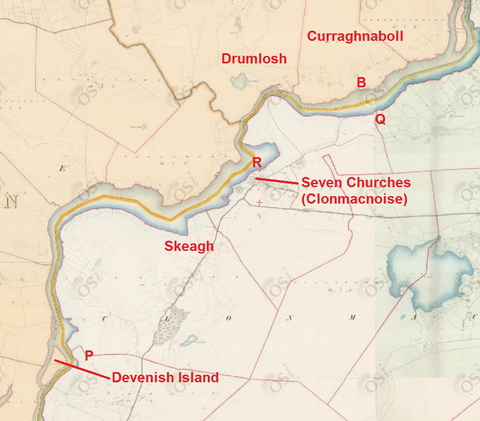
There exists A Map of the River Shannon from Athlone to Killaloe, Surveyed by John Killaly 1795, which contains much of interest. I do not have permission to reproduce it here, but here is the section around Clonmacnoise from the ~1840 OSI 6″ map.

Clonmacnoise OSI ~1840

Clonmacnoise OSI ~1840

I have marked on the map some of the placenames used by Killaly.

The legend reads:

[…]

B. Ford least water 4F 6J [which I take to mean 4′ 6″]

[…]

From Q to P the proposed Canal is ¾ Mile shorter than the River.

From Q to R [the proposed Canal] is ¾ Mile shorter than the River.

It seems therefore that, in 1795, someone was considering shortening the Shannon by digging one of two possible canals to cut off peninsulas along the east bank. Given the narrowness of the stretch between the esker and the river, I suspect it would have been impossible to dig either of them without destroying Clonmacnoise.

I would like to know more about the proposal and about why it was abandoned.

Incidentally, some folk prefer the spelling Clonmacnois but the Placenames Database of Ireland uses Clonmacnoise.

My OSI logo and permit number for website

Water levels

Waterways Ireland is warning of low water levels on Lough Ree. You can see here how the level at Athlone Weir has changed over the past 35 days.

After the summer

I don’t really know much about politicians, local or national, but I presume that, in the summer recess, they retire to their country estates for a bit of huntin, shootin and fishin, with breaks for trips to agreeable parts of foreignlandia (Tuscany, perhaps) and with occasional visits from other gentlefolk.

At any rate, something distracts them and keeps them quiet, but summer is now giving way to autumn and, er, innovative suggestions are coming thick and fast from politicos anxious to get other people to contribute to social and economic development in their constituencies (or to get reelected, whichever comes first).

So we have one who wants a walkway across Meelick Weir and another who wants a riverbus service on the Park Canal in Limerick.

Meelick turns up in another story from the past week, by John Mulligan in the Irish Independent. But despite the silly headline and subhead, the body of the article is a thorough and balanced account of flooding on the Shannon. Mr Mulligan is to be commended.


Worth a tenner …

.. of anybody’s money, even in sterling. An Abebooks trader is selling a copy of the Pilot Book of the River Shannon for £10. This is a short (~44-page) book, with no photos but an interesting map in the back (be VERY careful unfolding it: it has three horizontal sections, ie two horizontal folds), produced by Bord Failte with directions by the IWAI. It is undated, but I think it’s from the 1950s. Anyone interested in the history of the development of the Shannon for recreational rather than commercial purposes might be interested.

I have no commercial or other link with the seller.

Lough Derg jellyfish

Story here, here and here (and no doubt elsewhere).

Partially female?

In this news report from Inside Ireland we read:

On Friday the 9th August, the Shannon based Search and Rescue (SAR) Helicopter (R115) flew its first missions with the first all-female pilot and co-pilot Capt. Dara Fitzpatrick and Capt. Carmel Kirby.

That suggests that there had been previous missions with partially-female pilots or co-pilots.

Or that Inside Ireland needs someone to rewrite its less felicitous phrases.

Two brief notes about eels

Fr Oliver Kennedy, of the Lough Neagh Fishermen’s Cooperative Society, which ran the eel fishery [PDF], has died at the age of 83.

The ESB eel-catching apparatus at Killaloe Bridge is being renewed (and not, as I feared, removed). Eels are caught now only to be transported around Ardnacrusha. Read about the fishery here and, at greater length, here.

Transition?

I am grateful to Waterways Ireland for letting me have the Shannon traffic figures for July 2013. As I said last month:

The usual caveats apply: the underlying figures (kindly supplied by Waterways Ireland) do not record total waterways usage because, for instance, sailing, fishing or waterskiing on lakes or river stretches, which did not involve a passage through a lock or Portumna Bridge, would not be recorded. The passage records are our only consistent long-term indicator of usage of the Shannon but they would not show, for instance, a change in the balance of types of activities from those in larger cruising boats to those in smaller (sailing, fishing, waterskiing) boats. It is quite possible, therefore, that overall usage might be increasing while long-distance cruising was declining.

I also said:

[…] the figures show a small increase over 2012 in passages by private boats. I suspect that July’s warm weather will spur a further increase.

And so indeed it proved to be.

Shannon all JanJul

A slight increase

July’s traffic was up enough to increase the total for the year to date: the first increase (for the period January through July) since 2003.

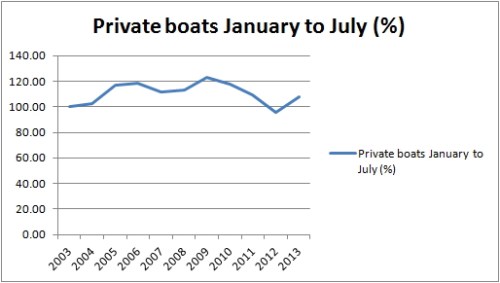
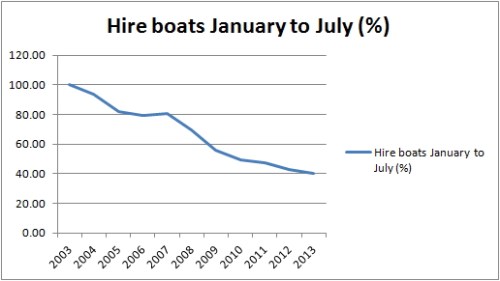
Here are the figures as percentages of the 2003 figure.

Shannon all JanJul %

Seven-month totals as percentages of the 2003 seven-month total

The total is still around 60% of 2003’s figure: a significant decline. But there was a marked increase in private traffic …

Shannon private JanJul %

Private traffic up

… while the decline in the hire-boat traffic continued.

Shannon hire JanJul %

Hire-boat traffic down

Over on Afloat, someone wrote that:

[…] a source close to Afloat.ie says that the falling numbers may be skewed by a growing emphasis on larger-capacity vessels on Ireland’s inland waterways, with eight- and 12-berth boats supplanting older four-berth vessels, and families and groups consolidating their recreational boating.

I don’t know what “skewed” is intended to mean. Well-capitalised hire firms may be adding larger boats to their fleets, but the number of passages is down by 60% and sources close to irishwaterwayshistory.com say that the combined hire fleet is down from about 500 to about 250 boats.

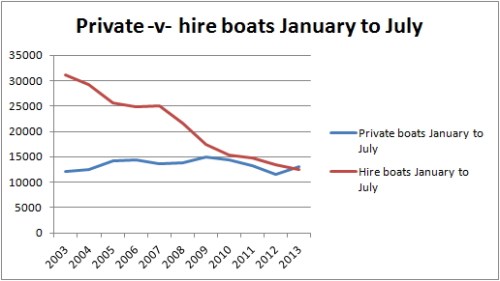
That doesn’t mean that the hire-boat industry is entirely dead, but it is much less important to the Irish waterways than it was. I don’t know of any published figures [if IBRA would like to supply them, I’ll happily publish them], but I suspect that employment within the industry has gone down and that its comparative economic importance to the Shannon and to the Irish tourist industry has declined too. And here is an interesting chart:

Shannon private v hire JanJul

The transition


For the first time that I know of, the seven-month figures show that measured private traffic outweighs hire-boat traffic. It may be that we need new approaches to attracting more overseas visitors to the Shannon. According to Waterways Ireland’s Lakelands & Inland Waterways Strategic Plan 2010–2015 (which I can no longer find on the WI website):

The mission of the Lakelands and Inland Waterways Strategic Plan is:
Throughout the Lakelands and Inland Waterways Region, to increase domestic and overseas visitors in number and revenue, while supporting existing sustainable tourism enterprises and encourage emerging tourism businesses through a series of practical business supports.

The plan was short on hard numbers for its targets, but at least as far as the Shannon hire business is concerned, it ain’t working.