
Tag Archives: Suir

The Suir towing-path

His late Most Excellent Majesty Henry the Eighth, by the Grace of God, King of England and France, Defender of the Faith, Lord of Ireland and of the Church of England and also of Ireland in Earth Supreme Head, has many claims to fame, but the greatest is undoubtedly his Act for the Weares upon the Barrow, and other Waters in the County of Killkenny of 1537, which begins thus:

Prayen the commons of this present Parliament assembled, That where at all times necessarie boates, scowts, wherries, clarans, cottes, and other vessels, loden and bestowed with goods, merchandizes, and other stuffe, have beene used to passe and repasse thorough and in the King’s most excellent Majesty’s rivers and waters of the Barrow, the Noyre, the Suyr, and the Rie, within this land, which Rie is in the county of Kilkenny, to and from the King’s citie of Waterford, and the townes of Kilkenny, Rosse, and Clomel [sic], to and from diverse borrowe and corporate townes, and other places, being sitiated in the counties of Kyldare, Catherlagh, Wexford, Kilkenny, Waterford, and Tipperary, through which great commoditie and profit hath growen and might grow to the said citie, townes, noroughes, and other places, and to all and every the King’s true subjects adjoyning to the same waters and rivers: […]

We resume a couple of pages later:

[…] and that the said owners, their servants, marryners, boatmen, and other rulers and conveyers, and all other persons coming in ayd and help of them and every of them, at all such times as the said mariners, boatemen, and other rulers and conveyers shall thinke the same necessarie and needfull, shall have and occupie at every of their wills and pleasures, the space and breadth of seven foote or more, as need require, of plain ground, upon every part of the land, of every side of every the said rivers and waters, next adjoyning to the said rivers and waters, and that to bee where they must needs draw the said boats and other vessels afore named, with strength of horses or men, by land […].

So His late Most Excellent Majesty provided that those drawing boats, using manpower or horsepower, could use a space seven foot wide on either side of the river. From the 1750s onwards, work was done on building a towing-path along the Suir between Carrick and Clonmel; work seems to have been finished before 1789 and the towing-path continued in use until the early years of the twentieth century.
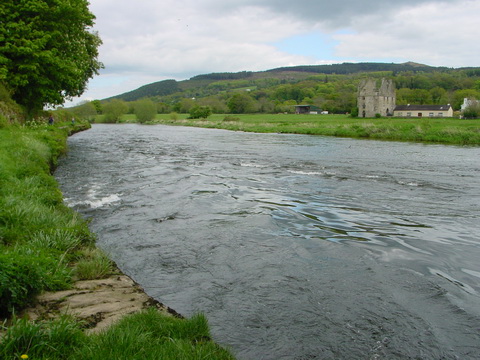
Kincor Castle below Sir Thomas's Bridge at Ferryhouse

Kincor Castle below Sir Thomas’s Bridge at Ferryhouse

Much, but not all, of the towing-path is accessible, and maintainted by South Tipperary County Council; as well as providing a walking route, it allows anglers, boaters and other leisure users to get to the river. However, some sections are impassable, so that it is not possible to walk the whole length of this extremely scenic route between Clonmel and Carrick.

South Tipperary County Council is now considering declaring public roads on the towing-path and thus taking it in charge.

South Tipperary County Council's newspaper ad about declaring public roads on the Suir towing-path

South Tipperary County Council’s newspaper ad about declaring public roads on the Suir towing-path

The Council’s documents are here. I think that this is a good idea and I have written to the Council (and to local newspapers) to declare my support.
 

Rescue boats on Irish inland waterways

I’ve moved my photos of rescue boats to a new page and added photos of some more services. Still a lot missing, though.

Attack on the Suir

Three men were killed and several wounded in the attack on Mr Malcolmson’s boats, near Clonmel, on Thursday evening. The populace, it is believed, were instigated to plunder the flour from no other motive but that of absolute distress. Stones flew like hail on the boatmen and police who escorted the cargoes, but not until very severe hurts were received, did the latter fire among the crowd, and on the third volley they dispersed.

The Limerick Chronicle, Wednesday 16 May 1827

The Repealer

Here is a brief account of a trip from Waterford to new Ross by steamer in 1842.

Buggering up the Barrow

In February 2012 Waterways Ireland published a study of the River Barrow called The Barrow Corridor Recreational, Tourism and Commercial Product Identification Study. I’ve devoted a lot of time to the document and I confess that, although I’m in favour of WI’s conducting these studies, I found this one rather disappointing. The principal problem, as I see it, is that the document just doesn’t hang together: it is not clear how the recommendations derive from the analysis. I also thought that its recommendations on navigation were weak, suggesting a fundamental misunderstanding of the nature of the Barrow.

I haven’t finished putting my thoughts on the subject together because I want to do the study justice, but I have put up six pages about the report, linked from an overview page here. I need to give the navigation page a little more thought; when it’s finished I’ll link it to the overview page and mention the matter here.

Cots, nets and salmon

Snap-net fishing in Carrick-on-Suir.

Barges, cots and subaltern waterways studies

I am to speak at Jamestown, near Carrick-on-Shannon in Co Leitrim, on Saturday 4 August 2012. Jamestown is having its heritage festival, and large numbers of old (converted) barges will be there. I will be giving one of four talks; mine is entitled

Down with barges: why cots were the really important vessels on Irish inland waterways.

I will be citing His Late Majesty Henry VIII, Fid Def, in support of my contention.

Here is some of the background to my thinking. If you would like to hear more, do come along on the day: the talks are open to all.

British power

The Sunday Business Post [paywall] reports that a British energy firm called SSE plc [formerly Scottish and Southern Energy plc], which already owns Airtricity, intends to buy Endesa Ireland. SSE’s press release is here.

Endesa owns the power stations at Tarbert, on the Shannon Estuary, and Great Island, at the junction of the Barrow and Suir estuaries; both are covered on this website. Endesa also owns a power station at Rhode, near the Grand Canal, and one in Co Mayo. It seems that SSE will also acquire options on sites at Lanesborough and Shannonbridge.

The Nore

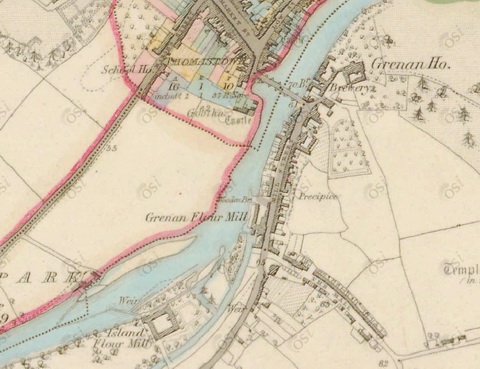
Thomastown ~1840 (OSI)

Thomastown, Co Kilkenny, is offering a month-long programme of events from 1 June to 1 July 2012, including:

  • on 1 June, an evening with singer Iarla Ó Lionáird, Carrick-on-Suir poet Michael Coady hydroelectroacoustic ensemble The Water Project
  • on 3 June, a talk on the archaeology of the River Nore, which will include industrial, transport and commercial heritage
  • on 17 June, poems and talks on mapping the Nore and on the river’s role in the development of Thomastown
  • on 24 June, talks on cot fishing on the Three Sisters rivers and (by Shay Hurley of Clonmel) on the cot-builder Tom Cuddihy
  • on 1 July, the Thomastown Regatta, including cot racing and cot handling.

There will be exhibitions and other events during the month; download the brochure here [PDF]; read about the Thomastown Weir and the Thomastown Community River Trust here.

We recall that Samuel Lewis wrote of Thomastown in 1837:

A very considerable trade was formerly carried on, and the town was the commercial depot for the county of Kilkenny ; flat-bottomed boats of an aggregate burden of 11,000 tons were constantly employed in conveying goods from this town, besides many others which did not belong to it; but the river is now choked up with deposits of sand. Inistioge has become the head of the navigation of the Nore, and the boats employed on the river at this place do not exceed an aggregate burden of 150 tons; the goods are now conveyed on Scotch cars by land from Waterford to Kilkenny. The improvement of the navigation of the Nore would tend greatly to the revival and extension of the trade of the town, and to the development of the resources of the county, which is rich in marble, coal, culm, slate, and limestone, for which, in addition to its agricultural produce, it would afford facilities of conveyance to the neighbouring ports. It has been estimated that the clearing of the channel of the river, which would open the navigation from New Ross to this town for flat-bottomed steam-boats of 70 tons’ burden, might be accomplished at an expense of £15,000, and effect, by a reduction of the charges for freight and the discontinuance of land carriage, a saving of at least £10,000 per annum. There are several large flour-mills worked by water in the town and its vicinity, and also two breweries and a tan-yard.

Great Island and Tarbert

The waterway power stations are back in the news again.