Tag Archives: waterways

Saunderson’s Shack

Some links to info about the Castle Saunderson estate, to which DCAL is trying to persuade DAHG to construct a sheugh.

Cavan County Council owns it, I think.

There is an International Scout Centre, although I’m not clear whether the scouts occupy the entire site or just part of it. For instance, do they control the church where services take place, at least occasionally?

There was an Orange parade to the site last year.

It is close to Belturbet, where the County Council has a River Project. Was that completed?

Belleek to Tralee in 10 hours by inland waterway

Learned Readers are undoubtedly familiar with Design-Driven Innovation, but I’m afraid I hadn’t come across it until I read a conference paper: S McCartan, P Murphy, R Starkel, A Sánchez González and M López Cabeceira “Design-Driven Innovation: Sustainable Transport Opportunities for the Inland Waterways of Ireland”, read at the fifth annual conference of the Irish Transportation Research Network at the University of Limerick from 3 to 5 September 2014.

The paper [PDF] can be downloaded free from Sean McCartan’s page on the academia.edu site, though you have to be registered with the site; the paper is also available, I think, from researchgate.net, but I’m not registered there so I haven’t tried the download.

As I understand it — and I am a Bear of Very Little Brain, and Long Words Bother me — Design-Driven Innovation means that a lot of clever chaps and chapesses come up with new and brilliant ideas and then ask people what they think of them:

The process of Design-Driven Innovation is an exploratory research project, which aims to create an entirely new market sector for a given product through changing the design meaning the user has for the product.

It seems that, in Ireland, 99.1% of freight travels by road, leaving just 0.9% for rail; 82.8% of passenger traffic is by car and 14.4% by bus and coach, leaving just 2.8% by rail. Waterways transport could use existing ports and canals; once the canals had the right bridges and automatic locks, running costs would be low. West coast ports could be used by a “coastal cruiser service”; people could travel by fast boat from Donegal right around the west and south coasts to Rosslare. All of this would reduce the carbon dioxide footprint (assuming, of course, that folk on the west coast wanted to travel, or needed to send goods, to anywhere else on the west coast rather than to Dublin).

On the inland waterways, 139 catamaran CLF vessels (Cruise Logistics Ferries) could run from Belleek to Tralee. Travelling at 22 knots, and ignoring lock times, they would complete the journey in only 10 hours; they could carry freight but also carry passengers in green luxury. These CLFs would be 81 metres long and 25 metres wide; each could carry 20 TEUs. At sea, 26 high-speed (40-knot) CLFs could each transport 12 TEUs from Cork to Dublin in just under four hours. And solar-powered catamarans on the Shannon and Erne could carry 64 passengers at 12 knots.

Meanwhile, the Grand, Barrow and Royal would not be forgotten. They would have a fleet of 1549 unmanned canal catamarans, with autonomous control systems, powered either by batteries or by fuel cells, ultimately fed from wind farms. They would each carry two TEUs but could also be converted for tourist cruising.

The overall aim, with those numbers of boats, is to replace half of the amount carried by road.

The paper concludes:

This is a first step in the analysis of the potential of the coastal and inland waterways of Ireland, to meet the EU targets for transport. State aid has been identified as a potential funding mechanism to support the realisation of these proposals.

Sometimes I wonder.


A quick bit of sheughery

Here, read this. I haven’t time to take it all in at the moment, but the minister’s “An updated business case was recently completed for my Department” is, as far as I know, misleading: that business case was completed by DCAL in Northern Ireland and sent to Dublin. Thus, as the SF TD Mr Ó Snodaigh probably knows, the “business case” (which is not a cost-benefit analysis) came from a Sinn Féin minister’s department.

It seems our designation of “Saunderson’s Sheugh” was spot on.

Northern Ireland spending on waterways

Sammy Wilson [DUP]: Looking through the list of capital projects, I see lock gates on the Shannon, bridge repairs on the Grand canal, enhancements of the Grand canal towpath, the Shannon Blueway and the multi-activity trail at Carrick-on-Shannon. Nearly every one of these projects is in the Irish Republic. Does the Minister see her role as fighting for projects in Northern Ireland or simply sitting there, handing over our money for projects in the Irish Republic?

Mr Wilson might not have noticed, during his terms in ministerial office, that waterways capital projects in each jurisdiction are paid for by the government of that jurisdiction. So NI money is not spent on capital projects in the republic; if NI politicians want more money spent on waterways improvements [as opposed to running costs] in Northern Ireland, it will have to come from the NI budget.

Unfortunately Mr Wilson’s party colleague, and successor as Minister of Finance and Personnel, Simon Hamilton, does not share Mr Wilson’s enthusiasm for erecting lock gates or towing-paths on the Erne [or whatever it was he wanted], for he has cut DCAL’s Budget [157-page NI budget and 28-page statement, both PDFs] and, in consequence, the amounts to be allocated to Waterways Ireland.

DCAL is wondering how to apply the chopper and is seeking views; a 190-page consultation document can be downloaded here [MS Word *.doc]. Neither DFP nor DCAL makes it easy to find the change from last year’s allocations, but DCAL says that the “savings” to be made by Waterways Ireland will be £468,000. As of today, that’s €630,727.

The Word document points out that

The budgets for the North/South Bodies are agreed by the North South Ministerial Council and are dealt with under different arrangements.  They are therefore outside the scope of this exercise.

So the document can’t say what the “front-line impact” of the cuts to Waterways Ireland’s allocation will be.

15% of WI’s current budget is paid by Northern Ireland and 85% by the republic. If the savings shown above are all to the current budget [which is not clear, though WI’s NI capital budget was pretty small anyway], then the total cut in WI’s current spending will be €5,204,847.

Note again that, without spending a lot more time on this than I currently have available, I cannot say from what base figure the cuts or savings are to be made.

Respondents to DCAL’s November 2014 consultation on the draft budget included only one who discussed waterways:

There was one response who stated that other sectors should be cut and funding to Waterways Ireland should be increased.

That was from an individual; it appears that no organisations commented on waterways issues and I cannot see any inland waterways-related voluntary body listed amongst those who submitted their views. As in the republic, arts folk seem to have been well organised.

The DCAL page contains a link to a surveymonkey page seeking responses.


Outbreak of sanity in Co Westmeath

Our big thing is to link the Galway Dublin cycleway into Kilbeggan and along the stretch of the old canal to Ballycommon. That’s around a million euro project and the biggest thing in our Vision for Kilbeggan plan.

Thus Dan Scally of Renew Kilbeggan in the Westmeath Examiner.

Canals conference 7 March 2015

Information posted at the request of the organisers


Inland Navigations of Ireland Historical Society
in partnership with
The Heritage Boat Association

The Canals of Ireland

Saturday 7 March 2015

Hugh Lynch’s Function Room, Tullamore, Co Offaly

Programme

Memorial Slides Conor Nolan 09.30
Welcome Gerard Bayly 09.55
Session 1 Chairperson Judie Lambert
The Canals of Europe Mike & Rosaleen Miller 10.00
The Canals of Ireland Colin Becker 10.20
Coffee break 10.40
Saving the Royal Niall Galway 11.00
Fighting for the Grand Mick Kinahan 11.20
Living on a Canal Eric Kemp 11.40
Morning Question Time 12.00
Lunch break 12.30
Session 2 Chairperson Kristina Baker Kenny
Newry Canal Geraldine Foley 13.30
Limerick Navigation Raymie O’Halloran 13.50
John’s River Brian Simpson 14.10
Grand Canal Kilbeggan Branch James Scully 14.30
Boyne Navigation Seamus Costello 14.50
Coffee break 15.10
The Future Joe Treacy 15.25
The Future Brian J Goggin 15.45
The Future Nigel Russell 16.05
Evening Question Time 16.25


Details

Admission:                          €12
Breaks:                                Tea/coffee included
Lunch in room:                   Soup and sandwiches included
Music:                                 Live music session during lunch
HBA:                                   Merchandise for sale
IWAI:                                  Merchandise for sale
Authors:                              Books for sale

Directions

Hugh Lynch’s Pub, Kilbride Street, Tullamore, Co. Offaly

087 250 5422


Politician asks sensible question shock

The invaluable KildareStreet.com tells us of this written Dáil question and answer on 4 February 2015:

Martin Heydon [FG, Kildare South]: To ask the Minister for Arts, Heritage and the Gaeltacht if her attention has been drawn to concerns regarding the lack of dredging on the lateral canals of the River Barrow and overgrown vegetation which is making navigation difficult; her plans to improve this situation; and if she will make a statement on the matter.

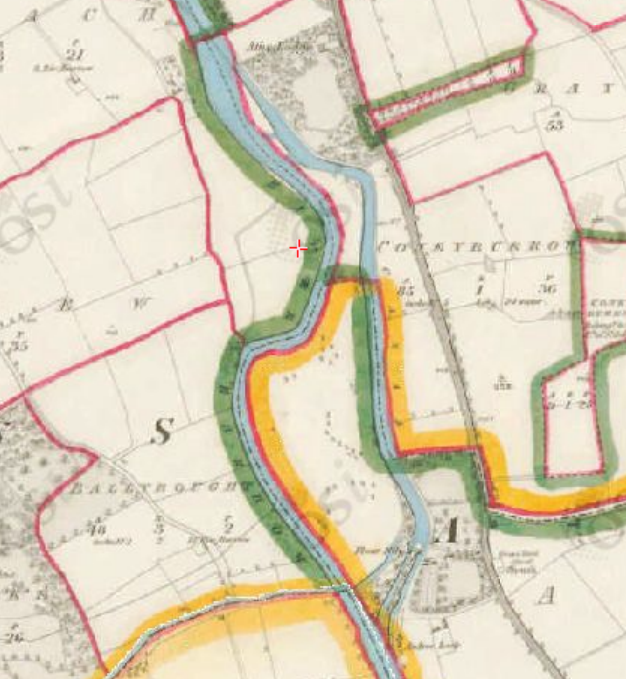
The lateral canal at Ardree on the Barrow

The lateral canal at Ardree on the Barrow [OSI ~1840]

Heather Humphreys [FG, Clones Sheugh]: I am advised by Waterways Ireland that, as the Barrow Navigation is wholly situated within the River Barrow and River Nore Special Area of Conservation (SAC), due regard must be given to the provisions of the EC (Birds and Natural Habitats) Regulations 2011. These require a rigorous assessment to be carried out to assess the impacts of any work on the protected species and habitats, prior to any works being undertaken.

If the impacts cannot be screened out and a Stage II assessment is required, a full planning application must be made. In addition, the Fisheries Consolidation Act 1959 (as amended) prohibits any in-stream works, such as dredging, during the spawning season from October to June.

I am informed by Waterways Ireland that dredging on the lateral canals of the Barrow Navigation was historically done during the winter months but that this is not now possible. However, Waterways Ireland is working with Inland Fisheries Ireland to formulate procedures which would allow work to be carried out in accordance with the relevant legislation. In addition, Waterways Ireland is continuing to work with all relevant agencies to ensure that as much work as possible is carried out on the Barrow within the time constraints which exist.

I have been assured by Waterways Ireland that it remains fully committed to the development of the Barrow Navigation in line with its statutory remit.

This question produced useful information, whereas some TDs seem to ask questions only as a way of assuring their constituents of their undying love and devotion. See, for instance, Brendan Smith, who has asked the same question at least three times.

Note that the short dredging season presumably applies to other rivers that are within SACs, such as the River Shannon at Plassey.

My OSI logo and permit number for website

The Corrib dredger

Drainage and Navigation Works: Construction of dredging machinery

The Commissioners having authorized the purchase of one of the iron dredgers used in the execution of the Shannon works, and then on that river at Athlone, the operation of removing her to Galway was commenced on 1st of March.

This was effected by first clearing her of all machinery, and then cutting up the hull or shell into pieces suited for carriage by land, in which manner every portion of her was removed to Galway.

In reconstructing this boat, considerable improvement and thorough repairs have been effected. A flat iron plate, three-fourths of an inch thick, has been substituted for the hollow iron keel, which lightens her draft of water five inches without any diminution of her steadiness, and an alteration of the position of the steam-pipes has been judiciously arranged. The keelsons were pieced, and whenever any materials were unsound they have been replaced.

The time occupied in the breaking up, transfer, and reconstruction of this dreder, weighing 200 tons, was five months and eleven days, and the whole work was executed at a cost of £803/8/11.

Four scows or decked barges have been constructed for the conveyance of the material raised by the dredger to spoil. Two of these boats are capable of carrying 30 tons, and the other two 45 tons.

Extract from the Annual Report of Mr S U Roberts CE, District Engineer for the year 1851 in Twentieth Report of the Commissioners of Public Works 1852

The Deel navigation

The Deel linked the Co Limerick town of Askeaton to the south side of the Shannon Estuary. Here is a page about the navigation and some of its quays. Note that it is a long page with many maps and photos, although they’re all reduced in size to minimise the strain on tinterweb.

The contagious cargo cult

Readers will be saddened to learn that Ireland’s cargo cult, the delusion that canals bring prosperity, is spreading. It may even be that an increasing frequency of political references to Saunderson’s [né the Clones] Sheugh means that the devotees are about to engage in sympathetic magic by attempting to dig a sheugh.

The sheugh was mentioned in both legislative assemblies on the island on 20 January 2015. In Dublin, Gerry Adams [SF, Louth] said:

I remind the House that the peace process is the most important political project on this island at this time and it needs to be nurtured, protected and enhanced. It must be at the top of the Government’s agenda alongside other priorities.

I wonder how many priorities can dance on the head of an agenda ….

I welcome the financial commitments that have been made, including €25 million in annual funding for the A5 road project, which will assist people in Tír Chonaill, Derry, Fermanagh and Tyrone. I welcome additional funding for reconciliation under the European Union’s PEACE and INTERREG programmes and the Government’s renewed commitment to the Narrow Water bridge and Ulster Canal projects. These are important developments which need to be delivered.

If the Shinners are going to prioritise such nitwitted public spending projects, Goldman Sachs will never allow them into government [assuming that Goldman Sachs cares what happens in Ireland, which they might not, pace Peter Sutherland]. Nobody else mentioned the sheugh in that debate, but several Norn Iron politicos seem to have succumbed to the delusion. They had a debate on “Ulster Canal: Tourism Benefits“, which is like having a debate about the nature of unicorn excrement without first checking to see whether unicorns exist.

Note, in what follows, the complete absence of any quantification of benefits, with only a single mention of costs and with an unwavering belief that canals bring prosperity, even if they lack any interesting features (apart from the engine shed in Clones). There is no attempt at identifying why tourists would be attracted to the sheugh, no discussion of the mechanism by which public spending is translated into tourism revenue and then into local or national benefit.

Not that southern politicians are any better, of course.

Anyway, back to the NI Assembly. Sean Lynch [SF] “asked the Minister of Enterprise, Trade and Investment for her assessment of the potential tourism benefits of re-opening the Ulster canal”. Note that he didn’t say how much of the canal he wanted.

Arlene Foster [DUP] [for it was she] said

The waterways of Northern Ireland have the potential to become an integral part of the tourism experience in Northern Ireland. The proposed Ulster canal development could provide opportunities for canal boating as well as supporting infrastructure to support walking and cycling, all of which would benefit our visitors and the local area.

All of which is waffle. She provided no assessment.

Although the project is being led by DCAL, the Northern Ireland Tourist Board (NITB) continues to work with the Ulster canal inter-agency group through the Destination Fermanagh steering group and with the Clones Erne East Blackwater project to try to maximise the tourism benefit that this project could bring.

Nice to hear that the treasure-seekers, the “inter-agency group”, still exist. I wonder what they do.

So far, Arlene seems to be sticking to her script and hasn’t given much away: the sheugh could do this, that or the other, but there’s nothing concrete. But Mr Lynch asks a follow-up question:

I thank the Minister for her somewhat encouraging answer. Does she agree that, because the canal goes through Monaghan, Fermanagh, Cavan and Tyrone, both tourism boards on the island of Ireland should work closely together to ensure that it is a success?

If it were worth doing, why would the tourism boards have to “work closely together”? Would not hundreds of thousands of foreigners, from lands without canals, come flocking to the sheugh and to the irresistible attractions of Clones? What more could the tourism boards do to sell the thing? “Visit a short canal in the middle of nowhere leading to Clones”?

Mr Lynch may just have been trying to trap Ms Foster into agreeing to some tourism crossborderality. But she seems to have been doing a bit of crossborderality of her own:

The TD for Cavan-Monaghan, Heather Humphreys, has taken a particular interest in the matter, as you would imagine. It is in part of her constituency, as it is in part of ours; therefore, she is keen to move the project forward. When I last spoke to her, she again mentioned the need to push ahead on the Ulster canal.

Oh dear.

So, I think, generally, there is support for the project. I suppose that the big challenge for us all is funding. The Northern Ireland Tourist Board — or Tourism Northern Ireland, as we should now call it — will work with its counterparts to assist and make sure that all the tourism benefits are put into any business case that is put forward.

When ministers are asked questions by members of their own parties, I wonder whether the questions were arranged beforehand in order to allow the ministers to make certain points.

William Humphrey [DUP] said “The Minister is quite right that the primary responsibility lies with the Department of Culture, Arts and Leisure.” The minister knew that already. But then he asked two questions. The first was:

Is Fermanagh District Council taking a collaborative approach to the cross-border element?

That might be intended to sell the prospect of further local government crossborderality to DUP supporters. The minister answered:

As I understand it, Fermanagh District Council is part of the Clones Erne East partnership, which seems to be driving this initiative. Of course, the Erne East councillors will be part of that partnership.

Humphrey’s second question, which elicited an interesting answer, was:

Obviously, in the current economic climate, budgets are tight. Has the Department looked at the possibility of funding from the European Union, given that it is a cross-border venture?

Ms Foster said

I simply do not know is the answer, because DCAL leads on this issue. However, I do know, and I have been advised, that some €54 million would be needed to secure the project to get it completed within 21 to 24 months. It is a large sum of money. If there are options to look elsewhere for funding, we would of course be supportive of them being explored.

Now, what is that €54 million for? Irish ministers have been quoting a figure of €35 million for years, even after 2011 when I was given a revised estimate of €45 million [overview of the history here]. That was to get to Clones. Is Clones now to cost €54 million? Or is that to Castle Saunderson? Or to Lough Neagh? Probably not the last. Note that these cost increases have come even before anybody starts digging anything.

Why does Clones deserve €54 million? Its population seems to be slightly below 3000; why not give every man, woman and child €15,000 each to forget about the sheugh, thereby saving €9 million?

Back to the Assembly. Basil McCrea [UUP], who may be the most sensible MLA, suggested, as he has suggested before, that users of inland waterways pay “for example, through a boat tax” something towards the cost of the waterways “provided that the money is used specifically for enhancing inland waterways?” Ms Foster said that was not her business and added

I want to encourage more people to come and use the inland waterways. Of course, I want them to use Lough Neagh and Lough Erne in particular.

I wonder why she omitted the Lower Bann, the Shannon–Erne Waterway and the various derelict navigations — including Saunderson’s Sheugh.