
… is for sale.
h/t Ewan Duffy
That’s November’s talk at the Killaloe-Ballina historical society; details here and an account of Sandra Lefroy’s talk about the Phoenix here.
Posted in Ashore, Built heritage, Canals, Charles Wye Williams, Economic activities, Engineering and construction, Extant waterways, Historical matters, Industrial heritage, Ireland, Irish inland waterways vessels, Operations, Passenger traffic, People, Politics, Rail, Restoration and rebuilding, Shannon, Sources, Steamers, The cattle trade, The grain trade, Tourism, waterways, Waterways management
There are other areas where tyres are used, namely, boat yards. I know this because I have a house on the Shannon. Are boat yard proprietors to be required to register as the proprietors of 30 or 40 tyres, which are often used to turn over boats safely? They are also used on informal jetties as protections for boats and so on. Is this area to be covered by the regulations?
Michael McDowell at the Joint Oireachtas Committee on Communications, Climate Action and Environment discussion of the Waste Management (Tyres and Waste Tyres) Regulations on Tuesday 17 October 2017.
Great quantities of salmon have been recently exported from Limerick to England, and the abundant supply of eels in the Shannon is furnishing a new and productive traffic in the English market. There are ten tons of this prolific fish now in tanks at Killaloe, awaiting a conveyance to London, and a vessel adapted for the trade will take on board from Limerick in the ensuing week forty tons of eels for the London market.
The Dublin Monitor 23 October 1844
Heal and Son have just completed the erection of machinery for the purifying of feathers on a new principle, by which the offensive properties of the quill are evaporated and carried off in steam; thereby, not only are the impurities of the feather itself entirely removed, but they are rendered quite free from the unpleasant smell of the stove, which all new feathers are subject to that are dressed in the ordinary way.
Old beds re-dressed by this process are perfectly freed from all impurities, and by expanding the feathers the bulk is greatly increased, and consequently the bed rendered much softer.
The following are the present prices of new feathers:
Mixed, 1s per lb
Grey Goose, 1s 4d per lb
Foreign Grey Goose, 1s 8d per lb
Best foreign Grey Goose, 2s per lb
Best Irish White Goose, 2s 6d per lb
Best Dantzic White Goose, 3s per lb
Heal and Son’s List of Bedding, containing full particulars of weights, sizes, and prices, sent free by post, on application to their establishment, 196, opposite the Chapel, Tottenham-court-road.
Daily News, London 24 October 1846

Posted in Ashore, Economic activities, Ireland
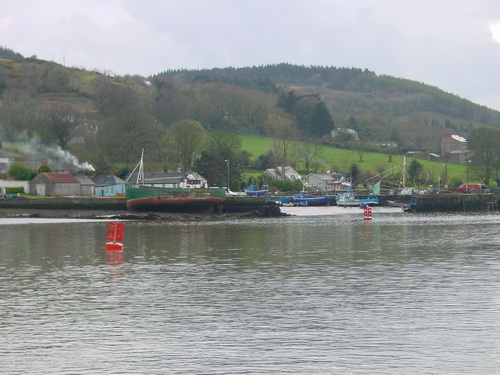
Cheekpoint
Andrew Doherty runs the Waterford Harbour tides’n’tales blog which, starting with a focus on the traditional fishing community of Cheekpoint, has broadened out to take in the whole of the Suir estuary and a few other things besides. As he says
My unending passion is researching and writing about our way of life and more fully understanding the history and heritage that surrounds us here.
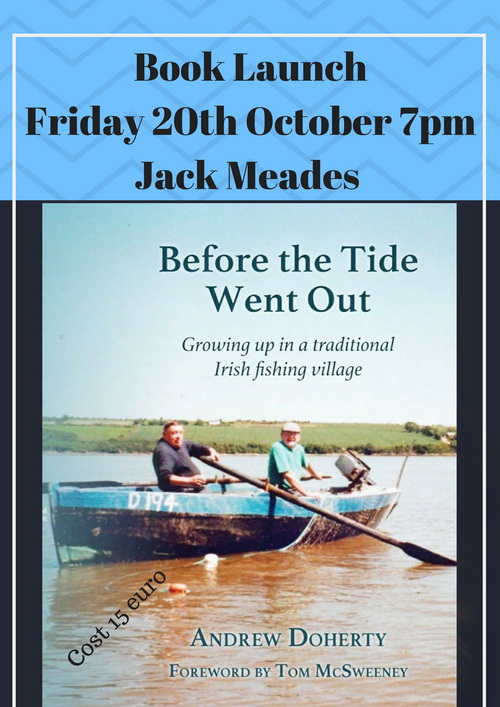
Before the tide went out
Andrew has now written a book, Before the tide went out, and it will be launched at Jack Meade’s on Friday 20 October 2017 at 7.30pm.
From the blurb:
Andrew Doherty vividly brings you into the heart of a now practically vanished fishing community, deep into the domestic lives of the people making a hard and precarious living from the river, only 6 miles from Waterford city centre. You share his affectionate memories of the local people and the fun that was to be had as a child playing in and around the fishing boats and nets on a busy quayside.
He also takes you out on the river, on bright and beautiful days, and on wild and dangerous nights, which he describes with a naturally story telling turn of phrase. You feel the cold, the misery of sea-soaked clothing and the pain of raw hands hauling on fish-scaled nets.
But what keeps you going is what kept him going for 15 years, the camaraderie and pride of spending time with brave, skilled and wise fishermen who could be grumpy, hilarious, sometimes eccentric, but never
boring.
Update: to buy the book see Andrew’s page here.
Posted in Ashore, Extant waterways, Historical matters, Ireland, Modern matters, Operations, Passenger traffic, People, Sea, Suir, The fishing trade, waterways
Tagged Cheekpoint, fishing, Suir, Waterford
There we were, about to breathe a sigh of relief that the Clones Sheugh had been buried at the crossroads, with a stake through its heart and numerous rows of garlic planted around it, when a crack appeared in the earth and the shriek of the undead made the night hideous.
Yes, it seemed that the Minister for Fairytales had successfully diverted everyone’s attention away from Clones by (a) designating the River Finn as the Ulster Canal, which would lead to a scout camp at the spiritual home of Ulster Unionism rather than to Clones, and (b) supporting a greenway walking route to take care of the handsacrosstheborder bit (although ministers from up there seemed to be scarce at the launch. I suppose they’re scarce anyway).
The greenway seems like a better idea to me, given that it’s significantly cheaper than canal restoration and likely to attract far more users, although I wasn’t impressed by the economic assessment in Waterways Ireland’s Ulster Canal Greenway draft strategy document from April 2017 [PDF]. Here is the assessment in full:
6.2 Economic Assessment
Ultimately, the cost of developing a route will play a part in the decision-making process. It may be technically possible to overcome an obstacle, but the cost might make it unfeasible and a longer route chosen. All factors in the Greenway Strategy will be assessed and the most sustainable routes chosen.
That seems to suggest that the costs and benefits of the plan have been thought through with as much care and attention as Her Majesty’s Government over the way has given to Brexit. Which, I imagine, will put paid to much handsacrosstheborderism anyway; I hope it doesn’t put paid to Waterways Ireland as well, although it’s bound to increase the difficulties under which that body labours.
But revenons à nos moutons. Just when we thought it was safe to go out, the dead arose. Sinn Féin MEP Matt Carthy said
Clones needs the Ulster Canal if it’s to have a viable tourism future.
Also from the report of the meeting:
A presentation at the meeting revealed that over 50 percent of buildings in Fermanagh Street in Clones are derelict.
Frustration at the lack of progress with the Ulster Canal was voiced, with representatives stating that it was on the agenda in 1999 and is still on it now.
Perhaps Clones has not got the message: the Ulster Canal is off the agenda. But there is a more fundamental problem: [some] small rural towns are dying because there is no longer any economic need for them. The scale of things has changed since the late nineteenth century; consumers can travel to Aldi and Lidl in larger towns; local markets and fairs are no longer how business is done.
Tourism is unlikely to rescue Clones: if it could do so, why isn’t the town already a tourist destination? Why aren’t its attractions well known throughout Germany and wherever else tourists come from? Enabling tourists to visit by water is not going to attract significant numbers from abroad: there are more scenic and interesting waterways elsewhere, in Ireland and on the continent. There would be a very poor return on the millions that a canal to Clones would cost — not helped by proposals for significant overpayment for land.
I still don’t understand why Sinn Féin is so keen on canals generally and the Clones Sheugh in particular. But Clones might find a new economic role as a post-Brexit smuggling centre.
Posted in Ashore, Built heritage, Canals, Economic activities, Engineering and construction, Foreign parts, Historical matters, Industrial heritage, Ireland, Modern matters, People, Politics, Restoration and rebuilding, Sources, Tourism, Ulster Canal, waterways, Waterways management
Tagged Clones sheugh, greenway, handsacrosstheborder, Minister for Fairytales, Sinn Fein, Ulster Canal, Waterways Ireland
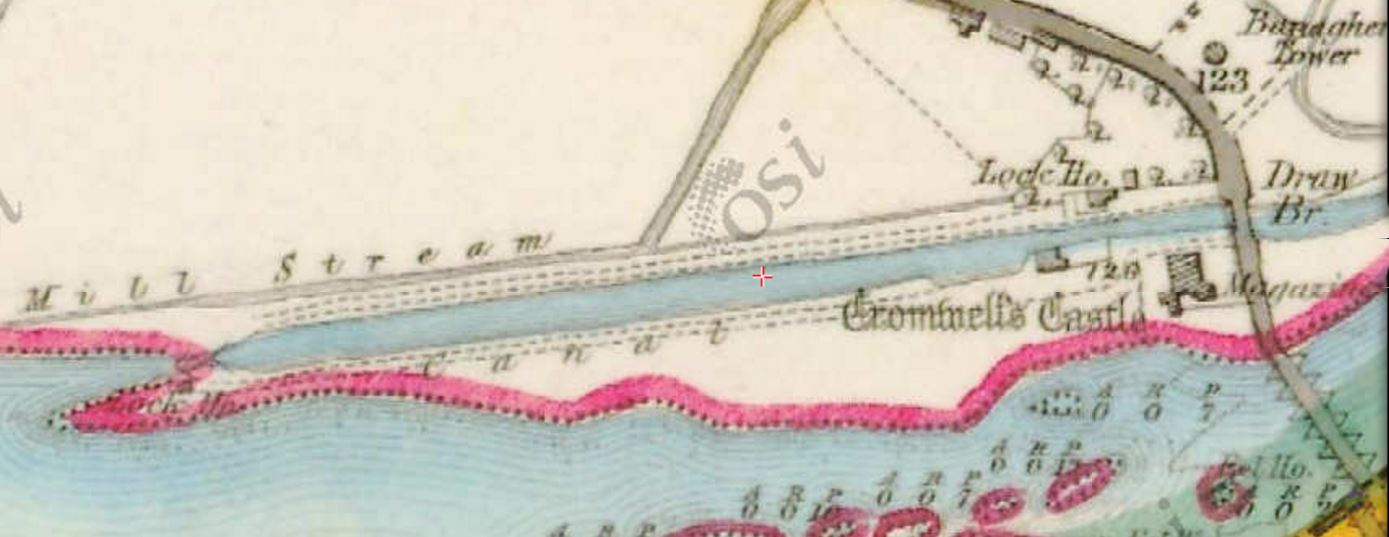
Banagher: the old canal (OSI 6″ map ~1830s)
I was in Banagher yesterday, visiting the site of the old (pre-Shannon Commissioners) canal on the north (virtual west) bank. The area is a park operated by a community group [I would welcome details and a link] and includes a pitch-and-putt course, an outdoor swimming pool in the river and storage for canoes (a group of young people was about to get afloat as I left).
It is also, as the map above shows, rich in waterways and military artefacts. Much of the waterways material can still be seen and a series of signs shows old drawings and provides useful information (though the lock, surprisingly, has no sign). I think I am right in deducing that the signs reflect the work of historian James Scully, one of those who gave an extremely enlightening and entertaining talk about Banagher Bridge a few years ago.
The park is well used by local people but it should also attract many tourists to take the short walk from their boats on the far side of the bridge. It is an excellent example of local initiative drawing on local expertise to illuminate local history and create a sense of place and it could be emulated at many other waterways sites along the Shannon.
Furthermore, added to Banagher’s other historic and literary associations, it shows the wealth of interesting material offered in this town. It is not, unfortunately, on the main tourist routes by road, but it should be possible to attract the interest (and the spending) of water-borne visitors.
I hope that will work for the community; in the meantime, I applaud their initiative.

Posted in Ashore, Built heritage, Canals, Charles Wye Williams, Economic activities, Engineering and construction, Extant waterways, Forgotten navigations, Historical matters, Industrial heritage, Ireland, Modern matters, Operations, Passenger traffic, People, Rail, Restoration and rebuilding, Roads, Shannon, Sources, Steamers, The grain trade, Tourism, Water sports activities, waterways, Waterways management
Tagged Banagher

 Irish waterways history