Category Archives: Built heritage

Up with this sort of thing

Folk interested in the history of the Shannon before 1850 may like to know of a talk …

The smart green technology of the 1830s: the Shannon steamers and the definition of Ireland

… to be delivered to the Thomond Archaeological and Historical Society on Monday 4 November 2013. It’s in Room T.1.17, TARA Building, Mary Immaculate College, Limerick, at 8pm.

A related topic …

Charles Wye Williams and the Anglo-Irish Trade

… will be discussed in one of the papers at the Eighth [British] Waterways History Conference on Saturday 26 October 2013 at the University of Birmingham. Leave a Comment below if you would like contact information for the conference.

Water levels in Athlone

At time of writing, the depth of water at Athlone Weir is 1.7m. “Staff gauge zero is 35.360m above Poolbeg datum”, which means the water level is 37.06m OD (Poolbeg). According to Bob Cullen’s 2002 article for Inland Waterways News [PDF], “The minimum navigation level in Lough Ree is 36.88m OD”, so if the level drops another 0.18m, about 7 inches, there may be a WI Marine Notice.

It seems that the dropping of the level of Lough Ree is intended to provide a buffer against flooding in the area from Athlone downstream to Meelick. According to Brian Hayes “A meeting between the ESB, Waterways Ireland and the Office of Public Works to review the interim operating regime is due to take place shortly.” [I have asked Waterways Ireland for a report on the meeting.]

But, if we are to believe the Dublin Evening Mail, the Shannon Commissioners took a rather more robust attitude to flooding downstream of Athlone: steamers [and PR] came first.

Waterways minister keen on waterways

An exchange from the Northern Ireland Assembly on 7 October 2013, thanks to theyworkforyou.com.

Pam Brown (DUP) asked the Minister of Culture, Arts and Leisure whether inland waterways could be developed to provide a major leisure and recreational activity resource.

Carál Ní Chuilín (Sinn Féin; Minister for Culture, Arts and Leisure): Waterways Ireland is one of the all-Ireland bodies that my Department has responsibility for. You can see the value of the work that it does, particularly in rural areas. I am also working with some councils to improve some of the waterways within their control. I agree with the Member that inland waterways provide brilliant opportunities not just for tourism but for local leisure. They are the economic driver in some towns and villages.

Pam Brown (DUP): I thank the Minister for her answer. She has touched on my supplementary question. Does the Minister agree that the development of inland waterways, while a great source of leisure and recreational activities, can also act as a catalyst for urban and rural regeneration?

Carál Ní Chuilín (Sinn Féin): I agree. I made a statement to the House in July, I think, about some of the events that take place at inland waterways across the island. Those events include festivals and family fun days. Huge numbers attend those events, and they act as economic drivers. Not only are those responsible keen to make sure that they are further developed, but people from other areas visit those festivals in towns and villages to see how they can extract that product for their area. They see the potential and outcome of those events.

That’s good: nice cheap family fun days, not expensive and unnecessary waterway restorations.

Work begins at Sallins

New moorings: Waterways Ireland press statement here and marine notice here.

Edenderry ducks …

… in the Irish Times [article will become inaccessible at some stage].

Newry and Narrow Water

I wrote a few days ago about the proposed bridge across Carlingford Lough at Narrowwater (or Narrow Water). I was reminded of that today on reading a debate, held in the Northern Ireland Assembly on 30 September 2013, about a proposed Newry Southern Relief Road [thanks to theyworkforyou.com].

Apart from an admittedly minor mistake made by a Sinn Féin MLA about the Newry Canal (first summit-level canal, not “oldest inland waterway” in These Islands), the debate was remarkable for its demonstration of cross-party agreement: not so much on the desirability of public works (a desideratum of Irish politicians since the eighteenth century) as on the irrelevance of the Narrowwater bridge. Jim Wells [DUP] said:

There has also been some progress on the Narrow Water bridge project, although we do not know exactly where we stand. First, that bridge is far from certain, and, secondly, even if it were built, it would not relieve much of the traffic that we are dealing with. It would certainly not relieve the large number of juggernauts coming through from Warrenpoint harbour.

Sean Rogers [SDLP] said:

Narrow Water bridge is merely a tourist bridge, but the relief road would take heavy goods vehicles off the streets of Newry, reduce traffic congestion and attract even more shoppers to the city. Heavy goods vehicles would also have a direct route to Warrenpoint port, increasing trade in the port area.

And the other contributors to the debate did not mention it, which suggests to me that it is seen as irrelevant to the traffic problems of Warrenpoint and of Newry.

The Minister for Regional Development, Danny Kennedy [UUP], gave a lengthy response to the debate, including this point:

A more detailed technical investigation of the specific options for crossing the Newry canal was also recommended, given the sensitive nature of this important heritage feature. It is expected to require at least the provision of a bascule, or lifting bridge, to allow the passage of tall ships on the canal. The width of the Victoria lock already limits the size of ship that can enter the canal and it is expected that any bridge would maintain a navigation channel that matches the width of the sea lock. My Department will continue to consult with NIEA on how the impact of the proposal on the canal might be mitigated and an appropriate design developed.

And it seems that one of the areas being considered for the road is Fathom, which is where the Victoria Lock is. It is a short distance north (and upstream) of the border.

It must surely be unlikely that there will be two crossings of Carlingford or the Newry River [and canal] within a few miles of each other. But if one option, the Newry Southern Relief Road, helps to relieve Newry and Warrenpoint traffic and the other, the Narrowwater bridge, doesn’t do so, then the first option would seem to be the rational choice.

Although I wouldn’t bother providing for “tall ships”.



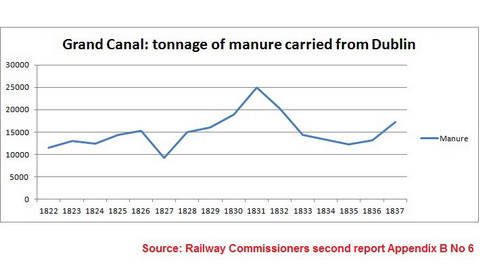
Keeping Dublin tidy

Fertilising the countryside

Fertilising the countryside

Erie warning: stuck with a sheugh

New York is a place in the Americas. There is a town of that name and there is also a state, whose economic development in the nineteenth century was assisted by the development of a canal, about which you can learn more on this excellent site. There is a trail along the canal that can be walked or cycled.

The canal is run by the New York State Canal Corporation, which is a subsidiary of the New York State Thruway Authority [a thruway is, it seems, a sort of road]. The canal loses money (naturally). The Thruway Authority sought to increase tolls; the State Controller said it should save money and improve management instead. Inter alia, it should

Commission an independent analysis of the Canal System to examine ways to streamline operations, seek new funding streams, and develop a realistically attainable vision for its future role in the upstate economy.

In his full report [Assessment of the Thruway Authority’s  Finances and Proposed Toll Increase [PDF] Office of the New York State Controller August 2012], the Controller said that

[…] the New York State Constitution forbids the Legislature to sell, abandon or otherwise dispose of the canals […]

but that

[…] choices regarding operational control and financial support for the Canal System are policy matters to be determined by the Governor and the Legislature.

His summary said that

Additional factors in the Thruway Authority‟s current weakened condition include the Authority‟s responsibility for financing and operating the State‟s Canal System as a result of legislation enacted two decades ago. The Canal System has consumed more than $1.1 billion of Thruway resources in the ensuing period. Contrary to the original legislative intent, responsibility for supporting the canals has diminished the Authority‟s ability to pursue its core mission. Moving the Canal System into the Thruway Authority was intended, in part, to stimulate tourism and economic development along the historic
canal corridors. This goal, too, has been elusive; boating activity on the canal has  declined substantially under Thruway control.

Later in the report he said

Second, the Authority‟s financial resources and organizational expertise, along with the then-newly created Canal Recreationway Commission, would position the underused Canal System to improve its facilities and marketing such that new users would be attracted from around the country, and even around the world.

Neither of these hoped-for outcomes has occurred. The Thruway Authority has invested more than $1.1 billion in the Canal System, and this drain of toll resources has also contributed to the deterioration of the Authority’s financial condition over the past decade. Meanwhile, despite major investments and new amenities, pleasure-craft activity on the Canal System in recent years is down by nearly one-third since the period immediately before the Thruway Authority assumed control.

The local media seem to take a somewhat more informed interest in their sheugh than do those in these parts:

Ireland and the United Kingdon could avoid finding themselves in these difficulties by refusing to recreate any more sheughs.


Who saved Clonmacnoise?

It seems possible that, at some stage in the late eighteenth century, there was a plan that would probably have destroyed Clonmacnoise.

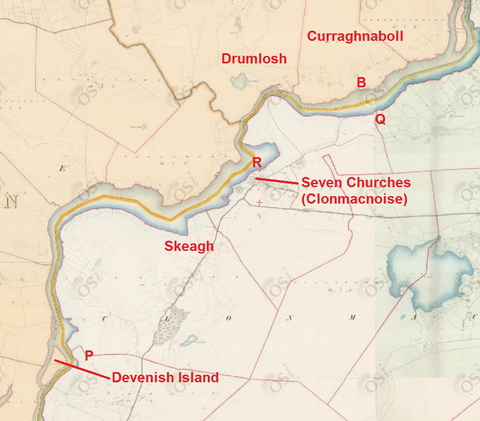
There exists A Map of the River Shannon from Athlone to Killaloe, Surveyed by John Killaly 1795, which contains much of interest. I do not have permission to reproduce it here, but here is the section around Clonmacnoise from the ~1840 OSI 6″ map.

Clonmacnoise OSI ~1840

Clonmacnoise OSI ~1840

I have marked on the map some of the placenames used by Killaly.

The legend reads:

[…]

B. Ford least water 4F 6J [which I take to mean 4′ 6″]

[…]

From Q to P the proposed Canal is ¾ Mile shorter than the River.

From Q to R [the proposed Canal] is ¾ Mile shorter than the River.

It seems therefore that, in 1795, someone was considering shortening the Shannon by digging one of two possible canals to cut off peninsulas along the east bank. Given the narrowness of the stretch between the esker and the river, I suspect it would have been impossible to dig either of them without destroying Clonmacnoise.

I would like to know more about the proposal and about why it was abandoned.

Incidentally, some folk prefer the spelling Clonmacnois but the Placenames Database of Ireland uses Clonmacnoise.

My OSI logo and permit number for website

Chambers, pots

Folk knowledgeable about canal engineering and artefacts might be able to contribute to a current discussion, over at the Helpful Engineer’s website, of the Four Pots overflow and the side chambers at Lock 16 (Digby Bridge) on the Grand Canal.