
There are not so many of them. I wonder what’s happening in Ireland.
There are not so many of them. I wonder what’s happening in Ireland.
Fianna Fáil, an Irish political party, has published what it describes as a “new Bill to help tackle River Shannon flooding“.
In fact, of course, the bill, if enacted, would do nothing of the sort, as the party itself admits. It proposes to add even more idiotic measures, including subsidies to encourage people to live in flood plains. But at the core of its thinking is that no interests, other than those of the inhabitants of flood plains, should carry any legal weight, and that that can be assured by placing a single body, the Electricity Supply Board, in charge of everything to do with the Shannon. Perhaps it was inspired by the ESB’s success in dealing with the salmon and eel fisheries — although some might prefer that the ESB concentrate on reducing electricity prices instead.
Blithering idiocy of this kind is not confined to Fianna Fáil and it is, I suggest, a reflection of the generally low level of ability and experience of Irish politicians. They are, I suggest, simply unable to think usefully about large and complex problems.
I tried to find CVs for all members of the current Dáil. I looked at Wikipedia entries, personal websites and party websites, as well as a few other sites that I hoped might have information.
I was looking for TDs whose CVs indicated significant experience in running large organisations or large projects: projects as large and complex as, for instance, managing Shannon floods, hospitals or the water supply.
I found nobody whose experience came anywhere near those levels (although it is of course possible that some TDs have such experience but choose to keep quiet about it). There were a few who had worked in medium or large organisations, but at junior levels, and some who had worked at senior levels in small organisations. Some of those with relevant experience had gained it in public or third-sector bodies: I was not looking solely for private-sector experience. But there were far too many who had worked in “professions” or as lobbyists of one kind or another, whose proudest boasts were of involvement in local bodies and of a desire to help individual constituents.
I’m sure they’re all very nice people. But I don’t believe that they have any conception of what it takes to analyse complex data, cost alternative policies or set up and run large organisations carrying out difficult tasks. Hence their focus on nit-picking and on the personal: they are simply unable to cope with anything more difficult. And hence too their fondness for setting up new organisations, reallocating functions and passing laws: they can do all of those things (and perhaps find places on boards for their mates) without having to get to grips with the real, the complex issues. They don’t even have to cope with the chaos their meddling causes — and they then have a new set of people they can shout at.
Some of them might just about be able to organise a piss-up in a brewery; few if any of them could organise the construction and fitting out of anything as complex as a large brewery or could manage the operations of such a brewery. That might not matter if they worked on policy analysis instead, but few of them seem to have any abilities in that sphere either. The problem is one of scale: organising a successful parish bingo night, or an election campaign, is not sufficient preparation for running a large project or organisation.
I see that wiktionary defines “shifting the deckchairs on the Titanic” as
To do something pointless or insignificant that will soon be overtaken by events, or that contributes nothing to the solution of a current problem.
That about sums it up.
A few minutes past two o’clock in the evening of Wednesday, the 6th instant, the Dover Castle left Glin [that should read Limerick] for Tarbert, with between 30 and 40 persons on board, including some of the Glin police.
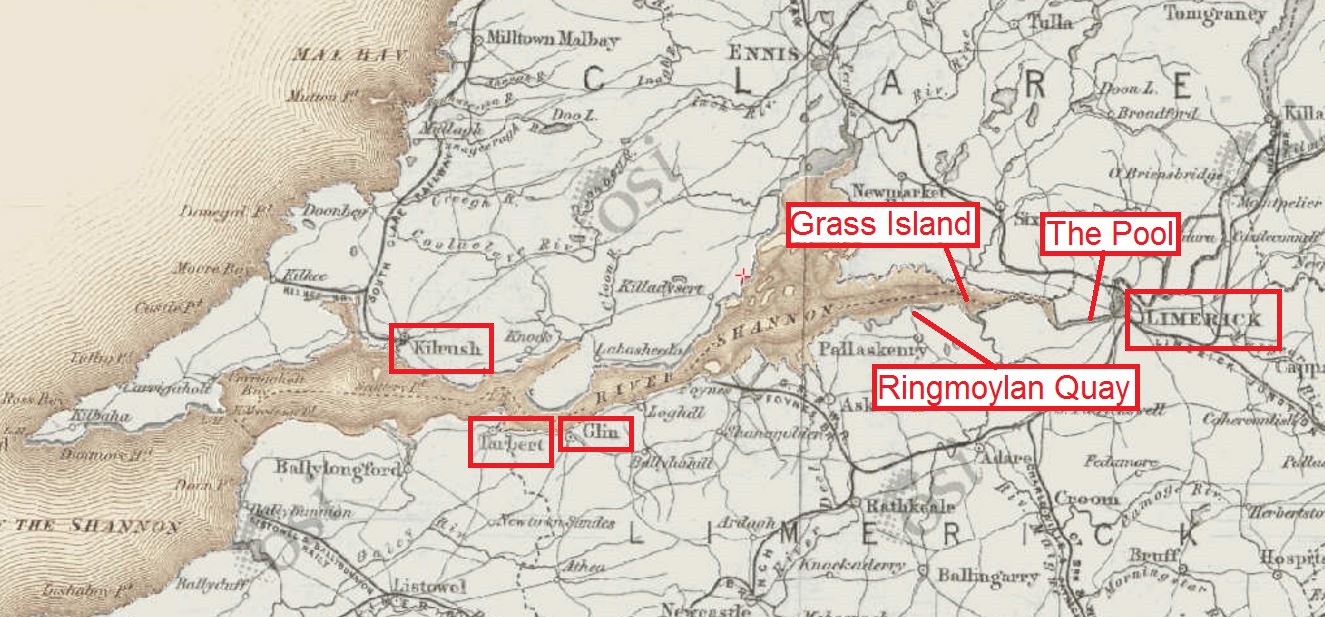
The route of the Dover Castle (OSI 25″ ~1900)
When she reached the pool, she took a large brig and a schooner in tow, which she took as far as Grass Island. She then continued her course, and when about three miles west of Ring Moylan quay, a thick fog came like a wall upon her, so that it was impossible to see half the length of the deck.
Captain White immediately dropped anchor, and was obliged to remain so. The fog continuing all night and the next day.
About two o’clock on Thursday, there being no appearance of the fog clearing off, and several persons on board having eaten nothing since Wednesday morning, two women fainted, and the circumstance having been communicated to the captain, he immediately ordered the steward to open a bag of flour, and served it out in large buckets to the women, who, in a short time, had large cakes made, and baked them for the passengers.
At half-past four o’clock the fog began to clear, and at five the steamer weighed anchor, and reached Kilrush in safety.
Statesman and Dublin Christian Record
19 January 1841 quoting Limerick Standard


Posted in Economic activities, Extant waterways, Historical matters, Ireland, Irish inland waterways vessels, Operations, Passenger traffic, People, Safety, Sea, Shannon, shannon estuary, Steamers, waterways, Weather
Tagged Captain White, Dover Castle, fog, Grass Island, Kilrush, Limerick, pool. Glin, Ringmoylan, shannon estuary, Tarbert
Some weeks ago Redmond O’Brien left a comment here; later he very kindly sent some photos. I have interspersed comment and pics here.
Today, while cycling on the Greenway along the Suir, I noticed a small pier and harbour by Mount Congreve.

Pier at Mount Congreve (copyright Redmond O’Brien)
Is anything known about this? Possibly used by Mount Congreve at some time? A rather unusual design. The pier/quay is rectangular with stone steps on the upriver side.

Stone steps (copyright Redmond O’Brien)
On the downriver side of the pier is a small rectangular harbour with a wall enclosing the side opposite the pier.

Enclosure at Mount Congreve (copyright Redmond O’Brien)
I wondered whether the pier or quay might have anything to do with the Christmas Canals, which Anthony M Sheedy said were “a joint effort between the Two Estates to bring irrigation into the Mount Congreve Estate”. I emailed the Mount Congreve Estate to ask if they knew anything about it, but I had no reply.
I also wondered whether the enclosed area might be for smaller boats, which might be transhipping cargoes to or from larger vessels tied at the end of the pier, quay or wharf. However, all of that is speculation.
The pier or wharf is shown on the 6″ Ordnance Survey map.

The pier on the 6″ Ordnance Survey map ~1840 (copyright Ordnance Survey Ireland)
It also appears on the 25″ map of around 1900.

The wharf and the wall on the 25″ map (copyright Ordnance Survey Ireland)
Here’s a close-up.

The wharf ~1900 (copyright Ordnance Survey Ireland)
I have found nothing about this in Charles Smith’s The Ancient and Present State of the County and City of Waterford or anywhere else, save for one possible clue in an article “Rambles by Road and by Rail” published in the Waterford Mail on 3 December 1862 and in the Waterford News on 12 December 1862 (both on the British Newspaper Archive), but originally from the Farmers’ Gazette. The article, part of a series, is about Mount Congreve. It begins:
There is scarcely an individual in Waterford or Tramore who does not know Mount Congreve, the beautifully situated residence of John Congreve Esq, in consequence of the free permission given by that gentleman to those who may wish at any time to visit his grounds. It is, consequently, the regular resort during summer and autumn of pleasure parties from Waterford and Tramore, those visiting it from Waterford generally preferring to sail up the Suir to the place, handy quays being erected at different parts of the grounds for the accommodation of visitors.
No doubt the quays could accommodate visitors, but a later part of the article offers a more plausible explanation for the existence of the handy quays:
Four large lime kilns are kept constantly at work during summer, one of them being generally working all the year round, not so much as a matter of profit, as for the purpose of affording employment and of supplying Mr Congreve’s tenants and others in the neighbourhood with lime at moderate rates. The limestone is brought from Mr Congreve’s property on the county Kilkenny side of the Suir, as there is no limestone on the county of Waterford side, and the navigable capabilities of that river enables vessels to discharge their cargoes of culm just at the kilns, thereby effecting a considerable saving in point of carriage. One way or other, a considerable number of people are employed by Mr Congreve in connection with his lime works, besides being of great service to the neighbourhood.
The 6″ OSI map shows what may be the handy quays here (they’re easier to see on the black and white version). And if you switch to Historic 25″ you’ll see even more round objects, with the legend LK, which I take to mean Lime Kiln.
However, the kilns are some way downstream of the wharf, and it has no LK legend or round objects near it. There are, though, some LKs just a little way up the Christmas canals.
But this is speculation, and I would be glad to hear from anyone who knows anything about the wharf on the Suir.
Posted in Ashore, Built heritage, Canals, Economic activities, Engineering and construction, Extant waterways, Forgotten navigations, Historical matters, Industrial heritage, Ireland, Irish inland waterways vessels, Operations, Suir, Uncategorized, waterways
Tagged Christmas canals, culm, lime kiln, Mount Congreve, pier, quay, Suir, Waterford, wharf
Mr Kernaghan’s steamer is navigating Lough Gill, which has increased the value of country produce in Sligo market 15 per cent, and it is proposed to connect the Lough with the Shannon four miles distant.
Roscommon & Leitrim Gazette 11 May 1844
What a collection of notables ….
Captain Beaufort RN, Hydrographer to the Admiralty
The Right Hon Maurice A Fitzgerald
Simon M’Gillivray Esq
The Right Hon Lord Talbot de Malahide
George Richardson Porter Esq, Board of Trade
Richard Griffith Esq, Civil Engineer
John David Latouche Esq
Peirce Mahony Esq
Daniel O’Connell Esq
The Hon Frederick Ponsonby
Charles Wye Williams Esq
Christopher Bullin Esq
James Ferrier Esq
James Jameson Esq
Richard Williams Esq
George M’Bride Esq
Francis Carleton Esq
Dublin Mercantile Advertiser, and Weekly Price Current 1 August 1836
From the British Newspaper Archive
Lewis Davis says:
Empirically, I find a robust negative correlation between rainfall variation, a measure of exogenous agricultural risk, and a measure of individual responsibility. Using rainfall variation as an instrument, I find that individual responsibility has a large positive effect on economic development.
Abstract on Tyler Cowen‘s site. You can rent the whole article for $6.
At Christmas 1839 the 150-ton schooner Lansdowne, owned by the Limerick Shipping Company, sailed from Limerick for Glasgow.
The Marquis of Lansdowne had been built at the company’s yard at North Strand, Limerick, downstream of the Wellesley Bridge and on land owned by the noble Marquis. She was named by Miss Russell, daughter of John Norris Russell, a principal shareholder, and launched on Tuesday 5 November 1839, in the presence of Sir William Macbean, Col Mansel and most of the officers of the garrison. The other merchant vessels in port had “colours flying from stem to stern” and “frequent discharges of artillery” welcomed the new schooner to the “world of waters”.
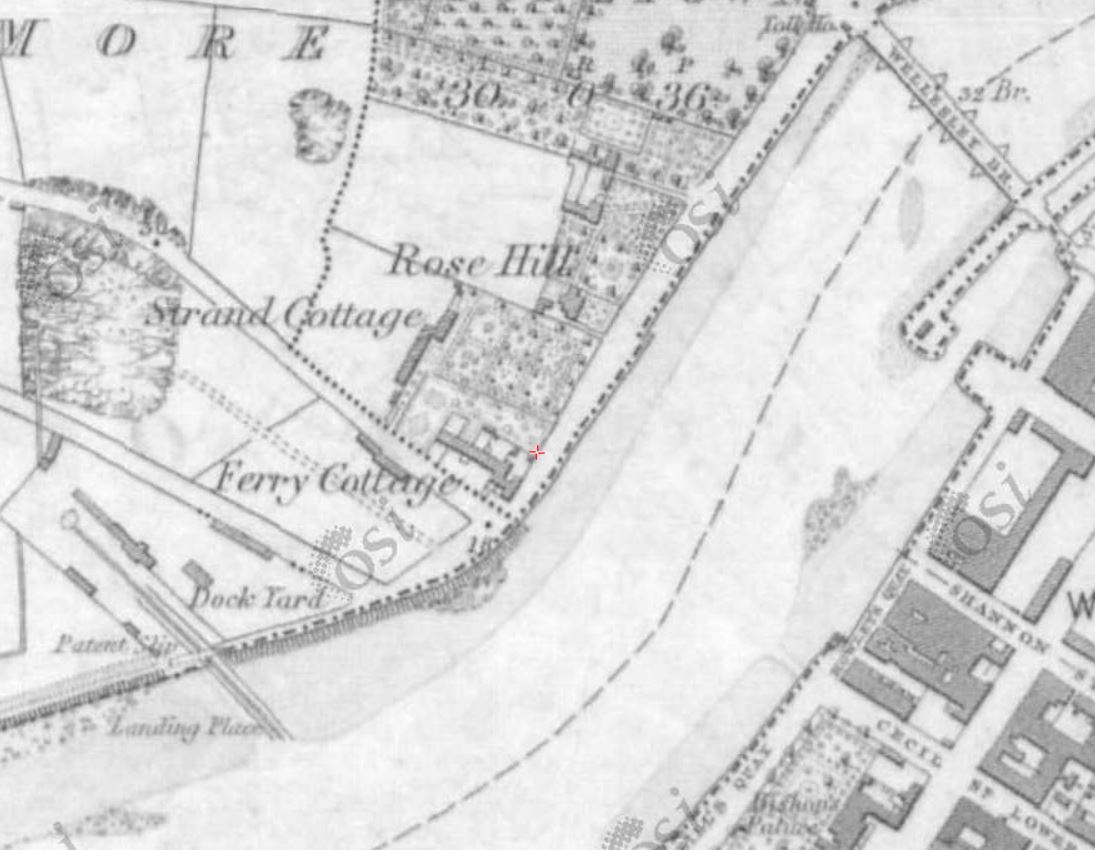
The Limerick Shipping Company’s ship-building yard (OSI ~1840)
The yard, which was equipped with a patent slip, had another schooner on the stocks at the time. According to Commander James Wolfe
There is a patent slip and yard at Kilrush, as well as at Limerick. At the latter place the slip is proved for vessels of 400 tons, at the former only for those of 250 tons. Repairs to any extent may be done at either of these places; and at Limerick some fine vessels have lately been built.
The Limerick Shipping Company had ten schooners by 1834 and, in 1838, bought a steam tug, the Dover Castle, which also competed in the passenger-carrying trade on the Shannon Estuary. By 1842 it had thirteen schooners and was offering regular weekly sailings between Limerick and London.
At no period were the Commercial interests of the Port of Limerick so prosperous, this spirited Company having now at their command a squadron of vessels equal, if not superior for all sailing qualities, to those of any other port in Ireland.
John Brown, aged 27 or 28, got married one day before the Lansdowne sailed at Christmas on what must have been one of its first voyages. In Glasgow, the schooner berthed at the Broomielaw, and in mid-January Brown went drinking with William Bennet and John Anson, both aged about 20. When they returned to the schooner, they lit the stove in the forecastle, closed the hatch and went to bed.
The port regulations banned fires on vessels after nine o’clock; the newspaper said [without citing any evidence] that the three men closed the hatch “so as to prevent a single ray being seen outside” by the police on the quay.
The unfortunate men went into their sleeping berths, and as might have been anticipated, the consequence proved fatal to all the three, the action of carbonic acid having done its deadly work long before morning.
About seven o’clock they were found dead, their countenances as calm as if they had still been under the influence of sleep. One of them was in a half sitting posture.
Two doctors inspected the bodies and “corroborated the accidental nature of the causes which led to death; and liberty was granted to have the bodies interred.”
The Lansdowne herself survived for only another three years: she was wrecked on the Scottish coast in January 1843.
Clare Journal, and Ennis Advertiser 7 November 1839
Sailing Directions for the Lower Shannon, and for Lough Derg; with some Hydrographic Notices of Lough Ree and Lough Erne. By Commander James Wolfe RN; being the result of Surveys made by Order of the Lords Commissioners of the Admiralty
Clonmel Herald 25 January 1840 quoting Glasgow Courier
Limerick Reporter 17 January 1843
All newspapers from the British Newspaper Archive:
Posted in Ashore, Economic activities, Engineering and construction, Foreign parts, Historical matters, Industrial heritage, Ireland, People, Safety, Sea, Shannon
Tagged Broomielaw, carbon monixide, Glasgow, John Norris Russell, Lansdowne, Limerick, Limerick Shipping Company, patent slip, Wellesley Bridge
According to the Irish Times of 27 August 2016
Fáilte Ireland has tendered [sic] for a company to help it develop a new tourism strategy for the swathe of land running down the middle of Ireland that falls outside the Wild Atlantic Way and Ireland’s Ancient East, the two linchpins of the State’s tourism marketing strategy.
The area, generally referred to in tourism marketing circles as “Ireland’s Lakelands” district, takes in parts of east Galway, Roscommon, Leitrim, much of north Tipperary, and runs down as far as the northern reaches of Cork. […]
The tender made no mention of the Lakelands moniker, but Ms Carroll [of Fáilte Ireland] […] said the Lakelands term, which is also used in the Programme for Government’s tourism strategy, may not end up being the final slogan that is used for the region.
I wonder what that does for Waterways Ireland’s Lakelands & Inland Waterways marketing and product development Initiative and what it says about the success of the Lakelands Strategic Plan [PDF]. I note too that the Irish Times refers to “the State’s tourism marketing strategy” whereas WI’s initiative was a cross-border one and included the Erne as well as the Shannon.

 Irish waterways history