
Waterways Ireland removed boats from Charlotte Quay in the Grand Canal Dock at Ringsend today.
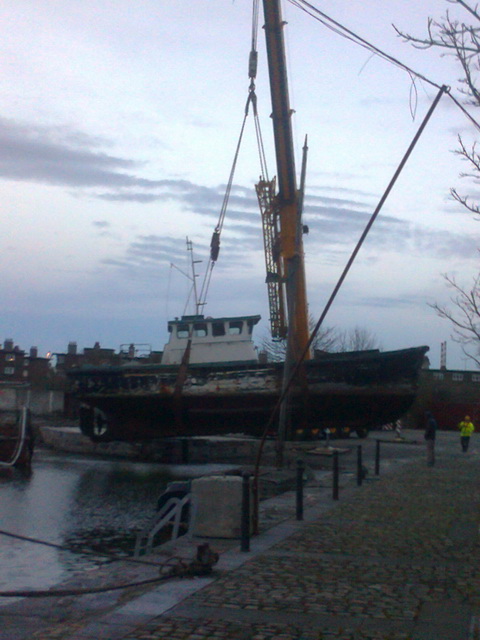
Being lifted
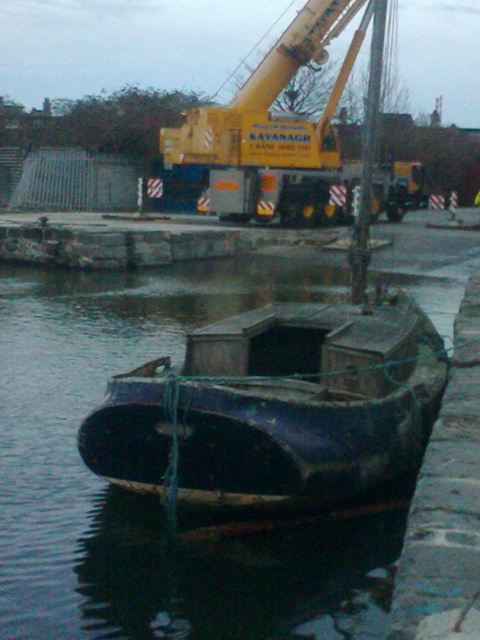
Getting ready
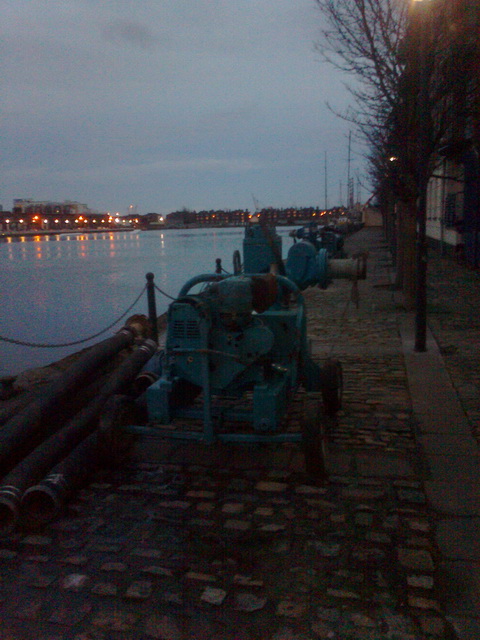
Pumps on the quay
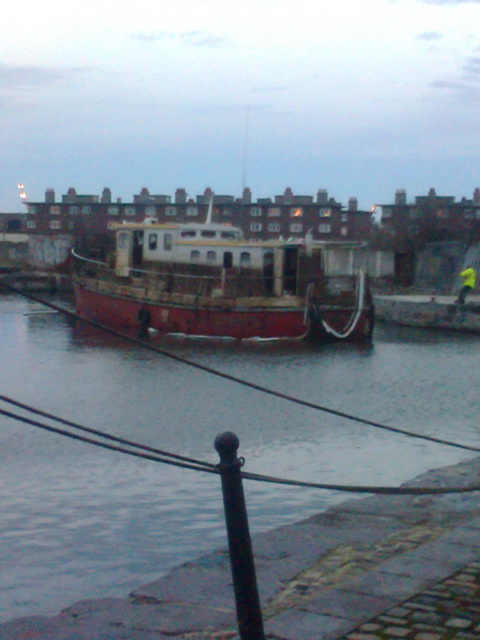
Ready for the slings
Thanks to Paul Quinn for the information and photos.
Waterways Ireland removed boats from Charlotte Quay in the Grand Canal Dock at Ringsend today.
Being lifted
Getting ready
Pumps on the quay
Ready for the slings
Thanks to Paul Quinn for the information and photos.
Posted in Ashore, Economic activities, Engineering and construction, Extant waterways, Ireland, Irish inland waterways vessels, Operations, waterways, Waterways management
Tagged barge, basin, boats, canal, Charlotte Quay, crane, Dublin, Grand Canal, Grand Canal Dock, Ireland, lift, lock, Operations, Ringsend, vessels, waterways, Waterways Ireland
It is always pleasing to learn that powerful folk take an interest in the humble pleasures of the proletariat. Thus, back in 2003, many a plebeian heart leapt with joy on learning that Tha Lord Laird o Artigarvan [as we say in Ulster Scots] was asking questions of Her Majesty’s Government in the House of Lords about Waterways Ireland developments on the River Shannon at Limerick, Boyle, Ballinasloe, Ballyleague, Shannonbridge and Scarriff.
Alas, it seems that Tha Lord Laird, who once had the highest expenses in Their Noble Lordships’ House, may not be asking questions in the House of Lords for some time. He resigned the Unionist whip in June; it appears that he may now be suspended from the House of Lords, whose members he esteems. It really take the biscuit.
SHANNON-RIVER. This is by far the most considerable river in Ireland, or perhaps in any known island, not only on account of its rolling 200 miles, but also of its great depth in most places, and the gentleness of its current, by which it might be made exceedingly serviceable to the improvement of the country, the communication of its inhabitants, and consequently the promoting inland trade, through the greater part of its long course, being navigable to a considerable distance, with a few interruptions only of rocks and shallows, to avoid which there are in general small canals cut, to preserve and continue the navigation.
Thus Wm Wenman Seward, Esq [correspondent of Thomas Jefferson], in his Topographica Hibernica; or the topography of Ireland, antient and modern. Giving a complete view of the civil and ecclesiastical state of that kingdom, with its antiquities, natural curiosities, trade, manufactures, extent and population. Its counties, baronies, cities, boroughs, parliamentary representation and patronage; antient districts and their original proprietors. Post, market, and fair towns; bishopricks, ecclesiastical benefices, abbies, monasteries, castles, ruins, private-seats, and remarkable buildings. Mountains, rivers, lakes, mineral-springs, bays and harbours, with the latitude and longitude of the principal places, and their distances from the metropolis, and from each other. Historical anecdotes, and remarkable events. The whole alphabetically arranged and carefully collected. With an appendix, containing some additional places and remarks, and several useful tables printed by Alex Stewart, Dublin, 1795. [Google it if you want a copy.]
Seward was one of many people who saw the Shannon as a valuable resource, even if they were vague on how it was to yield a return. I was reminded of that on reading the Strategic Integrated Framework Plan for the Shannon Estuary 2013–2020: an inter-jurisdictional land and marine based framework to guide the future development and management of the Shannon Estuary. The Introduction includes this:
The Shannon Estuary is an immensely important asset and one of the most valuable natural resources in Ireland and the Mid-West Region in particular — the fringe lands and the marine area both provide space and location for development, activities and opportunities to progress economic, social and environmental growth within the Region.
This report is an attempt to show how the estuary could deliver a return. The core point seems to be that a small number of areas are designated as “Strategic Development Locations for marine related industry and large scale industrial development”, thus protecting them from the attentions of the environmentalists: the whole of the estuary is a Special Area of Conservation and a Special Protection Area.
Almost all the Strategic Development Locations are already industrialied in some way:
There is one more, Inishmurry/Cahircon (which is not boring), which is even more interesting because there is no industry there at present. It was used as a resting place for certain vessels, but it was also proposed as the site for an explosives factory. Perhaps the designation as a Strategic Development Location suggests that that proposal is not dead but merely sleeping.
Ballylongford is equally lacking in industry, despite activity at Saleen in the early nineteenth century. However, Shannon Development assembled a large landbank nearby; the report’s Executive Summary says:
The Ballylongford Landbank benefits from a significant deepwater asset and extant permission for a major LNG bank.
Here is the area in question. Note that the red oval is just to indicate the rough location; it does not show the boundaries of the landbank.

Ballylongford (OSI ~1840)
You can see a proper map and a marked-up aerial photo in Volume 1 of the report [PDF] on page 73 (77/174).
Shannon Development agreed to give a purchase option on a little uder half of the site to Shannon LNG Ltd, which proposed to build a liquefied natural gas terminal there, to be supplied by ship; much information is available here.
The Commission for Energy Regulation decided to introduce charges that would have increased Shannon LNG’s costs; the company took the matter to court but, yesterday, lost its case. The Irish Times report here will probably disappear behind a paywall at some stage; the Irish Independent report is here and the Limerick Leader‘s here (its photo shows Tarbert and Moneypoint; the Ballylongford site is off to the left).
If the Ballylongford development does not proceed, plans for economic growth on the Shannon estuary may prove to be for the birds.

Posted in Ashore, Economic activities, Engineering and construction, Extant waterways, Ireland, Natural heritage, Non-waterway, Operations, Politics, Scenery, Sea, Shannon, shannon estuary, Sources, Steamers, Tourism, Uncategorized, Waterways management
Tagged Ballylongford, boats, Clare, ESB, estuary, Fergus, Hess, Ireland, Kerry, Limerick, liquefied natural gas, LNG, Operations, SAC, Saleen, Shannon, shannon estuary, Shannon Foynes Port Company, Shannon LNG, SIFP, SPA, Tarbert, waterways
Waterways Ireland is currently (I presume) implementing its Corporate Plan 2011–2013 [PDF], which still has a month to run. That plan set out, inter alia, a mission:
Our mission is to provide a high quality recreational environment centred on the inland waterways in our care, for the benefit of our customers.
It also had core values, which is nice, and a vision:
Our long term vision is to create an interrelated waterways network which will provide accessible recreational benefits and opportunities for all.
We wish to create facilities and services which will attract and impress visitors from home and aboard, supporting and encouraging the tourism and recreational industries in Northern Ireland and Ireland and promoting sustainable economic growth across the island of Ireland. We seek to protect and enhance the natural environment in and along our waterways for the enjoyment of future generations.
For the period of this plan we intend to focus on the consolidation, improvement and promotion of existing waterways in order to maximise their use. We will progress toward our long term vision by focusing development on the Ulster Canal.
And it had strategic objectives:
To deliver the benefits and opportunities the waterways can provide across a range of areas, Waterways Ireland has identified 6 strategic objectives which will drive the delivery of our Mission and Vision and the objectives set out in this Corporate Plan. These Strategic Objectives are to:
1. Manage and maintain a reliable and high quality waterways network.
2. Develop and restore the waterways network.
3. Enhance the existing waterways network to widen its appeal to users.
4. Promote increased use of our waterways resource principally for recreational purposes.
5. Assess, manage and develop the assets of Waterways Ireland.
6. Develop an organisation of excellence.
Reading that lot, it seems to me that the focus was inward rather than outward, perhaps more in line with traditional engineering-led waterways management than with the new and exciting marketing-led organisation of the future.
The mission is de haut en bas, with waterways coming before customers, and the first sentence of the vision continues the theme. The second sentence does mention economic affairs, but “supporting and encouraging the tourism and recreational industries” suggests that tourism and recreation are something that other people do, not something that WI does: it does not seem to see itself as part of the “tourism and recreational industries”.
The intro to the strategic objectives is pure management gobbledegook, but the really revealing bit is the list of objectives. The last two are inward-looking, but note the ordering of the first four and what the balance of elements says about the corporate focus: WI is going to
This is what used to be called a sales model: design and build your widgets first; then go and flog them to the punters. There is an alternative approach: start by finding out what the potential punters might want and then design and build your widgets to meet their needs. In reality, of course, you do something in between, because you’re not starting with a blank slate: your factory can make one particular kind of widget, not all possible kinds. And, similarly, WI’s main asset is a collection of waterways, not of (say) amusement parks or bookshops.
But a marketing focus could help an organisation to think about how its widgets are to be used. The result doesn’t have to be as crude as adding the word “solutions” to everything; it can be used to shape how the organisation presents its widgets and to whom it presents them. And, in my view, WI needs to do that because, according to the only reliable (and admittedly inadequate) measure we have, the Shannon traffic figures, waterways usage has been declining for at least ten years. [I know that there are other waterways, and many other types of activities thereon, but I don’t know of any published statistics about the extent of usage.] WI needs to reimagine the waterways.
When Jimmy Deenihan spoke in the Dáil on 16 October 2013, he said:
The [budgetary] provision will enable Waterways Ireland to deliver on its core activities and targets, which include keeping the waterways open for navigation during the main boating season and promoting increased use of the waterways resource for recreational purposes. This expenditure should also assist in developing and promoting the waterways, attracting increased numbers of overseas visitors and stimulating business and regeneration in these areas. Capital funding of almost €4 million will be made available to Waterways Ireland to facilitate the ongoing maintenance and restoration of Ireland’s inland waterways, thereby increasing recreational access along the routes of waterways.
My attention was attracted by the phrase about keeping waterways open “during the main boating season”, which suggests a new, restrictive policy. However, the rest of the list is pretty much in line with the existing objectives. I hope that something more radical will come out of the corporate planning process in which WI tells me it is currently engaged.
By the way, note that there was no mention of either heritage, which was the excuse for nicking the waterways from the OPW, or northsouthery.
Posted in Economic activities, Engineering and construction, Extant waterways, Industrial heritage, Ireland, Operations, People, Politics, Sources, Tourism, Uncategorized, Water sports activities, waterways, Waterways management
Tagged corporate plan, department of arts heritage and the gaeltacht, Ireland, lakelands, marketing, Operations, strategy, waterways, Waterways Ireland
I’ve just read the minutes (they call ’em joint communiqués, to be posh) of all the North South Ministerial Council Inland Waterways meetings since northsouthery got going again in 2007.
After a bit of catching up in the first couple of years, the NSMC has usually managed to “note” WI’s Annual Reports and Accounts about six months after the end of the year to which they refer: the accounts for 2008 were noted in 7 months, 2009 in 5, 2010 in 7, 2011 in 7 and 2012 in 6. But “noting” doesn’t mean approving: various other bods, including two Comptrollers and Auditors General, then have to look at them, so the citizenry doesn’t get to see the accounts for many months afterwards: the report and accounts for 2012 are still not available.
Nothing to see there, then: both WI and the NSMC appear to be doing their bit as fast as could reasonably be expected. But what is odd is the delay in noting or approving plans and budgets. Knowing litle of management science, I had the naive idea that managers would be working to approved plans and budgets from the start of the year, but WI usually doesn’t get approval until the year is almost over. I do not know why that is.
WI’s business plan for 2008 was approved in October 2007, which is reasonable, although it seems to have been revised in July 2008. But the plans for 2009 and 2010 were not approved until 11 months into the year, that for 2011 until 10 months and that for 2012 until June 2013, six months after the end of the year. I realise that forecasting is difficult, but retrospective planning is surely less than useful.
The same delays apply to the budgets for 2010, 2011 and 2012. So the June 2013 meeting of the NSMC approved or noted:
I do hope that someone checked to ensure that all the documents accorded with one another: it would be really embarrassing if they didn’t. But as a management exercise this seems to be somewhat less than useful.
The same meeting also
… noted progress on the development of the 2013 Business Plan and budget. Following approval by Sponsor Departments and Finance Ministers the plan will be brought forward for approval at a future NSMC meeting.
It is good to know that, six months into the year, there was progress on the business plan and budget for that year. The minutes of the November meeting don’t mention the 2013 business plan and budget (but do, I am pleased to note, mention the 2014 versions), but there was a disturbing item of information on the previous day, 19 November 2013. Brendan Howlin, Minister for Public Expenditure and Reform, replied to a written question from Gerry Adams [SF, Louth], saying inter alia
The 2013 Budget allocation to the Body are subject to on-going discussion by the two Sponsor Departments.
This is November; 88% of the year has passed and the Irish budget for 2013 was approved long ago — yet WI still hasn’t been told its budget for 2013. WTF is going on?
I note that the same applies to the other north-south body or bodies that share the [RoI] Department of Arts, Heritage and the Gaeltacht and the [NI] Department of Culture, Arts and Leisure as sponsors. An Foras Teanga, which includes Foras na Gaeilge and Tha Boord o Ulstèr-Scotch, likewise still has its 2013 budget under discussion by the two departments.
I have asked DAHG about this, and will no doubt receive a full and frank reply in due course. In the meantime, I can only speculate. Is it possible that one minister wants to spend very much more or less on waterways than the other does? As the total current expenditure is fixed at 85%/15%, it seems to me that one side might very well come up with a figure that the other didn’t like.
Is it possible that DCAL, run by Mr Adams’s party colleague Carál Ní Chuilín, is more keen on cross-border bodies than is DAHG, run by Fine Gael minister Jimmy Deenihan? Or are both of them struggling to find savings to pay for the Clones Sheugh, or at least as a deposit for the SEUPB?
Or could it simply be that WI is having great difficulty in cutting its expenditure to fit within the limits imposed by the RoI budget?
Posted in Economic activities, Engineering and construction, Extant waterways, Foreign parts, Ireland, Irish waterways general, Operations, People, Politics, Sources, Ulster Canal, waterways, Waterways management
Tagged accounts, annual report, budget, business plan, capital expenditure, Carál Ní Chuilín, corporate plan, current expenditure, department of arts heritage and the gaeltacht, Gerry Adams, inland waterways, Jimmy Deenihan, North South Ministerial Council, NSMC, Operations, Ulster Canal, waterways, Waterways Ireland

 Irish waterways history