Category Archives: Historical matters

Barrow cot

The Kildare Nationalist tells us that folk in Athy intend to build replicas of a cot formerly owned by Cassidy’s of Monasterevin.

They say that

The whiskey and beer was transported to Dublin on canal boats and the Barrow Cot Boat would have been used to keep the river and canal clear for the bigger boats.

I don’t understand that. First, the bigger boats wouldn’t have needed to enter the river en route from the distillery to Dublin. Second, keeping the canal clear was the job of the Grand Canal Company, not of carriers or traders on the canal. I would be grateful for more information about this.

Cassidy’s actually operated until around 1921, early twentieth rather than early nineteenth century. Perhaps the Edgar Holmes who owns the cot is related to the Samual Edgar Holmes of the engineering firm said to have taken over the premises in 1934.


A new book

Andy Wood’s Abandoned & Vanished Canals of Ireland, Scotland and Wales [Amberley Publishing, Stroud 2015] is now available. It is a companion to his Abandoned & Vanished Canals of England.

Many (but by no means all) of the Irish canals are covered on this site; the author sought and was granted permission to draw on this material and has generously acknowledged that.

I have not yet had time to read the book but I did note that the author seems to have confused Grand Canal Harbour and Grand Canal Docks.

Waterways Ireland draft heritage plan

Boogie on over to the WI website for a copy of the WI draft heritage plan, and send WI your comments by 6 November 2015.

WI staff have put a lot of work into this and consulted various people, including me. I argued for a more activist approach, with more history and less about communities, and I would have let the twitchers and other nature-lovers look after themselves and their little feathered friends …

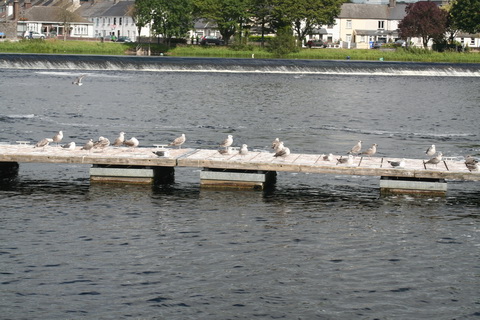
Birds hijacking facility at Athlone intended for (and paid for by) humans

Freeloading birds hijacking facility at Athlone intended for (and paid for by) humans. And who’s going to have to pay for cleaning it? Humans, that’s who. Human rights, that’s what we need …

… but I quite appreciate that Waterways Ireland has to be polite to all these people and can’t disobey the law, no matter how insane the legislation is.

But I digress. Get some comments in, preferably plugging industrial and transport heritage and economic history.

Carlow Distillery

THOMAS HAUGHTON and CO., (being about to withdraw from the Trade,) are ready to receive proposals to Let with a fine, or Sell the Interest in their Concern, consisting of Distillery, Water-mill, Malt-house, Corn-stores, extensive Vaults for bonding Stores, with an excellent Dwelling-house; the whole situate at Carlow, on the bank of the navigable river Barrow.

The Copper Works and Utensils having been lately erected are all in perfect order, and there being a home Sale at the door for the entire produce, renders this Concern a most eligible investment for any competent person (or Company,) with a moderate capital.

The Dublin Mercantile Advertiser, and Weekly Price Current 16 December 1833

From the BNA

Portumna drawbridge

BORRISOKEEN, July 14. — The Solicitor-General, Mr Doherty, will arrive here to-morrow for the purpose of investigating the late unfortunate occurrences of this town on the 26th and 28th ultimo. This measure of the Government seems to restore some confidence to the minds of the people. Had this investigation not been granted, no person could calculate on the consequences of the expressed resolution of the peasantry to come into Borrisokeen, in a body of 50,000 or 60,000, to have vengeance for the loss of their relatives and neighbours.

On Saturday last a person named Dagg, a Protestant, residing in Borrisokeen, but who left it on account of the late occurrences, was apprehended at the mountains of Thoreebrien, when the country people held a consultation on the most effectual mode of putting him to death. Disregarding his entreaties and professions of innocence, he was dragged along by about 500 persons, and, on coming to Portumna, they determined to tie his legs to one part and his arms to the other part of the drawbridge across the Shannon, and then open it, that he might be drawn asunder. Fortunately at the time a gentleman from Borrisokeen passed by, and by his interference, with that of the parish priest, the life of the unfortunate man was spared.

Salisbury and Wiltshire Journal 27 July 1829

From the BNA

Newspaper accounts at the time suggest that there was an affray in Borrisokane at the end of the fair. Five mounted police either attacked or attempted to disperse the crowd; stones were thrown; Captain Dobbyn, a Stipendiary Magistrate, read the Riot Act and ordered the police to fire, which they did, killing two people. Two days later, during the funeral of one of those shot, one John L—, an Orangeman, and four companions, fired on the mourners from behind portholes on his house, or sallied forth to fire, killing four immediately and mortally wounding another. There is nothing to suggest that the unfortunate Mr Dagg was in any way involved.

Hamilton Lock

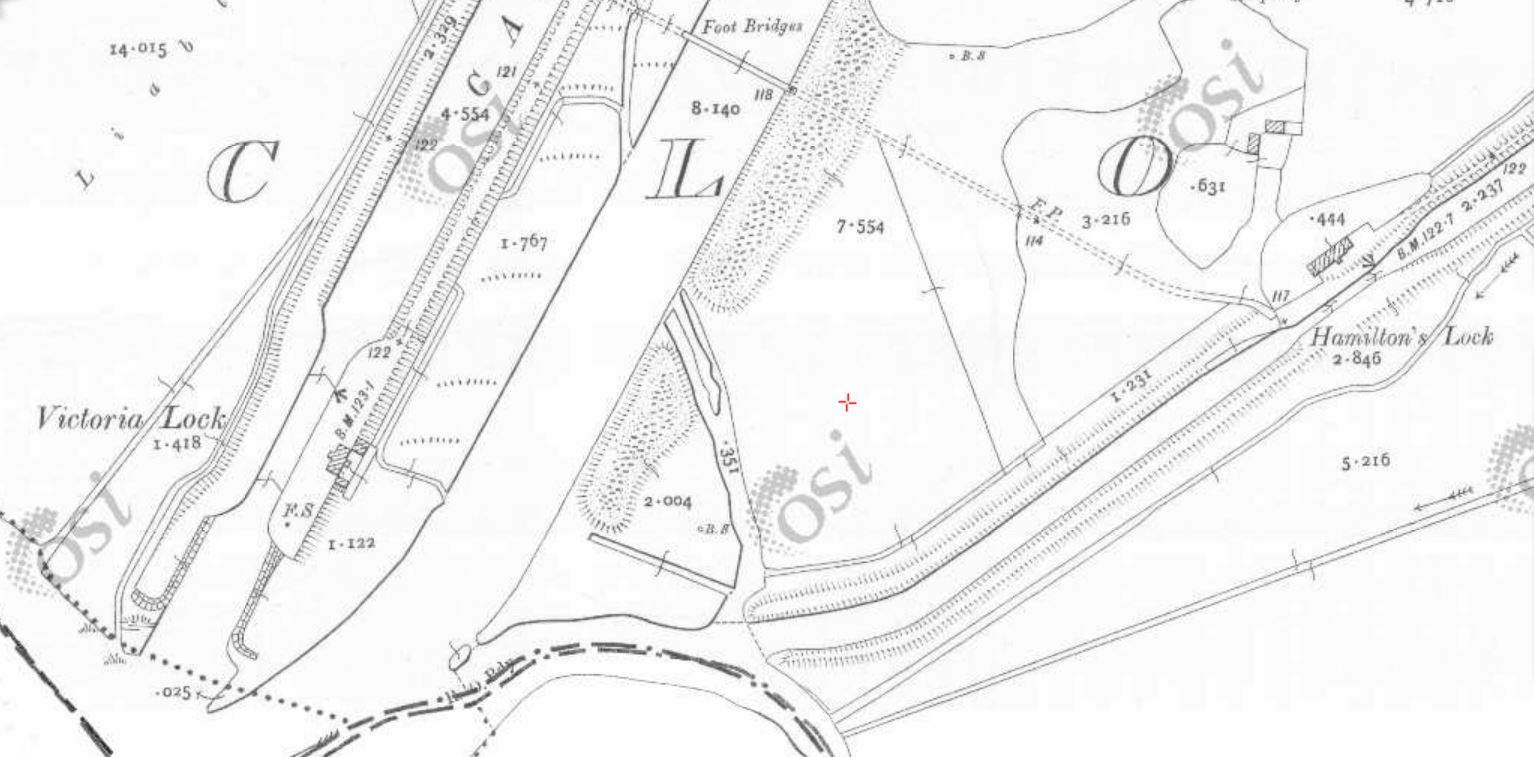
Victoria (Meelick) and Hamilton Locks (OSI ~1900)

Victoria (Meelick) and Hamilton Locks (OSI ~1900)

Lord Dunkellin: Do you know the Victoria lock at Meelick?

Sir Richard Griffith: I do.

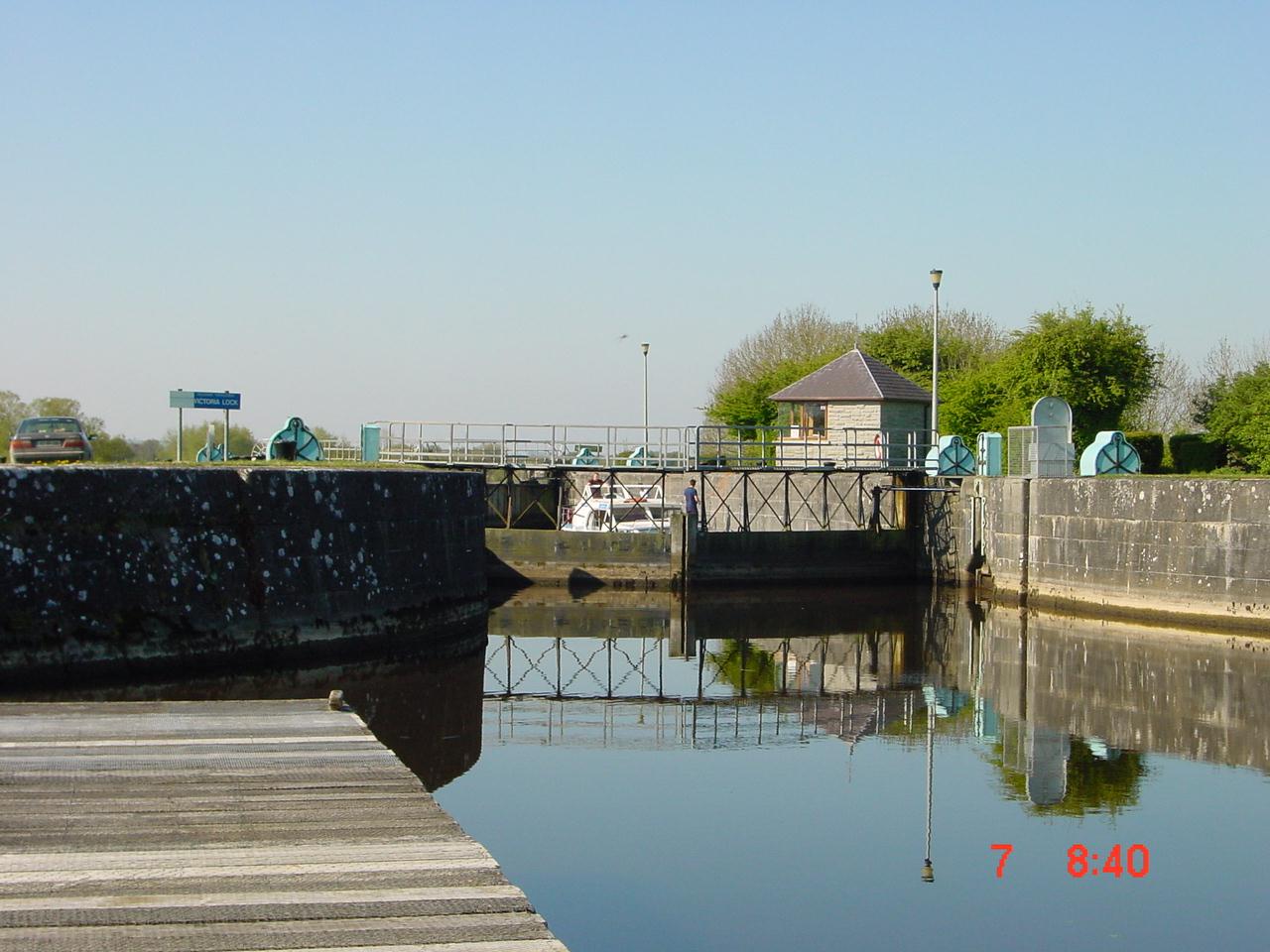
Victoria Lock, Meelick

Victoria Lock, Meelick

Dunkellin: Do you know what is called the Old Cut, the old canal?

Griffith: Yes.

Dunkellin: The Victoria lock is a new work, is it not?

Griffith: It is.

Dunkellin: Should you be surprised to hear that vessels do not use that frequently, but go by the old cut?

Griffith: In times of very high flood I am aware that the canal boats find it advisable and beneficial to go by the Hamilton lock, on the old cut, in preference to the other.

Dunkellin: Prima facie, one would have thought that a new work like the Victoria lock would have the effect of regulating the state of things?

Griffith: It arises from the Counsellers’ Ford, as it is called, above Meelick; it has not been sufficiently excavated, and there is a strong current, and the boats are not able to get up to it in times of high flood.

Dunkellin: Then the boats made use of the old canal instead of the new lock?

Griffith: Under those peculiar circumstances they did.

Evidence of Sir Richard Griffith to the Select Committee on the Shannon River 12 June 1865

My OSI logo and permit number for website

C&RT and waterways history

I mentioned earlier that Waterways Ireland intends to promote the collection, archiving and use of waterways oral history. Across the water, I gather that the Canal & River Trust is setting up a Canal Research Network:

Canal & River Trust is the charity entrusted with the care of 2,000 miles of waterways in England and Wales. Our canals are home to over 2,700 listed structures, 50 scheduled ancient monuments and five UNESCO world heritage sites. The National Waterways Museum in Ellesmere Port is home to the Waterways Archive, an internationally significant collection of historic records relating to Britain’s waterways and the people who built, used, and lived on and near them both within Britain and as connections to the sea and the world beyond.

We are keen to establish a scholarly research network for academics and researchers in other organisations to connect with the Canal & River Trust and with each other, sharing their research and finding opportunities for collaboration. The reach of our organisation and the quality of resources available means that there is real scope to develop meaningful, impactful projects together.

We would very much like to invite you to the inaugural meeting of the Canal Research Network at the Rolt Conference Centre at the National Waterways Museum on Wednesday 22nd July from 11am – 2pm. There will be an opportunity to hear about future plans for the museum and archive —  including a proposed collaborative doctoral award between Canal & River Trust and the University of Huddersfield. We are unable to cover travel
costs, but lunch will be provided.

RSVP john.benson@canalrivertrust.org.uk by Monday 13 July. Full details of the programme will be sent in due course.

Please feel free to pass this invitation on to colleagues in your organisation or elsewhere who may be interested in coming — please ask them to RSVP to the email above. And if you would like to be part of the network but cannot make that date, let us know and we will add you to the mailing list for future events.

With all best wishes
John Benson
Archivist
The Waterways Archive
National Waterways Museum
South Pier Road
Ellesmere Port
Cheshire
CH65 4FW
Tel: 0151 373 4378 […]

That reached me on the same day as the Railway & Canal Historical Society’s Journal Number 223, July 2015, which contains an article by Joseph Boughey “Waterways history research: progress, prospects, problems and limits”, in which he says

What is now needed, I submit, is a Waterways Study Centre (WSC), or rather two, one in physical form, one provided and accessed by electronic means. […] I would envisage that [the WSC] would need to be located in, or close to, an established archive of documents and other artefacts. (Given this, only one or two current locations seem appropriate, but ideally existing facilities could be expanded!)

WI and oral history

I learn from the Heritage Council that Waterways Ireland is seeking tenders for a pilot oral history project. The winner is to

  • Undertake a minimum of 3 interviews per waterway under our jurisdiction (see list above in Introduction). Any interviews relating to the Ulster Canal will be included as part of the Lough Erne Collection for the purposes of this pilot project. […] The interview questionnaire (to be agreed with Waterways Ireland) should endeavour to elicit material that adds to our existing archive, would be beneficial in our schools education programme and used in a broader promotion capacity.

  • Devise an oral history handbook for Waterways Ireland so staff members and community groups can advance this project in years to come.

  • Deliver training on best practices and guidelines in oral history interview skills and techniques. All training to be delivered in Waterways Ireland offices.

This is very interesting for several reasons. Let me get two quibbles out of the way first:

  • Why is the Clones Sheugh treated as part of the Erne? And why mention that specifically? What sensitivity is being addressed here?
  • Why is this tender not mentioned on WI’s Tenders page or the Current tenders page to which it links or anywhere else that the WI search engine can find?

I think there are four important points about this.

First, it is good that WI is devoting resources to the collection of oral history.

Second, it is good that it has applications in mind for the material: it may be used both in WI educational programmes and in marketing.

Third, the requirement for a training programme and a handbook is yet more evidence [on top of Éanna Rowe’s appointment to manage the Shannon] that the balance of skills required within Waterways Ireland nowadays is different from that of the past. While engineering will always be important, given the extent of the waterways infrastructure that has to be maintained, WI needs a higher proportion of people engaging with users, potential users and communities or devising product variants to attract such users. The marketing department can’t do all the work by itself.

Fourth, it is good that “community groups” as well as “staff members” will be able to use the oral history handbook. I hope that the term “community groups” won’t be interpreted too strictly — that individual amateur historians, for example, will be able to use the handbook — so that all waterways oral history can follow a common format, that the records are conserved properly and that the appropriate consents to the use of the material are collected at the time of the interview.

I should perhaps make a declaration of non-interest: I am much occupied with the waterways of the early nineteenth century but have not, so far, found any survivors from that time whom I could interview. But I might, perhaps, be allowed to express the hope that WI won’t altogether neglect such earlier history, about which there is much yet to be learned.