Category Archives: Ireland

Killaloe in the age of steam

That’s November’s talk at the Killaloe-Ballina historical society; details here and an account of Sandra Lefroy’s talk about the Phoenix here.

Tyres

There are other areas where tyres are used, namely, boat yards. I know this because I have a house on the Shannon. Are boat yard proprietors to be required to register as the proprietors of 30 or 40 tyres, which are often used to turn over boats safely? They are also used on informal jetties as protections for boats and so on. Is this area to be covered by the regulations?

Michael McDowell at the Joint Oireachtas Committee on Communications, Climate Action and Environment discussion of the Waste Management (Tyres and Waste Tyres) Regulations on Tuesday 17 October 2017.

Eels from Killaloe

Great quantities of salmon have been recently exported from Limerick to England, and the abundant supply of eels in the Shannon is furnishing a new and productive traffic in the English market. There are ten tons of this prolific fish now in tanks at Killaloe, awaiting a conveyance to London, and a vessel adapted for the trade will take on board from Limerick in the ensuing week forty tons of eels for the London market.

The Dublin Monitor 23 October 1844

Closing the Irish ports

[The Rev Charles Boyton FTCD] has a great deal of wit. Indeed in this respect he is the Irishman all over — he evinces no symptom of degeneracy from our models of the last century. His remarkable speech on the Marquis of Anglesey‘s interview in Cork with Doctor Baldwin will never be forgotten.

Lord Anglesey had spoken, in rather a threatening fashion, of “blocking up all the Irish ports with four gun-brigs, and inflicting on the Irish a total suspension of intercourse with England. What then would you do,” continued his Excellency, “if deprived of the English market? What would you do with your corn, and butter, and pork?”

“What would we do with our corn, and butter, and pork?” repeated Mr Boyton. “Why eat them, to be sure! — What else would we do with them? But our viceroy”, continued the speaker, “seems to think that Ireland would suffer, and that England would not, if the intercourse between the countries were suspended. We export food to England; their exports to us are chiefly manufactured articles — the cutlery of Sheffield, the china ware of Worcester, the carpets of Kidderminster. Suppose now our intercourse with England suspended; which party would be worse off? Paddy, who would gladly devour the food which England refused to receive; or John Bull, whose English stomach, notwithstanding its powers, could scarcely digest a Sheffield whittle, or a Worcester tea-cup?” — Mr Boyton is the darling of the Conservative party, and no wonder.

From “Irish Eloquence” in The Dublin Penny Journal Vol IV No 170 October 3, 1835

Feather beds purified by steam

Heal and Son have just completed the erection of machinery for the purifying of feathers on a new principle, by which the offensive properties of the quill are evaporated and carried off in steam; thereby, not only are the impurities of the feather itself entirely removed, but they are rendered quite free from the unpleasant smell of the stove, which all new feathers are subject to that are dressed in the ordinary way.

Old beds re-dressed by this process are perfectly freed from all impurities, and by expanding the feathers the bulk is greatly increased, and consequently the bed rendered much softer.

The following are the present prices of new feathers:

Mixed, 1s per lb
Grey Goose, 1s 4d per lb
Foreign Grey Goose, 1s 8d per lb
Best foreign Grey Goose, 2s per lb
Best Irish White Goose, 2s 6d per lb
Best Dantzic White Goose, 3s per lb

Heal and Son’s List of Bedding, containing full particulars of weights, sizes, and prices, sent free by post, on application to their establishment, 196, opposite the Chapel, Tottenham-court-road.

Daily News, London 24 October 1846

Phoenix

On Wednesday 25 October 2017, at 7.00pm, Sandra Lefroy will be talking about the Phoenix, the (formerly steam-powered) vessel built in 1872, at the Malcolmson-owned Neptune Iron Works in Waterford, for Francis Spaight of Derry Castle on Lough Derg. The venue is the library in Killaloe, which is on the site of the lockhouse.

History afloat. The life and times of the Phoenix: a unique 1872-vintage heritage boat of Killaloe and Ballina

Now almost unique, the nineteenth-century Phoenix is one of the most historical boats in Ireland. She has been based in Killaloe for much of her life, mostly in the ownership of the Lefroy family. Sandra Lefroy will tell us something of the history of this wonderful craft, and what it is like to live on board a heritage vessel.

Details here.

Canals and popery

Between 1768 and 1774

… means were devised to provide secure investment facilities for Catholics in projects of national and public utility, which at the same time left the whole system of the popery laws intact.

The earliest example I have found of this opening of the back door to Catholic investment was an act of 1768 for improving navigation between Limerick and Killaloe. To encourage Catholics to invest in the enterprise all shares were to be regarded as ‘personal estate and not subject to any of the laws to prevent the growth of popery’. Thus the indirect ownership of land involved in such investment would not be at the mercy of Protestant discoverers.

A blanket concession on similar lines was given in 1772 to Catholic shareholders in all inland navigation companies and in insurance companies. The fact that these acts now made it possible for Catholics to become shareholders and sometimes directors in such companies as the Grand Canal Company, must have served to break down segregation barriers to some slight extent.

Maureen Wall “Catholics in Economic Life” in L M Cullen ed The Formation of the Irish Economy The Mercier Press, Cork 1969, rp 1976


Boris the Shinner

I have suspected for some time that Britain’s Brexiteers are actually Sinn Féiners.

After 1916 the Irish Shinners decided to leave a larger economic and political entity and to do so without any business plan or any realistic idea of how their proposed state would make a living.

After 2016 the British Shinners decided to leave a larger economic and political entity and to do so without any business plan or any realistic idea of how their proposed state would make a living.

One lot of Irish Shinners, led by the lunatic Éamon de Valera, wanted a hard Irexit and started shooting the soft Irexiteers who, happily, managed to keep control; it is to be hoped that matters don’t go that far in Britain.

It may be objected that the evidence for this contention, that Brexiteers are Shinners, is a little light, but I have now found confirmation: Boris Johnson is an enthusiast for insane canal construction projects.

The mark of the Shinner is upon him.

How to civilise Co Galway

An article from the Dublin Penny Journal of 13 September 1834 [Vol III No 115], conducted by P Dixon Hardy MRIA, solves that and other longstanding problems.

Public works in Ireland

The tunnel or archway through Lord Cloncurry’s grounds

Having in our last described the line of railway from the entrance station in Westland-row to the Pier at Kingstown, we now take the opportunity, while presenting our readers with two other views of the road, of inserting an article which, since our last publication went to press, has appeared in The Sun newspaper, relative to the carrying on of public works in Ireland. Our readers will perceive that its general bearing is in perfect accordance with the opinions we have more than once before expressed, when speaking on the subject of railways. We have already stated our reasons for giving a preference to railways over other modes of conveyance; but we fully agree in opinion with the writer of the article to which we refer, that no greater benefit could be conferred upon Ireland than the introduction of a cheap and expeditious means of conveying her agricultural produce from the heart of the country to the extremities — whether this be by canals or railways is a matter to be decided by the locality of those districts through which the lines of road may pass.

“We do not often derive so much pleasure from the perusal of a public document as we have from a careful inspection of the plans, and consideration of the suggestions, contained in the Second Report of the Commissioners of Public Works in Ireland, just printed by order of the House of Commons. Notwithstanding the low ebb at which the tide of Ireland’s prosperity stands at present, we predict, from the great improvements that are now being carried on, in clearing harbours, opening canals, and making roads along the eastern, southern, and northern coast, that the day is not very long distant when Ireland will, from being a bye-word among the nations of Europe, become equal to some of its proudest states in industry, wealth, intelligence, and love of order.

The worst crimes of Ireland are the results of the poverty and despair, rather than the evil disposition of her population. Public works, besides giving employment to thousands of her labouring poor, whom want has rendered almost desperate, will be the means of inducing capitalists to establish factories where facilities are afforded for carrying on an extensive trade; and will enable agriculturists to raise produce wherever a line of good road, a cheap water carriage, or convenient shipping, supplies them with a sure market for the fruits of their industry.

During the last eighteen months the sum of one hundred and twenty-nine thousand, six hundred and thirty-three pounds were expended in the improvement of Kingstown and Dunmore harbours, the making of roads on the Antrim coast, and the building of bridges, and other improvements in different parts of Ireland. The consequences of these works are already beginning to be manifested in the improved condition of the inhabitants in their vicinity, and the altered aspect of the immediately adjoining face of the country.

The commissioners themselves say that ‘Wherever a new road is constructed, flourishing farms at once spring up, and the carts of the countrymen press on the heels of the road-makers as the work advances’. And in a preceding paragraph the following most important information is given: — ‘In traversing a country covered with farms, and in a high state of cultivation, showing every sign of a good soil and of amply remunerating produce, it becomes difficult to credit the fact that, ten or twelve years since, the whole was a barren waste, the asylum of a miserable and lawless peasantry, who were calculated to be a burden rather than a benefit to the nation; and that this improvement may entirely be attributed to the expenditure of a few thousands of pounds, in carrying a good road of communication through the district’.

What Ireland stands most in need of at the present moment is, a cheap and expeditious means of having her agricultural produce conveyed from the heart of the country to the extremities. Now, in our judgment, the best way of effecting this would be by canals, of which she stands in the greatest need.

The first of these should be a canal from Dublin to Galway, which would cut the whole island across, from east to west, uniting St George’s channel with the Atlantic ocean. This line of communication between the capital of Ireland and a great commercial town on the extreme coast, would be of immense importance to the inhabitants of both, but of still more so to the whole population of Connaught, among whom it would be the direct means of introducing manufacturing industry, and a taste for the arts, enjoyments, and elegancies of civilized life. The distance between Dublin and Galway is about one hundred and four miles, through which a direct line of canal has already been carried for forty-two miles — namely, from Dublin to Philipstown; so that in point of fact the work is already begun, and only wants the aid of government, and the assistance of the landed proprietors in King’s County, Roscommon, and Galway, the value of whose estates would be trebled by it, to effect its entire completion.

The next line of canal should be from Ballyshannon Harbour to Dundalk, by Enniskillen, by which the greatest facilities would be given to agriculture and manufacturing improvements in the counties of Donegal, Fermanagh, and Leitrim; and more especially to the trade of Ballyshannon and Dundalk, which, though capable of being made emporiums of provincial industry and wealth, are now little better than marts for the fish caught along their coasts. However, great praise is due to Colonel Conolly, the member for Donegal, who has advanced a thousand pounds, and given security for four thousand more, for repairing the harbour of Ballyshannon, which, when finished, will be of great benefit to the people of the town, and the inhabitants along the western coast, from Sligo to Killybegs.

The last line of communication which we would suggest to the government, besides the navigation of the Shannon, which is sufficiently dwelt upon in the reports of the select committee on that subject, is a canal from Waterford to Sligo, intersecting the canal from Dublin to Galway, somewhere about Philipstown.

This, with such a line of communication from Dublin to Belfast, would unite all Ireland; and in a very few years would render the country as prosperous, as rich, and as contented as any in Europe. The intercourse which those canals would give rise to between the people in every part of the provinces, would extinguish that spirit of religious animosity which now divides and destroys them. Bring men only together, and they will soon remove the prejudices of each other.

The people of Ireland are at present as much removed from each other at the distance of fifty miles apart, as if the whole Indian ocean rolled between them. Hence, the jealousies, and hatreds, and cherished recollections of feudal wrongs, so common in almost every district of Munster and Connaught. But let once manufacturing industry prevail in these districts — let the voice of the mechanic be heard in the villages — and we will pledge ourselves that the people of Ireland, with all their alleged love of mischief, will find other employment than that of parading nightly in a Captain Rock uniform, or recording vows of vengeance against Sassenachs and collectors of king’s taxes.”


Sinn Féin asks useful PQ about waterways shock

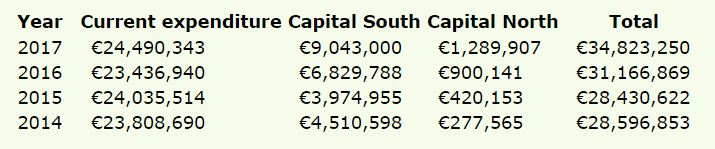
Yes, Caoimhghín Ó Caoláin, SF TD for Cavan-Monaghan, has asked a useful question about waterways, one that doesn’t seem to have been designed to promote an insane restoration proposal. He asked for “the current and capital expenditure by Waterways Ireland in each of the years 2014 to 2016; the estimated level of current and capital expenditure for 2017″. The answer included this table:

WI budgets


Current spending comes 85% from the Free State and 15% from Norn Iron; capital spending is paid for by the administration in whose territory the montey is to be spent.

There may be a problem here in that I have a feeling that, if there is no NI Executive, spending is limited to 90% of the previous year’s figure [I am open to correction on this], which might cut the NI contribution to current spending: I presume that the RoI contribution would then be cut too, to maintain the 85:15 ratio.

The Minister for Fairytales also said that WI gets money from “third-party funding contributions towards specific projects and from its own income from licences and property.” However, its own income is pathetically small.

I am writing less about current waterways affairs because I’m concentrating on those of the nineteenth century (unlike Sinn Féin, which focuses on the eighteenth), but I did read WI’s Annual Report and Accounts for 2016 [PDF] with interest. Despite the considerable challenges it faces [including the pensions nightmare], the organisation has been expanding its range of activities and looking to new users and new uses. I hope that the Brexit hard border, which I suspect is now unavoidable, doesn’t completely bugger things up.

If it does, we might need to ask Sinn Féin whether it can think of anyone who could help smuggle motor-cruisers across the border to enable boats to move between the Shannon and the Erne. Perhaps their day will come.