Category Archives: Natural heritage

Matters of minor importance

Some recent(ish) discussions amongst the People’s Representatives. I haven’t time to analyse them all. All links courtesy of the estimable KildareStreeet.com.

Brendan Smith [FF, Cavan-Monaghan] wants a sheugh in Clones; he got the usual answer. And he allowed Jimmy Deenihan [FG, Kerry North/West Limerick] to announce, on 19 December 2013, the death of the suggested extension of the Erne navigation to Lough Oughter [loud cheers]:

Brendan Smith: To ask the Minister for Arts, Heritage and the Gaeltacht if he has received the feasibility study on the proposed extension of the Erne navigation from Belturbet to Killeshandra and Killykeen; and if he will make a statement on the matter.

Jimmy Deenihan: I am informed by Waterways Ireland that it commissioned a Strategic Environment Assessment for the possible extension of the Erne Navigation from Belturbet to Killeshandra and Killykeen.

On reviewing the environmental information from this process, Waterways Ireland considers that the environmental designations of this lake complex make the feasibility of the proposed navigation extension highly unviable. For that reason, I am advised that Waterways Ireland does not propose to pursue this project any further at this time.

Well, that’s one minor victory for sanity. Here’s how a dredger got to Lough Oughter in 1857.

Maureen O’Sullivan is anxious to recreate the economy of the eighteenth and nineteenth centuries by using canals for carrying cargoes. Especially on the Shannon–Erne Waterway, where commercial carrying was so successful before. [What is it about the Irish left?] Thank goodness that the sainted Leo Varadkar gave not an inch: someone should make that man Taoiseach, President and Minister for Finance. And Supreme Ruler of The Universe and Space.

The web-footed inhabitants of the midlands, who have discovered that they live in a flat area with rivers, keep wittering on about Shannon flooding, failing to realise that it is a message from The Lord, telling them to either (a) move to higher ground, eg Dublin, or build arks. On 15 January 2014 Brian Hayes told Denis Naughten, inter alia, that info from the recent OPW/CFRAM monitoring of water levels on Lough Ree (which I think was when the levels were lowered) would be placed on the OPW website “in the coming days”; I haven’t been able to find it yet so I’ve emailed the OPW to ask about it. And on 21 January one James Bannon said that he intends to introduce a bill setting up a Shannon authority, which will have magical powers. Well, if it doesn’t have magical powers it won’t be able to stop the Shannon flooding, but perhaps it’s designed to allow the unemployed landowners of Ireland another forum in which to demand taxpayers’ money to prop up their uneconomic activities.

Finally, a senator called John Whelan wants a longer consultation period on the proposed amendments to the canals bye-laws. I suppose I’d better read them  myself.

Reading list

Waterways Ireland has been putting out more and more stuff on its website.

If you haven’t already seen them, you can get the full set of Product Development Studies, in PDF format, here.

Even more interesting, to this site, are the waterway heritage surveys. Those for all waterways other than the Shannon are available here. The Shannon study was done some years ago (I remember making some comments on it at the time) and will be uploaded “in due course”.

I was in a WI office yesterday and had a quick look at the Lower Bann survey, which was done by Fred Hamond (so we know it will be good), and I’m looking forward to learning more about the waterway I know least about. It is done thematically and has lots of illustrations: Fred is able to see and present the bigger picture, but a full database, with all the supporting information, is available on request.

Où est la plume de ma tante?

21 February 2018: voici une mise à jour.

Post originally written in January 2014 follows

Où sont les neiges d’antan? [That’s French for “Where is Anto’s stash of heroin?”] Où est l’étoile d’émeraude?

I remarked in August, on sighting le grand bateau de Monsieur Thibault in Athlone, that it carried the Le Boat brand, not that of Emerald Star. Emerald Star is now one speck within Le Boat, which is one of the activities within the Marine Division of the Specialist & Activity Sector of TUI Travel, which employs 54000 people.

Le le Boat bateau

Le le Boat bateau

I wrote to Messrs TUI Travel’s “corporate communications” department at the time to ask whether the Emerald Star name was being phased out, but answer came there none: no doubt all 54000 employees were busy at the time. But I noticed today that a hapless seeker after truth, searching for “emerald star”, ended up here, so I had a look myself. There is no emeraldstar.ie website (and emeraldstar.com is unrelated) but the UK Le Boat site has a little badge on the top left of the page saying “Emerald Star from le Boat”. I wonder whether that appears if the site detects that you’re accessing it from outside Ireland. I could find no other mention of Emerald Star, so I suspect the brand is doing a Cheshire Cat.

I was glad to find that Messrs Le Boat have found Google Translate useful. At least, I assume that’s how they produced this paragraph under their “Useful info” tab:

Useful Info for the Ireland

The Irish coast rises tallish from the sea, and yet the terrain drops farther inland, creating a sort of cup where the water gathers. One fifth of the water drains inward to the Shannon River, Ireland’s largest at 360 kilometres (224 miles). The fall on the navigable middle section of the river is slight at only 9 metres (29 feet), which means the water moves slowly. A Shannon River map also reveals the large number of lakes in the Shannon system, a real plus for canal boat cruising!

No, I’ve checked: it’s not Ulster Scots.

Then there’s this:

Feel the irresistible lure of the Shannon-Erne

The Shannon River gives Ireland’s central reaches their character. It’s an obvious feature if you study a Shannon River map. At a glance, it’s clear that the waters influence the land. The fishing is superb and golf is extremely popular! The towpath is level, so you’re in cycling heaven! […]

You learn something every day: I never knew that the Shannon had a towpath. I wonder where it is.

But that’s not the only puzzle. Messrs Le Boat list some suggested cruises, eg:

The Celtic Cruise Ireland
Oneway: Portumna to Carrick-on-Shannon

[…]

The golf course calls! The fishing itch must be scratched! Castles loom tall! Feel the warm embrace of Celtic charm!

Who writes this rubbish? But this is the puzzling one:

The Northern Shannon Cruise Ireland
Return Trip: Carrick-on-Shannon, via Belturbet

[…]

Travelling in the thousand lakes area takes you from the Lake Niegocin to the Lake Sztynorckie, with plenty to see on the way!

Well, I admit I don’t know the north Shannon as well as I do Lough Derg [“Lough Derg, an angler’s paradise, casts an Irish spell of contentment to keep you fishing and having too much fun!”], but I can’t find either of those lakes on any Shannon or Erne map. Où sont les mille lacs de M. Thibault? Où sont les Niegocins, Antoin? Ils sont dans le jardin avec la plume de ma tante.

Lough Derg floods: a book

If you happen to have €1400 or so to spare, you could buy Henry Trench’s 1879 book called Shannon Floods. Lough Derg level. The 25 Miles North from Killaloe with a double-page map and seven coloured plates. I have no connection with the seller — and no €1400 either, so I won’t be buying it.

A new concept in electricity transmission

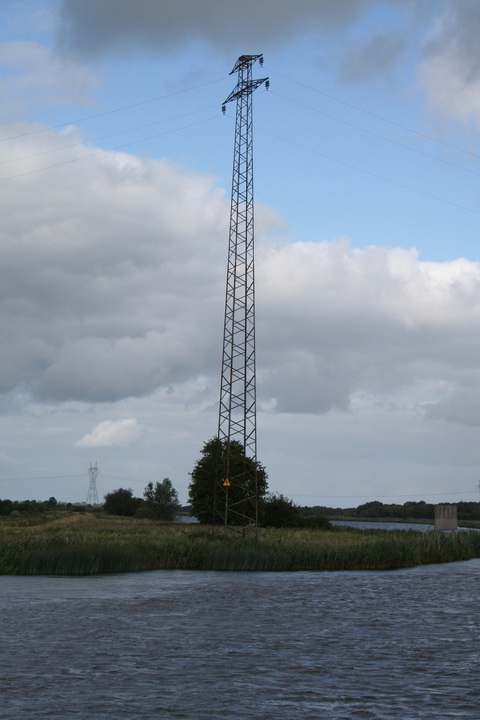
Lower pylons 2_resize

We read on the Clare FM website:

The Government says it is not realistic or financially feasible to run new electricity pylons underground.

Well, yes, I’d imagine there’s something in that. Although I don’t quite see why anyone would want underground pylons. I knew some folk wanted underground electric cables, but hadn’t realised they wanted the pylons buried too.

Personally, I’m all in favour of pylons: I like them, and would like to see more of them. I don’t understand why a row of nice pylons should be thought to make scenery less, er, scenic. It might make scenery less like a pre-industrial idea of scenery, but that’s a good thing; big it up for Stephen Spender.

And think of the industrial heritage value in the future: as well as old canals and railways, folk will come to photograph pylons; indeed some people already do so.


A former British inland waterways campaigner has died

See here and here.

Draining Lough Derg

The ESB is currently letting more water down the old course of the Shannon, from Parteen Villa Weir through O’Briensbridge, Castleconnell and the Falls of Doonass. This channel gets the first 10 cubic metres per second from the Shannon; the next 400 go through Ardnacrusha and anything left over is sent down the old course.

The result is to help to reduce the water level on Lough Derg while raising it on the old course.

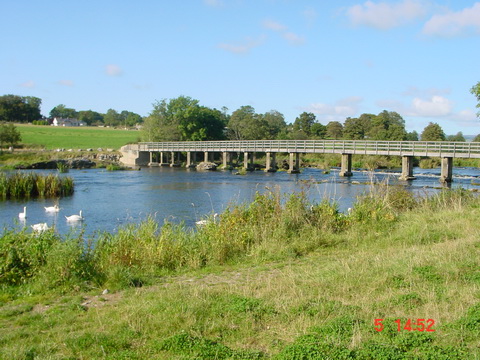
The footbridge in Castleconnell at normal summer level in 2002

The footbridge in Castleconnell at normal summer level in 2002

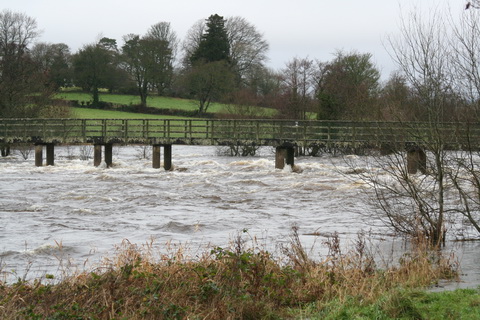
The footbridge on 1 January 2014

The footbridge on 1 January 2014

Before Ardnacrusha was built, the old channel took the entire flow of the Shannon, so it can take more than it has now.

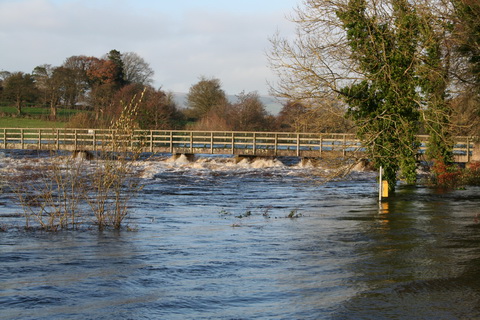
The footbridge in the floods of November 2009

The footbridge in the floods of November 2009

The level is still below that of 2009, when the land around the old channel flooded in several places. But much land is waterlogged: I saw yesterday that the upper reaches of the Nore, the Barrow and other rivers were in flood. And more rain is forecast.

Wouldn’t it be nice if some of that could be sent to Dublin instead? I see that some folk claim (on what looks like a website that hasn’t been updated for a while) that the evil Dublin folk want to extract 350 million litres of water from the Shannon every day; the original idea was to take it from Lough Ree but now it seems that Lough Derg is the preferred source.

Now 350 million litres sounds like a lot, but it’s 350 000 cubic metres per day, 14 583.3 per hour, 243.05 per minute, 4.05 per second, which is less than 1% of normal flow through the two channels draining Lough Derg. There’s a lot more at the moment, and the good citizens of Dublin are welcome to come down and fill their buckets. I suspect that Clare TD Michael McNamara has got things out of proportion.

Addendum: 350 million litres per day, over a lake whose area is 130 square kilometres, would lower the level of the lake (if my calculations are correct) by 2.69 millimetres. If no water entered the lake, the level would be down 983 mm after a year, ignoring evaporation and other abstractions and assuming that the Shannon and other tributaries no longer flowed in and that there was no rain.

Wind and eels

Interesting BBC story about a possible cause for the decline in the number of eels.

The grunts of Lough Neagh

In The Cookin’ Woman: Irish country recipes (Blackstaff Press, Belfast and Dover New Hampshire, facsimile edition 1986), Florence Irwin says of Lough Neagh:

This lake, 153 square miles, has always provided much sea-food. Eeels [sic], pollan, trout, grunts and their elderly relatives, perch, to mention the most common fish eaten by the loughsiders and sold by them.

No doubt that is true for certain values of “sea”.

She says that the (Irish) pollan is found only in Lough Neagh, but that does not seem to be true. I had not come across the grunt before: earlier, in her chapter on soups, Ms Irwin has a recipe, from Moortown, for grunt soup, which requires 1 dozen grunts; she explains that

Grunts are the young of perch.

Seamus Heaney says

Perch we called “grunts” …

which suggests that perch are grunts or vice versa. Wikipedia says

The grunts are a family, Haemulidae, of fishes in the order Perciformes.

The taxonomy set out on its page about Perciformes suggests a relationship between grunts and perch that is more complex than either Ms Irwin or Mr Heaney allows, but says

Classification is controversial.

I am left wondering whether there are still grunts in Lough Neagh and, if so, whether they are of the Haemulidae family or whether the name is simply used locally for perch, young or old.

Here is a page about the Lough Neagh fisheries.

Money from the bog

To a small extent reclamation is now going on in Ireland; Mr M’Nab, of Castle Connell, county Limerick, has reclaimed 80 acres of the worst red bog, devoid of vegetation and 20 feet deep. It was drained, then coated with the subsoil, and the land which was not worth 2s 6d per acre is now worth 30s per acre.

Thus Robert Montgomery Martin in his Ireland before and after the Union with Great Britain third edition with additions; J D Nichols and Son, London; James McGlashen, Dublin 1848.

I have written here about Mr Macnab (that was how the spelling settled down) and his talent for extracting money from the bog at Portcrusha, which is between Castleconnell and Montpelier, Co Limerick. It seems that his achievements are still remembered — and emulated.

Incidentally, in the same work, published in 1848, Mr Martin refers to the

… large practical mind, great experience,  and Christian philosophy …

of Sir Charles Trevelyan.