Category Archives: Non-waterway

For certain values …

In the Irish Times of 5 January 2016 Fintan O’Toole has an article headed “Genuine local democracy part of the solution to flooding“. He points out that

  • in 2004 the Irish Times property supplement showed a photograph [we are not told whether it was part of an ad or advertorial or of a critique of property development] showing a sign advertising for sale a flooded field that had been zoned for residential use
  • in 1997 a resident of Clonmel detailed how the town’s natural flood defences had been destroyed
  • in 1999 a man in Ennis blamed the flooding of his house on the granting of too many planning permissions
  • in 2000 3500 Clonmel residents objected to building on flood plains
  • nitwitted local councillors didn’t care.

He concludes that

As flooding gets worse, we will have to spend enormous amounts of money on engineering solutions. But in fact one part of the solution doesn’t cost any money at all. It’s called listening. Or, to give it its political title, it’s called genuine local democracy. Top-down, very expensive technocratic measures may have to be part of the response. But they will only work in a political culture that has eyes to look at the land and ears to listen to what people know about it.

Well, up to a point, Lord Copper. The article provides no evidence that a majority of the citizens — in any local authority area, Dáil constituency or other political unit — shares the erudite and enlightened views of those who write letters to, or columns in, the Irish Times. In fact, given that the citizens have, over more than one hundred years, continued to elect large numbers of nitwits to the local authorities and, for almost a century, to the Dáil, it seems unlikely that democracy — genuine, local or otherwise — will ever produce the right answers.

Which may explain why so much power now resides elsewhere, in the hands of experts and courtiers, and why elected representatives are reduced to throwing the occasional tantrum, providing tea and sympathy and making empty promises that then come back to haunt them.
 

Aw sheughs

On 6 November 2015 there was a meeting of the Inland Waterways flavour of the North South Ministerial Council, whereat the Minister for Fairytales (RoI) and the Minister for Marching Bands (NI), each with a sidekick, discussed waterways matters. The joint communiqué, artfully written to provide outsiders with as little information as possible, is available here [PDF], but here’s a summary:

  • WI’s “capital expenditure focused on infrastructure repairs”, presumably because it has no money for any improvements or extensions, except a bit of dredging in or near the constituency of the Minister for Fairytales
  • yes, that means the River Finn, Saunderson’s Sheugh, which we’re pretending is or was part of the Clones Sheugh or Ulster Canal
  • WI has managed to get “third party funding” of over €1 million for waterside developments, which is good: much better than transferring WI money to other bodies. WI is trying to nab euroloot but, as there were no announcements of success, we must assume that this is work in progress. Mind you, the ministers would probably claim the success (and the photoshoots) anyway
  • WI may sell some unspecified property
  • the important one:

LEGACY SCALE LINKAGES FOR NORTHERN BASED WATERWAYS IRELAND STAFF

The Council approved the determination made by Waterways Ireland regarding legacy scale linkages for northern based staff.

I knew you’d want to know about that. Whatever it means.

On 17 November 2015 the latest attempt to get the boys and girls of the Northern Ireland Assembly to be nice to other reached some sort of conclusion, which you can read about in the Irish Times (until it disappears behind a paywall) and the Manchester Guardian. But of course the important question is whether we southron loons have to buy sweeties (sheugher candies) for our northern brethren to persuade them to be polite. For that, gentle reader, you must turn to the inspiringly-titled A fresh start — the Stormont Agreement and implementation plan, available here [PDF].

You will not, of course, want to bother reading most of it, so we can skip straight to Section E Irish Government Financial Support on page 30. New readers may wish to know that, many NI disagreements ago, the Irish government, led at the time by a group of leprechauns who believed they possessed a pot of gold, resolved to impress the poor benighted northerners with a display of southern wealth and power. Accordingly, it promised to pay for all sorts of transport infrastructure, provided that it could be claimed to have some sort of cross-borderality and preferably looked iconic. Whether there was any point to any of the schemes was a matter omitted from consideration.

The three main proposals, IIRC, were

  • the A5, a road in Northern Ireland
  • the Narrow Water Bridge, which would cross the Newry River in the middle of nowhere (whereas a south-eastern bypass of Newry might actually be useful). And it would have an opening span for the many vessels that visit Newry by the Ship Canal
  • the Clones Sheugh, a short section of the Ulster Canal.

Unfortunately the hardheaded northerners have long memories and they keep looking for their three sweeties long after the Free State realised that it couldn’t afford them. So has this latest throwing of their toys out of the pram forced the Free Staters to give in and buy them the A5, the iconic bridge and the Clones Sheugh?

Up to a point, Lord Copper.

The Irish government says it’s all in favour of, er, “investing” in infrastructure “to support North-South co-operation to help unlock the full potential of the island economy”, where no doubt eighteenth century transport methods will prove to as important as they were in the time of Grattan’s Parliament. But with that, and all the other waffle and irrelevancies shoved in at the start of the section, it is clear that the Irish government is trying to big up a small contribution. It drags in the European Union, the Dublin to Belfast railway, flood relief, energy, communications and health, which have nothing to do with the case, but which between them fill almost the whole of the first page.

From there, though, it has to get specific, or at least look as if it’s doing so. Accordingly, each of the three white elephants gets a subsection to itself, with numbered paragraphs, from which we learn that:

  • the Free State government “remains supportive of the commitment under the St Andrews Agreement” to co-fund the A5. It’s going to pay more (I think): £25 million a year in the years 2017–2019, up from a total of £50 million
  • the Free State government “remains committed to the concept of the Narrow Water Bridge”, which has “potential to provide jobs” [how?]; it will review the plans with the NI Executive and think about it by June 2016. It says nothing about the disappearance of funding
  • the Free State government does not say that it “remains supportive of the commitment under the St Andrews Agreement” to fund the Clones Sheugh. Nor does it say that it “remains committed to the concept”. What it does say about the sheugh is that it is funding Saunderson’s Sheugh (see above), it will think about more cross-border greenways and blueways including the Ulster Canal and it and the NI Exec will identify “options for jointly developing future phases of the Ulster Canal restoration project”, which I take to mean that the southron taxpayer won’t be stuck with the entire bill. Oh, and it’s going to think about funding a bleeding sail training vessel, another exercise in pointlessness and nitwittery.

That’s almost it: there is something about a north-west thingie, senior officials will meet and there will be progress reports.

These documents are not necessarily constructed to provide information to outsiders, but my sense is that the Clones Sheugh danger to the southron taxpayer has receded for the moment, although the Narrow Water Bridge and the sail-training nitwittwery need to be blown out of the water (or into it). The A5 road is to go ahead: I don’t know much about it but it might be the least objectionable of the lot.


Waterways Ireland draft heritage plan

Boogie on over to the WI website for a copy of the WI draft heritage plan, and send WI your comments by 6 November 2015.

WI staff have put a lot of work into this and consulted various people, including me. I argued for a more activist approach, with more history and less about communities, and I would have let the twitchers and other nature-lovers look after themselves and their little feathered friends …

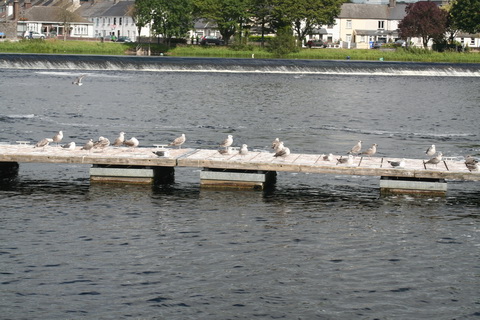
Birds hijacking facility at Athlone intended for (and paid for by) humans

Freeloading birds hijacking facility at Athlone intended for (and paid for by) humans. And who’s going to have to pay for cleaning it? Humans, that’s who. Human rights, that’s what we need …

… but I quite appreciate that Waterways Ireland has to be polite to all these people and can’t disobey the law, no matter how insane the legislation is.

But I digress. Get some comments in, preferably plugging industrial and transport heritage and economic history.

Royal Canal closure

I don’t usually report WI marine notices, but the current closure of the Royal Canal at Abbeyshrule is the result of one of the more unusual incidents I can recall.

Carlow Distillery

THOMAS HAUGHTON and CO., (being about to withdraw from the Trade,) are ready to receive proposals to Let with a fine, or Sell the Interest in their Concern, consisting of Distillery, Water-mill, Malt-house, Corn-stores, extensive Vaults for bonding Stores, with an excellent Dwelling-house; the whole situate at Carlow, on the bank of the navigable river Barrow.

The Copper Works and Utensils having been lately erected are all in perfect order, and there being a home Sale at the door for the entire produce, renders this Concern a most eligible investment for any competent person (or Company,) with a moderate capital.

The Dublin Mercantile Advertiser, and Weekly Price Current 16 December 1833

From the BNA

Stamping out cancer

ADHESIVE LABELS. — It cannot be too generally known that the very numerous cases of cancer which have lately prevailed are attributed by the faculty and scientific men to moistening the adhesive postage stamps with the tongue and lips. A little new milk is much preferable, and also causes them to stick faster particularly on glazed and smooth letter paper.

Waterford Chronicle 19 December 1840

From the BNA

Not a lot of people know that.

Portumna drawbridge

BORRISOKEEN, July 14. — The Solicitor-General, Mr Doherty, will arrive here to-morrow for the purpose of investigating the late unfortunate occurrences of this town on the 26th and 28th ultimo. This measure of the Government seems to restore some confidence to the minds of the people. Had this investigation not been granted, no person could calculate on the consequences of the expressed resolution of the peasantry to come into Borrisokeen, in a body of 50,000 or 60,000, to have vengeance for the loss of their relatives and neighbours.

On Saturday last a person named Dagg, a Protestant, residing in Borrisokeen, but who left it on account of the late occurrences, was apprehended at the mountains of Thoreebrien, when the country people held a consultation on the most effectual mode of putting him to death. Disregarding his entreaties and professions of innocence, he was dragged along by about 500 persons, and, on coming to Portumna, they determined to tie his legs to one part and his arms to the other part of the drawbridge across the Shannon, and then open it, that he might be drawn asunder. Fortunately at the time a gentleman from Borrisokeen passed by, and by his interference, with that of the parish priest, the life of the unfortunate man was spared.

Salisbury and Wiltshire Journal 27 July 1829

From the BNA

Newspaper accounts at the time suggest that there was an affray in Borrisokane at the end of the fair. Five mounted police either attacked or attempted to disperse the crowd; stones were thrown; Captain Dobbyn, a Stipendiary Magistrate, read the Riot Act and ordered the police to fire, which they did, killing two people. Two days later, during the funeral of one of those shot, one John L—, an Orangeman, and four companions, fired on the mourners from behind portholes on his house, or sallied forth to fire, killing four immediately and mortally wounding another. There is nothing to suggest that the unfortunate Mr Dagg was in any way involved.

The ESB and eels

A minister speaks [or at least reads out a script prepared by other people].

I see that

The independent Standing Scientific Committee on Eels sets targets of quantities to be transported annually.

Which would be nice, if transporting eels were an end in itself. But the object is surely to increase the eel population, and I note that the minister had nothing to say on that subject. Nor did he tell John McGuinness what the stock of eels was. So we have no idea whether all this activity is achieving anything, and responsibility is diffused amongst the members of an Standing Scientific Committee on Eels, none of whom seem to have any stake in the matter.

This is a clear case for privatisation: sell the eels and the fishing rights to people [cooperatives, as on Lough Neagh?] who will have an interest in managing the populations of eels, rather than in managing the numbers trapped and transported.

The minister also introduced a red herring about compensation, which he wasn’t asked about. By my reckoning he answered only half the question, and even that credits him with answering the ritual invocation “if he will make a statement on the matter”.

Photographing the invisible

Waterways Ireland is having a photographic competition for which it is

seeking contributions from the public on what they think best fulfils the theme “Waterways Heritage”.

Details here. You can win an iPad Air, which I think is a sort of pocket calculator for chaps with ponytails.

I was in two minds about whether to publicise this competition. You see, many of the bits of “heritage” I’m interested in are invisible, having vanished since the late nineteenth century. So maybe they’re not heritage at all?

But I decided that it would probably be difficult for Waterways Ireland to judge a competition in which all the photographs were of invisible objects, so I should encourage the photographing of the visible.

I was asked recently by another respectable public sector body to say, for publication, why industrial heritage was important to me. Unfortunately my response was deemed to be unusable, because it was too controversial. I’ll write more about that soon.

Piscator, Navita and Shannon navigation rights

I was never any good at fishing. The only time I ever caught anything was when fishing for mackerel with feathers from a boat, which is [I gather] the equivalent of shooting fish in a barrel [surely a pointless exercise: if you wanted to catch or kill them you could just let the water out of the barrel].

My knowledge of angling comes, therefore, almost entirely from two sources. The first is observation: from the comfort of a boat, I’ve seen anglers along riverbanks, huddled under umbrellas in the rain, miles from any amenities. They don’t seem to be having a lot of fun, but that is no doubt because they “affect a holy melancholy”, as explained in my second source.

Izaak Walton begins his The Compleat Angler or the Contemplative Man’s Recreation, being a Discourse of Rivers, Fishponds, Fish, and Fishing [a 1904 edition available here] with a friendly argument between Piscator, Venator and Auceps, each lauding his own pastime. They cite learned authorities, refer to scripture and quote poets at length before refreshing themselves at the Thatched House.

Then Venator, having become an apprentice angler, learns “How to Fish for, and to Dress, the Chavender or Chub” and many another fish, pausing to hear Maudlin, the milkmaid, sing her song and her mother sing a response. After a supper of barley-wine and trout, Piscator, Venator and two more anglers, Peter and Coridon, sing more songs, including The Angler’s Song, which includes this stanza:

Of recreation there is none
So free as fishing is alone;
All other pastimes do no less
Than mind and body both possess;
My hand alone my work can do,
So I can fish and study too.

Towards the end of the book’s first part [the second being written by Charles Cotton], Piscator recites a poem attributed to Sir Harry Wotton, this being the last stanza:

Welcome, pure thoughts, welcome, ye silent groves,
These guests, these courts, my soul most dearly loves;
Now the wing’d people of the sky shall sing
My cheerful anthems to the gladsome spring;
A prayer-book, now, shall be my looking-glass,
In which I shall adore sweet virtue’s face,
Here dwell no hateful looks, no palace cares,
No broken vows dwell here, nor pale-faced fears; Then here I’ll sit, and sigh my hot love’s folly,
And learn t’affect a holy melancholy;
And if contentment be a stranger, then
I’ll ne’er look for it, but in heaven, again.

They don’t write ’em like that any more.

Piscator iratus

I had assumed that this blend of contentment and holy melancholy characterised the anglers of today. But when, having visited the excellent website of the Limerick and District Anglers Association, I moved instead to their FaceTweet page, I found that the modern angler’s lot is not a happy one. The angler has to contend with the iniquities of the Electricity Supply Board [which owns fishing rights on the Shannon], Inland Fisheries Ireland  [whose role on the Shannon I know not] and, now, kayakers.

In discussion of another post on the subject, the Association said:

Therefore canoeists who enter this section of river without permission are trespassing.

That interested me, and I thought I should look further into navigation rights on the Shannon. [Update 10 June 2015] I have posted my interim conclusions here.

There is a second point. The Old River Shannon Research Group repeated the kayaking topic on its FaceTweet page with this comment:

This is a commercial company trying to turn the Castleconnell beats into something like Lahinch has become with surfers. See their website here. This type of “development” requires Appropriate Assessment.

I am most reluctant to disagree with the learned Dr William O’Connor on anything, as he knows far more than I do about environmental matters, but his comment raised a second topic of interest and I thought I might look into that too. Again, I’ll post separately on that.