Category Archives: People

White flour

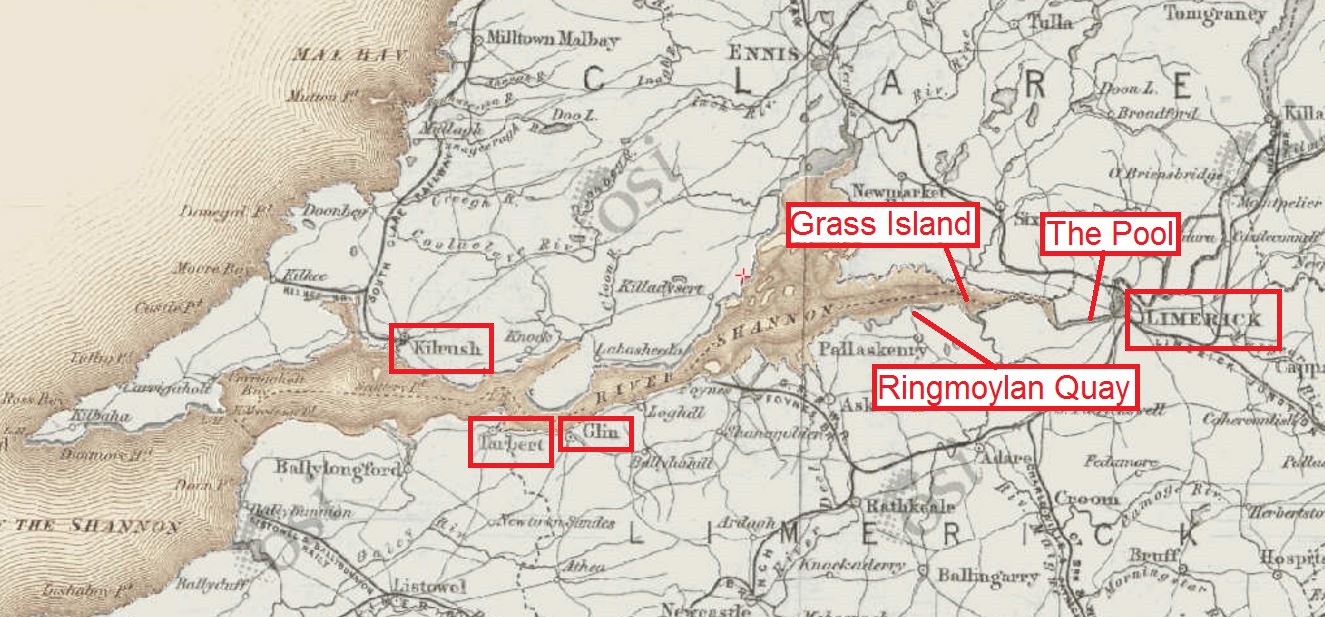
A few minutes past two o’clock in the evening of Wednesday, the 6th instant, the Dover Castle left Glin [that should read Limerick] for Tarbert, with between 30 and 40 persons on board, including some of the Glin police.

shannon-estuary-osi-02

The route of the Dover Castle (OSI 25″ ~1900)

When she reached the pool, she took a large brig and a schooner in tow, which she took as far as Grass Island. She then continued her course, and when about three miles west of Ring Moylan quay, a thick fog came like a wall upon her, so that it was impossible to see half the length of the deck.

Captain White immediately dropped anchor, and was obliged to remain so. The fog continuing all night and the next day.

About two o’clock on Thursday, there being no appearance of the fog clearing off, and several persons on board having eaten nothing since Wednesday morning, two women fainted, and the circumstance having been communicated to the captain, he immediately ordered the steward to open a bag of flour, and served it out in large buckets to the women, who, in a short time, had large cakes made, and baked them for the passengers.

At half-past four o’clock the fog began to clear, and at five the steamer weighed anchor, and reached Kilrush in safety.

Statesman and Dublin Christian Record
19 January 1841 quoting Limerick Standard

My OSI logo and permit number for website

From the BNA

The American and Colonial Steam Navigation Company

What a collection of notables ….

Provisional Committee of 1836

Captain Beaufort RN, Hydrographer to the Admiralty
The Right Hon Maurice A Fitzgerald
Simon M’Gillivray Esq
The Right Hon Lord Talbot de Malahide
George Richardson Porter Esq, Board of Trade
Richard Griffith Esq, Civil Engineer
John David Latouche Esq
Peirce Mahony Esq
Daniel O’Connell Esq
The Hon Frederick Ponsonby
Charles Wye Williams Esq
Christopher Bullin Esq
James Ferrier Esq
James Jameson Esq
Richard Williams Esq
George M’Bride Esq
Francis Carleton Esq

Dublin Mercantile Advertiser, and Weekly Price Current 1 August 1836

From the British Newspaper Archive

From the BNA

Why rural Ireland is doomed?

Lewis Davis says:

Empirically, I find a robust negative correlation between rainfall variation, a measure of exogenous agricultural risk, and a measure of individual responsibility. Using rainfall variation as an instrument, I find that individual responsibility has a large positive effect on economic development.

Abstract on Tyler Cowen‘s site. You can rent the whole article for $6.


The danger of carbon monoxide

At Christmas 1839 the 150-ton schooner Lansdowne, owned by the Limerick Shipping Company, sailed from Limerick for Glasgow.

The Limerick Shipping Company

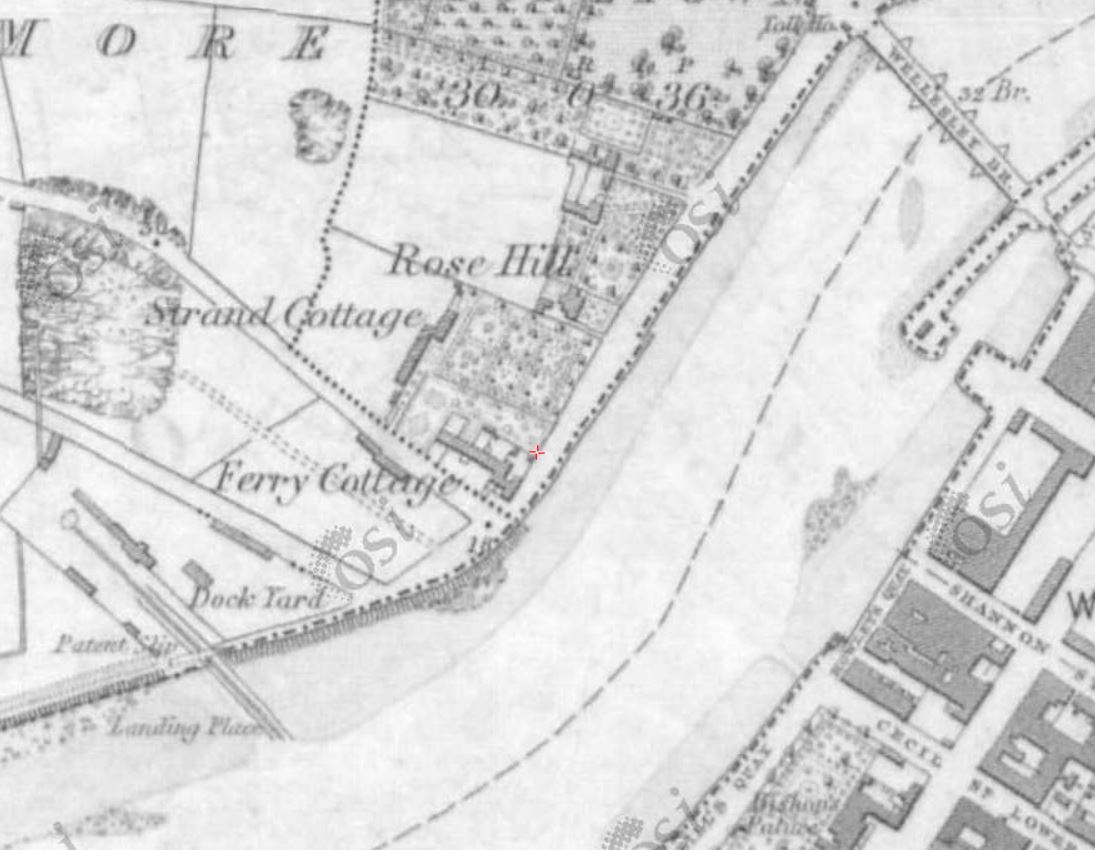
The Marquis of Lansdowne had been built at the company’s yard at North Strand, Limerick, downstream of the Wellesley Bridge and on land owned by the noble Marquis. She was named by Miss Russell, daughter of John Norris Russell, a principal shareholder, and launched on Tuesday 5 November 1839, in the presence of Sir William Macbean, Col Mansel and most of the officers of the garrison. The other merchant vessels in port had “colours flying from stem to stern” and “frequent discharges of artillery” welcomed the new schooner to the “world of waters”.
The Limerick Shipping Company's ship-building yard

The Limerick Shipping Company’s ship-building yard (OSI ~1840)

My OSI logo and permit number for website

The yard, which was equipped with a patent slip, had another schooner on the stocks at the time. According to Commander James Wolfe

There is a patent slip and yard at Kilrush, as well as at Limerick. At the latter place the slip is proved for vessels of 400 tons, at the former only for those of 250 tons. Repairs to any extent may be done at either of these places; and at Limerick some fine vessels have lately been built.

The Limerick Shipping Company had ten schooners by 1834 and, in 1838, bought a steam tug, the Dover Castle, which also competed in the passenger-carrying trade on the Shannon Estuary. By 1842 it had thirteen schooners and was offering regular weekly sailings between Limerick and London.

At no period were the Commercial interests of the Port of Limerick so prosperous, this spirited Company having now at their command a squadron of vessels equal, if not superior for all sailing qualities, to those of any other port in Ireland.

Death at the Broomielaw

John Brown, aged 27 or 28, got married one day before the Lansdowne sailed at Christmas on what must have been one of its first voyages. In Glasgow, the schooner berthed at the Broomielaw, and in mid-January Brown went drinking with William Bennet and John Anson, both aged about 20. When they returned to the schooner, they lit the stove in the forecastle, closed the hatch and went to bed.

The port regulations banned fires on vessels after nine o’clock; the newspaper said [without citing any evidence] that the three men closed the hatch “so as to prevent a single ray being seen outside” by the police on the quay.

The unfortunate men went into their sleeping berths, and as might have been anticipated, the consequence proved fatal to all the three, the action of carbonic acid having done its deadly work long before morning.

About seven o’clock they were found dead, their countenances as calm as if they had still been under the influence of sleep. One of them was in a half sitting posture.

Two doctors inspected the bodies and “corroborated the accidental nature of the causes which led to death; and liberty was granted to have the bodies interred.”

The Lansdowne herself survived for only another three years: she was wrecked on the Scottish coast in January 1843.

Sources

Clare Journal, and Ennis Advertiser 7 November 1839

Sailing Directions for the Lower Shannon, and for Lough Derg; with some Hydrographic Notices of Lough Ree and Lough Erne. By Commander James Wolfe RN; being the result of Surveys made by Order of the Lords Commissioners of the Admiralty

Clonmel Herald 25 January 1840 quoting Glasgow Courier

Limerick Reporter 17 January 1843

All newspapers from the British Newspaper Archive:

From the BNA


Sewage

Having a boat with a holding tank and no bypass system, we take a keen interest in the availability of pump-outs on the Shannon. We used that at Dromineer before heading upriver, but then found that:

  • that at Castle Harbour, Portumna, seemed to have disappeared, probably as part of the harbour renovations; no doubt it will return eventually
  • that at Banagher was not working. There was no notice to say so and the Waterways Ireland patroller who visited the harbour was not aware of the fact. We notified WI but a repair team did not arrive
  • that at Shannonbridge was blocked by a private cruiser. A hire-boat tried to use the pump-out but the hose would not stretch to any position other than that occupied by the private boat. The hire-boat folk even tried to tie their boat to span the gap between the cruiser and the boat behind it, but the hose would not stretch far enough
  • at Athlone the pump-out on an outside hammerhead pontoon had been disconnected as the berth was now allocated to a trip boat. There was a pump-out at the inner end of the pontoon fingers but, while it might be possible to get in safely, getting out would have been pretty well impossible without hitting someone else’s boat.

We were not inconvenienced by this: we went to Quigley’s at Killinure and got pumped out there. But I was struck by the fact that the only other boats we saw trying to use the pump-outs were hire boats, so I looked at the Carrick Craft Captain’s Handbook [PDF/Flipbook] where I found, on page 8, that hirers are given pretty definitive advice about using their holding tanks and the pump-outs:

All boats are equipped with holding tanks for sewage. Tanks should only be emptied at pump-out stations. It should be noted that it is illegal to dispose of sewage overboard. Never moor alongside pump-out stations for longer than required to empty the holding tank.

There is more detailed advice on page 26.

The poor benighted foreigners take all of this seriously, not realising that, in Ireland, illegality is no reason not to do something — an instance perhaps of what Brian Lucey called a “preference for discretion“. But the point is that those I saw were taking considerable trouble to obey the Irish laws and were being frustrated in doing so. It seems unfair that they should waste an hour or so in trying to get a pump-out — or should endanger themselves in trying to get near the pump.

Some suggestions:

  • hirers might be advised to use the facilities at IBRA bases as much as possible, but not to rely on being able to do so on change-over day
  • Waterways Ireland patrollers might check the condition of pump-outs (and other harbour facilities) when checking boat numbers; they might report to the appropriate engineers
  • keeping pump-out locations free at all times would be a waste of space, but they might have markings asking boaters to move when someone does want to use the facilities
  • the operators of the Athlone marina might be asked to put a pump-out on an outside berth.

Oh, and folk might be advised not to swim in harbours ….

A distinguished visitor to the Shannon

Dwarkanauth Tagore, of Calcutta, the distinguished and princely East Indian, who is making a tour of the United Kingdom, arrived in this city, on Tuesday evening with his suit [sic], in an elegant drag with four horses, and he put up at Cruise’s hotel.

The native Prince merchant partook of a dejeune at Killaloe on Tuesday. The City of Dublin Steam Company placed all their vessels on the Upper Shannon, at his command, and they were gaily decorated with flags, in compliment to the distinguished stranger, who left Limerick this day on a visit to Killarney Lakes, and is expected to call at Derrynane, the seat of Mr O’Connell.

Dwarkanauth Tagore dined and slept at Lord Rosse’s, on Monday night, where he examined the prodigious telescope — drove to Banagher, on Tuesday morning, and embarked on board the Lansdown [sic] steamer, proceeded through Victoria Locks Meelick, accompanied by Colonel Jones, and Mr Rhodes CE, also by Mr Howell, Secretary to the Dublin Steam Company. He was much pleased with the new works at Meelick, and also with the operations of a diver in a helmet, who exhibited the mode of using that apparatus.

The dejeune on board the Lansdown was provided by the Steam Company. Several ladies and gentlemen came up by the Lady Burgoyne to join the party of [at?] Portumna in the Lansdown. After partaking of the good cheer, they had dancing and music on deck till they reached Killaloe, much to the amusement of the stranger guest, who felt edlighted, not only with the scenery of the lake, but also with the company of the ladies.

Limerick Reporter 5 September 1845

From the BNA

Castle-Connell Regatta

To take place on 1st and 2nd Oct, 1850

First days race

£        s        d

1st For all Four Oared Gigs                                                5        0        0
Entrance                                                                                0       10        0
Second boat to save entrance money

2nd For all First Class Cots                                                3        0        0
Entrance                                                                                0        5        0
Second Boat                                                                          0      15        0

3rd For all Fishing Cots to be rowed down stream and polled back with 2 Polls
First Boat                                                                              2       10        0
Second do                                                                             0       15        0
Entrance Each                                                                     0         2        6

4th For all Cots to be paddled down River with 2 Paddles and polled back with 2 Polls
First Boat                                                                              1       10        0
Second Boat                                                                         0         7        6

Second Day’s Race

First — For all Four Oared Gigs                                       4        0        0
Entrance                                                                                0        2        6
Second Boat to save Entrance Money

Second — For all Fishing Cots to be rowed with
two oars and a paddle                                                        2        0        0
Second Cot                                                                           0       10        0
Entrance                                                                               0         2        6

Third Race — For all Fishing Cots to be rowed
down the river with two oars and paddled
and polled back with two poles                                       1        10        0
Second Boat                                                                        0        10        0
Entrance                                                                              0          2        6

Fourth Race — For all Fishing Cots with
one paddle                                                                           1          0        0
Second Boat                                                                        0          5        0
Six to start or no race

NB No Race for any of the above Plates, unless 3 Boats start.

The decision of the Stewards to be final in all cases, and by whom the distance on the river will be laid out.

Boats for the First Race to start at Ten o’Clock precisely, and to be entered at Mr Wilson’s before Ten o’Clock each day.

An Ordinary at Wilson’s Hotel each day.

There will be a Ball at the Old Assembly Rooms, of which further notice will be given on Saturday.

Stewards

Sir Richard De Burgho, Bart
Colonel Vandeleur
Captain Wyndham 1st Royals
S Vansittart 1st Royals
A Vincent Esq
A W Heard Esq

Limerick and Clare Examiner 25 September 1850

From the British Newspaper Archive run by Findmypast Newspaper Archive Limited, in partnership with the British Library.


Walking the Royal

Great walking match

A CELEBRATED MATCH is now performing by W F Simpson, a Native of Dublin, at RUSSELL-STREET, or JONES’S-BRIDGE, Royal Canal. He purposes Walking

1000 Quarter Miles in 1000 Quarter Hours!

for a Wager of £100 to £50. Such a feat has never been performed by any Pedestrian trained in England.

Admission, 2d each.

Freeman’s Journal 25 September 1850

From the British Newspaper Archive run by Findmypast Newspaper Archive Limited, in partnership with the British Library.

Bedding

A pawnbroker at Kilrush, in the county of Clare, is said to hold nearly 800 feather beds, most of which he is endeavouring to sell, as the terms for which they were severally pledged have expired.

Preston Chronicle 30 June 1849

From the British Newspaper Archive run by Findmypast Newspaper Archive Limited, in partnership with the British Library.

[The earliest mention of this story that I have found is in Bell’s Weekly Messenger 23 June 1849, which named the pawnbroker as Dowling but cited no source. Several other newspapers repeated the item on 30 June and in the week or so following.]

[Slater’s National Commercial Directory of 1846 lists Jeremiah Dowling of 111 Moore st, Kilrush, as a pawnbroker.]

Special Agent O’Brien

Synan Meehan, who absconded from Kilrush with £76, and was apprehended in Liverpool by Mr P O’Brien, the Dublin Steam Packet Company’s [Kilrush] agent, was brought up at the Limerick Police office on Thursday, before T P Vokes Esq, who ordered him to be sent on to Kilrush for final examination, and whither he proceeded by steamer in charge of two policemen. When arrested in Liverpool, he was in a state of intoxication, and but a few shillings were found in his possession. He stated that in February last he lost £30, which he had to make good every month when closing his accounts, and fearing it would be discovered he was induced to make off. The offender was regarded in Kilrush as a strict teetotaller, but having violated his solemn pledge to Father Mathew, little confidence could be reposed in him.

Southern Reporter and Cork Commercial Courier 12 August 1845

From the British Newspaper Archive run by Findmypast Newspaper Archive Limited, in partnership with the British Library.