Category Archives: People

The Bishop of Killaloe and the bridge at Moys

That would be the Bishop of the United Church of England and Ireland, as established by the fifth article of the Acts of Union of 1800, of course.
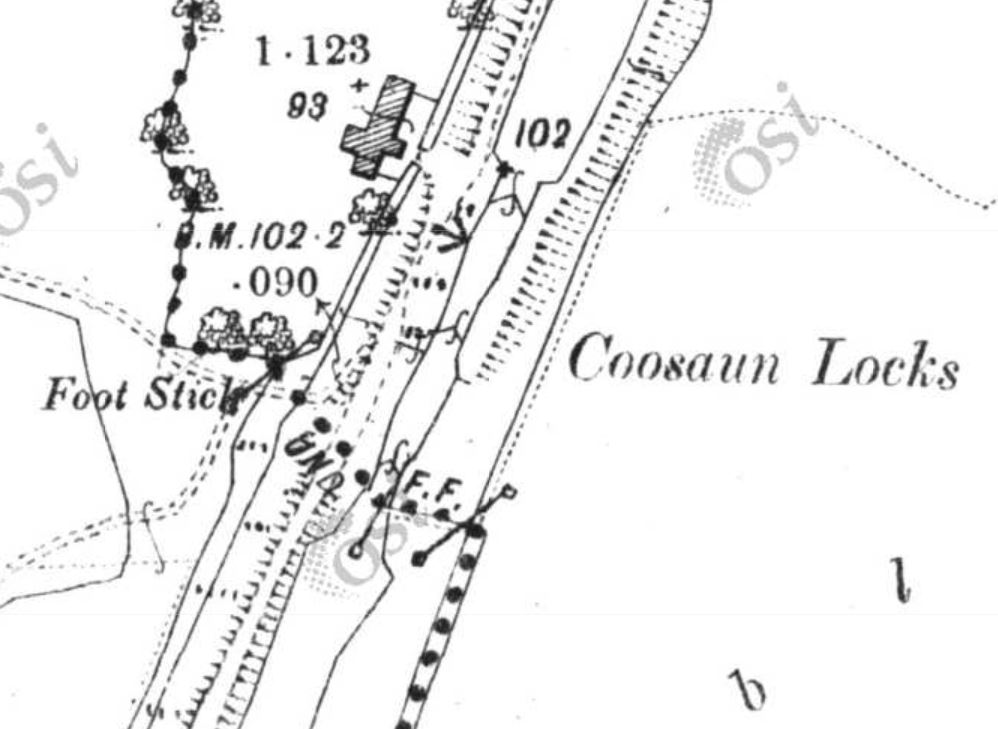
Cussane lock (OSI 25″ ~1900)

Cussane (or Coosaun, as above) Lock was the furthest downstream of the three locks on the Killaloe Canal. It was submerged by the “Flooded Area” created by Parteen Villa Weir as part of the Ardnacrusha hydroelectric scheme.

The middle lock on the Killaloe Canal is at Moys and its remains are visible, just above the water, in normal non-flood conditions. It is (or was until recently) still possible to go through it by (small) boat, though of course without needing to use the lock mechanisms.
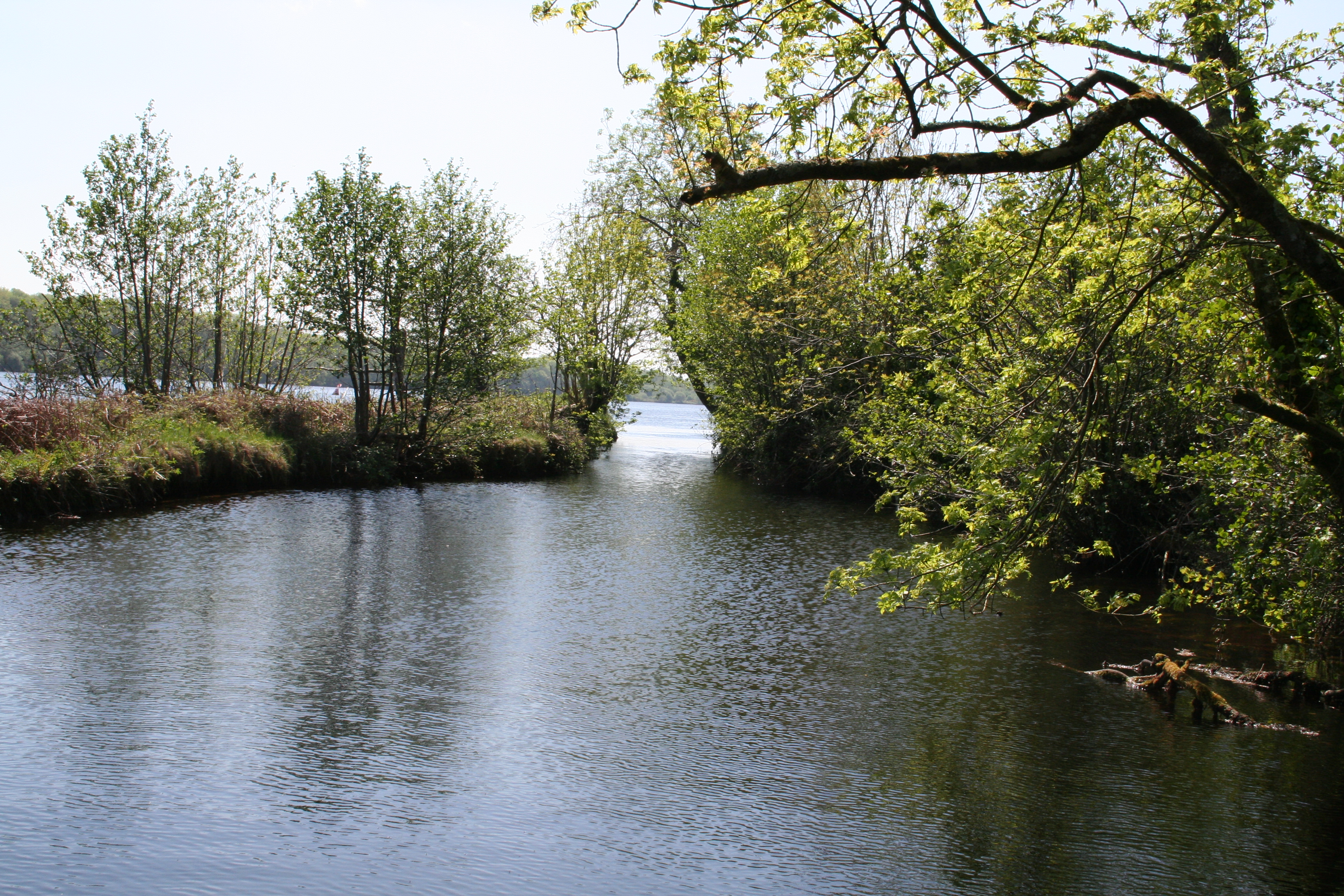
Approaching Moys Lock from upstream

However, although the lock itself survives, the bridge that crossed it is no longer there. It was shown on the 6″ (~1840) and 25″ (~1900) Ordnance Survey maps; I would guess that it was removed as part of the Ardnacrusha works, but I don’t know and would welcome information.
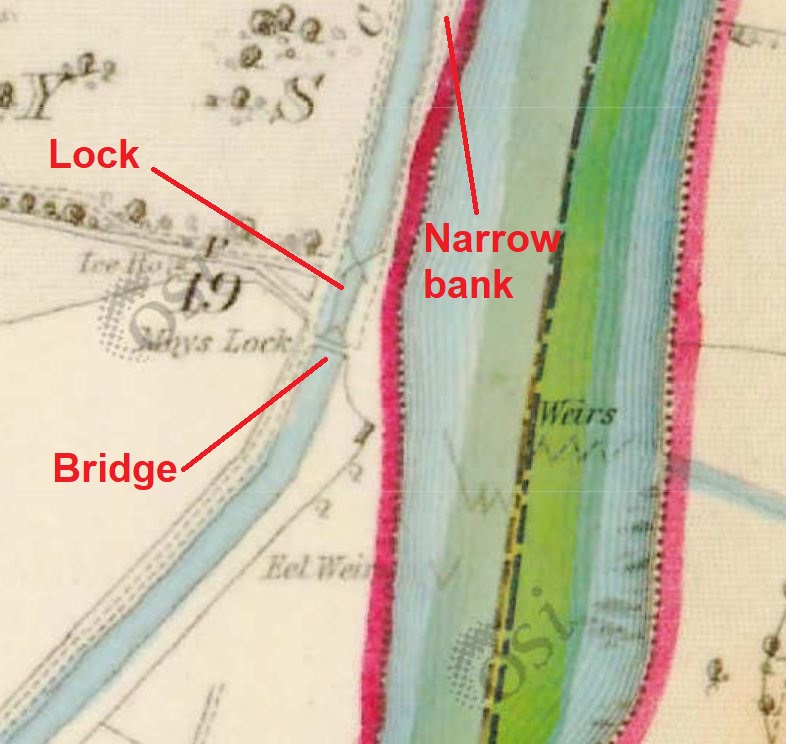
The lock and bridge at Moys (OSI 6″ ~1840)

The other thing I don’t know about the bridge is why it was built in the first place. Hely Dutton [Statistical Survey of the County of Clare, with observations on the means of improvement; drawn up for the consideration, and by direction of the Dublin Society The Dublin Society, Dublin 1808] wrote that

It seems to be the general opinion in Killaloe, that the canal has been cut in the most improper direction; they think it should have been brought in a valley between Killaloe and Dr. Parker’s, and to the north of the Bishop’s house, and not parallel to the Shannon as at present. Bishop Bernard offered several thousand pounds, if this line had been pursued; for, instead of cutting his demesne off from the Shannon, as at present it does, it would have gone at the back of his house; if this was the only objection, I think the engineer acted very impartially, as all public officers should, but very seldom do.

That suggests that the bishop was not best pleased to have a canal in front of his house; if he was willing to pay “several thousand pounds” to have the canal put somewhere else, the Limerick Navigation’s promoters must have been able to deploy considerable firepower (political and financial) to overcome his opposition. I wonder whether promotion to Limerick might have helped: according to a later estimate [Dublin Weekly Register 21 September 1822], promotion from Killaloe to Limerick would have increased a bishop’s income from £7000 to £8000 a year.

Charlotte Murphy [“The Limerick Navigation Company 1697–1836” in North Munster Archaeological Society Journal Vol 22 1980], describing John Brownrigg’s report on the navigation in 1801, said

This latter [Moys] lock had a bridge over the tail to accommodate the Bishop of Killaloe, whose demesne was served by the canal.

But what accommodation did the bishop need? A small strip of land downstream of the lock was insulated by the canal; perhaps the bridge provided access for cattle.

Another possibility is that the bridge provided access to the episcopal eel weirs. According to Mr Blackburne QC, addressing the Shannon Commissioners in 1837 on behalf of the Bishop of Killaloe and Sir Gilbert King Bart of Jamestown [Saunders’s News-Letter 29 December 1837],

The bishop, his tenants, and his predecessors had from time immemorial been in the habit of using twenty-five eel weirs, extending from the tail of Lough Dearg down the whole line of the rapids of Killaloe, which place, from natural impediments, could never be made navigable.

I think I have read somewhere that the eel weirs were worth £75 a year to the bishop, but I can’t remember where I saw that so I haven’t been able to check it.
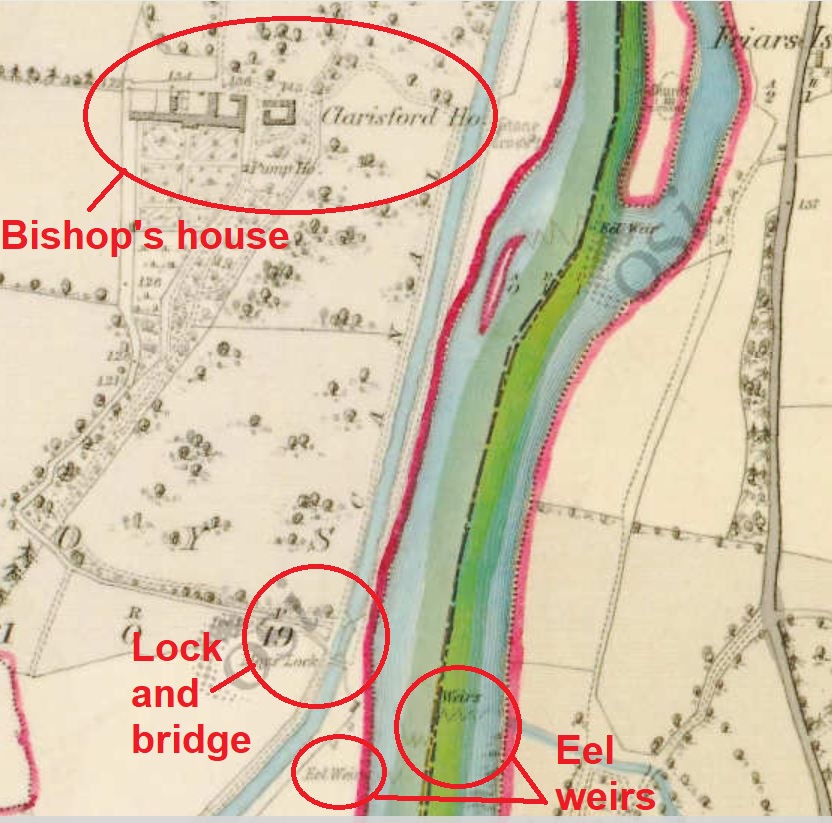
The bishop’s house, the lock and the bridge (OSI 6″ ~1840)


There is one other aspect. The bridge was used by the horses towing boats on the canal and, of course, by the men leading them. We know that because the towing-path changed sides at Moys Lock. It was on the west side of the canal from Cussaun to Moys but on the east from Moys to Killaloe: it is marked on the 6″ OSI map and named on the 25″.

That forced horses and men to walk on a narrow embankment rather than on the shore. But it kept them out of the bishop’s garden and a little further from his house. Might that have been the intention?

I would be glad to hear from anyone who knows more about Moys.


Limerick Navigation lockkeepers

The Limerick Navigation was in five sections — three canals with river sections in between — and joined Limerick to Killaloe and the rest of the inland Shannon. The canal sections had locks, each controlled by a lockkeeper who lived on site. The job passed from generation to generation: some of the lockkeepers’ cottages are still inhabited by descendants of the lockkeepers.

Cussane lock (OSI 25″ ~1900)

Cussane was the furthest downstream of the three locks on the Killaloe section of the canal. It was covered by water when the Ardnacrusha hydroelectric scheme created the “flooded area” below Killaloe. If memory serves, Cussane was known as Crowe’s Lock.

In the online searchable catalogue of the Registered Papers of the Chief Secretary’s Office in the National Archives, there is a letter dated 15 February 1830 [CSO/RP/1830/815]

[…] from James Saurin, Henry R Paine, and John Radcliffe, [Directors General of Inland Navigation], Board of Control, [Dublin], to Hugh Percy, 3rd Duke Northumberland, [Lord Lieutenant of Ireland, Dublin], recommending Denis Crow to succeed Lott Corboy sheriff as lockkeeper on the Limerick Navigation.]

There is also a letter dated 2 June 1830 [CSO/RP/1830/836]

from James Saurin, J Armit, and Henry R Paine, [Directors General of Inland Navigation], Navigation Office, [Dublin], to Hugh Percy, 3rd Duke Northumberland, [Lord Lieutenant of Ireland, Dublin], recommending dismissal of Simon Johnston, lockkeeper on the Limerick Navigation, for irregularities and for deception; asking to employ Michael Gully in his stead, for Stg£9-4-9 per annum.

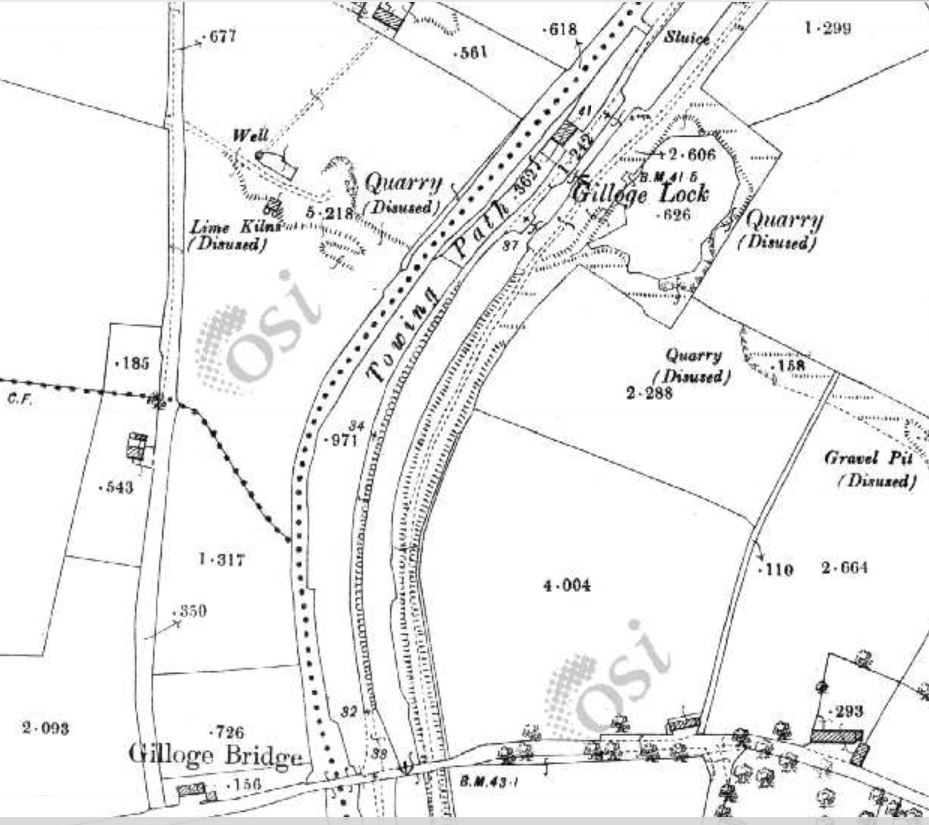
Gully’s Lock is at Gillogue, on the central canal section known as the Plassey–Errina Canal.

Gillogue lock (OSI 25″ ~1900)


Robert French of Monivea

Another addition to the collection of turf and bog navigations: the Monivea navigations, developed by Robert French in the middle of the eighteenth century. The navigations, like certain others in the nineteenth century, combined drainage, navigation and water power.

Monivea is near Athenry in Co Galway.


The Church of the Sacred Heart, Roscommon

So there you are, en route from Kingsbridge railway station in Dublin to Westport in Co Mayo. Or, as it might be, from Westport to Dublin. Either way, the journey takes at least three hours.

What you would like, of course, is to lengthen the journey by making a little stop along the way. In particular, you would like to stop in Roscommon to see the Church of the Sacred Heart. You could get off your train, visit the church and then catch the next train. You might even be able to do the same in Castlerea.

That is according to Senator Terry Leyden of Fianna Fáil. Now that the Shannon stopover, which hijacked transatlantic passengers en route to Dublin, is no more, the good Senator proposes an equivalent for the railways.

Waterways update: work in progress (1759)

Here is some information about the work of Messrs Ockenden and Omer on Irish waterways up to 1759. It is extracted from a book by Henry Brooke; Ockenden had, twenty years earlier, subscribed to support Brooke’s play. It is not impossible that they were acquainted, in Ireland or in England. Apart from anything else, both were supporters of Frederick, Prince of Wales: see A N Newman “The Political Patronage of Frederick Lewis, Prince of Wales” in The Historical Journal Vol 1 No 1 1958 on Ockenden’s post in the prince’s household at £100 a year and here on Frederick’s “many attentions” to Brooke.

Brooke’s account contains some information about Ockenden’s work that I have not seen elsewhere. I found the reference to Brooke in Thomas McIlvenna This Wonder-Working Canal: a history of the Tyrone Navigation Coalisland Canal Branch IWAI 2005.

The Prince of Denmark?

Look here, upon this picture, and on this.

Bolshies on the Grand

The Grand Canal Company strike of 1890, starring William Martin Murphy and Barry Fitzgerald.

Daniel O’Connell and the Night of the Big Wind

In Liberator: the life and death of Daniel O’Connell 1830–1847 [Gill & Macmillan, Dublin 2010], the second volume of his biography of O’Connell, Patrick M Geoghegan writes

On 5 January 1839 a scandal engulfed the [Precursor] society, and O’Connell suffered one of the greatest betrayals of his life. He had spent the day with [Peter] Purcell [the most important mail-coach operator in Ireland and later founder-chairman of the Great Southern & Western Railway] at the Corn Exchange, attending various committee meetings, and afterwards they walked arm-in-arm in friendly conversation back to O’Connell’s home at Merrion Square.

O’Connell begged Purcell to join him and his family for dinner, but Purcell excused himself and the two men ‘parted at the door as friends part, who expect to meet next day’. There was some time before dinner, so O’Connell entered his study, where he picked up that day’s Freeman’s Journal.  He began reading it and was astonished to find a letter from Purcell exposing financial irregularities in the Precursor Society and threatening to resign unless they were resolved.

Purcell had discovered that the funds of the society had been lodged in O’Connell’s name in the National Bank, and implied that O’Connell had turned a political movement to his own pecuniary advantage and had used ‘the garb of patriotism’ for his own ends. Demanding a full investigation, Purcell called for the money to be placed in the hands of publicly appointed treasurers.

The source cited is John O’Connell Recollections and experiences during a parliamentary career from 1833 to 1848 2 vols London 1849 (although O’Connell did not, as far as I could see, give a date for the incident.

In fact, the date given is wrong. The Freeman’s Journal for 5 January 1839 contains no letter from, or information attributed to, Peter Purcell. His letter was written on 5 January, a Saturday, but was published on the following Monday, 7 January 1839.

O’Connell’s account is seriously misleading. The affecting scene in which the Liberator walks home arm in arm, all unconscious that his companion has just betrayed him, and only discovers the betrayal on chancing to read a newspaper shortly afterwards, is utter nonsense. He might have walked home with Purcell (who lived on the north side of Dublin) on Saturday 5 January, but he could not have read the letter on that day. He could, clearly, have read the letter on 7 January, but I think it utterly impossible either that he and Purcell would have been working all that day at the Corn Exchange or that they would have strolled to Merrion Square afterwards.

That’s because Sunday 6 January 1839 was the Night of the Big Wind. Admittedly, by daylight on Monday, the storm had “sunk back into a steady and heavy gale from the SW” but it “continued throughout the remainder of the day” [Freeman’s Journal 8 January 1839]. The whole city was “a scene of general devastation, houses unroofed, and windows broken in every direction”. Chimneys fell into the street or into the buildings; some houses lost their front walls.

In Stephen’s-green, Merrion-square, and Fitzwilliam-square, there were few houses which escaped the general desolation. Those of the two former localities suffered in particular, stacks of chimnies [sic] being thrown down in every direction, and crushing the roofs beneath them, the streets below being literally covered with slates and brick. But it has as yet been impossible for us to ascertain the remotest approximation to the extent of the damages, or the innumerable injuries which must have been inflicted in the interior. […] The stately trees which ornamented the lawn in front of Leinster-house, in Merrion-square, were almost all torn from their roots, leaving but a few of the smaller ones standing, and that enchanting spot has lost its beauty for ever.

If Daniel O’Connell and Peter Purcell were strolling arm in arm through that lot, they were better men than I am, Gunga Din. In fact, unless O’Connell’s house escaped damage, I doubt if he would have been sitting quietly reading the paper in his study while waiting for dinner: I’m sure he’d have been up on the roof with a tarpaulin, a hammer and a bag of nails from B&Q.

But that is the less important, if more amusing, respect in which John O’Connell’s account is inaccurate. He entirely misrepresents the nature of Purcell’s letter. Purcell said nothing to suggest that he believed O’Connell to be guilty of “peculation under the garb of patriotism”; indeed he explicitly said the opposite:

[…] I consider so sacred a fund as that which has been collected from the hard earnings of a confiding peasantry should not only be secure (which I fully believe it to be in the hands of Mr O’Connell), but that it should be so placed as to be above suspicion, even in the minds of our political enemies.

I have placed here a PDF of the text of Purcell’s letter, transcribed from the Freeman’s Journal of 7 January 1839, with paragraphing and punctuation adjusted to suit my tastes.

It seems clear to me that Purcell did not accuse O’Connell of dishonesty. He was instead objecting to two things:

  • O’Connell’s blurring of the line between the personal and the organisational
  • O’Connell’s refusal to honour his own promises, promises which had led Purcell to mislead others about the future management of the funds.

O’Connellites successfully defended their leader against an accusation that Purcell had not made: they showed that he had not helped himself to the money and pretended that there was therefore nothing to worry about.

Afterwards, O’Connell and his supporters, especially the increasingly insane Thomas Steele, constantly attacked and insulted Purcell. However, Purcell achieved far more in the remaining few years of his life [he died in 1846] than O’Connell did [he died in 1847], and I suggest that the incident of the Freeman’s Journal letter shows why.

O’Connell was a tribal chief, requiring loyalty to himself and seeking to build a dynasty rather than an organisation. In his last years he alienated many who might have made alliances with him, even if they would not have supported him, and when his country’s need was greatest, in the Famine, he had no influence that he could wield to help it.

Purcell, on the other hand, was a modern business man: he had built a huge and successful operation (and ran several ancillary businesses too) and, when he lost his mail-coach business, he built another and even more enduring organisation, the Great Southern and Western Railway. It was the most successful railway in Ireland and its descendant, CIÉ, is still with us. Getting it off the ground (as it were) required cooperation with people of very different backgrounds and views, balancing the advice of a range of technical experts, seeing off competitors and opponents and managing extremely large amounts of money.

O’Connell by 1840 had made himself into a single-issue, single-constituency chief; Purcell was (to echo Brian Farrell’s terminology) a supremely competent chairman. Had O’Connell listened to Purcell in late 1838 and early 1839, they might have built a powerful and lasting organisation that united rather than divided Irish interest groups. But that prospect had blown away before the Night of the Big Wind.


Dromineer

Not that many pubs, surely.

Steam and the British Protestant Constitution

On Friday 23 February 1827 Viscount Lorton, holding a Petition in his hand, addressed the House of Lords.


My Lords, in rising to request permission to lay upon your Lordships’ table a Petition from the Protestants of the county of Sligo, I shall beg leave to say a very few words upon the subject matter it contains.

In the first place, I must premise by observing, that it has the signatures of nearly (or entirely) the whole body of the resident Gentlemen, and in the strongest but most respectful language prays that no further concessions may be granted to the Roman Catholics of Ireland. With my countrymen, my Lords, I most decidedly concur; but at the same time think it necessary to stand forward as an advocate for Emancipation, though not exactly for the description of persons who have for so many years been urging claims hostile to the Constitution in no very qualified terms.

No, my Lords, those for whom I would claim this boon are the Protestants of Ireland, who, I do not hesitate to affirm, are at this moment the most oppressed portion of the British subjects. In fact, they are a proscribed people, and if some strong measures are not adopted for their relief and security, all who are capable must leave the country, and we may expect to hear of the remainder being annihilated in one way or another.

It may be unnecessary for me to inform your Lordships, that a Roman Catholic Parliament has been permitted to sit in Dublin, from nearly the period of passing an Act in this House for putting down the late Roman Catholic Association, and that it is of a much more dangerous nature, in as much as it combines the entire mass, from the highest to the lowest. At first the higher order seemed to stand aloof, but no sooner did the founders of this tremendous engine contrive to enlist under their banners the clergy, than all ranks, from the highest peer downwards, were put into requisition, and from that time have exhibited as much zeal in the cause as the most furious demagogue in the land: such is their infatuation, and such, my Lords, is the very extraordinary power and controul that the Pope maintains over the hearts and understandings of those who belong to his church.

Having said thus much of the Dublin Convention, I must further observe, that, at its sittings, the most bitter denunciations are uttered against every thing that is Protestant, both as to the public institutions as against individuals, who, in the most cowardly manner, are held up to the detestation of the Romish peasantry, by the propagation of every species of the most malignant falsehood, and are thus marked as fit subjects for assassination, when a proper opportunity may occur.

My Lords, the philippics of Messrs O’Connell and Sheil are, no doubt, familiar to most of your Lordships, but more particularly the base and dastardly observations of the latter person, when our late Illustrious and lamented Commander-in-Chief was lying on his death-bed!

My Lords, it is difficult to think or speak upon the subject with patience; the speeches of these people have so excited the country, that the general opinion is a rebellion must take place. Should such a calamity befall the land, I trust, my Lords, the strongest measures will at once be taken to prevent any of the leaders of the Roman Catholic Association from leaving Ireland, for no doubt they will be among the first who will endeavour to make their escape from the mischief they have occasioned. But, my Lords, they should be forced to fight it out, and should not be permitted to leave their poor deluded victims to the just vengeance of the Government.

Some of these bitter enemies to the British Protestant Constitution have pointed out in the most exulting manner, that the invasion of Ireland by a foreign foe would now be an easy matter, in consequence of the perfection that the navigation by steam had been brought to. But here, my Lords, they have shewn their ignorance nearly in as strong a manner as their malignity; for never was there a discovery made which so completely secures Ireland from being taken by surprise by a hostile power, in as much as hundreds of thousands of gallant British soldiers could be landed and set in motion against an enemy in the course of from ten to twenty hours; and it should also be told these threatening boasters, that one British Company possesses more steam vessels than all Europe besides.

[cont p94]


From the Morning Post 24 February 1827