Category Archives: Politics

The Armagh Canal

Another unbuilt canal mentioned by the indefatigable Mr Atkinson.

A proposal for making a canal from the city of Armagh to the river Blackwater, near the town of Moy

In order to shew, that carrying into effect the annexed sketch of a line [alas not annexed to the Google scan of Atkinson’s book], for opening a navigable communication from Armagh to the river Blackwater, would be a work of public utility, the following reasons are most respectfully submitted to the Right Honourable and Honourable the Committee of the House of Commons.

From Armagh, being the most considerable market in the kingdom for the sale of brown linens, the manufacture of that staple article is carried on to a very great extent in its neighbourhood; but this manufacture is in danger of being most materially injured, from the great scarcity of fuel, which is such as to oblige the opulent inhabitants to use English coal, at a great expense of land carriage; and they have latterly, at inclement seasons, been under the necessity of subscribing large sums, to procure that article at a low price for the poor, to prevent them from perishing.

Should a navigation be opened from Lough Neagh it would give the means of a supply of turf from the extensive bogs in the neighbourhood of the lake, would open a communication with the collieries at Coal island, in the county of Tyrone, and bring English or Scotch coal at considerably under the prices at which they can now be procured.

An extensive trade in general articles of merchandise being carried on from Armagh, not only to its own neighbourhood, but to a considerable part of the counties of Monaghan and Tyrone, by opening a navigation through Lough Neagh to the ports of Belfast and Newry, this trade would be very considerably extended, to the great advantage of Armagh, and all those places to which its trade extends, and would tend much to improve the public revenue.

To the great number of bleach-greens and flour mills in the neighbourhood of Armagh, water carriage would be of the highest importance, as well for the conveyance of bleaching stuffs, coals, grain, and flour, as of timber, slates, and other heavy articles, used in erecting and repairing the necessary buildings, machinery, &c.

In a large tract of country, from Blackwater town to Lough Neagh, and from thence up the river Bann, and along the canal to Newry (an extent of nearly 30 miles), there is no limestone whatever; so that lime can only be procured by land carriage from a distance of several miles, which prevents its being at all used in that important national object — agriculture.

Was a canal opened from Armagh, it must necessarily go through the lands in that vicinity, containing inexhaustible quantities of limestone, which could be conveyed by boats returning from Armagh, at a very inconsiderable expense, to all that part of the county above mentioned.

The cut, as laid down in the plan, would extend about five and a half miles; and according to the estimate, would, when completed, cost from £18,000 to £20,000, about one-third of which could be raised by subscription.

To keep the works in repair, and pay interest to the subscribers, would require a toll of about sixpence per ton on all boats carrying coals, or any other species of merchandise; but boats laden merely with turf or limestone might be charged only twopence per ton.

The number of horses constantly employed in bringing coals, turf, and other necessaries, to Armagh, amount to some hundreds; two-thirds of these would, from a canal, become unnecessary, and consequently make a saving to the country of their keeping, attendance, &c to a very large amount.

Should the Armagh navigation be carried into execution, it would be necessary to give the commissioners of it a power of laying on a very small toll on vessels coming into the Blackwater from Lough Neagh, to enable them to clear, and keep in order, a cut which was made many years ago (as marked in the plan), to avoid a sand bank in the mouth of the river Blackwater.
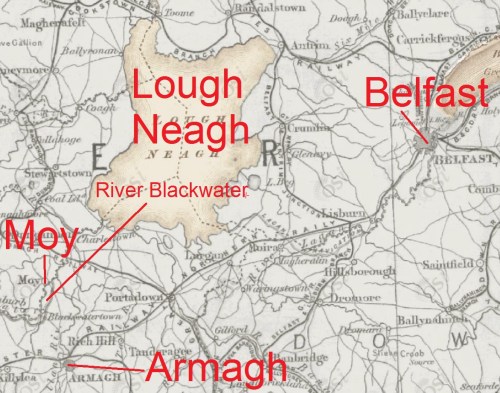
 

Armagh, Moy and Lough Neagh

Armagh, Moy and Lough Neagh

A Atkinson Esq (late of Dublin) Ireland exhibited to England, in a political and moral survey of her population, and in a statistical and scenographic tour of certain districts; comprehending specimens of her colonisation, natural history and antiquities, arts, sciences, and commerce, customs, character, and manners, seats, scenes and sea views. Violent inequalities in her political and social system, the true source of her disorders. Plan for softening down those inequalities, and for uniting all classes of the people in one civil association for the improvement of their country. With a letter to the members of His Majesty’s Government on the state of Ireland Vol II Baldwin, Cradock, and Joy, London 1823.

The Armagh canal document, bearing a date of June 20th 1800, is also included in Rev John Dubourdieu Statistical Survey of the County of Antrim, with observations on the means of improvement; drawn up for the consideration, and by direction of The Dublin Society Dublin 1812 [Google scan, again sketchless] but is not, oddly, mentioned in Sir Charles Coote Bart Statistical survey of the County of Armagh: with observations on the means of improvement; drawn up in the years 1802, and 1803, for the consideration, and under the direction of the Dublin Society Dublin 1804 [at archive.org here], although Coote does say of Newry

A canal has been in contemplation, to be cut from this town to Armagh, and an iron road is also talked of, but there has been no decision in either cases.

My OSI logo and permit number for website

The Dublin to Lough Neagh Canal

Here’s another lunatic canal proposal: one I hadn’t come across before.

Proposal for making a line of navigation from Dublin to Lough Neagh

It is proposed by several noblemen and gentlemen of the county of Meath, and of the manufacturing counties of the north of Ireland, the river Boyne company, with several merchants of the city of Dublin and of the commercial towns of the north, to complete, by private subscription, together with such aid as parliament may be pleased to grant, a navigable canal, from the royal canal at Blanchardstown, near Castleknock, in the county of Dublin, to Navan, Kells, Balieborough, Monaghan, Armagh, and Lough Neagh.

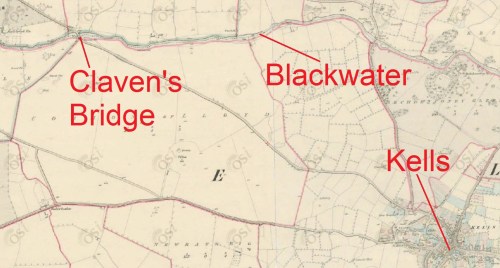
The object of this undertaking is to open a direct intercourse between the metropolis and the manufacturing towns of the north; and it is conceived, by the proposers for this undertaking, that a canal, large enough to navigate twenty-five ton boats on, would answer the trade; and in consequence of many locks being already made, rising from the city of Dublin to Castleknock, they think such a canal could be carried on very cheaply from thence to Navan, where another ascent takes place, through the locks of the Boyne navigation to the level of the town of Kells, and the river Blackwater, at Glevin’s bridge, three miles north of that town.

Claven's Bridge over the Blackwater near Kells

Claven’s Bridge over the Blackwater near Kells

My OSI logo and permit number for website

The country northward appears so fit for inland navigation, that no doubt can be entertained of being able to cut cheap canals through it. It is therefore most humbly hoped, if a line for a canal in this direction should be found to answer the expectation, that parliament will be pleased to allow the undertaking to become a part of the intended system of inland navigation of Ireland, and to a share of whatever bounty parliament may grant to accomplish the same.

The advantages that would arise to the nation from this undertaking, are too obvious to take up the time of this honourable house with any comment upon them.

A Atkinson Esq (late of Dublin) Ireland exhibited to England, in a political and moral survey of her population, and in a statistical and scenographic tour of certain districts; comprehending specimens of her colonisation, natural history and antiquities, arts, sciences, and commerce, customs, character, and manners, seats, scenes and sea views. Violent inequalities in her political and social system, the true source of her disorders. Plan for softening down those inequalities, and for uniting all classes of the people in one civil association for the improvement of their country. With a letter to the members of His Majesty’s Government on the state of Ireland Vol II Baldwin, Cradock, and Joy, London 1823

The (re)invention of heritage

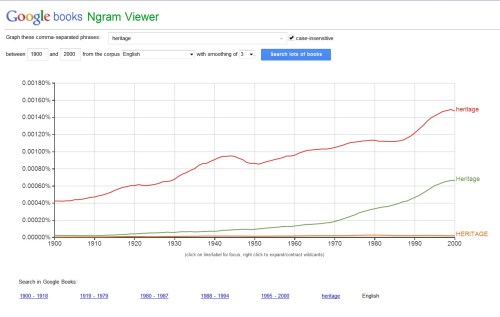
From Google’s Ngram viewer (more here):

ngram[Sorry, Google: couldn’t get the embedding to work properly. WordPress’s whitelist omits Google, though maps seem to work OK. Here’s the original.]

The growth in the use of “Heritage” with an initial capital is particularly interesting. I can think of three possible reasons:

  • that more organisations, eg The Heritage Council, use the word in their titles
  • that the word is increasingly used as an abstract noun at the start of sentences like “Heritage is important”
  • that the word is increasingly used as an attributive adjective at the start of sentences like “Heritage apples should be preserved”.

Traditional, personal uses (like “My heritage from my ancestors …”) are, I think, less likely to require initial capital letters. That in turn might suggest that Google’s Ngram viewer is reflecting a new(ish) set of meanings for the word and might lead us to ask what that new(ish) usage is (or was) intended to achieve.

It might also lead us to ask whether an even newer concept might now be more useful: one that would dissuade well-meaning folk from preserving and displaying context-free old tat and persuade them to find and record information instead.

The liveaboard life …

… in London.

Heritage nonsense and the Naomh Éanna

There was a Dáil debate last week about the scrapping of the Naomh Éanna; nobody gave any good reason for keeping the vessel. Preservation proponents decided not to ask for money: instead they wanted the thing left hanging around while they worked out an “investment plan“, something that they could have done at any time over the last twenty-five years.

The funniest part was the final paragraph of the third contribution by Éamon Ó Cuív [FF, Galway West], who said:

Agus muid ag caint faoi stair, is fiú a lua gur úsáid RTÉ an bád seo le haghaidh scannán an-mhaith a rinne siad, “The Treaty”. Nuair a bhí Collins ag dul go Sasana sa scannán, is ar an mbád seo, seachas bád amuigh i nDún Laoghaire, a bhí sé. Tá ceangal stairiúil le hócáidí thar a bheith stairiúil ag an mbád sin. Níl ag teastáil ach cúpla mí ionas go mbeadh deis ag daoine rud éigin a eagrú. Beidh beagáinín slándáil i gceist. B’fhéidir go mbeidh costas beag ar Uiscebhealaí Éireann. Ní dóigh liom go mbeidh sé suntasach i gcomhthéacs an maitheas a d’fhéadfadh sé seo a dhéanamh dá gcoinneofaí an bád. Má táimid ag lord eiseamláir don rud a bhféadfadh a bheith i gcest, níl le déanamh againn ach cuairt a thabhairt ar Faing agus dul isteach ar an flying boat ansin.

Learned readers will recognise that Google Translate’s version needs improvement:

And we are talking about history, it is worth mentioning that RTÉ use the boat for a very good film they made, “The Treaty “. When Collins was going to England in the film, most of the boats, except boat out in Dun Laoghaire, it was. There are historical connections with historical events particularly at this boat. All you need is a few months so that people have the opportunity to organize something. The security bit concerned. There may be a small cost of Waterways Ireland. I do not think it will be significant in the context of the good it could do this if the boat is kept. If we lord model for what could be gcest, we do not just visit Foynes and go flying into the boat then.

So the Naomh Éanna is valuable because it was used as a film set. And Foynes flying-boat museum shows what could be done.

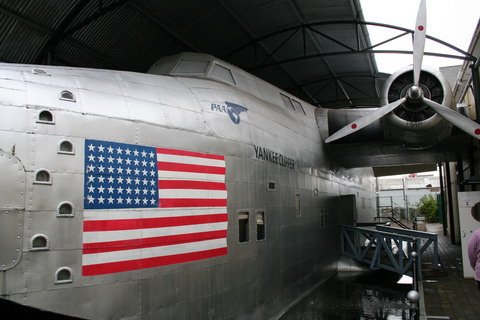
Foynes flying-boat

Foynes flying-boat

Up to a point, Lord Copper. You see — and I know this may come as a shock — the flying-boat on display at Foynes is not actually a real flying-boat. It’s not even a portion of a real flying-boat. It’s a reproduction of a portion of a flying-boat and it was built by a film-set designer.

If anyone really needs to be able to see around a small mid-twentieth-century ship, I suspect that the Foynes folk could provide a replica that would cost less to keep than the real thing.

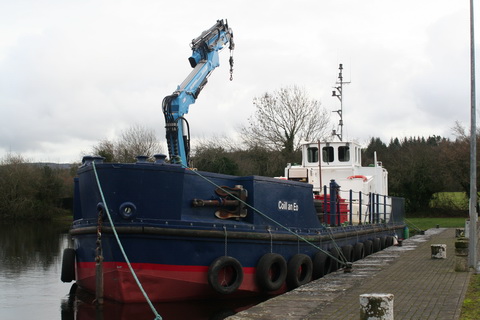
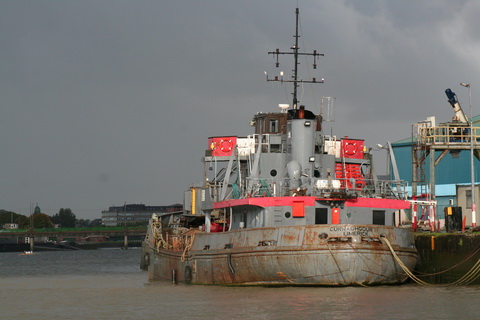
Alternatively, if Dublin needs another example of a locally built vessel, and one different in form from the Cill Áirne, it could take over the Curraghgour II or the Coill an Eo, both also built in Dublin. Maybe the preservationists should start now on their investment planning.

Coill an Eo

Coill an Eo

Limerick Port old dredger Curraghgour II 6_resize

Curraghgour II

An investment plan for the Naomh Éanna?

In a debate about the Naomh Éanna in the Dáil on 13 February 2014, Joan Collins TD [People Before Profit Alliance, Dublin South Central] said:

I understand the National Asset Management Agency and the Irish Ship & Barge Fabrication Company have expressed an interest in stepping in with an investment plan to restore her to her former beauty.

I see nothing about the ship on NAMA’s website, so I cannot provide any information about its views.

According to the most recent modified accounts for the Irish Ship and Barge Fabrication Company Ltd, on file at the Companies Registration Office, its total assets at 28 February 2013 were €286 in cash.

The company had no fixed assets.

Its called-up share capital was shown as €100000 and the balance on its profit & loss account was -€99714.

According to its Annual Return (B1), made up to 30 November 2013, its authorised share capital was €200000, made up of 100000 €1.00 ordinary shares and 100000 €1.00 Non Cum Red Pref shares. Only 100 of the ordinary shares were issued: 1 was owned by Saul Casey and 99 were owned by Sam Field-Corbett. All 100000 Non Cum Red Pref shares were issued and were held by Printation Limited.


What part of “no” does Brendan Smith not understand?

On 11 February 2014 Brendan Smith [FF, Cavan-Monaghan] asked a written question and got a written answer:

To ask the Minister for Arts, Heritage and the Gaeltacht the level of expenditure incurred to date in relation to the feasibility study and any other studies undertaken in respect of the proposed extension of the Erne Navigation from Belturbet to Killykeen and Killeshandra; if his Department proposes to review the decision not to proceed with this project any further; and if he will make a statement on the matter.

Jimmy Deenihan [FG, Kerry North/West Limerick] said:

I am informed by Waterways Ireland that expenditure incurred to date in relation on this project, the Lough Oughter project, on the Erne Navigation from Belturbet to Killykeen and Killeshandra is €84,647. I am also advised that, on reviewing the environmental information from this process, Waterways Ireland considers that the environmental designations of this lake complex make the feasibility of the proposed navigation extension highly unviable.

I understand that Waterways Ireland does not, therefore, propose to pursue this project any further at this time.

The thing is that Mr Smith asked about Lough Oughter back in December and was told then:

On reviewing the environmental information from this process, Waterways Ireland considers that the environmental designations of this lake complex make the feasibility of the proposed navigation extension highly unviable. For that reason, I am advised that Waterways Ireland does not propose to pursue this project any further at this time.

Unless Mr Smith thinks that Waterways Ireland has won the Euromillions lottery since December, he is just wasting time and resources by asking again about Lough Oughter.


Flood plains

Patrick O’Donovan [FG, Limerick] wants to drain the Shannon. Or wants farmers to do it. He doesn’t want the “multiplicity of agencies [which] have made it virtually impossible for anything to be done with the river and the rivers and streams draining into it”; he wants a non-multiplicity of agencies — “the OPW, the Department of the Environment, Community and Local Government, Inland Fisheries Ireland or whoever” — to dig sheughs and stop flood plains flooding. He says

The one group of people who seem to have no say are those who live on the banks of the rivers or who have watched thousands of gallons of water coming in their front door and out their back door.

But he is wrong. That is the one group of people who can stop flood waters coursing through their houses and who can do it most quickly, most easily and without the permission of a single state agency.

The solution is simple: they should move house, away from the flood plains to higher ground.

Big it up for the OPW

I’ve just been reading some particularly nitwitted Dáil discussions and I need some time to calm down enough to report on them to the Learned Readers of this site. Let me just say that anyone who thinks that politicians cannot distinguish fact from fiction is absolutely right. But enough of that for the moment.

I reported earlier on an oddity in the results from the OPW’s Athlone waterlevel gauge. I emailed the OPW about it and a helpful chap got back on more or less immediately.

He explained that the data we see on the waterlevel.ie site is, as it were, live: raw unfiltered data with nothing added, nothing taken away. The same data goes in to the OPW and they spotted that the Athlone gauge was reading too high. They found the sensor was faulty; they have now adjusted it and the new, lower readings are correct.

The disappearance of the placenames is because of some work in progress on improving the website; they will be back.

He kindly pointed me to a list, in .xlsm format, downloadable from here; it shows all hydrometric stations in Ireland. It shows who operates them, whether they’re active and whether they use telemetry (which I take to mean that they can be monitored remotely). Unfortunately OPW itself doesn’t seem to have any gauges on Lough Derg and nor does Waterways Ireland. OPW does have a rather excitable gauge at Scarriff and gauges upstream of Meelick Weir and Meelick (Victoria) Lock. The ESB has gauges with telemetry at Ballyvalley (25073) and Killaloe (25074) but I can’t find any website giving the levels. If, Gentle Reader, you can find one, perhaps you would let us know.

The consoling part of dealing with the OPW is that you get the distinct impression that they know some useful stuff. Unlike, say, some folk working in Kildare Street ….

Doonbeg

It seems that this chap has bought the glof course near the (proposed) Doonbeg Ship Canal. I’m sure that any further development will be in the best possible taste.