Category Archives: Politics

Underwear and the Ulster Canal

In September 2010 I wrote:

[…] a government department, in a time of economic crisis, is proposing to commit to the spending of at least €35,000,000, without having any certainty of being able to get the money anywhere. Unless Waterways Ireland has surplus assets that I don’t know about, I cannot see how it can raise that amount by selling property in a slump; nor do I see any certainty that the Department of Finance will supply the money.

So the Department of Community, Equality and Gaeltacht Affairs won’t be choosing between two sources of funding. Its only possible source is the Department of Finance, and its only possible argument is that, unless the taxpayer stumps up, the shame will be too great: the neighbours will realise that we’re all fur coat and no knickers.

Since the creation of the Department of Arts, Heritage and the Gaeltacht in 2011, we’ve seen a slow striptease, with the government flicking up the corners of its fur coat and gradually hinting at the nakedness underneath.

The setting up of an inter-agency group of treasure hunters was the most explicit acknowledgement that the Irish government could not afford to build the Clones Sheugh. The group included folk from Fermanagh District Council, the Northern Ireland Tourist Board, the NI Strategic Investment Board and the Department of Culture, Arts and Leisure, so the burden of treasure-hunting was spread north of the border. But if that constituted the fifth veil — highlighting rather than concealing nakedness — the sixth has now been dropped.

On Tuesday 9 July 2013 the Select Sub-Committee on Arts, Heritage and the Gaeltacht was concluding its consideration of the revised 2013 estimates for the Department of Arts, Heritage and the Gaeltacht (and the National Gallery). Sandra McLellan, Sinn Féin TD for Cork East, said:

I have one more question, on subhead D4, Waterways Ireland. There is a promise of stage payments to Waterways Ireland to begin the process of making the opening up of the Ulster Canal a reality. Planning permission to begin the project was sought and is due to be approved at this month’s Fermanagh District Council planning meeting and permission has already been approved in County Monaghan. Once the Government releases the funding, the process should move quickly and whatever land purchases are needed will be made. Does the Government intend on doing this and will Waterways Ireland have the adequate funding to undertake the project in 2013–2014?

The minister, Jimmy Deenihan [FG, Kerry North/West Limerick], began by talking about planning permissions and compulsory purchases:

At this stage, the planning permissions have been granted. That, in itself, was a challenge because of environmental and other reasons. The next process will be the CPOs to get the land. In many cases, hopefully, we can acquire the land by agreement. That will be the next challenge.

He went on to say why the Irish government couldn’t afford the sheugh:

There is an inter-agency group sitting. It is something I established, where the local authorities and the statutory organisations, North and South, have all come together around a table and are looking for alternative sources of funding too rather than merely funding from the Dublin Government. Originally, the agreement was that this would be funded by Dublin and the funding for it was identified with the sale of property at the time. During the Celtic tiger, the property, down in the docklands, etc., was quite valuable. However, with the collapse of the property market, that potential source of funding was not there to the same extent, although, with the property market now recovering, that property could become valuable again. Hopefully, it will and can contribute to the overall costs.

Note that phrase “rather than merely funding from the Dublin Government”. But there is more to come:

The next stage would be the acquisition of the land in order to provide the canal and the inter-agency group is looking at possibilities. Also, my counterpart in Northern Ireland, the Minister for Culture, Arts and Leisure, Carál Ní Chuilín MLA, is looking at possible funding for the small portion that is in the North. Funding may be available for that from the Northern Executive and, maybe, Westminster. That, obviously, would help. Wherever we can get funding for this, certainly we will be striving to get it. It will be incremental. We will have to approach it on a staged basis but the important point is to get it started.

So the idea that the wealthy and munificent southern government would pay the entire cost of the sheugh, as a present to the benighted and miserable inhabitants of Norn Iron, and as a demonstration of the prosperity to be expected from a united Ireland, has been abandoned altogether. If Carál Ní Chuilín [who is, coincidentally, a Sinn Féin MLA] manages to extract money from her colleagues for that portion of the sheugh lying within Norn Iron, it will mean that the construction is being funded in the same way as other Waterways Ireland capital spending: each government pays for the development within its own jurisdiction.

Will Ms Ní Chuilín manage to persuade her colleagues? In September 2010 I wrote:

[…] I see no evidence whatsoever that the Northern Ireland executive, or Her Majesty’s government, has any intention of ever starting the JCBs rolling along the Ulster Canal. They are happy to support the principle of canal restoration; they are even prepared to allow southern taxpayers to spend money (borrowed from the bond markets) crossing northern soil. It is possible that, if the canal to Clones brings wealth and prosperity to Co Monaghan, the northern executive will rethink. But as it stands, the evidence suggests that the southern taxpayer will be permitted to dig to Clones, and perhaps even to Monaghan and Caledon, but that the canal will never get any further.

It is possible that having a Sinn Féin minister running DCAL will change  economic perceptions, and no doubt Simon Hamilton, the [DUP] Minister of Finance and Personnel, will be easily persuaded. Having an Irishman as UK Chancellor of the Exchequer may help the Sinn Féin cause: the last time that happened, HMG wasted half a million pounds on the Shannon.

But back to the minister:

It is a good North-South project. It links North and South. There also could be some possibilities under European funding, for example, there was funding available for the Ballyconnell canal and some of that was derived from European funding. We will be looking at every possible source of funding in order to get the project off the ground and to complete it over a period of time. Besides, Waterways Ireland, from its own capital budget, may have some small amount of funding available to initiate the project as well. I will be looking at identifying funding from different sources and, hopefully, over a period of time, we can provide the canal.

There are two sets of points in that paragraph. One suggests that the inter-agency group has not yet found the pot of gold, indeed that it has no very firm ideas about where to find it. Waterways Ireland is unlikely to be able to spare more than the price of a few shovels, but even if it devoted its entire capital budget to the Clones Sheugh it would take at least ten years to pay for it.

The other set of points is contained in the first two sentences:

It is a good North-South project. It links North and South.

Any minor boreen could be said to link North and South, but without costing €40 million or so. In fact, though, the Clones Sheugh is not a good project: it is a waste of money. It will link a couple of fields in the middle of nowhere to, er, Clones, which is no doubt a vibrant hub of culture. It will not attract significant numbers of foreign tourists, so it will merely displace waterways activity from elsewhere, and it will not generate new business or employment opportunities except perhaps for part-time summer jobs in a couple of pubs.

I have compared the Irish (and especially Sinn Féin) enthusiasm for canals to a cargo cult, but perhaps a more modern comparison, and one in line with this post’s heading, would be to the Underpants Gnomes (a metaphor I used here about the Shannon in 1792). It will be recalled that the Underpants Gnomes had a three-phase business plan:

  1. Collect Underpants
  2. ?
  3. Profit.

The Irish government’s (and perhaps Sinn Féin’s) devotion to the Clones Sheugh might be explained by their adherence to a similar plan:

  1. Build canal
  2. ?
  3. Peace and prosperity.

But, knickerless, they cannot gird their loins. Maybe Little Miss Higgins‘s video might provide useful advice.

Envoi

The minister’s extensive reply did not stop Sandra McLellan from asking pretty much the same question nine days later, causing me to wonder why the shinners want the sheugh:

Is there something in the St Andrew’s Agreement, or some other bit of northsouthery, that promises a sheugh to Sinn Féin, to enable them to claim credit for some high-profile but non-threatening all-Irelandism? Is the Clones Sheugh the price of SF support for the Police Service of Northern Ireland? I don’t know, but there must be some explanation for the failure to kill off the sheugh.

[h/t to the learned AD, who drew my attention to the meeting of the select sub-committee, which I had not myself noticed. AD is not, however, to be blamed for my views — or for my metaphors]
List, list, O, list!

Yes: the list of holders of marked fuel traders’ licences [xls] has been updated several times since I last reported but I see no change that affects Shannon boaters.

Canal carrying 1846: Dublin to Waterford

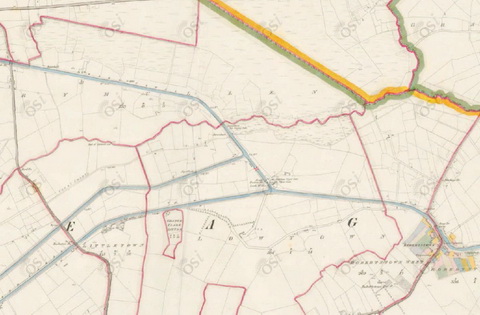
Lowtown is at the western end of the summit level of the Grand Canal; it thus has some claim to be the highest point on the canal. It is close to the village of Robertstown in County Kildare.

Lowtown is also the site of the junction between the main (Dublin to Shannon) line of the Grand Canal and its most important branch, the Barrow Line.

Lowtown (OSI ~1840)

Lowtown (OSI ~1840)

The main line from Dublin comes in from near the bottom right and exits near the top left. The two cuts leaving near the bottom left are the Old and New Barrow Lines, which join together just off the map. The Barrow Line runs to Athy, in south County Kildare, from which the Barrow [river] Navigation runs to the tidal lock at St Mullins, downstream of Graiguenamanagh.

The River Nore joins the Barrow a litle further downstream; the Nore is navigable on the tide upstream to Inistiogue. The combined rivers flow south through the port of New Ross and eventually join the estuary of the River Suir. Turning right at that point takes you up the Suir to Waterford, Carrick-on-Suir and Clonmel. Thus the Barrow Line, from Lowtown, forms an inland waterway link between Dublin and some towns along the Barrow, Nore and Suir.

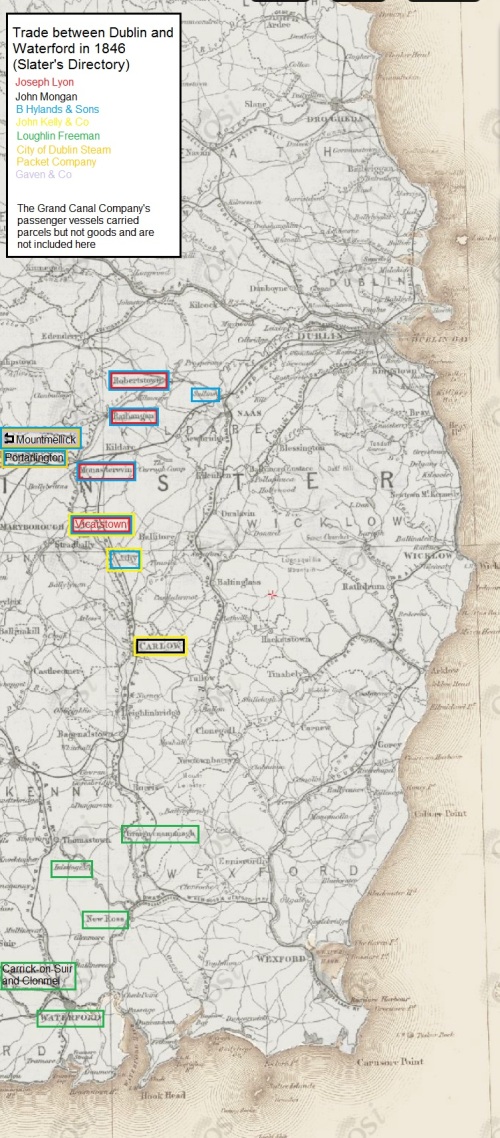
Isaac Slater’s Directory[i] of 1846 lists those carrying goods on inland waterways. There is a long list for Dublin; entries for other towns list those providing local services. There are some conflicts between the lists (see below).

The map below shows those carrying on the Barrow Line of the Grand Canal and on the rivers Barrow, Nore and Suir. Each carrier is assigned a colour, which is used to frame the name of each place served by that carrier. Some towns (Mountmellick, Carrick-on-Suir, Clonmel) are off the map, further to the west. Note that the map is from the 25″ Ordnance Survey map of around 1900 rather than the 6″ of around 1840: I used it because it was clearer, but it shows features (eg railway lines) that were not present in 1846.

Click on the map to get a slightly larger version.

Dublin to Waterford: inland waterway traders 1846 (OSI)

Dublin to Waterford: inland waterway carriers 1846 (OSI)

Notes

All but one of the carriers are shown as having Dublin premises at Grand Canal Harbour, James Street. The exception is Gaven & Co, which is mentioned only in the Mountmellick entry.

I have not included the Grand Canal Company’s passenger-carrying boats, which carried parcels but not goods.

The City of Dublin Steam Packet Company entry for Dublin does not include Portarlington and Mountmellick amongst the towns served but the entry for Mountmellick says that the company’s boats leave for Dublin every Tuesday and Friday (its agent being John White) while that for Portarlington says they leave weekly. Boats from Mountmellick had to pass through Portarlington as well as Monastereven and other towns en route to Dublin.

Similarly, the entry for Mountmellick says that the Hylands boats leave there every other day while that for Portarlington says that they pass through weekly.

There is a page missing from the electronic copy of the directory that I consulted so the entry for Monastereven is incomplete.

The entry for Carlow says

To DUBLIN, and also to [New] ROSS, Boats depart, at uncertain periods, from the Wharfs of Lawrence and James Kelly, the Quay.

It does not say whether Lawrence and James Kelly owned any boats. They may have had boats but used them only for their own goods.

The entry for Mountmellick says “Bryan Hyland” rather than “B Hylands”.

The entry for Mountmellick includes the only mention I have found of Gaven & Co’s boats (James Waldron, agent).

The entry for Rathangan says

There are Boats for the conveyance of Goods, but no fixed period of departure.

Thomas Berry & Co, the most important carrier on the Grand Canal, did not venture south of Lowtown.

More

As far as I know, little has been written about the carrying companies, especially those of the nineteenth century. I would be glad to hear from anyone who can correct, supplement or comment on this information.


[i] I Slater’s National Commercial Directory of Ireland: including, in addition to the trades’ lists, alphabetical directories of Dublin, Belfast, Cork and Limerick. To which are added, classified directories of the important English towns of Manchester, Liverpool, Birmingham, Sheffield, Leeds and Bristol; and, in Scotland, those of Glasgow and Paisley. Embellished with a large new map of Ireland, faithfully depicting the lines of railways in operation or in progress, engraved on steel. I Slater, Manchester, 1846

My OSI logo and permit number for website

Sinn Féin sheughs again

Sinn Féin demonstrates its continuing commitment to the unification of Ireland reconstruction of the Clones Sheugh. KildareStreet tells us that Sandra McLellan, TD for Cork East, no doubt motivated by the wealth of waterways in her own area, asked a written question on 18 July 2013:

To ask the Minister for Arts, Heritage and the Gaeltacht the position regarding the Ulster Canal restoration project; the remaining steps that must be taken to complete the project; if he will provide an indicative timeline for the completion of the project; and if he will make a statement on the matter.

She got a more or less standard answer from the minister, Jimmy Deenihan [FG, Kerry North/West Limerick]:

As the Deputy will be aware, in July 2007, the North/South Ministerial Council (NSMC) agreed to proceed with the restoration of the section of the Ulster Canal between Clones and Upper Lough Erne. The then Government agreed to cover the full capital costs of the project, which were estimated at that time to be of the order of €35m.

It was always the intention that the Ulster Canal project would be funded from the Waterways Ireland annual allocations, as agreed through the annual estimates processes in this jurisdiction, as well as the deliberations of NSMC in relation to annual budgets. It was a key consideration throughout the process that the Ulster Canal project would be supported by a significant level of projected income from the commercialisation of certain Waterways Ireland assets. However, as the Deputy will be aware, the economic downturn has had a negative impact on those plans.

In the meantime, the Ulster Canal project is progressing on an incremental basis. Planning approvals have recently been secured for the project in both jurisdictions. I welcome these developments, which, I am sure the Deputy will agree, are a significant milestone for the project.

I am continuing to explore all possible options to advance this project within the current fiscal constraints. In this regard, an Inter-Agency Group on the Ulster Canal has been established to explore and examine ways to advance the project and to examine possible funding options for it, including existing funding streams and the leveraging of funding from other sources, including EU funding options.

Isn’t it funny? Every so often the shinners ask a question to remind the minister that they, er, haven’t gone away, you know. They don’t get really aggressive about it and they don’t seem to be organising mass rallies in Clones to demand a sheugh. And the minister is equally polite, saying in effect “we haven’t shot your horse”.

This project is not very important: it’s a waste of money and will be of no benefit to the national economy, and a government seeking savings could easily kill it off. Yet it has refused, over several years, to take that obvious step. Instead, it’s devoting departmental time, and that of other public servants, to (admittedly low-cost) measures that seem to be intended to show that the project will be maintained on life support, even if it never rises from its bed.

Is there something in the St Andrew’s Agreement, or some other bit of northsouthery, that promises a sheugh to Sinn Féin, to enable them to claim credit for some high-profile but non-threatening all-Irelandism? Is the Clones Sheugh the price of SF support for the Police Service of Northern Ireland? I don’t know, but there must be some explanation for the failure to kill off the sheugh.


The uses of regulation

One of the things about being an Enemy of the Working People is that you start thinking about stuff like regulation. It tends to be supported by well-meaning liberal folk, who think that it will tame the wilder excesses of entrepreneurs, but its effects may not be those that were intended.

Consider, to take an example well away from Irish waterways matters, the study discussed here by Aaron Carroll of the effects of telling folk about the numbers of calories in their meals. The regulators’ idea was that, if fast-food eateries told consumers how many calories were in their food, fat folk would eat less (and the social and economic costs would be lower, I suppose). Some researchers decided to check. To quote Aaron Carroll:

Researchers approached 1121 McDonald’s customers both before and after calorie posting began in New York City. Each had a random chance of being handed (1) information that described the recommended calories a man and woman should eat each day, (2) information that described the recommended calories a man or woman should eat each meal, or (3) nothing. The hypothesis was that giving people information about recommended intake would help them to make better choices about how much to order. After all, the whole menu labeling thing is based on the idea that giving people calorie information will reduce obesity.

The result?

Giving people calorie recommendations didn’t change what people offered.

I think “offered” should be “ordered”. But the point is that the regulation, requiring that menus show calories, doesn’t seem to have had the effects that the regulators desired.

In a sense, though, that’s a fairly neutral outcome. At worst, as Carroll says,

[…] although the result was not statistically significant (p=0.07), people who were given more calorie information ordered more calories.

But there are outcomes than can be much worse than that, especially in regulatory capture, a topic that should be of interest in Ireland. One way of looking at the state is to see it as a tool or machine that can be used by powerful gangs to advance their own interests. In Ireland it is used by gangs of insiders (especially operatives in the state-protected industries: moneylenders, legal operatives, teaching operatives, body plumbers, enforcers and so on) to protect both their earnings and their status. The Troika has, alas, struggled in vain against them.

But I digress. Another way of using the power of the state might tempt folk who have commercial competitors (AKA “the enemy”). You could find a regulation or two that your opponent has broken: the more regulations there are, the more certain it becomes that your enemy has broken something or other. You can then use that breach to attack him or her.

Suppose, for example — and I realise I am in the wilder realms of the imagination here — you ran a business in the marine leisure sector which, if the decline in Shannon traffic is any guide, may be suffering from declining demand. And suppose you had several competitors in the same geographical area, and offering roughly the same services, as yourself. You could compete in the standard ways, perhaps using Jerome McCarthy’s Four Ps [Product, Promotion, Price, Place] in your marketing mix. But if your product and place were more or less the same, and if promotion were of little use in a declining market, you might be left competing on price, which might have its own drawbacks.

But there might be other weapons available to you: weapons that the innocent Mr McCarthy did not dream of. Suppose, for instance, that you found that one or more of your competitors had breached one or more of a body of regulations — there are lots of such regulations, mostly incomprehensible to the layman. You could cause or encourage the state (or one or other of its arms) to investigate your competitor. And, even if you didn’t have your competitor’s business shut down, you would have increased the costs to that business and forced its management to spend hours, nay days, as well as large fees, on trying to escape from the net. And perhaps a sympathetic politician might take up the matter, questioning ministers about it.

Given the general saintliness of the Irish people, and the high moral and ethical standards that have always prevailed, I am quite sure that nothing of the kind has ever happened, or could ever happen, but it does make me wonder whether regulation should be regulated.

Watering Dublin

Someone asked me recently about the progress of the scheme to supply Dublin with water from the Shannon. I had to confess that I haven’t been keeping up with the matter, because I don’t think it’s very important, but happily KildareStreet.com has provided an update. On Tuesday 16 July 2013 one of the Sinn Féin chappies, Brian Stanley of Laois-Offaly, asked a priority question:

54. To ask the Minister for Environment, Community and Local Government the progress being made on the Dublin, Garryhinch, Shannon water supply project; and the timeframe for planning, construction and completion phases of this project.

I suspect that most folk think of the scheme as one involving Dublin and the Shannon, so that the inclusion of Garryhinch may have been puzzling. It seems that Garryhinch is on the road from Portarlington to Mountmellick, just after that nasty bend where folk go to commit golf.

And Mr Stanley is interested not because he wants Garryhinch, Portarlington Golf Club, or indeed Portarlington and Mountmellick to be flooded but because he wants his constituents to be employed digging a hole in the ground there (a bit like the Clones Sheugh, really) and working in a water-based ecopark that will include a reservoir where the Shannon’s water will be stored.

Anyway, Fergus O’Dowd [FG, Louth], who is a Minister of State for something, replied:

The Dublin water supply scheme long-term water source is listed as a scheme at planning stage in my Department’s water services investment programme 2010 to 2013. Dublin City Council is the lead authority for this scheme, on behalf of all of the water services authorities in the greater Dublin area.

Studies carried out for the city council and a strategic environmental assessment have identified a preferred option which involves abstraction of raw water from Lough Derg and pumping the abstracted water through a new pipeline to a proposed storage reservoir at Garryhinch cut-away bog in County Offaly, forming part of a proposed midlands water-based eco-park. After treatment, water would then be conveyed to the west of Dublin where the new supply would be integrated with the existing storage and trunk distribution system.

In December 2012, the Department approved a brief for the engagement of consultants for the planning and statutory approval phase of the scheme. Dublin City Council has carried out a procurement process and I understand it will shortly be in a position to appoint a consultant to advance the further planning of this scheme.

The programme for project implementation has been developed based on the planning and statutory approval phase taking approximately two years. The detailed design and procurement phase should take a further two years, while the construction and commissioning phase should be completed in three years.

Following their appointment by Dublin City Council, the consultants will undertake the environmental impact statement and other statutory requirements in preparation for a submission to An Bord Pleanála which will adjudicate on the matter.

He forgot to mention “best practice”, so he’s lost some brownie points. Mr Stanley wanted it all to happen much faster, to be completed before 2021, but the discussion provided no more useful information. Bord na Móna has some more information about the eco-park here. All good stuff, much as I suggested for Lough Oughter, but I’d lose the eco title: eco stuff is so last millennium.

Waterproof wireless telegraphy

A couple of weeks ago I wrote about wireless telegraphy, concluding that:

At present, the rational decision for a boat-owner is to buy a cheap VHF without bothering to get either a certificate for the operator or a licence for the vessel. This is the rational decision because the official channels for getting certificates and licences are slow, expensive and cumbersome. It may therefore be — who knows? — that the populace has already decided to ignore the regulations.

For leisure boating within some sensible distance of the shore, I suggest that the current regulations be either drastically simplified or, perhaps better, scrapped altogether. That might mean giving the International Telecommunication Union a kick up the transom, but the present system is counterproductive: it seems to limit the use of handheld VHFs in cases where they could be very useful, if only to allow search and rescue volunteers to stand down earlier.

Two reports published today by the Marine Casualty Investigation Board have caused me to reconsider that conclusion.

In the Brownstown Head case [Report no MCIB/229; no 11 of 2013] [PDF], two occupants of a 16′ punt were thrown into the water when the boat capsized. They had a handheld VHF in the boat, but it sank when the boat capsized; one occupant put his mobile phone in his mouth to keep it above the water but it was knocked out. As a result, they were unable to summon assisstance. They eventually tried to swim to the shore, but only one made it; the other was drowned.

In the MacDara’s Island Currach case [Report no MCIB/215; no 10 of 2013] [PDF], a fisherman seems to have fallen overboard from a 6.15m open boat, in which he was alone. It was equipped with flares and a VHF in a watertight container, but as the report says:

5.6. There are unique problems with fishing operations from small open boats by lone fishermen. Once they become separated from their vessel their means of communicating their distress are on board their boat and not accessible to them.

In neither of these cases was the possession of a handheld VHF of any use. The VHF sets would have had to be (a) waterproof and (b) securely attached to the boaters’ lifejackets. The report on the MacDara’s Island Currach case recommends:

6.5. That the “Code of Practice for Fishing Vessels under 15 LOA” section 9.5 Radio Equipment should be amended by the addition of a requirement for undecked vessels where there is a lone occupant that an appropriate beacon should be of the type worn on the person.

In fact, the same recommendation could be applied to cases like Brownstown Head, where there were two people in the boat. That is broadly in line with the actions announced by two ministers on 8 July; note Simon Coveney also said:

I am also establishing a new high level working group on safety in the fishing industry, to look at all aspects of safety on fishing vessels and to report to Minister Varadkar and myself with recommendations before the end of the year. The new working group will be chaired by Mr John Leech current CEO of Irish Water Safety. Because a common thread of comment in recent times has been the need to pay particular attention on issues surrounding the number of small inshore boats that get into difficulty, I have charged the group with focussing to a large degree on this aspect.

So the wider use of handheld VHFs won’t solve every problem. I still think, though, that such wider use should be encouraged by the removal of unnecessary barriers.

Inland lifeboats to be exempt from VAT

Irish Water Safety has issued a press release [PDF] saying that the government is to introduce (or launch or make or pass or something) the Value-added tax (refund of tax) (rescue boats and related equipment) order 2013 which will allow inland community rescue boats to reclaim VAT on their purchases. Under the Value-Added Tax (Refund of Tax) (No 18) Order 1985, coastal community rescue boats have been able to reclaim VAT [PDF] but inland boats have not.

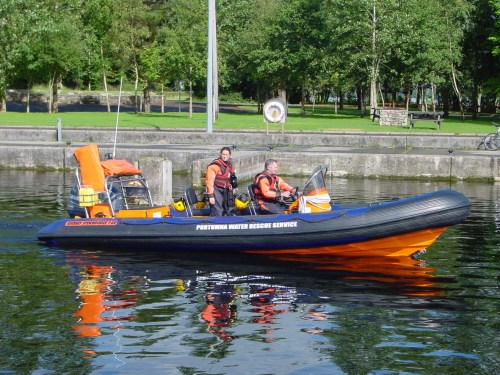
Portumna Water Rescue Service

Portumna Water Rescue Service

Irish Water Safety has a defined role in assessing the eligibility of community rescue boats for VAT exemptions; indeed its checklist and guidelines for community rescue services [PDF] are rather surprisingly headed Inspection for VAT Refund Certificate. The background is explained in another document Inshore Rescue Guidelines [PDF], which will presumably now be amended to include provision for inland boats. The “Declared Facility” boats [those approved and able to claim the VAT exemption] are listed here; there is also a list of other known rescue boats, some of which, being on inland waters, will now presumably apply to IWS for approval. Thus what is already a large rescue service will become even larger and more important.

I have photos of some of these boats on this page. I have none of the Corrib & Mask Rescue service, which I regret as today’s announcement was made on their turf and with their assistance. IWS says:

They will be the first Community Rescue Boat Ireland Lifeboat to be in a position to avail of this financial incentive.

Incidentally, I do not know whether the existing inland lifeboats operated by the Coast Guard and RNLI are affected by this or whether they could already reclaim VAT. If anyone can tell me, I’ll be glad to add the information here.

Dialogue

Some time ago I noted that Waterways Ireland was now down wid da kidz in da hood, doing groovy things like social meeja with a Youtube thingie. It features (inter alia) a flight in a helicopter gunship along a restored Clones Sheugh. At least, that’s what I presume was going on, although I couldn’t work out how to fire the rockets at the suspiciously large number of narrowboats found along the way. The scenic highlight of the journey was Clones.

There’s also a Facebook page, from which I learned that there is now a skippered boat available for hire on the Barrow. And there is a Twitter whatsit, which does two interesting things.

First, it has summaries of marine notices, which will be useful to those cruising on the waterways without internet access.

Second, it shows signs of WI’s engaging in public dialogue with users, even when their comments might be critical. This is very welcome; it will be interesting to see the extent to which such public dialogue is permitted to develop.


Living on boats in Dublin

Clare Daly [Socialist, Dublin North] elicited some information via written answers on 10 July 2013; h/t KildareStreet.

Clare Daly: To ask the Minister for Arts, Heritage and the Gaeltacht the recommendations of the Waterways Ireland consultation process on utilising Dublin’s waterways and the reason recommendations for the development for spaces for houseboats were not implemented; and his plans for same.

Jimmy Deenihan [FG; Kerry North/West Limerick]: I wish to advise the Deputy that Waterways Ireland is committed to utilising Ireland’s waterways to the greatest extent possible. In relation to the Deputy’s query regarding utilising Dublin’s waterways for the development for spaces for houseboats, I am informed that Waterways Ireland has plans to develop provision for houseboats in the Dublin City area on the existing floating moorings at Grand Canal Dock in Ringsend.

The Deputy should be aware that when Waterways Ireland applied to the Dublin Docklands Development Authority for permission to install floating moorings around the Waterways Ireland Visitor Centre to provide approximately 55 berths for boats/vessels back in 2003, the Authority issued a Certificate of approval under Section 25 of the Dublin Docklands Development Authority Act, 1997 which included the condition that ‘This Certificate permits the use of the 55 berths for boats/vessels used solely for amenity on the waterways and not as permanent residential or commercial units’. Waterways Ireland is currently in discussion with the Dublin Docklands Development Authority with the aim of having 25 berths designated for permanent residential or commercial use at Grand Canal Dock.

Second h/t to Clare Daly. I trust that Waterways Ireland will auction the residential berths to maximise the revenue from these prime city-centre locations.