Category Archives: Restoration and rebuilding

The Scotch Quay crane

Here is a page about the crane on Scotch Quay, on St John’s Pill in Waterrford. I would welcome information on the age of the crane, on who made it and on how it works.
Heritage outside the box

I was not entirely complimentary about Waterways Ireland’s online survey on the contribution of boating to the economy. However, its latest online survey seemed to me to be better designed.

It’s part of a consultation seeking opinions about a Heritage & Biodiversity Plan. I was afraid that the survey might limit the scope of responses to a small number of prepackaged options, but in fact I found it easy to make suggestions that might be outside the range of those expected. The response boxes expand as required, although I didn’t test the upper limits.

I encourage readers to complete it.

St John’s Pill: an update

I have found a little more information about the involvement of George Lane Fox with the upper reaches of St John’s Pill; I have written about it here.

Budget 2015

End of austerity?

Waterways Ireland’s southern money [85% of its current budget plus the full cost of capital work undertaken in the republic plus, according to this unicorn who has just dropped in, the full cost of the Clones Sheugh] comes from the Department of Arts, Heritage and the Gaeltacht under the heading of North-South Co-operation. The figures are subject to the approval of the North-South Ministerial Council.

Waterways Ireland accounts for the largest portion of the North-South Co-operation funding but the budget documents [PDF] don’t show the breakdown between WI and the languages body.

The 2014 estimate for current expenditure on NSCoop was €35,271,000; the 2015 figure is €34,870,000.

The 2014 estimate for capital expenditure (all but €119,000 for Waterways Ireland according to page 213) was €3,977,000; the 2015 figure is €3,487,000. Rather neatly, that’s 10% of the current expenditure figure. In 2008 WI got €11,000,000.

The total is 2% down on 2014.

The aim of the NSCoop programme

The aim of this Programme is to maintain, develop and foster North-South co-operation in the context of the implementation of the Good Friday Agreement and the St. Andrews’ Agreement.

Under this Programme, the allocation for 2015 will:

  • Through Foras na Gaeilge and the Ulster-Scots Agency, promote the Irish and UlsterScots language and culture; and

  • Through Waterways Ireland, maintain the waterways for some 15,000 registered boat users.

I noted last year that the department’s high-level programme activities were to include:

Development of inland waterways within the context of the implementation of the Good Friday and St Andrews Agreements.

I deduce, therefore, that development of inland waterways has been abandoned; the [more sensible] aim is now that of maintenance. Furthermore, I note that there is no mention of tourism or of non-boating waterways uses like those lauded by the minister the other day.

Capital “investment”

According to Table 1  Multi-Annual Capital Investment Framework 2015-2017 on page 211, Exchequer Capital Funding to the Department of Arts, Heritage and the Gaeltacht is to fall from €62 million in 2015 to €36 million in each of 2016 and 2017. The 2015 capital estimates are:

A – ARTS, CULTURE AND FILM €42,460,000
B – HERITAGE 6,916,000
C – IRISH LANGUAGE, GAELTACHT AND ISLANDS 8,717,000
D – NORTH-SOUTH CO-OPERATION 3,487,000

The allocations to the last three groups are small, so it looks as if the luvvies will be suffering the cuts. But the level of cuts is rather large; I wonder how that’s going to work.

A win for the luvvies

The departmental overview begins on page 45. On page It shows that Total Gross Voted Current Expenditure is to stay constant at €212 million in 2015, 2016 and 2017. Below that we read:

The multi-annual expenditure ceilings are binding and it will fall to the Department of Arts,Heritage and the Gaeltacht to deliver services within these agreed allocations for the period 2015-17. This includes responding to emerging expenditure pressures over that period without recourse to additional Exchequer allocations. To do so will involve commitment to ongoing reform and efficiency measures and reprioritisation of expenditure as appropriate.

And on page 46:

This funding will enable a significant level of services to be delivered in 2015. The funding provided reflects the Government’s commitment to the conservation, preservation, protection, development and presentation of Ireland’s heritage and culture and the promotion of the Irish language, support of the Gaeltacht and development of island communities.

No mention of waterways, or even of northsouthery, in that lot.

On page 47 we learn:

The 2015 current expenditure ceiling of €212m represents an increase of €4m over the REV 2014 allocation and €7m over the previously published expenditure ceiling.

The additional current expenditure funding in 2015 will be utilised to support existing services and fund initiatives to commemorate the foundation of the State.

So the previous talk of continuing savings has vanished; the department’s total budget is up by 4%, just under €10 million. What we are seeing is a reallocation within the department:

A – ARTS, CULTURE AND FILM up 11%
B – HERITAGE down 12%
C – IRISH LANGUAGE, GAELTACHT AND ISLANDS  up 1%
D – NORTH-SOUTH CO-OPERATION down 2%,

Why are the luvvies getting the loot?

All of this is from a quick perusal; more later as information emerges, in particular when the minister addresses the Dáil.

Broadstone

You can visit the building on the weekend of 18 & 19 October 2014 as part of Open House Dublin. And there are other sites of industrial heritage and transport interest that will be open between 17 and 19 October.

Uninformative press release aboot thon sheugh

Plans to restore the Upper Lough Erne to Clones section of the Ulster Canal are being pursued by the Department of Culture, Arts and Leisure and the Department of Arts, Heritage and the Gaeltacht

it says here. The official NSMC version is here. No mention of the inter-agency treasure-seekers; perhaps the swag is in here:

Progress on the development of the new INTERREG V and PEACE IV Programmes for the period 2014 – 2020 was discussed. The Council noted that the draft Programmes had been submitted to the EU commission by the deadline of 22 September 2014.

I see that WI employee payments for pensions are going up:

16. Ministers also acknowledged the ongoing work in relation to reform of the North South Bodies Pension Scheme, including recently approved amendments to ensure the Scheme complies with employment legislation and best practice in both jurisdictions and to increase employee contributions.

Someone with a tin ear (perhaps someone who doesn’t do crosswords) wrote this:

driving a shift to public and more sustainable modes of transport and the potential for shared cross border public transport services in border areas.

Driving would be right, especially in Donegal. But what about parity of esteem?

development of cross border Greenways

Why no Orangeways?


A puzzle in waterways history

According to the Lagan Canal Trust,

The Lagan Navigation also forms part of a wider all Ireland waterway network. This network of waterways once traversed through the towns and cities of Ireland delivering goods and produce, helping to shape the economic fortunes of the country.

I would be grateful for information about any goods or produce that were ever carried from the Shannon, or from the Royal or Grand Canals or the River Barrow via the Shannon, through the Junction Canal in the Ballinamore & Ballyconnell Drainage District [later called the Ballinamore & Ballyconnell Canal and later still the Shannon–Erne Waterway] and then the Ulster Canal to Lough Neagh or any of the waterways connected therewith. Or, of course, in the opposite direction.

As far as I can tell, outside the sales blurbs written by engineers seeking employment and waterway owners seeking subsidies, there was never a connected all-Ireland waterways network; nor was there ever any need or demand for such a thing.

Any more than there is now.


A1 @ A2SN

I wrote here about the workshop, being organised by A2SN, the Archives and Artefacts Study Network, and PRONI, the Public Record Office of Northern Ireland, entitled

By air, sea and land — Transport & Mobility through the archives.

I attended the workshop yesterday; it was absolutely excellent. I can’t remember the last time I attended an event where every speaker was both a good communicator and worth listening to. The programme covered waterways, roads, railways, aircraft, public transport and shipping, with two more theoretical, but no less interesting, sessions at the end — followed by a reception on and tour of the SS Nomadic.

The timetable had been designed to provide much opportunity for discussion between speakers and attenders: it was successful, thanks largely to its enforcement with a rod of iron, or rather with three sheets of card.

I imagine that the A2SN blog will have a full report when KH has had a chance to recover, so I won’t cover it here, but it was gratifying to note that Waterways Ireland is working on making access to its archive much easier.

If A2SN hold any more events on the island of Ireland, I’ll be there.


The Royal under the Railway

A new, short book, on aspects of the history of the Royal Canal, published by the Railway and Canal Historical Society, will be launched at the Clinker Lecture on 18 October 2014. The title is The Royal under the Railway: Ireland’s Royal Canal 1830–1899 and it covers a number of topics, mostly about the canal after it was bought by the Midland Great Western Railway. From the Introduction:

The accounts of the Midland Great Western Railway for the half year ending 31 December 1849, four years after it bought the Royal Canal, showed its gross income from the railway as £23,773 and its income from the canal as £7,677, roughly a quarter of the total. By 1899, though, income from the railway was £264,393 and that from the canal £2,220, less than one per cent of the total. The Royal Canal, never particularly successful, had declined into utter irrelevance.

It may seem perverse, therefore, to offer even a short book on the canal’s history in that period, especially as there exist two full histories, by Peter Clarke and by Ruth Delany (with Ian Bath in the most recent edition). This, though, is not a full history, even of the limited period, roughly 1830–1899, from just before the railway took over until the end of the nineteenth century. This is rather a complement to those histories, providing just enough background information to  enable the book to stand alone while covering some new topics and providing new or extra information on others. The topics include:

  • the 120-foot steam-powered narrowboat
  • the Midland Great Western Railway’s early attempts at running canal boats
  • the ingenious Mr Mallet’s moveable bridge
  • the whore who held the mortgage on the canal
  • the competition between the roads of Roscommon and the Royal Canal
  • the reconstruction of Dublin bridges over the canal
  • the horses who slept on board their boat.

[…] this book is not intended to be the last word on any of those topics. I hope that it might encourage others – those researching local, family, social, industrial, transport, economic or technological history – to record and transmit anything they might learn about the history of the Royal Canal. To take just three topics, we know very little about canal employees, the operations of canal traders or the management of the horse-drawn canal boats. On any one of those, useful information could just as easily be found by a local or family historian as by a canal specialist.


Shannon traffic figures to July 2014

I am grateful to Waterways Ireland for letting me have the Shannon traffic figures for July 2014. All the usual caveats apply:

  • the underlying figures do not record total waterways usage (even for the Shannon) as, for instance, sailing, fishing or waterskiing on lakes or river stretches, which did not involve a passage through a lock or Portumna Bridge, would not be recorded
  • the passage records would not show, for instance, a change in the balance of types of activities from those in larger cruising boats to those in smaller (sailing, fishing, waterskiing) boats
  • figures like these, for a small number of months, will not necessarily be representative of those for the year as a whole. The winter months, January to March, see little traffic in any year; for April, May and June, the weather can have a large influence on the amount of activity especially, I suspect, in private boats.

On the other hand, the figures do include the Shannon’s most significant tourism activity, the cruiser hire business. And they are our only consistent long-term indicator of usage of the inland waterways.

Shannon all boats Jan to Jul 2014

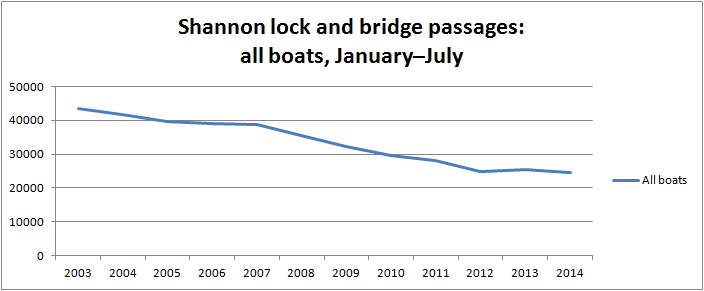
Total (private + hired) traffic for the first seven months of each year

Traffic in 2013 was up a bit on 2012; 2014 is down slightly below the 2012 level. It’s the lowest seven-month figure in the series (ie since 2003), which is a bit of a surprise: I thought that the good weather would encourage more boating.

The changes are small, so their importance must not be exaggerated, but they’re not cause for celebration. Let’s see whether the drop was amongst private or hired boats (or both).

Shannon private boats Jan to Jul 2014

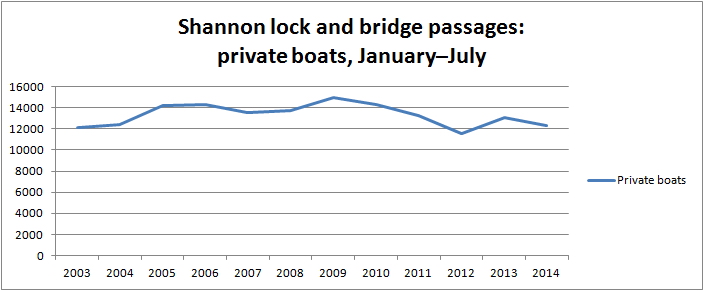
Private-boat traffic for the first seven months of each year

Private traffic is up a bit on 2012 but down on 2013.

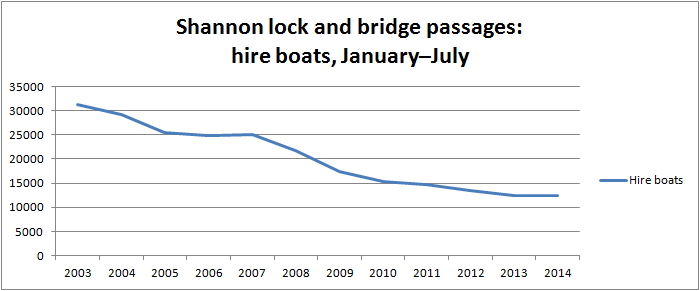
Shannon hired boats Jan to Jul 2014

Hire-boat traffic for the first seven months of each year

Hire-boat traffic is down on both previous years, but the pace of decline seems to have slowed.

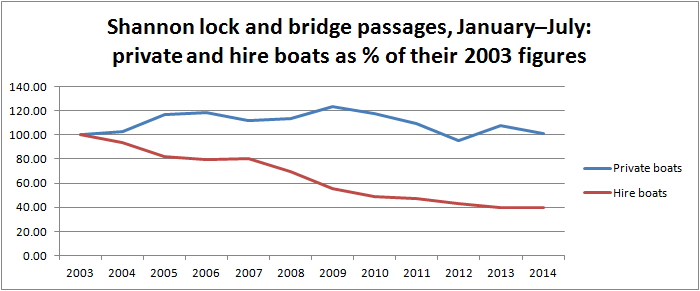
Shannon private and hired -v- 2003 Jan to Jul 2014

Changes since 2003: private and hired boats

Hire-boat traffic seems to be levelling off at 40% of its 2003 figure: a massive loss of business. I do not know whether anyone is trying to, or could, recover that amount of business. I am not aware of any new Shannon-based tourism business that could compensate for the losses in the cruising (hire-boat) business, but I would be glad to hear from anyone who knows of such projects. Something with high growth potential is required.

Private traffic is wobbling either side of its 2003 figure: the increases during the Celtic Tiger years have been lost.

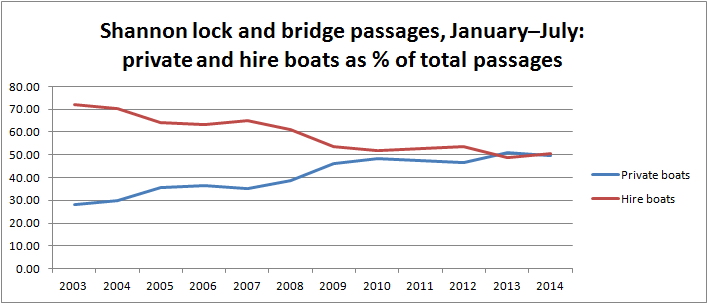
Shannon private -v- hired boats Jan to Jul 2014

Still roughly 50/50

In the year to July 2014, hire-boat traffic was just above private traffic, but there is very little in it. Private traffic is now comparatively more important to Waterways Ireland [which may be why it is now trying to establish its economic importance] but it does not bring in much money from outside the two jurisdictions, so the case for public spending on waterways becomes much weaker.

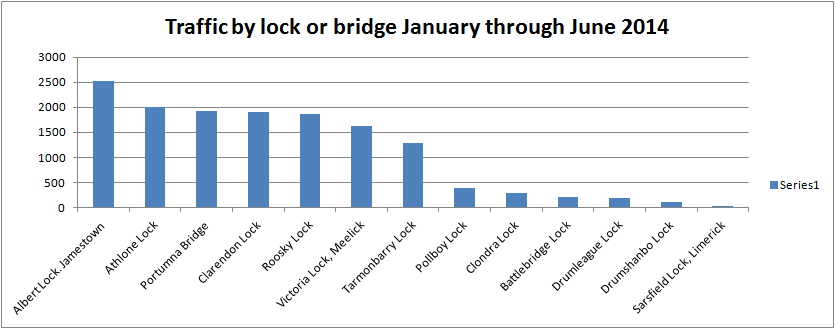
And, quite clearly, opening more waterways doesn’t work: as this chart showed last month, the branches off the main lines of the Shannon, Erne and SEW are little used. The Lough Allen Canal, the Suck and the navigation to Limerick are very little used and I see no sign that the reopened Royal Canal has attracted many visitors to Ireland. What is needed is more intensive usage of the main waterways, not further dilution by the opening of more branches [to Clones or anywhere else].

SnnNav JanJun 6

High and low usage

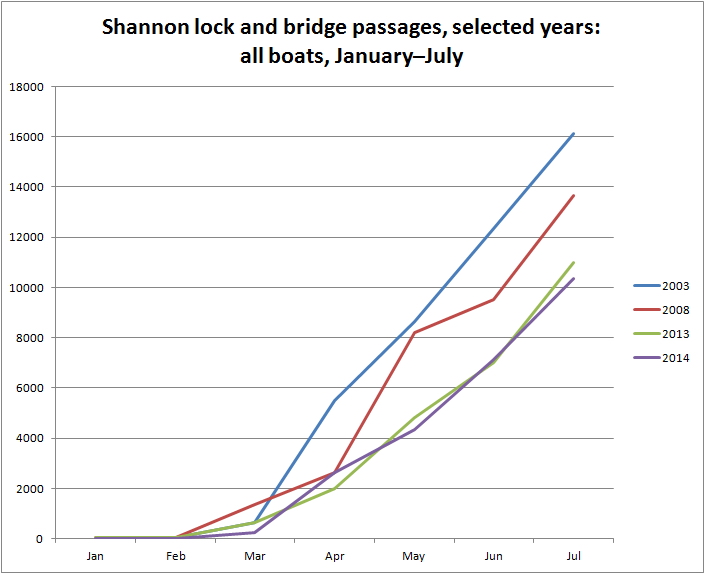
Finally, I thought it might be interesting to see whether the monthly pattern of usage has changed since 2003. To avoid an over-cluttered chart, I included only four years: 2003, 2003 +5, 2003 + 10 and 2014. The chart is for all boats, private and hired.

Shannon all boats by month selected years Jan to Jul 2014

Monthly traffic, selected years

The season seems to have got going earlier in 2003 and even in 2008. Was the weather better in those years?