
Category Archives: Roads

The Groody turnpike

The River Groody flows into the Shannon downstream of Plassey, where the University of Limerick is located.

Groody 04_resize

Groody and Plassey (OSI ~1840)

The river itself may be hard to see, but the green wriggly line follows the course of the Groody except just north of Groody Bridge, where the river takes a more direct course towards the Shannon.

The road crossing Groody Bridge was the main road from Dublin to Limerick and the route followed by the mail-coaches. And, just to the west of the bridge, the 6″ Ordnance Survey map (of about 1840) shows a Turnpike, presumably controlling access to the road to Dublin. The road between Naas and Limerick, in other words most of the way to Dublin, was controlled by the Bourne family, who also ran the Dublin to Limerick mail coaches (which were amongst the few in Ireland to achieve an average of eight miles an hour).

Groody turnpike 03_resize

Groody bridge and turnpike (OSI ~1840)

I met a man who told me that his family owned this building, which is opposite the Aldi shop on the Dublin Road, Limerick.

Groody turnpike 01_resize

The building 1

It had been a shop at some stage and had had an extra window inserted, but he said it was originally a toll cottage. I don’t think it was for collecting the Limerick tolls [I don’t know where they were collected on the “Groody approach”, but I suspect it may have been near Pennywell]; I think it was for collecting the turnpike charges. Its position seems to match that of the turnpike building shown on the map.

However, I haven’t been able to find evidence on the matter one way or the other. I can’t find the building on the Griffith Valuation, perhaps because its value was too low to be recorded. And the Land Registry’s information doesn’t go back beyond 1982.

Groody turnpike 02_resize

The building 2

I would therefore be grateful to anyone who can provide evidence on whether this building was the turnpike cottage for the road to Naas.

My OSI logo and permit number for website


Hurrah for the red, white and orange

Colour discrimination seems to be rampant in Ireland. Of the sets of colours [red, white and blue] and [green, white and orange], there is Official Endorsement of two, green and blue, while red, white and orange are ignored. Even the North/South Ministerial Council has got in on the act, with a whole page on its website about greenways and blueways. They must have been overdosing on the Erne flag. Their page is a list of links, sort of plonked there without context or explanation, but there’s probably some hands-across-the-borderism or something going on.

I read in the Guardian today of a proposal for a greenway on the former railway line between Roscrea and Portumna via Birr. And a jolly good thing too, but how many greenways and blueways can one small island accommodate? How thinly will the tourists be spread? And what about those of us who hate walking, cycling, kayaking and other such energetic pursuits?

Interesting information about the Ulster Canal …

… as distinct from ministerial reelection photo opportunities.

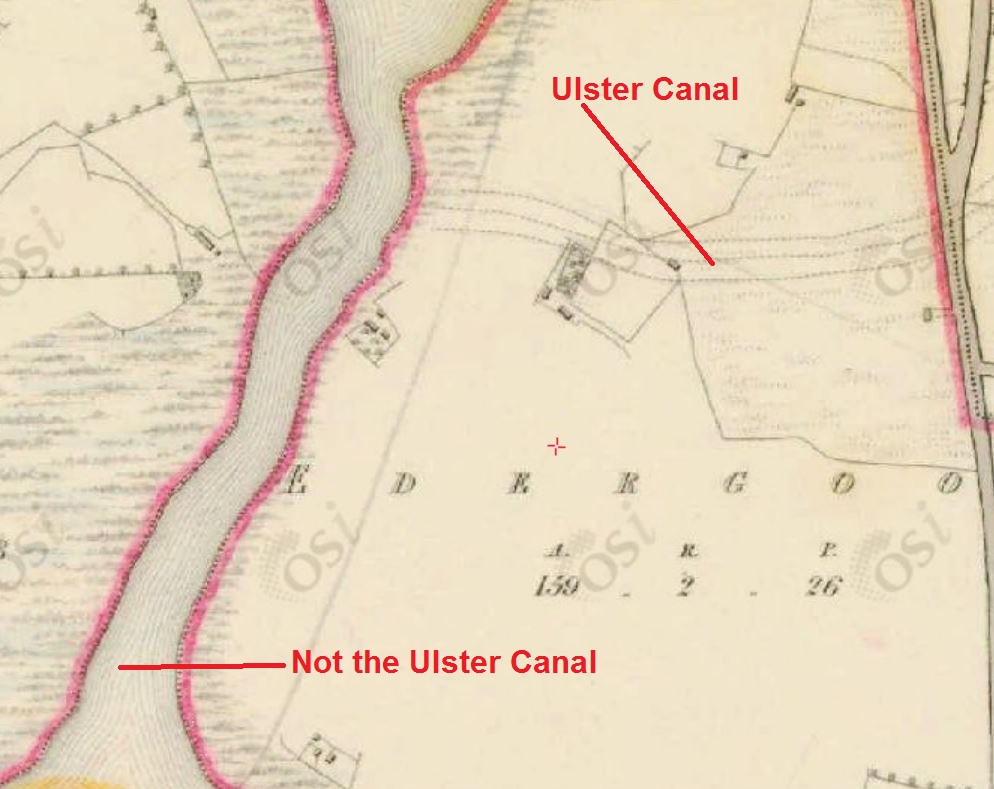
By the way, some folk get confused about the location of the Ulster Canal; this map may help:

Saunderson's Sheugh -v- the Ulster Canal (OSI ~1840)

Saunderson’s Sheugh -v- the Ulster Canal (OSI ~1840)

Anyway, for folk who are interested in weightier matters than ministers talking through portions of their anatomies that they can’t distinguish from their elbows, here is some speculation about opening bridges on the Ulster Canal.

That’s the Ulster Canal Ulster Canal, not the Saunderson’s Sheugh “Ulster Canal”, by the way.

My OSI logo and permit number for website


Was the Brickey a navigation?

The Brickey is a small river that flows into Dungarvan Bay. Small boats used its lower, tidal reaches, but in the eighteenth century there was a proposal to link the Brickey to the Finisk, another small river that flows into the Blackwater south of Cappoquin.

Waterford County Museum, and others, believe that work began on that project in the mid nineteenth century and that a driveable track along the south bank of a stretch of the river was built as a towpath.

I have visited the river and looked online for further information; my conclusions (with maps and photographs) are here. However, I would welcome further information.

Where is it?

A correspondent is anxious to identify the location shown in a painting of a bridge over a canal.

It is most likely that the scene is somewhere on the wider waterways of northern England. It is just conceivable that it might be in Ireland, though, so I said I’d put a copy up here and see if anyone can identify it. If you can, please leave a Comment below.

Unidentified canal bridge

Unidentified canal bridge. Click to enlarge

Are the Sheughers …

seeing sense?

A cynic (not that there are any of them around here) might say that DAHG feels that it has done as much as it’s going to do (admittedly at Waterways Ireland’s expense) by dredging the River Finn and that it has told Monaghan Council that, if it wants any more Sheughery for Clones, it will have to pay for it itself. The Council might like a canal, but only if someone else pays for it, so it will have to be content with a greenway.

And rightly so.


Shannon history

Folk interested in the history of the Shannon Navigation, and in particular in the work of the Shannon Commissioners in the 1840s, may like to get hold of an article “Steam, the Shannon and the Great British breakfast”, published in the Journal of the Railway & Canal Historical Society Vol 38 Part 4 No 222 March 2015.

Belleek to Tralee in 10 hours by inland waterway

Learned Readers are undoubtedly familiar with Design-Driven Innovation, but I’m afraid I hadn’t come across it until I read a conference paper: S McCartan, P Murphy, R Starkel, A Sánchez González and M López Cabeceira “Design-Driven Innovation: Sustainable Transport Opportunities for the Inland Waterways of Ireland”, read at the fifth annual conference of the Irish Transportation Research Network at the University of Limerick from 3 to 5 September 2014.

The paper [PDF] can be downloaded free from Sean McCartan’s page on the academia.edu site, though you have to be registered with the site; the paper is also available, I think, from researchgate.net, but I’m not registered there so I haven’t tried the download.

As I understand it — and I am a Bear of Very Little Brain, and Long Words Bother me — Design-Driven Innovation means that a lot of clever chaps and chapesses come up with new and brilliant ideas and then ask people what they think of them:

The process of Design-Driven Innovation is an exploratory research project, which aims to create an entirely new market sector for a given product through changing the design meaning the user has for the product.

It seems that, in Ireland, 99.1% of freight travels by road, leaving just 0.9% for rail; 82.8% of passenger traffic is by car and 14.4% by bus and coach, leaving just 2.8% by rail. Waterways transport could use existing ports and canals; once the canals had the right bridges and automatic locks, running costs would be low. West coast ports could be used by a “coastal cruiser service”; people could travel by fast boat from Donegal right around the west and south coasts to Rosslare. All of this would reduce the carbon dioxide footprint (assuming, of course, that folk on the west coast wanted to travel, or needed to send goods, to anywhere else on the west coast rather than to Dublin).

On the inland waterways, 139 catamaran CLF vessels (Cruise Logistics Ferries) could run from Belleek to Tralee. Travelling at 22 knots, and ignoring lock times, they would complete the journey in only 10 hours; they could carry freight but also carry passengers in green luxury. These CLFs would be 81 metres long and 25 metres wide; each could carry 20 TEUs. At sea, 26 high-speed (40-knot) CLFs could each transport 12 TEUs from Cork to Dublin in just under four hours. And solar-powered catamarans on the Shannon and Erne could carry 64 passengers at 12 knots.

Meanwhile, the Grand, Barrow and Royal would not be forgotten. They would have a fleet of 1549 unmanned canal catamarans, with autonomous control systems, powered either by batteries or by fuel cells, ultimately fed from wind farms. They would each carry two TEUs but could also be converted for tourist cruising.

The overall aim, with those numbers of boats, is to replace half of the amount carried by road.

The paper concludes:

This is a first step in the analysis of the potential of the coastal and inland waterways of Ireland, to meet the EU targets for transport. State aid has been identified as a potential funding mechanism to support the realisation of these proposals.

Sometimes I wonder.


Outbreak of sanity in Co Westmeath

Our big thing is to link the Galway Dublin cycleway into Kilbeggan and along the stretch of the old canal to Ballycommon. That’s around a million euro project and the biggest thing in our Vision for Kilbeggan plan.

Thus Dan Scally of Renew Kilbeggan in the Westmeath Examiner.

The Deel navigation

The Deel linked the Co Limerick town of Askeaton to the south side of the Shannon Estuary. Here is a page about the navigation and some of its quays. Note that it is a long page with many maps and photos, although they’re all reduced in size to minimise the strain on tinterweb.
