Category Archives: Sea

Better drowned than duffers

The Irish Sailing Association is at it again, lobbying for the retention of a system under which the vast majority of owners of diesel-powered private pleasure craft can safely engage in tax dodging.

The ISA folk don’t want you think about that part of it so, although they say that they hold “no brief for those who have not complied with the current arrangements”, they concentrate on all the disasters that will befall leisure sailing folk if they can’t buy cheap diesel. Apparently there will be outbreaks of scurvy, plagues of locusts and unwanted exercise if boaters can’t continue to buy subsidised fuel.

You can read it all here if you want a laugh, but Commander Walker’s immortal words come to mind:

BETTER DROWNED THAN DUFFERS IF NOT DUFFERS WON’T DROWN.

If owners of private pleasure craft are as nitwitted as the ISA say …

Leisure vessels would go to sea either overburdened with spare cans of fuel, or with insufficient reserves on board. Distress situations would arise and lives would be at risk.

… they will at least have the consolation of knowing they may be nominated for the Darwin Award. But I don’t believe they are, and I believe in the power of the free market: if seafaring yachties have to use white diesel, a supply will arise to meet the demand.

The ISA are asking us to ignore the elephant in the room: to treat as an incidental and minor side-effect the fact that (by my reckoning) 99.75% of those who should be paying tax are not doing do. That scale of tax-dodging means that the current scheme is a complete failure, indeed a farce. It would have been really nice if the ISA had used their accumulated brainpower to devise schemes whereby yachties (and other owners of diesel-powered private pleasure craft) would have to pay the full price for their fuel.

The ISA say …

The issue for leisure sailors is not the price of diesel but its availability.

… but the fact that (at a rough guess) only 0.25% of them have been paying the proper rate of tax for the past five years, even though all they have to do is to send a cheque to the Revenue Commissioners, strongly suggests to me that “leisure sailors” are keenly interested in the price and have few qualms about ripping off the state.

According to Practical Boat Owner 584 March 2015, one Harry Hermon, described as “chief executive of the RSA”, said:

The ISA’s role is to promote the sport and to protect the interests of Irish sailors, hence the ISA’s interest in this matter. It is not the ISA’s remit to regulate or to enforce regulation.

But what the ISA is doing goes well beyond the neutrality that that suggests: it is actively promoting and lobbying for the retention of a scheme that facilitates tax-dodging by boat-owners. The ISA’s stance might be slightly less irritating if their friend Cantillon in the Irish Times hadn’t been prating about an “honour system” for paying the requisite tax. In 2014 just 20 boat-owners paid the tax for 2013 [I have not yet got the figures for 2015, covering tax due for 2014], which suggests that honour is not to be relied upon.

You might think that the ISA would have an interest in the financial health of the state: after all, the taxpayers give them over one million euro a year. But perhaps, in the yachting world, it’s more blessed to receive than to give?

Background

The ISA are lobbying because the European Commission has taken an interest.


The Liffey link lottery

In The Grand Canal of Ireland [David & Charles, Newton Abbot 1973], Ruth Delany says

In 1784 the construction of a link with the River Liffey had been discussed.

John Brownrigg had suggested a link from the Grand Canal Company’s harbour at James’s Street, but the plan eventually adopted was that of the Circular Line, the four-mile canal we have today, joining the Liffey via the Grand Canal Docks at Ringsend.

However, I have found a piece of evidence showing that the company considered the Liffey link ten years earlier, in 1774. Delany says that there are no board minutes for two years between 1773 and 1775, which would explain why this earlier plan has not hitherto been noticed. The evidence is from the Hibernian Journal; or, Chronicle of Liberty 19 October 1774.

The Trustees for executing the Canal of Communication between the Canal and the Harbour of Dublin, Toll free, confiding in the Favour of the Public for the Support of a Work of so great national Utility, have unanimously resolved upon the following Scheme, grafted upon the State Lottery for this present Year, for raising a Fund for that Purpose.

The Necessity of this Application to the Public at present, will appear from a Report of the Committee of Works of the Canal Company, certifying that the Works contracted for by Mr Traill between the Liffey at or near Sallins and the City Bason, are in such Forwardness as to render it absolutely necessary to proceed in making the above mentioned Communication early in the next Year; the said Report is in the Hands of the Secretary to the Canal Company.

2 prizes of                      £2000          is £4000
4 prizes of                         £750          is £3000
5 prizes of                         £150          is   £750
10 prizes of                          £50          is   £500
20 prizes of                          £40         is   £400 *
40 prizes of                             £5        is   £200
180 prizes of                            £1/10   is   £270
600 prizes of                           £1         is   £600
19150 prizes of                          £0/6     is £5740 *
First drawn first three days £40          is   £120
Last drawn                          £200          is   £200
£15780

NB Not quite two Blanks to a Prize; and the Publick will take notice, that £35 is accounted for more than the Tickets will amount to.

Ten per Cent to be deducted from the Prizes for the Use of the Scheme.

15000 Tickets, 4 Numbers each, at £1 1s each to Subscribers for a Lot not less than 50 Tickets.

Price to Non-subscribers, one Guinea each Ticket.

Subscriptions are now receiving, and Tickets delivering out at the Navagation-house [sic] in Grafton-street, where the Prizes will be paid immediately after the Arrival of the Numerical Book from London. The Securities required from the Subscribers, viz Bankers Notes, Government and Fire-office Insurance Debentures, and City of Dublin Bonds, are to be lodged in the Bank of Thomas Finlay, Esq, and Company.

The Names of the Trustees for carrying the above Scheme into Execution, may be seen at the Navigation-House [sic], in Grafton-street.

There’s an idea for DAHG.


* sic

Shannon history

Folk interested in the history of the Shannon Navigation, and in particular in the work of the Shannon Commissioners in the 1840s, may like to get hold of an article “Steam, the Shannon and the Great British breakfast”, published in the Journal of the Railway & Canal Historical Society Vol 38 Part 4 No 222 March 2015.

Impractical Boat Owner

We list only walk-ashore berths with mast-up access from the coast.

Thus Practical Boat Owner 585 April 2015 in its 2015 Marina price guide.

I do not know how a yacht can reach Kinnego or Sandy Bay Marina on Lough Neagh, from the coast, with its mast up.

Belleek to Tralee in 10 hours by inland waterway

Learned Readers are undoubtedly familiar with Design-Driven Innovation, but I’m afraid I hadn’t come across it until I read a conference paper: S McCartan, P Murphy, R Starkel, A Sánchez González and M López Cabeceira “Design-Driven Innovation: Sustainable Transport Opportunities for the Inland Waterways of Ireland”, read at the fifth annual conference of the Irish Transportation Research Network at the University of Limerick from 3 to 5 September 2014.

The paper [PDF] can be downloaded free from Sean McCartan’s page on the academia.edu site, though you have to be registered with the site; the paper is also available, I think, from researchgate.net, but I’m not registered there so I haven’t tried the download.

As I understand it — and I am a Bear of Very Little Brain, and Long Words Bother me — Design-Driven Innovation means that a lot of clever chaps and chapesses come up with new and brilliant ideas and then ask people what they think of them:

The process of Design-Driven Innovation is an exploratory research project, which aims to create an entirely new market sector for a given product through changing the design meaning the user has for the product.

It seems that, in Ireland, 99.1% of freight travels by road, leaving just 0.9% for rail; 82.8% of passenger traffic is by car and 14.4% by bus and coach, leaving just 2.8% by rail. Waterways transport could use existing ports and canals; once the canals had the right bridges and automatic locks, running costs would be low. West coast ports could be used by a “coastal cruiser service”; people could travel by fast boat from Donegal right around the west and south coasts to Rosslare. All of this would reduce the carbon dioxide footprint (assuming, of course, that folk on the west coast wanted to travel, or needed to send goods, to anywhere else on the west coast rather than to Dublin).

On the inland waterways, 139 catamaran CLF vessels (Cruise Logistics Ferries) could run from Belleek to Tralee. Travelling at 22 knots, and ignoring lock times, they would complete the journey in only 10 hours; they could carry freight but also carry passengers in green luxury. These CLFs would be 81 metres long and 25 metres wide; each could carry 20 TEUs. At sea, 26 high-speed (40-knot) CLFs could each transport 12 TEUs from Cork to Dublin in just under four hours. And solar-powered catamarans on the Shannon and Erne could carry 64 passengers at 12 knots.

Meanwhile, the Grand, Barrow and Royal would not be forgotten. They would have a fleet of 1549 unmanned canal catamarans, with autonomous control systems, powered either by batteries or by fuel cells, ultimately fed from wind farms. They would each carry two TEUs but could also be converted for tourist cruising.

The overall aim, with those numbers of boats, is to replace half of the amount carried by road.

The paper concludes:

This is a first step in the analysis of the potential of the coastal and inland waterways of Ireland, to meet the EU targets for transport. State aid has been identified as a potential funding mechanism to support the realisation of these proposals.

Sometimes I wonder.


MCIB kicks ass

Marine Casualty Investigation Board report Investigation into the loss of the Sail Training Passenger Vessel STV Astrid on 24th July 2013 PDF here. Very long but, apart from the photos, the meat is in the first part. At the end you can read angry letters from Dutch authorities.

Update

Direct link amended, but just in case here’s a link to the page on which you click to download. And in case that falls over, here’s the page listing all MCIB reports and here’s the MCIB home page.

Rivers of London

Map here [h/t CELR].

The Deel navigation

The Deel linked the Co Limerick town of Askeaton to the south side of the Shannon Estuary. Here is a page about the navigation and some of its quays. Note that it is a long page with many maps and photos, although they’re all reduced in size to minimise the strain on tinterweb.

The madness of Daniel O’Connell

In 1828 Daniel O’Connell was elected to the House of Commons for County Clare. As a Roman Catholic, he could not take the Oath of Supremacy [Frizzell, the illustrator, seems to have got his date wrong] and so could not take his seat, but the Emancipation Act 1829 removed that obstacle. However, it was not retrospective, so O’Connell had to stand again in County Clare; he was elected unopposed in July 1829.

On Sunday 31 January 1830 “The Patriotic member for Clare, Daniel O’Connell Esq, sailed from Howth […] at 8 o’clock, for England, to attend his Parliamentary duties” [Tipperary Free Press 3 February 1830] and when Parliament resumed on Thursday 4 February 1830

Daniel O’Connell Esq took the oaths prescribed by the Catholic Relief Bill, and his seat as a member for the county of Clare. The honourable member seated himself on the third row of the opposition side of the house, and exactly opposite to Mr Peel.

[London] Standard 5 February 1830

O’Connell’s letter

Before he left Ireland, O’Connell issued a letter to “the people of the County of Clare”; according to the Morning Post of 20 January 1830 it was issued from the Parliamentary Intelligence Office, 26 Stephen-street, on 15 January 1830. It began

MY FRIENDS AND BRETHREN — I take up the pledges which I made to you when I called on you to repose in me the high and awful trust of being your Representative. I will endeavour honestly to redeem those pledges.

For this purpose I propose to leave Dublin on the 26th of this month. I go off at the commencement of Term, and I shall be absent for two, if not three, entire Terms. Men will sneer at me for talking of these sacrifices to public duty, who, themselves, seek their own individual advantage in all their political exertions. I readily consent, and will proceed to do my duty to you with alacrity, zeal, and perseverance.

There was more along those lines, and then he said

My Parliamentary duties will naturally divide themselves into two distinct branches: the first relates to your local concerns; the second, to those mighty interests in which your prosperity is involved with that of all Ireland.

There were four local concerns: two about canals and two about ports.

An asylum harbour

West Clare [OSI ~1900]

West Clare [OSI ~1900]

The first port proposal was to build an “asylum harbour” on the west coast. An asylum harbour was a port that provided refuge in storms: Kingstown [Dun Laoghaire] was an asylum harbour (amongst other things). O’Connell thought an asylum harbour on the west coast would provide a safe haven for vessels coming across the Atlantic, feeling the force of the Gulf Stream and the prevailing westerly winds: they risked being “embayed on the iron-bound coast between Loop Head and Hag’s Head” where the Cliffs of Moher are. It is not clear how vessels could safely enter such a harbour, given that it would require them to come close to the lee shore, but O’Connell said

The existence of an asylum harbour on Malbay would be of the greatest value to the trade of the British Isles. I do hope to be able to realise this project, in the execution of which the talents of my most valued friend THOMAS STEELE would be found to be most highly beneficial to that county which he adorns by his abilities and patriotism.

O’Connell no doubt had in mind Thomas Steele’s talents as a urinator.

Carrigaholt and Kilrush

O’Connell also wanted

[…] the construction of two suitable piers, with other works, completely to protect shipping; the one on the Bay of Carrigaholt, the other on Scattery or Kilrush Harbour.

The commerce of Kerry, Clare, and Limerick, are interested in these works. We shall certainly obtain the powerful assistance of the patriotic Member for Limerick. His assiduity, information, and public spirit, render him a model which Irish representatives should imitate.

He wasn’t quite as complimentary about Thomas Spring Rice a few years later, when O’Connell’s five-hour speech in favour of the repeal of the Acts of Union was topped by Spring Rice’s six-hour contribution.

Here is a page about Kilrush. I haven’t done a page about Carrigaholt so there follows some information to fill the gap until I get around to doing it properly.

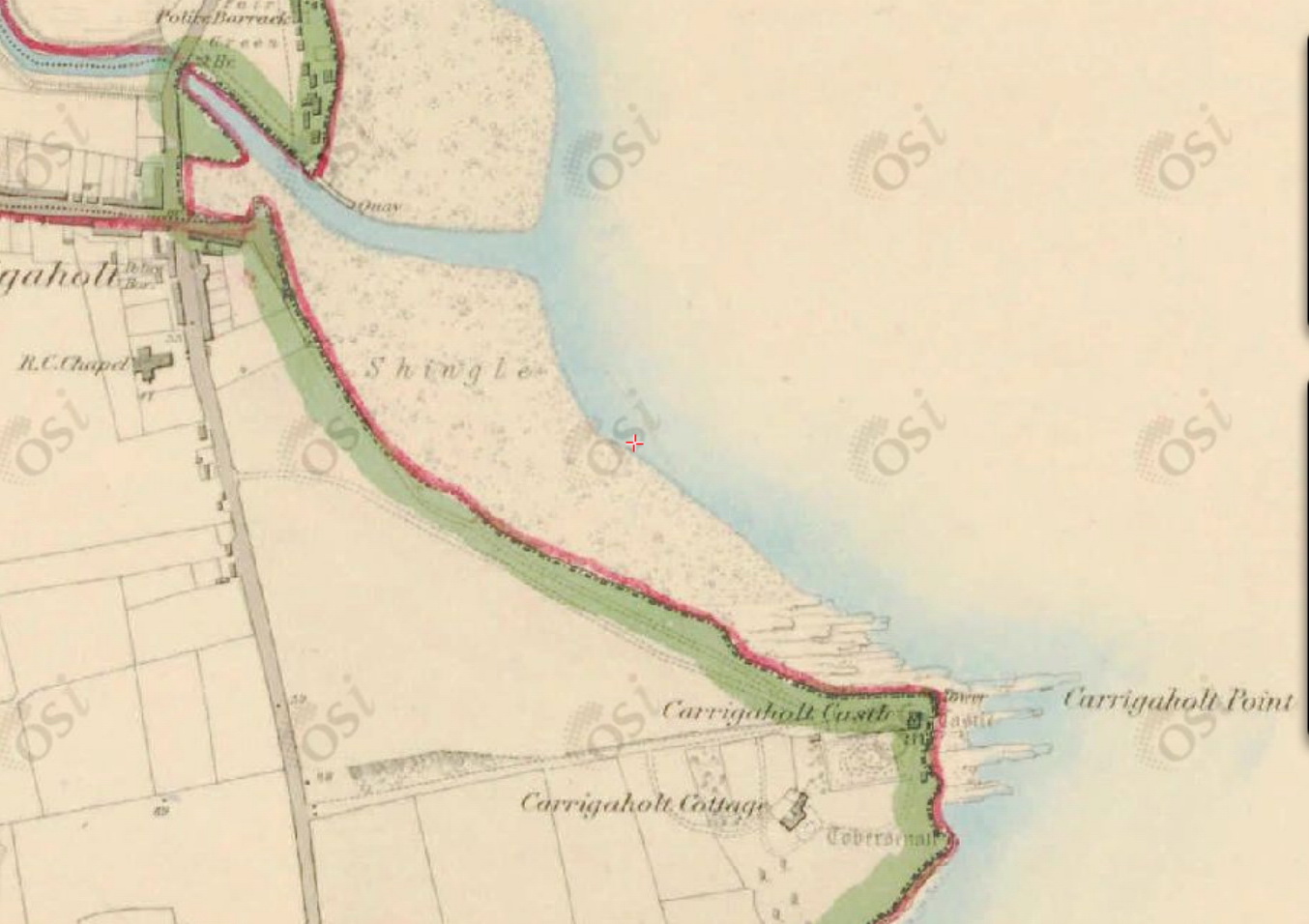
The earlier pier at Carrigaholt was built by Alexander Nimmo and was more successful than his harbour down the road at Kilbaha. Despite the description on the DIA site, I assume that it is the one shown on the 6″ OSI map.
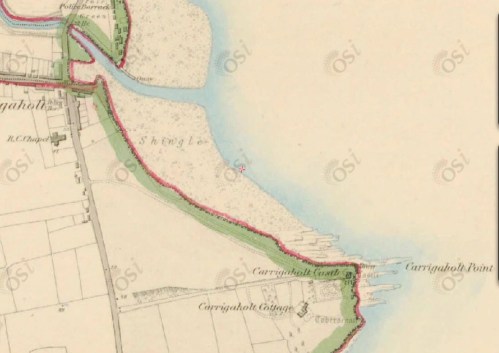
Carrigaholt map 1

The old quay at Carrigaholt (OSI ~1840)

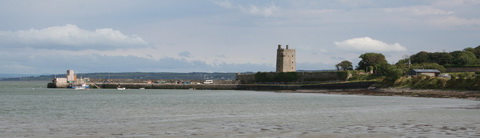
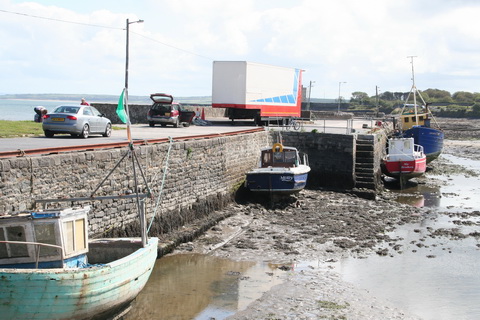
Here’s a photo.
Carrigaholt August 2011 7_resize

The old quay at Carrigaholt as extended

Commander James Wolfe’s Sailing Directions [PDF], compiled some time before 1848, say

Round Kilcradan, to the northward, and protected by it, is the anchorage or Road of Carrigaholt. It is a very fine secure anchorage with all winds from the westward, but from the ENE to S much sea prevails, though not heavy enough to endanger a vessel well found in ground tackling. With SW gales, a long rolling swell sets in round Kilcradan Point, which renders riding here at those times very uneasy. These roads have the advantage of being free from any great strength of tide.

The ground is level all over the road, but from six fathoms it shoals gradually towards the shores; the bottom, of sand over clay and mud, is generally considered good holding ground. The best anchorage for a large ship is with the top of Ray Hill in one with the Coast-guard Watchhouse W ¾ N, and Moyarta Lodge, just open of the point on which Carrigaholt Castle stands, nearly N ½ W in 5½ to 6 fathoms low-water springs.

The shore forms two smaller bays, the northern of which takes its name from the village which stands on its shores, and the southern is called Kilcradan. Both are very flat and shallow; in the latter there is a coast-guard station, but it is not a boarding station. The village is a poor miserable place, and does not afford supplies of any sort, nor can a ship complete water here. At the village is a small pier, accessible only (to loaded boats) at high water. It is used by the turf-boats, though most of these load on the beach.

Carrigaholt Castle, a high square tower on the point, and the chapel, a cruciform building, with its belfry, are very conspicuous objects.

As those directions were written some years ago, I suggest that you should not use them for navigating nowadays. You can tell that they are out of date because the village does now afford most excellent supplies, chiefly in the Long Dock. The Long Dock does not, alas, seem to have updated its website since 2006, having gone over to the Dark Side of FaceTweet which, at least to me, is impossible to search, so I can’t point you to a list of the interesting beers the Long Dock stocks in addition to its excellent food.

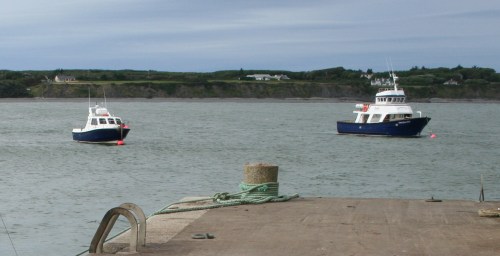
My spies tell me that, if you happen to be driving a barge from, say, Donegal to Limerick — not that I’m encouraging you to do anything of the sort — Mr Luke Aston of the Carrigaholt Sea Angling Centre will be able to advise on moorings. He’s got a Lochin, so he must be sound. You can have a day’s sea angling with him or a day watching dolphins with Geoff Magee (to whom I owe a glass of sherry), followed by a meal at the Long Dock: what more could you want?
Carrigaholt new harbour 24

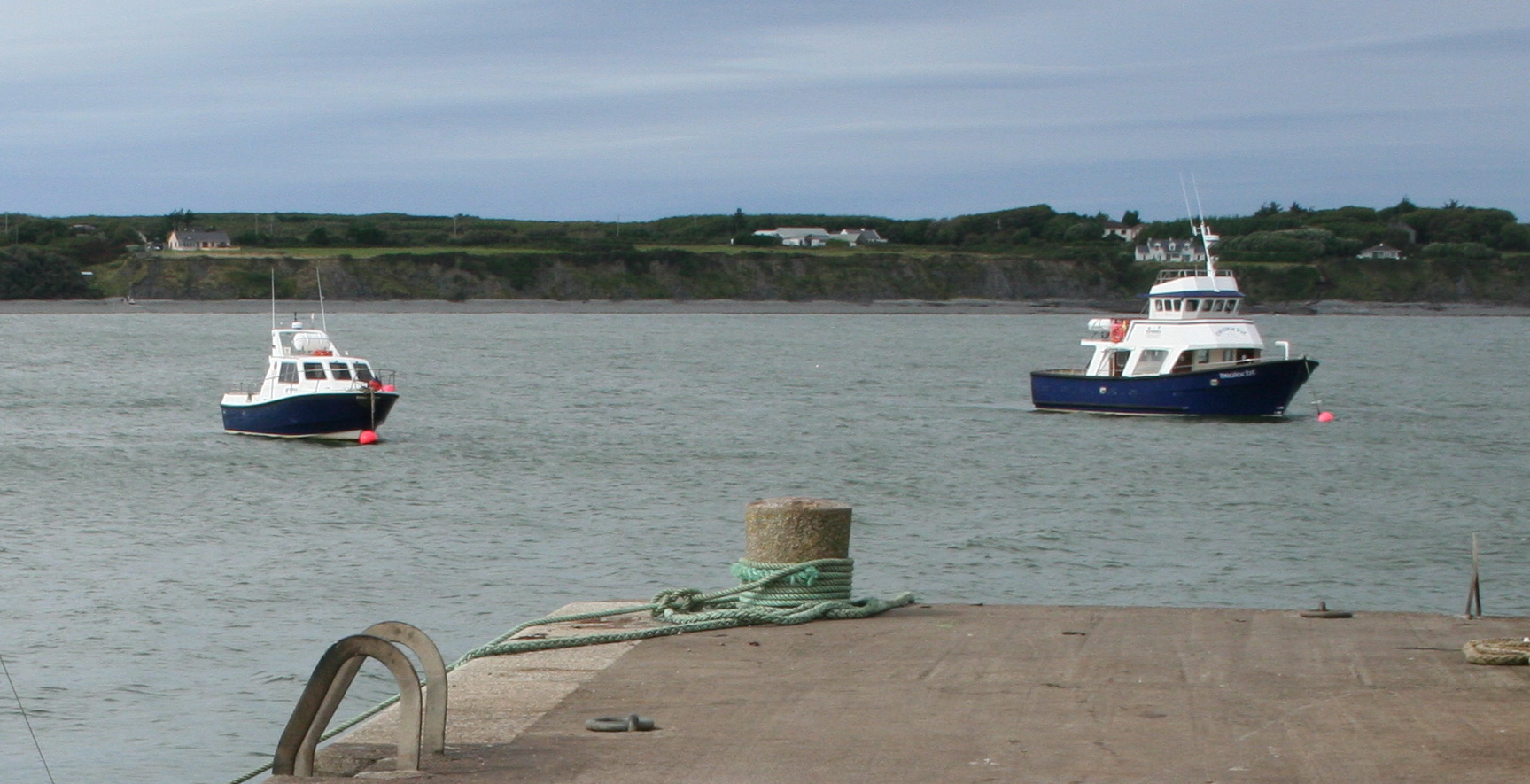
Luke Aston’s Lochin [I assume] and Geoff Magee’s Draíocht

Well, if you were Daniel O’Connell, you’d want a new pier or quay.
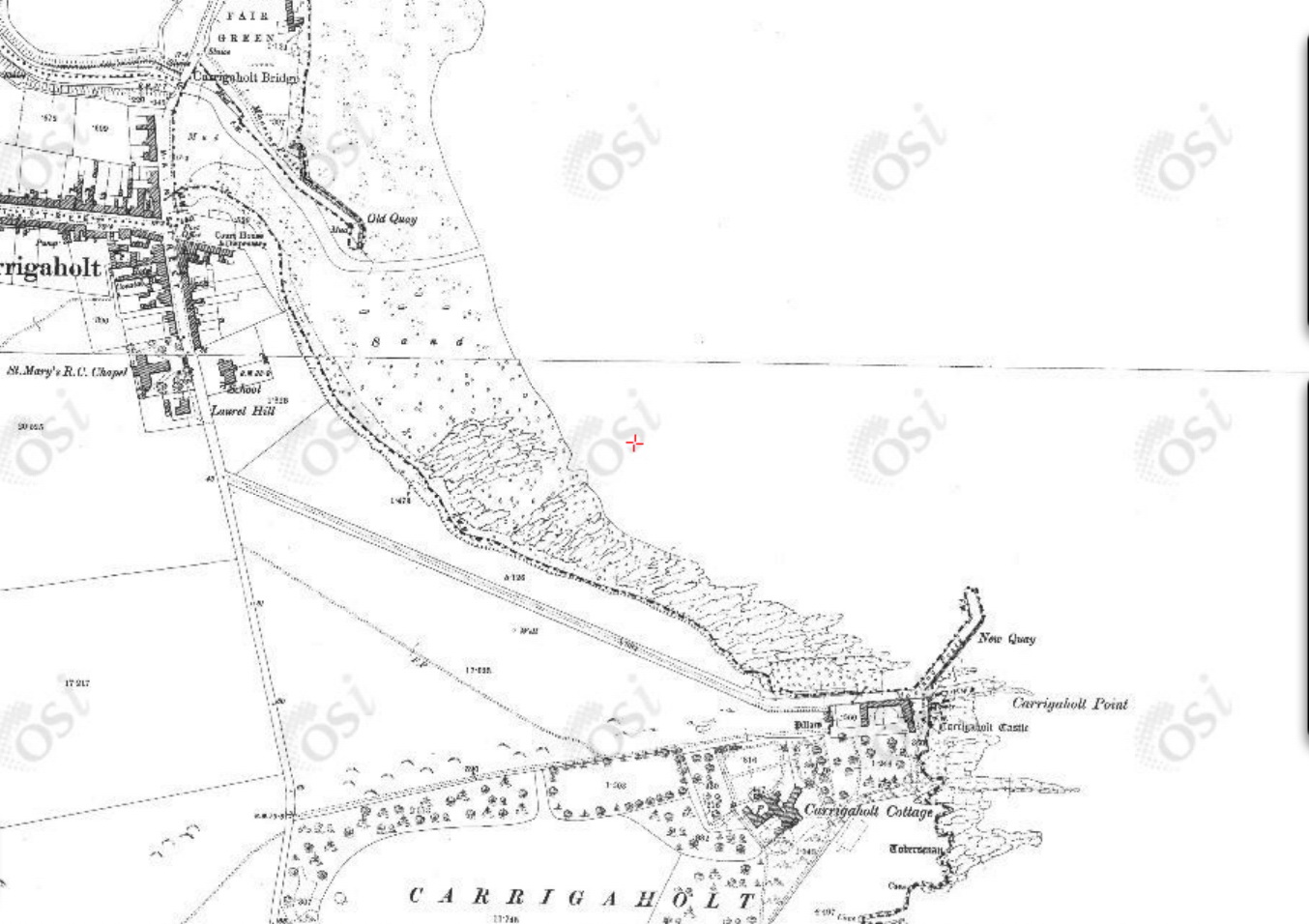
Carrigaholt map 2

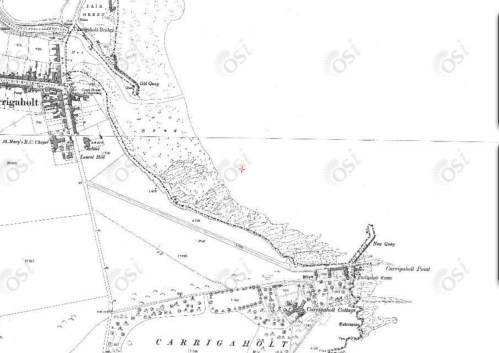
Carrigaholt old and new quays [OSI ~1900]

The old quay was extended at some stage and a new quay was built at the castle. I don’t know have dates for either of those, but I think the new quay was built as a fisheries pier in the 1890s. If, Gentle Reader, you know the dates, and can save me from having to plough through years of Board of Works reports, do please leave a Comment below.

If O’Connell had any role in having the old pier extended, that would have been the only one of his four local concerns on which he had any success, although he could also claim a minor supporting role in having the pier at Cappa, Kilrush, extended in the 1840s.

Carrigaholt new harbour 30_resize

Carrigaholt new quay seen from the old quay

The canal to Ennis

Daniel O’Connell’s third local concern was

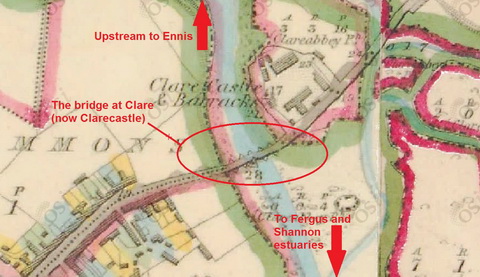
The opening of the navigation of the Fergus to Ennis, so as to make that town a sea-port. The tide rises about half a mile beyond that town; and if there were a short canal cut near the village of Clare, of about 300 yards, vessels of burden could deliver their cargoes at Ennis, and carry away the produce of the country to the most remote markets.

This was a proposal that came up several times, but it was never implemented. The Shannon Commissioners built a fine quay at Clare [now Clarecastle] in the 1840s, but they left it as the head of the navigation.

Wolfe’s Sailing Directions made it clear that the passage of the Fergus estuary was not to be undertaken lightly:

A mile to the eastward of the Beeves is the principal and only navigable entrance to the River Fergus, which comes from the NNE amid vast banks of mud, and numerous islets and rocks. Having passed the Beeves, steer up for Feenish Island till you bring the tall square tower of an old castle (called Court Brown) in one with the north point of Low Island, WNW¼W, which is studded with white houses.

You must then keep rather more to the northward for the round hill of Coney Island, until Cannon Castle is in one with the peak of Grady Island, W¼S, when you must bear away for the east point of Coney Island; you will then shortly come into five and six fathoms, where you must anchor with the sharp peak of Coney Island bearing N by E and Cannon Castle WSW1/3W in about six fathoms soft muddy bottom.

Grady's and Cannon Islands from off Innish Corker [Admiralty Surveyors 1841 by kind permission of the UK National Archives]

Grady’s and Cannon Islands from off Innish Corker [Admiralty Surveyors 1841 by kind permission of the UK National Archives]

Beyond this it would be impossible to proceed without a pilot. The river beyond Coney Island winds through vast banks of mud, extending from 1 to 1½ miles from the shore, decreasing gradually in width from 600 yards, and varying in depth from nine to three feet up to the town of Clare, nearly seven miles in a direct line, and nine following the channel.

At Clare the bed of the river is dry at low water, but there is a quay, alongside of which vessels load. Clare is a miserable place, though the shipping port of Ennis. It is a military station.

Pilots may be had at Low Island, but no vessel above 150 tons should go up to Clare.

Clare_resize

The bridge at Clare[castle] [OSI ~1840]

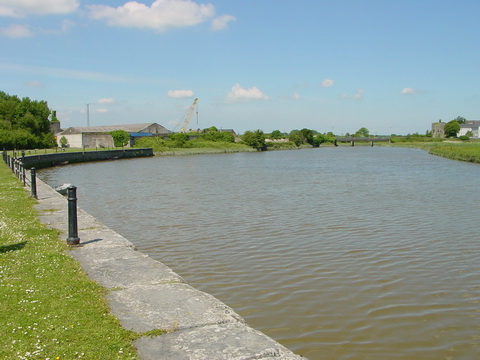
As well as a lock, some opening mechanism would have been required for vessels to get though the bridge, which was not the current flat structure; here is a photo of the old bridge.
Clarecastle Fergus Navigation June 2007 07_resize

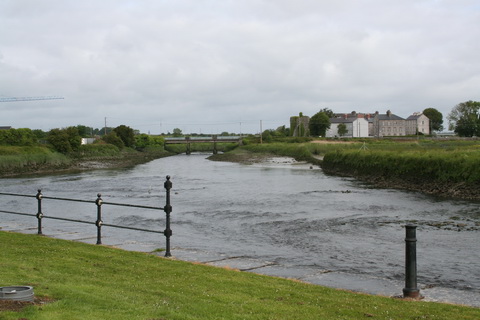
Looking from the Shannon Commissioners 1840s quay at Clare towards the bridge
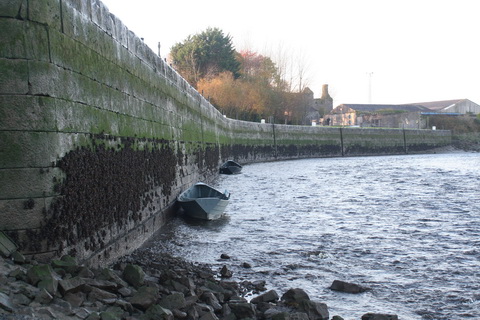
Clarecastle November 2014 16_resize

Clarecastle gandalows at the quay

Clarecastle old quay from far side 03_resize

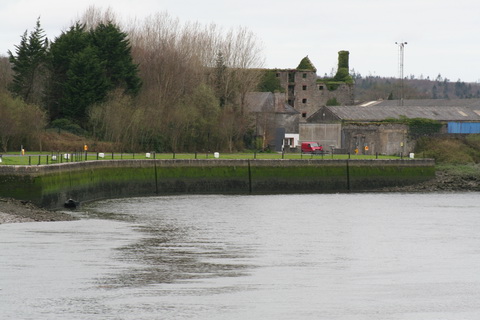
The quay from across the river

Very low water at Clarecastle 5_resize

Low water at Clarecastle

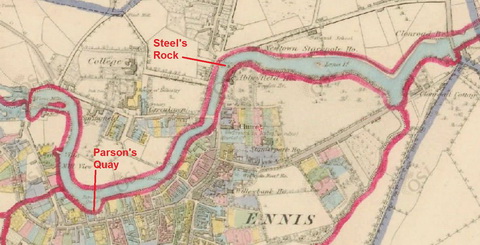
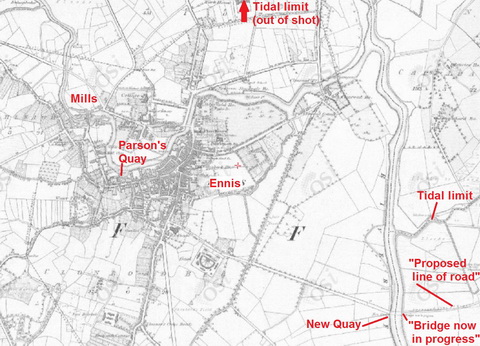
The interesting thing is that, even though a boat could not pass through Clarecastle to the estuary, there must have been some navigation on the Fergus; I would like to know more about what and how much was carried when. There was a quay, Parson’s Quay, in Ennis …
Ennis_resize

Parson’s Quay in Ennis [OSI ~1840]

… and another quay further downstream. I put the next map in black and white to make it easier to see things; it’s scaled down from the Ennis map.
Quays_resize

Ennis and district [OSI ~1840]

The map also shows that O’Connell was right about the tide: it did flow well above Ennis.

The other canal

Although the first three proposals were not implemented, and probably would have been either uneconomic or unsuccessful, they weren’t absolutely bonkers. His fourth idea, though, was nuts.

The fourth local concern relates to a communication by a canal from the bay of Galway to Limerick. The point of junction should be somewhere in the neighbourhood of Killaloe. The entire of the western and midland counties of Ireland would derive great advantage from such a canal.

Getting through the hills above Killaloe would have been fun. But the real problem with the proposal is that O’Connell fundamentally misunderstood the nature of the Irish economy. Each Irish port served its own hinterland, shipping out its produce and shipping in coal, timber and other overseas goods. But the ports did not need to trade with each other, as each performed the same function.

The exception to that was created by the application of steam on the inland Shannon, which allowed perishable produce from the Limerick area to be carried across Ireland for export through Dublin to Britain. That role was soon taken over by the railways.

But there was no point in connecting two westward-facing ports by canal: if they needed to trade with each other, they could do so by sea.

My OSI logo and permit number for website

Greyways and the Black Bridge

Martin McGuinness [SF] was asked recently, in the Northern Ireland Assembly, about blueways:

Leslie Cree [UUP]: It was interesting to read that Waterways Ireland has developed this first blueway in the Carrick-on-Shannon area. Can he share with us if, in fact, Waterways Ireland has developed any projects for the Erne waterway itself?

Mr McGuinness said:

These projects are under ongoing consideration by Waterways Ireland, as the development of blueways and greenways could add to our tourist potential. It is clear from how greenways have been used, particularly in the west of Ireland, that they have huge health benefits for those now walking and cycling and involved in physical activity.

There is a proposal for another greenway from Derry city to County Donegal. Blueways and greenways offer important tourist potential, and it is exciting to see that Waterways Ireland is considering the linkage in the Leitrim area and how it can be extended to Lough Erne.

But, if I might remind TPTB, not everybody likes walking, cycling and physical activity; not everybody is going to be rolling around in a kayak or paddling a canoe. There are older folk, there are those who rightly view exercise with the gravest of suspicion and there are those whose interests simply lie elsewhere.

The Greyway concept

It is for such folk that I have developed the Greyway [TM]  concept. It’s the same as a blueway or a greenway but without the sweating or the lurid dayglo clothing.

The basic idea is that you form a “route” or “way” as a marketing concept to get more people using your existing assets. Your expenditure is low: research, product development, marketing and information provision rather than infrastructure; self-guided rather than staffed user experiences. Direct income might be low too, although there may be ways to extract cash from users; there might also be spin-off opportunities for other providers. [All my usual reservations about small-scale providers apply here too.]

There might be Greyways catering for

  • walkers: gentle walks with opportunities for sitting down, drinking tea and getting a taxi back to the start
  • drivers: long-distance routes taking in several sites
  • boaters: most of Waterways Ireland’s sites are accessible by water and by road. Furthermore, some trip boats might use elements of the Greyway material in providing information for their passengers.

Themes

You need a theme to attract people: “come and walk/drive the X Greyway and see all the lovely/interesting Ys”. No doubt there are several possible values for Y: bunnies, trees, fish, bogs, hills …. But the main thing that Waterways Ireland has to sell, and that it does not currently sell, is its industrial heritage. The Shannon, in particular, exists as an improved navigation only because of (a) steam, (b) the British industrial revolution, (c) Irish agriculture and (d) low politics. And industrial heritage is something that interests some at least of the older folk. Package it into routes and sell it for grey pounds, euros or dollars.

There is all sorts of interesting stuff along the Shannon, mostly just lying there, and it should be put to work. The most concentrated section is along the old Limerick Navigation, from Limerick to Killaloe: for instance, last time I looked seven of the original twelve milestones were still present. [The distance was 12 Irish miles, approx 24 km or 15 statute miles.] It’s a walkable route and it includes

  • the neglected Black Bridge at Plassey, whose very existence reflects the Victorian version of Just-in-time delivery
  • the bridge and artefacts at O’Briensbridge
  • the richest waterways heritage site in Ireland at Killaloe.

But there could also be driving tours along the middle Shannon, between Portumna and Athlone, where there is lots to see, and from Lanesborough upwards. Shannon Harbour might eventually house a museum ….

ERIH

What I’m suggesting is that Waterways Ireland should designate the Shannon as the first route (as opposed to site) in Ireland within the European Route of Industrial Heritage [ERIH] framework. ERIH’s website includes descriptions of the route system and of anchor points, which may be too advanced for present use, but why not a European Theme Route in Transport and Communication? Ireland might even make a case for the use of advanced (or at least interesting) transport technology (steamers) in carrying agricultural produce to industrial markets.

Furthermore, if CIE were to cooperate, the railways might be brought in too, and the livestock trade, and Dublin Port, and a regional route linking to Liverpool and the railway to Manchester ….

There is an interesting story to be told about the Shannon and its links to the east coast and beyond; its industrial heritage could be used to attract tourists and entertain natives.