Category Archives: Sea

Concrete boats and barges

The latest issue of the [UK] Boat Museum Society‘s Waterways Journal, Violume 16, contains a very interesting article on “Concrete Boats and Barges” by the Rev David Long; several of the hulls are in Ireland. There are also articles on the restoration of a wooden coal-carrying Box Boat and on the carrying firm of Richard Abel & Sons of Runcorn and Liverpool, as well as a splendidly iconoclastic piece by Joseph Boughey on Robert Aickman, a founder of the [UK] Inland Waterways Association. [Non-hagiographic accounts of the history of the Inland Waterways Association of Ireland have yet to be written.]

It is not easy for folk without sterling bank accounts to buy copies of its Journal from the Boat Museum Society, but I have bought issues in the past from The Canal Shop [Vol 16 has not yet been listed at time of writing] and no doubt there are other sources too.

Shannon history in Birmingham

According to the Railway & Canal Historical Society’s Events page, its annual Clinker Memorial Lecture, to be held in Birmingham in October 2014, will be about River Shannon steamers in the second quarter of the nineteenth century:

The 2014 Clinker Memorial Lecture will be held in Birmingham on the afternoon of Saturday 18th October 2014. The speaker will be Brian Goggin, BA (Mod), MA.

Brian graduated from Trinity College, Dublin in Economics and Politics, and spent some years as honorary Editor of the quarterly magazine of the Inland Waterways Association of Ireland. He and his wife Anne have been boating on Irish inland waterways since the late 1970s. He is currently working on a book on the Shannon steamers of the 1830s and 1840s, and the Clinker Lecture will draw on his research.

Before lunch (and independent of the Lecture) there will be a walking tour of central Birmingham, focusing on sites of waterway and railway interest.


Effin Bridge: a modest proposal

Effin Bridge, the railway lift-bridge over the Royal Canal on the seaward side of Newcomen Bridge in Dublin, has caused some little annoyance to boating folk. It is raised on a small number of days each year to allow boats through; many staff must attend and Waterways Ireland must pay Iarnród Éireann, the railway company, for each lift, as well as paying its own staff for attending.

Perhaps a more modest structure might work. Something like this.

Description of a new Lift Bridge for the Midland Great Western Railway, over the Royal Canal at Newcomen Bridge, Dublin. By Bindon B Stoney, MA, MInstCE

This bridge carries a short branch of the Midland Great Western Railway of Ireland across the Royal Canal immediately below Newcomen Bridge, at the very oblique angle of 25 degrees and, though the canal is only 15 feet wide, the bridge carrying the railway requires to be nearly 40 feet long on the skew.

The trains run over this bridge at about two feet above ordinary water level, and whenever a boat is passing along the canal the bridge is lifted from 8 to 13 feet, according to the height of the deck load, so as to permit the boat to pass beneath. The bridge is formed of two strong single-plate girders of the usual type, which lie underneath the rails, with cross girders and side brackets over which the platform is laid. This bridge is lifted by means of a lever 40 feet long, formed of two plate girders braced together horizontally, and attached rigidly at right angles to the centre of the bridge, and this lever is itself balanced at its centre on blunt steel knife edges like the beam of a pair of scales. The weight of the bridge at one end of the lever is counterpoised by an equal weight of metal attached to the other end, so that the whole structure turns freely on the knife edges, which work in steel pillow blocks on the top of metal standards, one on either side of the lever. The opening and closing motions are regulated by a small crab-winch and chain worked by hand; the ends of this chain are attached to the lever at several feet on either side of the knife edges, and its centre is wound on or off from the barrel of the winch, which is itself bolted down to a mass of concrete extending beneath the metal standards.

The man in charge works this arrangement with the greatest ease, and it is so regulated that the bridge is opened or closed in about one minute. It might be moved much faster than this, as the friction is reduced to a mere trifle by the knife edges, but it is not convenient to put so large a mass in rapid motion when there is nothing to be gained by so doing. It was essential that the bridge should be erected speedily and so as to interrupt the traffic as little as possible, and the first engine passed over it in about twelve weeks after the contractors, Messrs Courtney, Stephens and Bailey, of Dublin, got instructions to proceed with the work and the traffic was interrupted for only about one week during erection. The lever sloping upwards has a somewhat singular appearance when the bridge is in position for trains to pass over and, on the other hand, the bridge itself has a singular effect when it is tilted up into the air for canal boats to pass beneath; but the author has successfully obtained what he aimed at — namely, simplicity of design, strength, ease of working, little aptitude to go out of order and last, but not least, very moderate cost.

Report of the Forty-eighth Meeting of the British Association for the Advancement of Science; held at Dublin in August 1878 John Murray, London 1879


Waterways [and other] archives

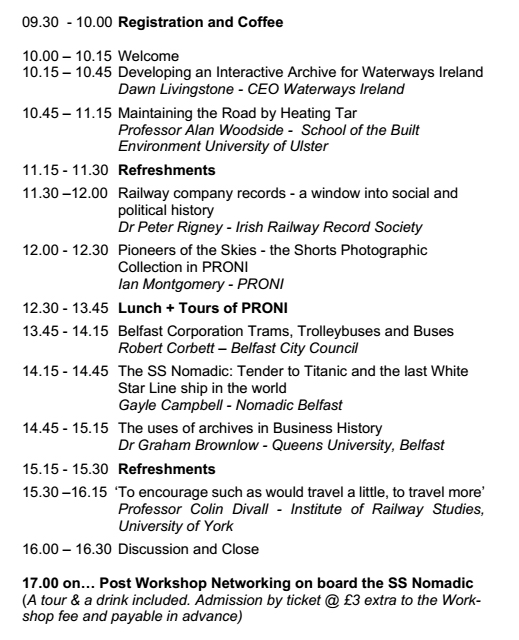
For anyone interested in transport history, there is an interesting-looking workshop scheduled for Belfast on 8 September 2014. It’s being held in the Public Record Office of Northern Ireland [PRONI] in the Titanic Quarter and there’s an optional extra tour and reception on the SS Nomadic afterwards.

The programme covers waterways, roads, railways and flight. For this site, the opening session is of great interest: Dawn Livingstone, CEO of Waterways Ireland, is to talk about an interactive archive for Waterways Ireland.

By air, sea and land

By air, sea and land

The workshop is being organised for PRONI by A²SN, the Archives and Artefacts Study Network, supported by the Historical Model Railway Society, the Business Archives Council and the Postal History Society.

The [two-page PDF] brochure is downloadable here PRONI transport archives workshop. The workshop fee is £20/€25 with an extra £3/€3.50 for the SS Nomadic visit. Sterling cheques are accepted; there is provision for paying in euro by online banking.

While on the subject of archives, I might mention again the Archives & Records Association, Ireland branch, whose [freely downloadable PDF] newsletters often cover topics of interest, and their Learn About Archives site here.

Eels

An update here and, from across the water, here.

Important topics in Ireland 1845–1850

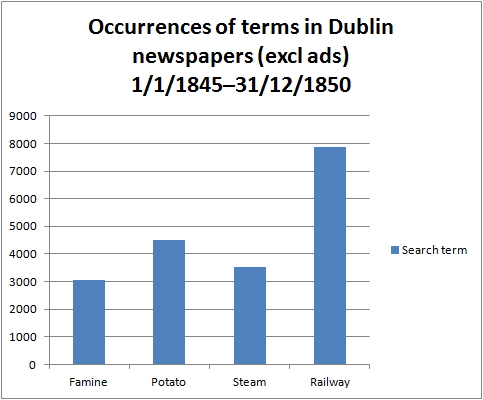
I thought it would be interesting to ask the British Newspaper Archive what people were reading about in newspapers published in Dublin between 1 January 1845 and 31 December 1850. The BNA has scans of two Dublin newspapers for that period, the Freeman’s Journal and the Dublin Evening Mail. I used the archive to search for four different words in those newspapers in that period; I then counted the numbers of results.

On the first round, I included ads and family notices.

Newspaper terms incl ads 1845–1850

Terms in Dublin newspapers (incl ads) 1845–1850

I guessed that the numbers for steam and railway might be exaggerated by their inclusion in ads so, on the second round, I excluded both ads and family notices. The result was as expected.

Newspaper terms excl ads 1845–1850

Terms in Dublin newspapers (excl ads) 1845–1850

I then asked Google’s Ngram machine to count the numbers of occurrences of four pairs of words between 1845 and 1850. I asked it to do a case-insentitive search, but it can’t do that for “compositions” (combinations of words), so it counted:

Ireland+potato
Ireland+steam
Ireland+famine
Ireland+railway.

Here is what it came up with, but whence I know not, other than that it searched the corpus English. The embedding process doesn’t seem to be working, so I’ve left the code here but also cut and pasted the output.

Google Ngram

Google Ngram

I suspect that, in recent times, the amount written about steam and railways of the period 1845–1850 in Ireland has been rather less than that about potatoes and the famine.


Splendid chaps, these arty types

I take it all back: I’ll never say another rude word about art gallery folk.

Well, not many, anyway.

The splendid folk at the National Gallery of Ireland have an online searchable archive that allows you to look at pics, download small watermarked versions and buy larger versions if you would like to do so. And “searchable” doesn’t just mean searchable by artist or type of paint or whatever it is: you can put in important terms like “steamer” and “shannon” and “canal”.

Admittedly you don’t get much back: two steamers, none of interest on this site, nothing about the Shannon and twelve canal scenes, only two of which are in Ireland. One of them, though, is very interesting indeed, and you can see it if you use

P4457

as your search term.

You should get an 1809 pic by one John Henry Campbell entitled “Ringsend and Irishtown from the Grand Canal, Dublin”, showing three wooden canal-boats, not particularly well moored, with their crews settling in (it appears) for the evening with fires lit and some with shelters rigged.

I can’t work out where they are, though. To get Ringsend lined up with Howth in quite that way, you’d have to be pretty close to the Grand Canal Docks, I’d have thought. Any guesses or deductions?


The Mahmoudié Canal

There is a possible link between the Mahmoudié Canal, which ran from Alexandria to the Nile, and Irish waterways. I have not managed to establish a definite link to this Irish canal-boat but it is not ruled out either, and a few other Irish connections came up along the way: Oscar Wilde’s father, for instance, who wrote about the Boyne and the Corrib, and sent his most famous son to school on the Erne, travelled on the Mahmoudié Canal.

And did you know that, in the early 1840s, you could buy bottled Guinness and Bass in Cairo? Or that, to transport 50 people (including 12 ladies and 3 female servants) and 3 bags and 62 chests of mail across 84 miles of desert, you would have needed, in 1841,

  • 130 camel men, donkey men and servants
  • an escort of 17 Arab horsemen
  • 145 camels
  • 60 donkeys
  • 12 saddle horses
  • 12 carriage horses
  • 7 carriage camels
  • 12 donkey chairs: “for invalids, or ladies, the donkey-chair forms as easy a conveyance as a palanquin or sedan”
  • 3 two-wheeled carriages
  • 1 four-wheeled carriage?

Or that, to reduce the number of rats and insects on a cangia (sailing boat) on the Nile, you should sink it for two or three days before boarding?

You can read about all of that and more in this PDF. However, it’s not for the faint-hearted: it’s 51 pages, with over 300 endnotes (which you don’t have to read) and lots of links for those who are really interested. There are illustrations in some of the linked materials.

The Mahmoudié mystery v04 iwh [PDF]

More reading material

A bit of a break from the politicking ….

First,  the long-awaited second edition of David Walsh’s extraordinary book Oileáin is now available from Pesda Press. It’s an exhaustive guide to the islands around Ireland, seen from a sea-kayaker’s perspective. It tells you where they are, how you get there, what the tides and currents and hazards are, whether you might be able to camp …. A lot of this is, of course, aimed mainly at folk rather more athletically minded than I am, but I got it for its information about the islands in the Shannon and Fergus estuaries. David’s website keeps an electronic version updated, so that you can check the latest information before you set off, but even if you’re unlikely to start paddling to the Skelligs yourself you may find the information and the photos of interest.

Shannon enthusiasts will be familiar with Richard Hayward’s Where the River Shannon Flows, written as Hitler’s war was breaking out. It is an account of a road trip down the Shannon during which a film about the river was being made: the party was in Portumna when Hayward heard, on a wireless set through a window, that Britain was at war with Germany. I was privileged, some years ago, to be able to see the film and to match it with the scenes from the book, from which L T C Rolt drew information for his Green and Silver. Hayward was a proud Ulsterman, but one who was happy to meet, converse and exchange songs with anyone of any creed anywhere in Ireland. He was, if I remember correctly, a confectionery salesman by way of a day job, but more importantly he was an actor, a writer and a singer. His style is of its time, and perhaps rather laboured by modern standards, but he was a decent skin and I haven’t read anything of his that I didn’t enjoy. I am pleased to learn that a biography, An Unrepentant Romantic — the life and times of Richard Hayward by Paul Clements, is due to be published by Lilliput Press in May.

In the same month, UCD Press is to publish James Murphy’s Ireland’s Czar: Gladstonian government and the lord lieutenancies of the Red Earl Spencer, 1868–86. That’s this chap here, whose claim to fame is that he has a dock on the Royal in Dublin, and a harbour on Lough Allen, both called after him.

I don’t know whether I want to shell out €50 for Nigel Everett’s The Woodlands of Ireland, 700–1800 [Four Courts Press, May], but I like the idea that it

Focuses on the fundamentally pragmatic and commercial view of trees adopted by Gaelic civilisation, and the attempts of the various Anglo-Irish administrations to introduce more conservative woodland practices into Ireland.

Cad a dhéanfaimid feasta gan adhmaid? Why, we’ll import seacoal from Whitehaven, of course.

Finally, I am hoping that Joe Curtis’s Terenure: an illustrated history [The History Press, Ireland, March] will have more information about the remarkable Bourne family.

The information on forthcoming books comes from the magazine Books Ireland, which was until recently edited by old Shannon hand (and, if I mistake not, former Ditchcrawler) Jeremy Addis. Jeremy has now passed over the tiller and the magazine is now edited by Tony Canavan and published by Wordwell.


The underwater underground canal

Some queries about the Ballykelly or Broharris Canal.