
There are not so many of them. I wonder what’s happening in Ireland.
There are not so many of them. I wonder what’s happening in Ireland.
A few minutes past two o’clock in the evening of Wednesday, the 6th instant, the Dover Castle left Glin [that should read Limerick] for Tarbert, with between 30 and 40 persons on board, including some of the Glin police.
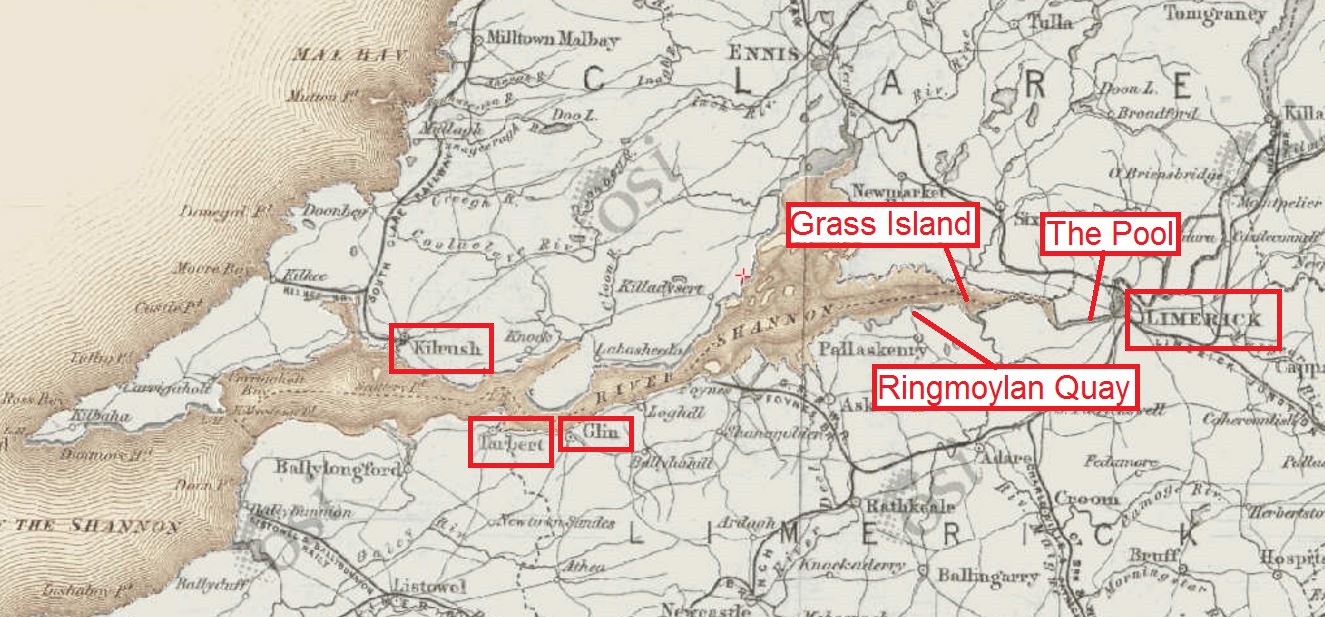
The route of the Dover Castle (OSI 25″ ~1900)
When she reached the pool, she took a large brig and a schooner in tow, which she took as far as Grass Island. She then continued her course, and when about three miles west of Ring Moylan quay, a thick fog came like a wall upon her, so that it was impossible to see half the length of the deck.
Captain White immediately dropped anchor, and was obliged to remain so. The fog continuing all night and the next day.
About two o’clock on Thursday, there being no appearance of the fog clearing off, and several persons on board having eaten nothing since Wednesday morning, two women fainted, and the circumstance having been communicated to the captain, he immediately ordered the steward to open a bag of flour, and served it out in large buckets to the women, who, in a short time, had large cakes made, and baked them for the passengers.
At half-past four o’clock the fog began to clear, and at five the steamer weighed anchor, and reached Kilrush in safety.
Statesman and Dublin Christian Record
19 January 1841 quoting Limerick Standard


Posted in Economic activities, Extant waterways, Historical matters, Ireland, Irish inland waterways vessels, Operations, Passenger traffic, People, Safety, Sea, Shannon, shannon estuary, Steamers, waterways, Weather
Tagged Captain White, Dover Castle, fog, Grass Island, Kilrush, Limerick, pool. Glin, Ringmoylan, shannon estuary, Tarbert
What a collection of notables ….
Captain Beaufort RN, Hydrographer to the Admiralty
The Right Hon Maurice A Fitzgerald
Simon M’Gillivray Esq
The Right Hon Lord Talbot de Malahide
George Richardson Porter Esq, Board of Trade
Richard Griffith Esq, Civil Engineer
John David Latouche Esq
Peirce Mahony Esq
Daniel O’Connell Esq
The Hon Frederick Ponsonby
Charles Wye Williams Esq
Christopher Bullin Esq
James Ferrier Esq
James Jameson Esq
Richard Williams Esq
George M’Bride Esq
Francis Carleton Esq
Dublin Mercantile Advertiser, and Weekly Price Current 1 August 1836
From the British Newspaper Archive
At Christmas 1839 the 150-ton schooner Lansdowne, owned by the Limerick Shipping Company, sailed from Limerick for Glasgow.
The Marquis of Lansdowne had been built at the company’s yard at North Strand, Limerick, downstream of the Wellesley Bridge and on land owned by the noble Marquis. She was named by Miss Russell, daughter of John Norris Russell, a principal shareholder, and launched on Tuesday 5 November 1839, in the presence of Sir William Macbean, Col Mansel and most of the officers of the garrison. The other merchant vessels in port had “colours flying from stem to stern” and “frequent discharges of artillery” welcomed the new schooner to the “world of waters”.
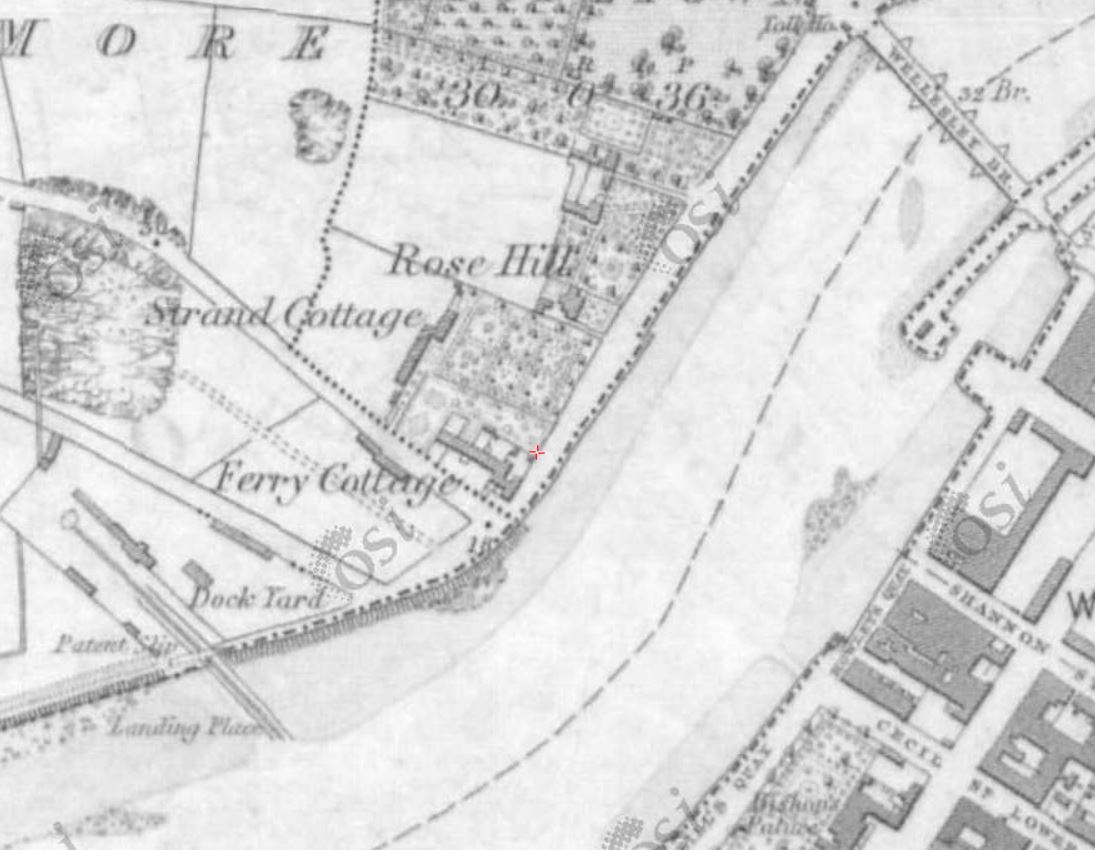
The Limerick Shipping Company’s ship-building yard (OSI ~1840)
The yard, which was equipped with a patent slip, had another schooner on the stocks at the time. According to Commander James Wolfe
There is a patent slip and yard at Kilrush, as well as at Limerick. At the latter place the slip is proved for vessels of 400 tons, at the former only for those of 250 tons. Repairs to any extent may be done at either of these places; and at Limerick some fine vessels have lately been built.
The Limerick Shipping Company had ten schooners by 1834 and, in 1838, bought a steam tug, the Dover Castle, which also competed in the passenger-carrying trade on the Shannon Estuary. By 1842 it had thirteen schooners and was offering regular weekly sailings between Limerick and London.
At no period were the Commercial interests of the Port of Limerick so prosperous, this spirited Company having now at their command a squadron of vessels equal, if not superior for all sailing qualities, to those of any other port in Ireland.
John Brown, aged 27 or 28, got married one day before the Lansdowne sailed at Christmas on what must have been one of its first voyages. In Glasgow, the schooner berthed at the Broomielaw, and in mid-January Brown went drinking with William Bennet and John Anson, both aged about 20. When they returned to the schooner, they lit the stove in the forecastle, closed the hatch and went to bed.
The port regulations banned fires on vessels after nine o’clock; the newspaper said [without citing any evidence] that the three men closed the hatch “so as to prevent a single ray being seen outside” by the police on the quay.
The unfortunate men went into their sleeping berths, and as might have been anticipated, the consequence proved fatal to all the three, the action of carbonic acid having done its deadly work long before morning.
About seven o’clock they were found dead, their countenances as calm as if they had still been under the influence of sleep. One of them was in a half sitting posture.
Two doctors inspected the bodies and “corroborated the accidental nature of the causes which led to death; and liberty was granted to have the bodies interred.”
The Lansdowne herself survived for only another three years: she was wrecked on the Scottish coast in January 1843.
Clare Journal, and Ennis Advertiser 7 November 1839
Sailing Directions for the Lower Shannon, and for Lough Derg; with some Hydrographic Notices of Lough Ree and Lough Erne. By Commander James Wolfe RN; being the result of Surveys made by Order of the Lords Commissioners of the Admiralty
Clonmel Herald 25 January 1840 quoting Glasgow Courier
Limerick Reporter 17 January 1843
All newspapers from the British Newspaper Archive:
Posted in Ashore, Economic activities, Engineering and construction, Foreign parts, Historical matters, Industrial heritage, Ireland, People, Safety, Sea, Shannon
Tagged Broomielaw, carbon monixide, Glasgow, John Norris Russell, Lansdowne, Limerick, Limerick Shipping Company, patent slip, Wellesley Bridge
Synan Meehan, who absconded from Kilrush with £76, and was apprehended in Liverpool by Mr P O’Brien, the Dublin Steam Packet Company’s [Kilrush] agent, was brought up at the Limerick Police office on Thursday, before T P Vokes Esq, who ordered him to be sent on to Kilrush for final examination, and whither he proceeded by steamer in charge of two policemen. When arrested in Liverpool, he was in a state of intoxication, and but a few shillings were found in his possession. He stated that in February last he lost £30, which he had to make good every month when closing his accounts, and fearing it would be discovered he was induced to make off. The offender was regarded in Kilrush as a strict teetotaller, but having violated his solemn pledge to Father Mathew, little confidence could be reposed in him.
Southern Reporter and Cork Commercial Courier 12 August 1845
From the British Newspaper Archive run by Findmypast Newspaper Archive Limited, in partnership with the British Library.
The Waterloo will sail hence for Warren’s Point, This Day (FRIDAY) the 16th instant, at Three o’clock; on TUESDAY the 20th, and SUNDAY the 25th instant.
The Mountaineer, C H Townley, will sail hence for Dublin, on SUNDAY next, the 18th instant, at Three o’clock.
The Belfast will also shortly resume her station between this Port and Dublin. These being the only Steam-packets which land their Passengers AT THE CITY, by them the Public avoid the dangerous landing at Dunleary in small boats, the hazardous and expensive mode of conveyance thence to Dublin (a distance of several miles), the disagreeable disputes with boatmen, the impositions practised by the lowest order of society, with various other difficulties; against which the complaints are universal.
Days of sailing from Liverpool will be, Sunday, Tuesday, Thursday, and Saturday.
Apply at the Packet-office, bottom of Redcross-street, or to WILLIAM STEWART.
Liverpool Mercury 16 May 1823
From the British Newspaper Archive run by Findmypast Newspaper Archive Limited, in partnership with the British Library.
Posted in Foreign parts, Historical matters, Ireland, Passenger traffic, Sea, Steamers, Tourism
Tagged belfast, boatmen, Dublin, Dun Laoghaire, Dunleary, Kingstown, Liverpool, lower order, Mountaineer, Newry, Red Cross Street, Redcreoss Street, steam boat, Steam Packet, steamer, steamship, Warren's Point, Warrenpoint, Waterloo, William Stewart
The City of Dublin Steam Packet Company have kindly given the use of the Dover Castle, steamer, to the Ladies of Limerick, for Friday next, when the ceremony of laying the foundation stone of the New Docks will be performed. A band will be on board the steamer.
Limerick and Clare Examiner 4 July 1849
Immediately alongside the spot where the stone was to be placed floated the Dover Castle steamer, filled principally with ladies. The excellent Band of the 74th Highlanders was also on board, and contributed much to the delight that animated many a countenance. Several boats and barges were also provided for the accommodation of ladies. Most of the spectators were invited by Cards issued from the Office of Public Works.
Limerick Reporter 6 July 1849
Loud cheering attested the joy that pervaded every bosom at the prospect of employment, which the ceremony held out. The Dover Castle, moored within a few yards of the large platform, was, as a matter of course, the most attractive appendage. It was occupied by the ladies of Limerick. They, too, evidenced by waving their white handkerchiefs (the symbol of their purity, their virtues and sympathy for the suffering poor) how sincerely they felt the importance of the occasion. A stream of music was then poured forth by the beautiful brass band of the 74th, which was quite in keeping with the general harmony.
The proceedings of the day were then brought to a pleasing and chearful close. The military filed off; the Artillery withdrew; the masts and pinnacles became deserted; the groups, about the ground, dissolved; the Corporate functionaries retired; the mace-bearer beat a modest retreat; the ladies were led off by their attendant squires; the people wended their way homewards, the boats disappeared, and the Dock works and ground were left to the sole possession of their ordinary occupants.
May we not hope — at all events, let us pray, that yesterday was an auspicious day for Limerick.
Limerick and Clare Examiner 7 July 1849
From the British Newspaper Archive run by Findmypast Newspaper Archive Limited, in partnership with the British Library.
Posted in Ashore, Built heritage, Charles Wye Williams, Economic activities, Engineering and construction, Extant waterways, Historical matters, Industrial heritage, Ireland, Irish inland waterways vessels, Operations, Passenger traffic, Sea, Shannon, shannon estuary, Sources, Steamers, Waterways management
Tagged City of Dublin Steam Packet Company, Dover Castle, floating docks, foundation stone, handkerchiefs, Ireland, ladies, Limerick, purity, Shannon

 Irish waterways history