Category Archives: shannon estuary

Barrow Line meets Barrow Navigation

Seen from the air, 1947. Several of Limerick too. What’s the boat at bottom left in this pic of Athlone? A search for “Ireland” gives 2642 results, which is more than I can go through. If you find anything interesting, I’d welcome a link, which I’ll add here.
Steam, the Shannon and the Great British Breakfast

That is the title of the Railway and Canal Historical Society‘s 2014 Clinker Memorial Lecture, to be held at the Birmingham and Midland Institute, Margaret Street, Birmingham B3 3BS, at 1415 on Saturday 18 October 2014.

The lecture will concentrate on the period before 1850 with such interesting topics as

  • Shannon steamers
  • the Grand and Royal Canals
  • the first Irish turf (peat) to reach the USA (possibly)
  • port developments in Dublin, Limerick and Kingstonw
  • the Dublin and Kingstown Ship Canal
  • the Midland Great Western Railway
  • what “cattle class” really means
  • bacon and eggs.

Admission is free and booking is not required. However, if you plan to attend, it would be helpful if you could e-mail […] to this effect.

The Clinker Memorial Lecture is named for Charles R Clinker, an eminent railway authoe and one-time historian of the Great Western Railway, who died in 1983.

If you would like the contact email address, leave a Comment below and I’ll get in touch with you direct.


Sliabh Aughty Furnace Festival

I don’t know how many people are aware that there were once extensive ironworks [which used water transport] along the lower western shore of Lough Derg and in the foothills of Sliabh Aughty. The existence of a townland called Furnace, near Whitegate, might be a clue, I suppose. Ger Madden had an article on “The Iron Works of Sliabh Aughty” in Sliabh Aughty: East Clare Heritage Journal No 7 [1997]; he told me the other day that the works burned an acre of oak every day during the season. That bears out what J H Andrews said in “Notes on the Historical Geography of the Irish Iron Industry” [Irish Geography: bulletin of the Geographical Society of Ireland Vol III No 3 1956]:

[…] the Irish woods were exploited [for charcoal] with an extravagant disregard for the future supply position, although at first the conversion of woodland to permanent pasture could have been justified in many cases as a rational long-term economic decision. […] [Cpppicing was] never adopted in Ireland, even by such enlightened land owners as Sir William Petty, so that even a small forge or furnace could despoil its woods at an alarming rate.

Ger and others in Mountshannon have now organised the Sliabh Aughty Furnace Festival, to be held in Mountshannon on 20 and 21 September 2013. The leaflet says:

In the 17th and 18th century, the western shores of Lough Derg were the setting for an intensive iron industry. Although little known, it has left many traces in the landscape and various archives.

The Sliabh Aughty Furnace Project is hoping to safeguard these monuments for the future, research the history and develop the story as a touristic attraction. […]

The festival caters both for those with a deep interest in the subject and for those who might like a lighter approach. For the first group, there is a series of talks in the Mountshannon Hotel, running from 1030 to 1630 (with an hour for lunch):

1030 Paul Rondelez “Iron production in the Sliabh Aughty mountains”
1100 Mary Sleeman “Heritage and the law”
1200 Gerard Madden “The Emmerton Papers” [an archive with valuable
information about the Clare ironworks]
1230 Professor Audrey Horning “Archaeology and early industry in Ireland and
the Americas” [yes, there is a direct link]
1400 Dr Colin Rynne “Industry on the Shannon”
1430 Dr Christy Cuniffe “An elusive foundry in the Slieve Aughty foothills: the
work of T Clarke”
1530 Sean Spellissy “Expanding on Slieve Aughty”
1600 Ewelina Rondelez “The Sliabh Aughty Furnace Project”

The Aistear Iniscealtra Park [the maze] will have events including blacksmithing, charcoal production, a living history tent, sword-fighting demonstrations, 17th century games, a knitting demonstration, an exhibition on the ironworks, stalls with local produce and a barbecue.

All of that for €10 (adult rate; under-16s €5, toddlers free).

On the Sunday there is a guided tour of the remaining furnaces, leaving the harbour at 10.30am: free if you use your own transport, €20 by bus.

There is a website here with full details including information about accommodation in the area.


Archives workshop: a reminder

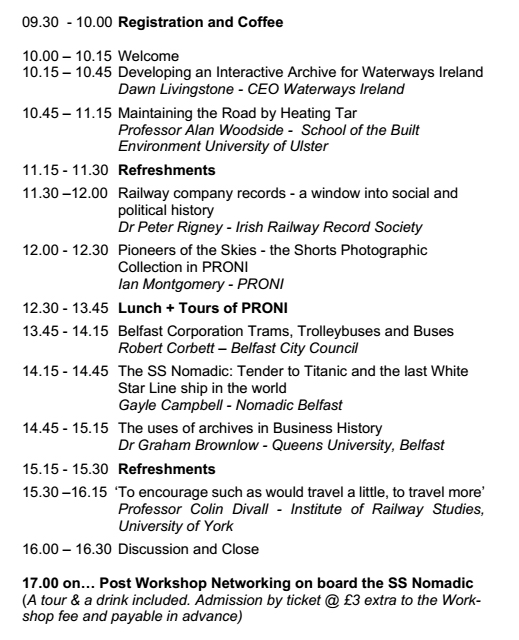
I mentioned, back in April, that an interesting-looking workshop is scheduled for Belfast on 8 September 2014. It’s being held in the Public Record Office of Northern Ireland [PRONI] in the Titanic Quarter and there’s an optional extra tour and reception on the SS Nomadic afterwards. This post is a reminder.

The programme covers waterways, roads, railways and flight. For this site, the opening session is of great interest: Dawn Livingstone, CEO of Waterways Ireland, is to talk about an interactive archive for Waterways Ireland.

By air, sea and land

By air, sea and land

The workshop is being organised for PRONI by A²SN, the Archives and Artefacts Study Network, supported by the Historical Model Railway Society, the Business Archives Council and the Postal History Society.

The [two-page PDF] brochure is downloadable here PRONI transport archives workshop. The workshop fee is £20/€25 with an extra £3/€3.50 for the SS Nomadic visit. Sterling cheques are accepted; there is provision for paying in euro by online banking.


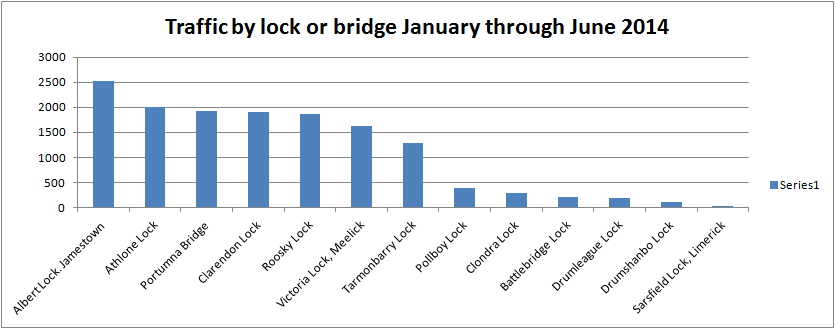
Shannon traffic figures for June


I am grateful to Waterways Ireland for letting me have the Shannon traffic figures for June 2014. All the usual caveats apply:

  • the underlying figures do not record total waterways usage (even for the Shannon) as, for instance, sailing, fishing or waterskiing on lakes or river stretches, which did not involve a passage through a lock or Portumna Bridge, would not be recorded
  • the passage records would not show, for instance, a change in the balance of types of activities from those in larger cruising boats to those in smaller (sailing, fishing, waterskiing) boats
  • figures like these, for a small number of months, will not necessarily be representative of those for the year as a whole. The winter months, January to March, see little traffic in any year; for April, May and June, the weather can have a large influence on the amount of activity especially, I suspect, in private boats.

On the other hand, the figures do include the Shannon’s most significant tourism activity, the cruiser hire business. And they are our only consistent long-term indicator of usage of the inland waterways.

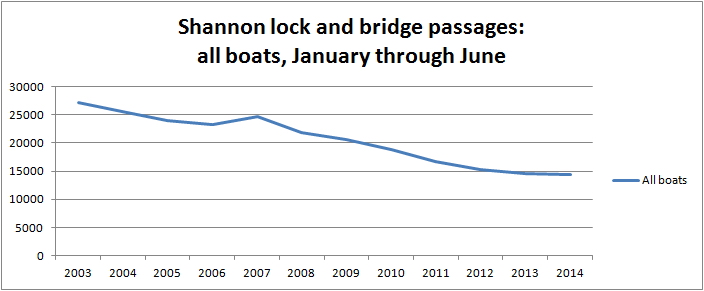
Total (private + hired) traffic for the first six months of each year

Total (private + hired) traffic for the first six months of each year

Total traffic is down again, but only slightly. The decline does seem to be levelling off and a continuation of the relatively good weather could increase usage.

SnnNav JanJun 2

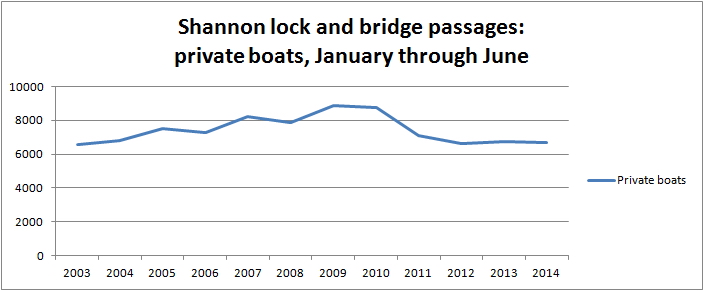
Private-boat traffic for the first six months of each year

Private traffic is down slightly on last year, but it has been pretty much the same for three years. I had thought that the good weather might have caused something of an increase, but on the other hand my own impression of Lough Derg traffic (not reflected in the passage figures) is that it has been fairly light.

SnnNav JanJun 3

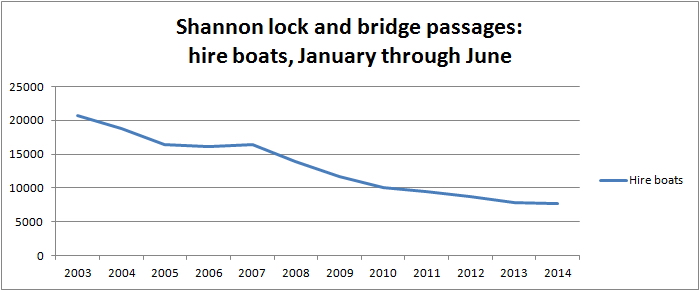
Hire-boat traffic for the first six months of each year

For hire-boat traffic, there is no sign of an upturn, although the drop on last year’s figures is not very large.

SnnNav JanJun 4

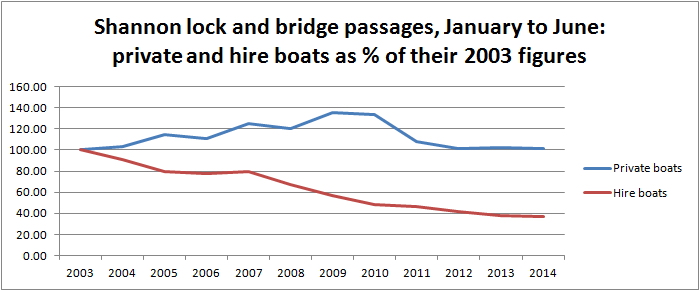
Changes since 2003: private and hired boats

That table amalgamates the two before it, but shows the figures as percentages of the 2003 figures. For private boats, the Celtic Tiger (nach maireann) caused an increase; that effect has worn off and usage has not changed much since about 2011. For hired boats, the decline began long before the Celtic Tiger idiocy.

SnnNav JanJun 5

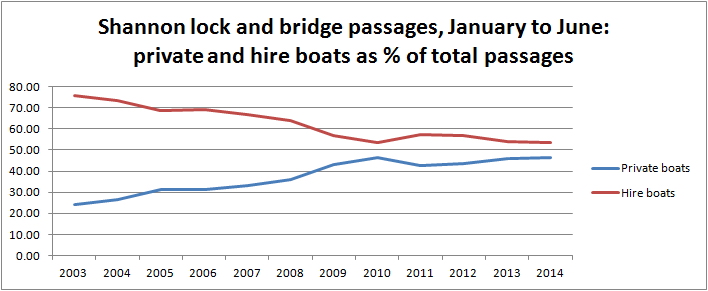
From 75/25 to 50/50

Hired boats were once the major users; private boats have almost caught up.

SnnNav JanJun 6

How to save money

I don’t know how much the various locks cost to run, so I can’t work out any measure of value for money, but the sea lock in Limerick and the Lough Allen Canal must surely be candidates for the chop.


Eel update

Dr William O’Connor says that no elver traps are operating on the River Shannon.

Shannon history in Birmingham

According to the Railway & Canal Historical Society’s Events page, its annual Clinker Memorial Lecture, to be held in Birmingham in October 2014, will be about River Shannon steamers in the second quarter of the nineteenth century:

The 2014 Clinker Memorial Lecture will be held in Birmingham on the afternoon of Saturday 18th October 2014. The speaker will be Brian Goggin, BA (Mod), MA.

Brian graduated from Trinity College, Dublin in Economics and Politics, and spent some years as honorary Editor of the quarterly magazine of the Inland Waterways Association of Ireland. He and his wife Anne have been boating on Irish inland waterways since the late 1970s. He is currently working on a book on the Shannon steamers of the 1830s and 1840s, and the Clinker Lecture will draw on his research.

Before lunch (and independent of the Lecture) there will be a walking tour of central Birmingham, focusing on sites of waterway and railway interest.


Eels

An update here and, from across the water, here.

More reading material

A bit of a break from the politicking ….

First,  the long-awaited second edition of David Walsh’s extraordinary book Oileáin is now available from Pesda Press. It’s an exhaustive guide to the islands around Ireland, seen from a sea-kayaker’s perspective. It tells you where they are, how you get there, what the tides and currents and hazards are, whether you might be able to camp …. A lot of this is, of course, aimed mainly at folk rather more athletically minded than I am, but I got it for its information about the islands in the Shannon and Fergus estuaries. David’s website keeps an electronic version updated, so that you can check the latest information before you set off, but even if you’re unlikely to start paddling to the Skelligs yourself you may find the information and the photos of interest.

Shannon enthusiasts will be familiar with Richard Hayward’s Where the River Shannon Flows, written as Hitler’s war was breaking out. It is an account of a road trip down the Shannon during which a film about the river was being made: the party was in Portumna when Hayward heard, on a wireless set through a window, that Britain was at war with Germany. I was privileged, some years ago, to be able to see the film and to match it with the scenes from the book, from which L T C Rolt drew information for his Green and Silver. Hayward was a proud Ulsterman, but one who was happy to meet, converse and exchange songs with anyone of any creed anywhere in Ireland. He was, if I remember correctly, a confectionery salesman by way of a day job, but more importantly he was an actor, a writer and a singer. His style is of its time, and perhaps rather laboured by modern standards, but he was a decent skin and I haven’t read anything of his that I didn’t enjoy. I am pleased to learn that a biography, An Unrepentant Romantic — the life and times of Richard Hayward by Paul Clements, is due to be published by Lilliput Press in May.

In the same month, UCD Press is to publish James Murphy’s Ireland’s Czar: Gladstonian government and the lord lieutenancies of the Red Earl Spencer, 1868–86. That’s this chap here, whose claim to fame is that he has a dock on the Royal in Dublin, and a harbour on Lough Allen, both called after him.

I don’t know whether I want to shell out €50 for Nigel Everett’s The Woodlands of Ireland, 700–1800 [Four Courts Press, May], but I like the idea that it

Focuses on the fundamentally pragmatic and commercial view of trees adopted by Gaelic civilisation, and the attempts of the various Anglo-Irish administrations to introduce more conservative woodland practices into Ireland.

Cad a dhéanfaimid feasta gan adhmaid? Why, we’ll import seacoal from Whitehaven, of course.

Finally, I am hoping that Joe Curtis’s Terenure: an illustrated history [The History Press, Ireland, March] will have more information about the remarkable Bourne family.

The information on forthcoming books comes from the magazine Books Ireland, which was until recently edited by old Shannon hand (and, if I mistake not, former Ditchcrawler) Jeremy Addis. Jeremy has now passed over the tiller and the magazine is now edited by Tony Canavan and published by Wordwell.


Heritage nonsense and the Naomh Éanna

There was a Dáil debate last week about the scrapping of the Naomh Éanna; nobody gave any good reason for keeping the vessel. Preservation proponents decided not to ask for money: instead they wanted the thing left hanging around while they worked out an “investment plan“, something that they could have done at any time over the last twenty-five years.

The funniest part was the final paragraph of the third contribution by Éamon Ó Cuív [FF, Galway West], who said:

Agus muid ag caint faoi stair, is fiú a lua gur úsáid RTÉ an bád seo le haghaidh scannán an-mhaith a rinne siad, “The Treaty”. Nuair a bhí Collins ag dul go Sasana sa scannán, is ar an mbád seo, seachas bád amuigh i nDún Laoghaire, a bhí sé. Tá ceangal stairiúil le hócáidí thar a bheith stairiúil ag an mbád sin. Níl ag teastáil ach cúpla mí ionas go mbeadh deis ag daoine rud éigin a eagrú. Beidh beagáinín slándáil i gceist. B’fhéidir go mbeidh costas beag ar Uiscebhealaí Éireann. Ní dóigh liom go mbeidh sé suntasach i gcomhthéacs an maitheas a d’fhéadfadh sé seo a dhéanamh dá gcoinneofaí an bád. Má táimid ag lord eiseamláir don rud a bhféadfadh a bheith i gcest, níl le déanamh againn ach cuairt a thabhairt ar Faing agus dul isteach ar an flying boat ansin.

Learned readers will recognise that Google Translate’s version needs improvement:

And we are talking about history, it is worth mentioning that RTÉ use the boat for a very good film they made, “The Treaty “. When Collins was going to England in the film, most of the boats, except boat out in Dun Laoghaire, it was. There are historical connections with historical events particularly at this boat. All you need is a few months so that people have the opportunity to organize something. The security bit concerned. There may be a small cost of Waterways Ireland. I do not think it will be significant in the context of the good it could do this if the boat is kept. If we lord model for what could be gcest, we do not just visit Foynes and go flying into the boat then.

So the Naomh Éanna is valuable because it was used as a film set. And Foynes flying-boat museum shows what could be done.

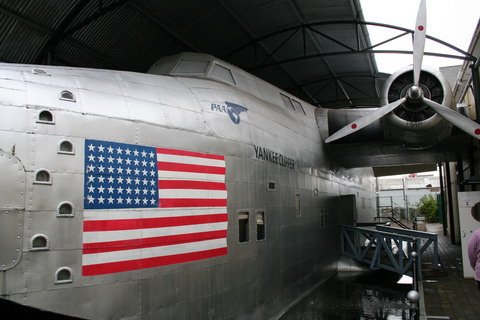
Foynes flying-boat

Foynes flying-boat

Up to a point, Lord Copper. You see — and I know this may come as a shock — the flying-boat on display at Foynes is not actually a real flying-boat. It’s not even a portion of a real flying-boat. It’s a reproduction of a portion of a flying-boat and it was built by a film-set designer.

If anyone really needs to be able to see around a small mid-twentieth-century ship, I suspect that the Foynes folk could provide a replica that would cost less to keep than the real thing.

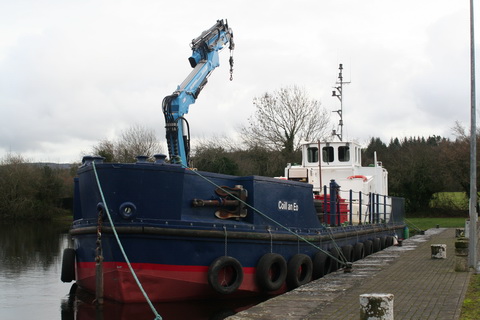
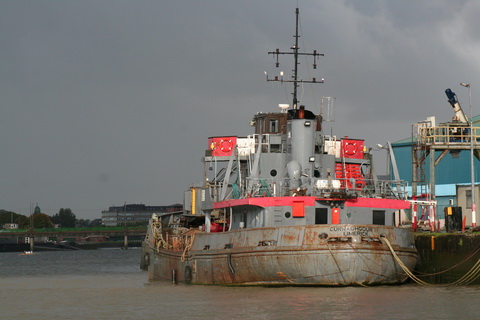
Alternatively, if Dublin needs another example of a locally built vessel, and one different in form from the Cill Áirne, it could take over the Curraghgour II or the Coill an Eo, both also built in Dublin. Maybe the preservationists should start now on their investment planning.

Coill an Eo

Coill an Eo

Limerick Port old dredger Curraghgour II 6_resize

Curraghgour II