Category Archives: shannon estuary

No queue for the quay …

… at Querrin on the Shannon Estuary. The page discusses its building and the early years of its operation.
Wasting sewage

An inquest has recently been held in Limerick, on the bodies of three seamen; and the jury gave a verdict, founded on the evidence of seamen and medical men, that the deaths had been caused by drinking the water of the Shannon, which the drainage of gas works and the common sewage had rendered poisonous. We trust that this unfortunate event, will induce the authorities of Limerick to take measures for applying sewage to the legitimate puspose of manuring the ground, instead of allowing a valuable material to go to waste, and to poison the waters of their river.

The Artizan July 1846

Up with this sort of thing

Folk interested in the history of the Shannon before 1850 may like to know of a talk …

The smart green technology of the 1830s: the Shannon steamers and the definition of Ireland

… to be delivered to the Thomond Archaeological and Historical Society on Monday 4 November 2013. It’s in Room T.1.17, TARA Building, Mary Immaculate College, Limerick, at 8pm.

A related topic …

Charles Wye Williams and the Anglo-Irish Trade

… will be discussed in one of the papers at the Eighth [British] Waterways History Conference on Saturday 26 October 2013 at the University of Birmingham. Leave a Comment below if you would like contact information for the conference.

Mountshannon seaplane

News from the Clare Champion about the possible cessation of commercial seaplane activities at Mountshannon. The article reports comments by Mr Emelyn Heaps, chief executive officer of Harbour Flights Ireland Ltd.

Harbour Flights

The Companies Registration Office finds four occurrences of the term “Harbour Flights”, all giving their address as 13 Parnell Street, Ennis, Co Clare. One is a business name; the others are:

  • Harbour Flights (Ireland) Limited
  • Harbour Flights (Couriers) Limited
  • Harbour Flights (BES Nominees) Limited.

According to the B1 Annual Return for Harbour Flights (Ireland) Limited to 30 September 2012 [the most recent available], the directors of the company are:

  • Ronan Connolly of Ennis, Co Clare, who is the Secretary; he holds seven other directorships of companies, two of which are Harbour Flights (Couriers) Limited and Harbour Flights (BES Nominees) Limited
  • Emelyn Heaps of Tulla, Co Clare; he holds nine other directorships of companies, two of which are Harbour Flights (Couriers) Limited and Harbour Flights (BES Nominees) Limited.

In the Clare Champion article, Mr Heaps “said the four directors and five shareholders will meet this weekend”; it is to be presumed that the two extra directors have recently joined the Board. The B1 return does say that the company had five shareholders:

  • Mr Heaps with 300000 ordinary shares
  • Mr Connolly with 300000 ordinary shares
  • Mr Adam Cronin of Cobh, Co Cork with 300000 ordinary shares
  • Mr Stewart Curtis of Bodyke, Co Clare with 100000 ordinary shares
  • Harbour Flights (BES Nominees) Limited with 4152 “A” ordinary shares.

The company’s authorised share capital is €105000 made up of half a million “A” ordinary shares at 1c and ten million ordinary shares, also at 1c; the issued share capital is €10041.52, of which €41.52 is the “A” ordinary shares and the rest the one million ordinary shares at 1c.

The financial statement of Harbour Flights (Ireland) Limited

The company has lodged abridged financial statements for the year ending 31 December 2011 [they refer to the company as Harbour Flights Limited, omitting “(Ireland)”].

The independent auditor said:

There is an excess of liabilities over assets, as stated in the Balance Sheet, and, in our opinion, on that basis there did exist at 31 December 2011 a financial situation which under Section 40(1) of the Companies (Amendment) Act 1983 requires the convening of an extraordinary general meeting of the company.

The abridged balance sheet shows a loss of €103944 in 2010 and €295130 in 2011. The Capital and Reserves section showed

  • Called up share capital 10042
  • Share premium account 26946
  • Profit and loss account (295130)
  • Shareholders’ funds (258142).

The other two companies

The balance sheet of Harbour Flights (BES Nominees) Limited as at 31 December 2011 showed current assets of 100 financed by called up share capital of 100. The company had two directors, Mr Connolly and Mr Heaps, and two shareholders, Mr Connolly and Mr Heaps, each with 50 shares.

The balance sheet of Harbour Flights (Couriers) Limited as at 31 December 2011 showed current assets of 100 financed by called up share capital of 100. The company had four directors, Messrs Connolly, Cronin, Curtis and Heaps, and four shareholders, the same four people, each with 25 shares.

Almost 21 months have passed since then and it is possible that all three companies have prospered greatly since 31 December 2011, especially after flights began in July 2013.

Operations

In January 2013 the Irish Independent reported that the company hoped to acquire a seaplane and its own website suggests that it made its first flight in July 2013 and intended to carry 10000 passengers in its first year. However, it seems that the Air Operator Certificate is held by National Flight Centre, Dublin, which says it will be operating the floatplane (seaplane) “in conjunction with Harbour Flights“.

I know nothing of aeroplanes, but the plane seems to be EI-CFP, a Cessna 172, which is said to carry three passengers. Assuming a seven-month tourist season (April to October) and seven-day-a-week operation, there are 214 days available for carrying passengers. The target of 10000 passengers a year would mean carrying 47 passengers a day, which means 16 flights a day, every day.

However, the first year’s operations do not seem to have started until 10 July, leaving only 113 days to carry 10000 passengers. That would mean 89 passengers a day, which would require 30 flights. The shortest flight time is 20 minutes (at €85 a head; longer flights are available) but I imagine that at least ten minutes are required at start and finish for boarding, so the operation must have been working 20-hour days all summer. I haven’t been in Mountshannon for some time, so I was unaware of the frenetic level of activity, but it must have been exciting.

addendum

I see that RTÉ reported, on 3 September 2013, a “test flight” to Galway. Such “test flights” have taken place to other locations, eg Cork, although it is not clear what distinguishes a test flight from, say, a marketing opportunity. RTÉ said that the flight was by a Cessna 206, which takes five passengers, but the photo shows EI-CFP, which is not (as far as I can tell) a Cessna 206 but a smaller Cessna 172.

There have been earlier announcements of services, eg to Limerick, where services were to begin in summer 2011. This website mentions an earlier proposed start. Some folk don’t seem confident of the soundness of the original business model.

Lakeland Seaplane Tours, based on Lough Erne, seems to have ceased operations.


Shannon passage times 1838

Estuary

Kilrush to Limerick 4 hours

Tarbert to Limerick 3 hours

Clare[castle] to Limerick 3.5 hours

Limerick Navigation

Limerick to Killaloe:

  • iron passenger boat 2.5 hours
  • timber passenger boat 3.5 hours
  • trade boat 6 hours.

Shannon

Killaloe to Portumna:

  • passenger steamer 6 hours
  • steamer towing lumber boats 8 hours.

Portumna to Shannon Harbour:

  • 6 hours.

Shannon Harbour to Athlone:

  • 8 hours.

Source: Railway Commissioners second report Appendix B No 6.

Partially female?

In this news report from Inside Ireland we read:

On Friday the 9th August, the Shannon based Search and Rescue (SAR) Helicopter (R115) flew its first missions with the first all-female pilot and co-pilot Capt. Dara Fitzpatrick and Capt. Carmel Kirby.

That suggests that there had been previous missions with partially-female pilots or co-pilots.

Or that Inside Ireland needs someone to rewrite its less felicitous phrases.

Canal carrying 1846: the Grand Canal

Isaac Slater’s Directory[i] of 1846 lists those carrying goods on inland waterways. Most of the carriers on the Grand Canal, which runs from Dublin to the River Shannon with various branches, claim to serve a modest number of places, but Thomas Berry & Co have a very lengthy list. So long is their list that it will require two maps to show all the places they served, with a third map for the rest of the carriers.

Note that the maps are from the 25″ Ordnance Survey map of around 1900 rather than the 6″ of around 1840: I used it because it was clearer, but it shows features (eg railway lines) that were not present in 1846.

There may be some cases where I have misidentified a destination; I would be grateful to have my attention drawn to such cases.

Click on a map to get a slightly larger version.

Thomas Berry & Co

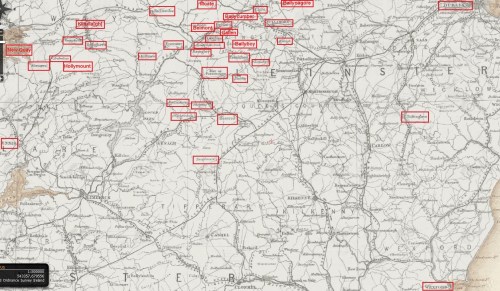
Thomas Berry & Co midland and south routes

Thomas Berry & Co midland and southern destinations (OSI)

The canal runs from Dublin, at the top right, left (roughly west) through Tullamore to Shannon Harbour, where it meets the river; there was an extension to Ballinasloe on the far side of the Shannon. Berrys served places along the canal and several others fairly close to it, but it looks to me as if there were three routes by road beyond that:

  • via Banagher (which has a bridge across the Shannon) to Eyrecourt and Killimor
  • from Ballinasloe to Loughrea and district and then south-west to Ennis in Co Clare
  • perhaps from Tullamore to Birr [Parsonstown], Roscrea (including Shinrone, Cloughjordan and Borrisokane) and Templemore.

There are also two outliers for which I can think of no plausible explanation: Baltinglass and Wexford. Perhaps their inclusion was a mistake. Certainly Berrys, like John M’Cann & Sons on the Royal Canal, seem to have had extensive road networks (perhaps using car-owning subcontractors?) to supplement their water-borne routes, but I don’t see why they would take on a route no part of which could sensibly have been conducted by inland navigation.

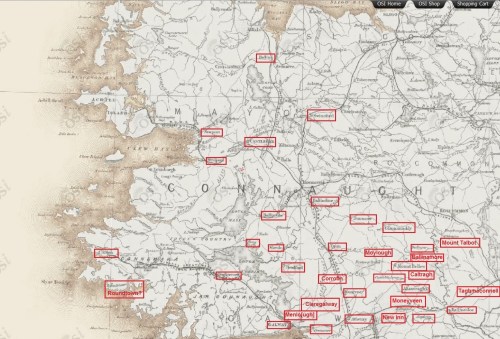
The next map shows the north-western destinations served by Berrys.

Thomas Berry & Co western routes

Thomas Berry & Co north-western destinations (OSI)

You can see that their network covered much of County Roscommon and went almost as far west into County Galway as it was possible to go; it also extended northwards into County Mayo.

I have not attempted to check what industries might have made these towns and villages worth serving. Berrys certainly seemed keen to take as much as possible of the traffic from west of the Shannon towards Dublin — excluding such of it as went by the Royal Canal: it is interesting to compare these maps with that for M’Cann on the Royal.

Finally, note that along the canal itself Berrys listed only destinations towards the western (Shannon Harbour) end: it seems likely that the roads took the valuable traffic from the eastern end into Dublin. There were no doubt turf boats taking fuel in from closer to Dublin, but they were not general carriers.

Other carriers

Now for the rest of the carriers.

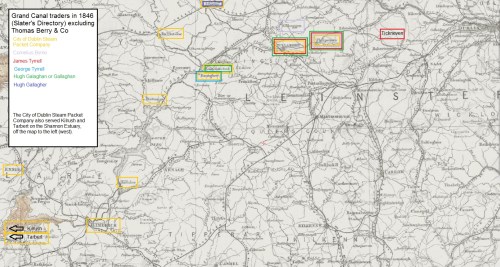
Grand Canal carriers 1846 excl Thomas Berry

Grand Canal carriers 1846 excluding Thomas Berry (OSI)

I have included the Shannon here as well as the Grand Canal; however I have covered the Barrow Line of the Grand Canal, as well as the navigable rivers Barrow, Nore and Suir, in a separate post. Of the carriers listed here, only the City of Dublin Steam Packet Company [CoDSPCo] (which employed horses to pull its boats on canals) ventured on to the Barrow Line, serving Portarlington and Mountmellick.

Berrys and the CoDSPCo were by far the largest firms on the Grand. I don’t know the size of the Berrys fleet, but the CoDSPCo had 52 barges in addition to its Shannon (and Irish Sea) steamers. Note that only on the middle Shannon, around the junction with the Grand Canal, and at Ennis did the two firms serve the same destinations: the CoDSPCo seems to have had the lower Shannon trade to itself.

With one exception, all the carriers, including Berrys, had Dublin depots at Grand Canal Harbour, James St; the Grand Canal Docks at Ringsend, joined to the Liffey, were not mentioned.

The exception is Hugh Gallagher, whose only listed destination was Athlone. It would be interesting to know how he served Athlone: whether by road or by water and, in the latter case, whether he used a steamer. I do wonder whether Hugh Gallagher might be the same person as the Hugh Galaghan (also Gallaghan) who served Philipstown [now Daingean], Tullamore and Shannon Harbour.

George Tyrrell is another who is listed with but a single destination, Banagher, whereas James Tyrrell is listed as serving Tickneven, Philipstown, Tullamore — and Edgeworthstown, which must be a mistake as it is closer to the Royal Canal.

Finally, Cornelius Byrne is shown as serving two destinations: Philipstown and Kilbeggan (which has its own branch off the main line of the canal).

Other information

A little extra information is available from the entries for towns other than Dublin in the Directory:

  • Naas has its own branch from the main line of the canal, but the directory says that “TO DUBLIN, there are Boats, as occasion require, but they have no fixed periods of departure.”
  • Edenderry also has its own branch, short and lock-free, but there is no mention of its being served by trade boats
  • Kilbeggan, with a longer, leakier, lock-free branch, was served by the CoDSPCo’s and Thomas Byrne’s boats travelling to Dublin three times a week. Is this Thomas Byrne related to the Cornelius Byrne mentioned above? It seems that Byrne went only eastward for only the CoDSPCo’s boats went westward (to Shannon Harbour, Ballinasloe and Limerick) two or three times a week
  • at Banagher, Fleetwood Thomas Faulkner of Main Street was the CoDSPCo agent; a downstream steamer left Shannon Harbour after the [passenger] boat from Dublin arrived and called at Banagher’s Bridge Wharf; an upstream steamer from Limerick called every afternoon at 3.00pm and met the night boat travelling to Dublin by the Grand Canal. I presume that this happened on every day except Sunday.

More

As far as I know, little has been written about the carrying companies, especially those of the nineteenth century. I would be glad to hear from anyone who can correct, supplement or comment on this information.

My OSI logo and permit number for website


[i] I Slater’s National Commercial Directory of Ireland: including, in addition to the trades’ lists, alphabetical directories of Dublin, Belfast, Cork and Limerick. To which are added, classified directories of the important English towns of Manchester, Liverpool, Birmingham, Sheffield, Leeds and Bristol; and, in Scotland, those of Glasgow and Paisley. Embellished with a large new map of Ireland, faithfully depicting the lines of railways in operation or in progress, engraved on steel. I Slater, Manchester, 1846

Mad foreigners

The August 2013 issue of Practical Boat Owner has just arrived. It has an article by Dick Everitt called “Mind your head …” in which he talks of dangers to boats from above rather than below: dangers from bridges and from electric power lines. He points out that electricity can jump to a metal mast and says:

So a safe clearance distance is given on the chart with a lightning-type symbol and in some countries a big warning sign is positioned nearby too. But do check local Notices to Mariners as long power cables can sag over time, reducing their official charted clearances.

Aren’t foreigners funny? Imagine having electricity suppliers actually telling boaters about the safe clearance under power cables! That would never happen here ….

I have spent several years trying to get ESB to tell me the safe clearances for cables across the Shannon. I thought I was getting somewhere at one stage but nothing happened. Perhaps ESB would prefer boaters to fry than risk getting sued for getting the clearance wrong.

Bock goes boating …

… on the Shannon Estuary, the second most interesting coast of Clare (the inland coast is the most interesting, the north-west coast the least). Includes nice pics of the Scattery battery.

The Washington gandalow

See here.