Category Archives: Sources

Trade boats

Relatively little has been published about the horse-drawn cargo-carrying trade boats used by the Grand Canal Company in the latter half of the nineteenth century, before it adopted semi-diesel engines. Here is some information and some speculation about the subject, but there is much that is not clear.
A Steam-ship Canal from Kilkenny to Inistiogue

A gentleman has mooted the propriety of forming a steam-ship canal from Kilkenny to the tidal water of Innistiogue,  and he has lodged £400 in the Provincial Bank as a beginning, and as an earnest of his good faith. His name is not given, why we cannot say; but of the fact that the money is actually lodged, we have been assured by the respectable manager of the bank, Andrew M’Kean Esq.

This half anonymous character is to be regretted; and we trust the promoter will not hesitate to announce his name at once, and set the project fairly before the public. Men do business now-a-days with their eyes well open. It is computed that £320000 would be sufficient for the completion of the undertaking. The distance is only thirteen miles. The promoter calls upon eight hundred men in the counties of Kilkenny, Waterford, and Wexford to come forward with £400 each, or else raise the money in £5 shares.

Dublin Evening Packet and Correspondent 27 August 1850 quoting the Kilkenny Journal. From the British Newspaper Archive run by Findmypast Newspaper Archive Limited, in partnership with the British Library.

[NB I have not been able to find any later notice of the development of this proposal. Further information will be welcomed]

The disappointed steamer

For one brief moment it seemed that the humble steamer Ballymurtagh might have a glittering future as a passenger vessel. Alas, it was not to be.

Closing the Grand Canal

The excellent Co Kildare Online Electronic History Journal has a reprint here of a 1959 article about the ending of commercial carrying on the Grand Canal. And putting “canal” in its search engine reveals lots more of interest.

Shannon lake levels

According to the Shannon Catchment-based Flood Risk Assessment and Management (CFRAM) Study Technical Assessment: River Shannon Level Operation Review [PDF: Office of Public Works v2_0 July 2012]

ESB collects and maintains records of rainfall, river and lake levels and flow data. Even though ESB has no responsibility to supply flood warnings under their regulations, it issues twice weekly lake level forecasts to all the relevant stakeholders since 2010.

Those stakeholders include Waterways Ireland.

As the levels of the lakes are of great interest to boat-owners and others, it would be really nice if either the ESB or Waterways Ireland were to publish those forecasts. WI wouldn’t need any elaborate new system: they could send them around as marine notices, and the cost would be minimal.

But perhaps the forecasts are already published somewhere? If, Gentle Reader, you know where they are, do please leave a Comment [preferably with a link] below.

Shannon traffic figures to October 2015

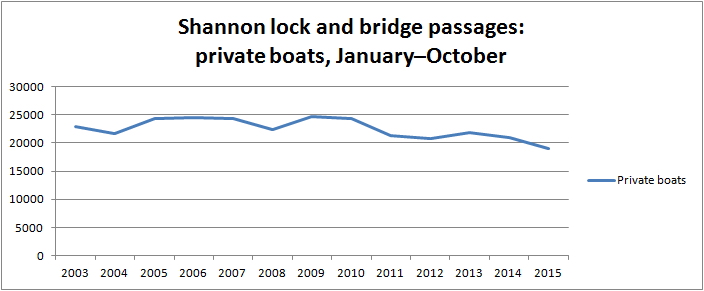
I have not posted charts of Shannon traffic figures for some months now. That was not Waterways Ireland’s fault: it has kindly continued to send the figures to me, but other demands on my time have intervened. However, I have now charted the figures to the end of October 2015, which takes in the bulk of the year’s boating activity. All the usual caveats apply:

  • the underlying figures do not record total waterways usage (even for the Shannon) as, for instance, sailing, fishing or waterskiing on lakes or river stretches, which did not involve a passage through a lock or Portumna Bridge, would not be recorded
  • the passage records would not show, for instance, a change in the balance of types of activities from those in larger cruising boats to those in smaller (sailing, fishing, waterskiing) boats
  • figures like these will not necessarily be representative of those for the year as a whole.

On the other hand, the figures do include the Shannon’s most significant tourism activity, the cruiser hire business. And they are our only consistent long-term indicator of usage of the inland waterways.

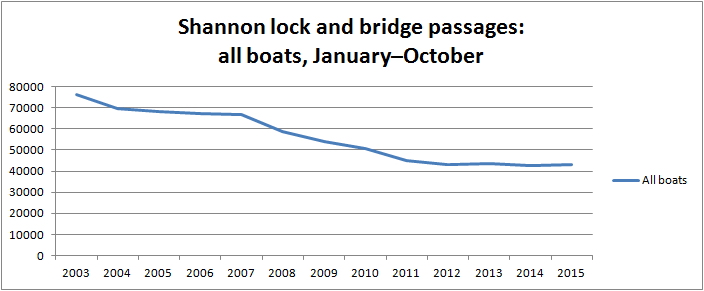
There has been a very slight increase in total traffic, although it might be better to regard the figures as confirming that traffic has stabilised at the new, lower level established around 2011.

Shannon JanOct all boats

All boats. The slight increase in total traffic seen up to May has continued to October

I commented on the May figures:

The big news is that there is an increase in the amount of hire-boat traffic and a decrease in the amount of private traffic. [Personal observation suggests very little activity on Lough Derg, apart from the sailing bods.]

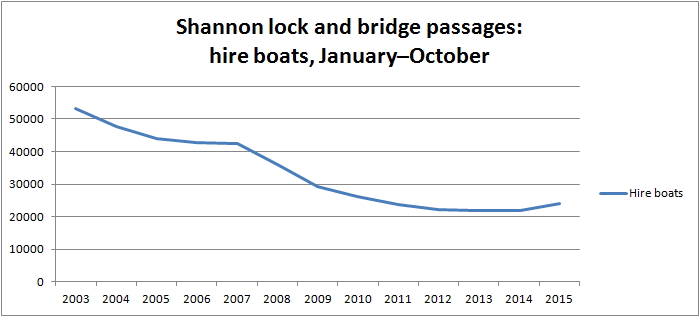
Again, that trend has continued. Hire-boat traffic is up …

Shannon JanOct hired

Hire-boat traffic is up

… and private-boat traffic is down.

Shannon JanOct private

Private-boat traffic is down

Perhaps the private boats were afraid to move from the new berths in Killaloe where they wanted to spend the winter at Waterways Ireland’s ridiculously low rates. Is this some delayed effect of the death of the Celtic tiger? Or was it the weather? Neither hire nor private figures changed hugely, but change they nonetheless did.

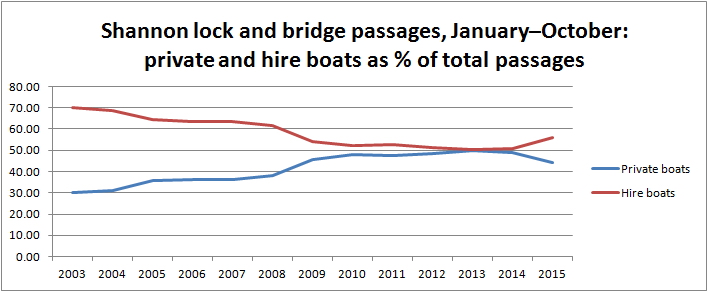
Shannon JanOct private -v- hired

After a brief period when it seemed that private traffic was overtaking hired, the hire-boats are in the lead again

Of course hire-boat traffic fell much further from its 2003 figure: it dropped to 40% and is still not much higher, whereas private traffic is still more than 80% of its 2003 figure.

Shannon JanOct v2003

Change (private and hired) since 2003

It would be nice to have data on other forms of waterways usage.


Monitoring water levels

Several organisations maintain sensors that detect water levels; some of them publish their readings on tinterweb.

The Office of Public Works, for example, shows real-time water levels here; this page shows the changes at Banagher over the past thirty-five days. It may be that the ESB’s run-off of water at Parteen Villa Weir has been having some effect.

The Environmental Protection Agency has a list of monitoring stations but you have to swear not to burn down the queen’s dockyards, insult the president or sell your granny before you’re allowed to look at it. When you’ve done that, you can view Hydronet data, but you have to choose your River Basin District first. If you choose the Shannon RBD, you get a list of stations — none of them on the Shannon itself — arranged in no comprehensible order, so you’re on your own after that. Here’s the one at Tyone on the Nenagh River by way of example.

Finally, Waterways Ireland has information here. The page takes quite a while to load. It covers only the waterways for which the body is responsible and information about the current water level (as compared with MSL Malin) is of limited use unless you’ve been monitoring it for some time. And, alas, there is no information on anywhere on the Shannon south of Meelick (Victoria) Weir, presumably because Waterways Ireland can’t control anything south of that.

Who can? The ESB, and I suspect they must have gauges at, say, Killaloe, but if they do I can’t find the readings published anywhere. It would be a boon and a blessing to men if ESB were to publish its information.

There is one other source of information that might help: there are some webcams on Irish rivers. Farsons have several, though none on the Shannon, and at the moment I can’t get any of the Irish ones to work for me.


Why the Shannon floods

From the search terms used, it seems that many people are visiting this site with questions about Parteen Villa Weir, water levels, Shannon floods and so on. They are not this site’s primary focus, but some non-technical information might be of interest.

The best place to start is with this quotation from a former web page of the Shannon International River Basin District:

The Shannon International River Basin District is the largest in Ireland at more than 18,000 km2 in area. It covers the natural drainage basin of the Shannon river itself, stretching from the source of the River Shannon in the Cuilcagh mountains in Counties Cavan and Fermanagh to the tip of the Dingle peninsula in north Kerry. It also includes coastal parts of Kerry and Clare which drain to the sea. It flows through 18 local authority areas and is also an international RBD as a small portion of County Fermanagh in Northern Ireland drains underground to the Shannon Pot.

The district is about one fifth of the area of the island, one quarter the area of the state. Rain that falls on that area of land ends up in the Shannon (or in a few small rivers in Clare and Kerry that flow to the sea). Some goes to the Shannon estuary or its tributaries; most flows into the non-tidal Shannon, which means the river upstream of Limerick.

The nature of the Shannon

Ireland has been described as saucer-like, with a high rim and a low flat centre. It’s not entirely true, but there certainly is a very large central plain, and the Shannon flows down through the middle of that. And, because the land it flows through is flat, the river falls very little.

In 113 miles from Leitrim to Killaloe, the Shannon falls just over 30 feet; the navigation channel needs only five locks. [By way of contrast, the Thames has 45 locks over 135 miles; the Trent has 12 locks over 42 miles.] So extra rainwater allows the Shannon to spread out, covering a much wider area, and it takes time for that water to drain away downstream. But many of the rivers that flow into the Shannon have been subjected to drainage schemes, so they can get rid of their flood waters quickly … into the Shannon.

Why don’t they open [or close] the weirs?

There are some weirs on the Shannon, designed to keep a minimum depth in the river for navigation; there are also some natural obstacles that hold water back. But once the level has risen high enough, water simply flows over the top of the weir, and there is nothing useful anybody can do — apart, of course, from farmers’ representatives and politicians, who can always make use of a photo opportunity.

The bottleneck

Almost all the water that enters the non-tidal Shannon will eventually flow through Killaloe, the town at the southern end of Lough Derg [it’s on the west bank, in Co Clare; the east bank is Ballina, in Co Tipperary].

As James Robinson Kilroe wrote in 1907,

[…] we have the formidable barrier at Killaloe, naturally damming up a considerable depth of water in Lough Derg, and the river falling away southward by a series of rapids which correspond with drops in the canal, south of O’Briensbridge […], along an alternative course, possibly one used by a branch of the Shannon.

The diagrams with that article are worth a look.

In the twelve Irish (fifteen statute) miles between Killaloe and the tidewater at Limerick, the river falls about 100 feet: more than three times its fall from Leitrim to Killaloe. In the nineteenth century, the water level at Killaloe used to change by about eleven feet between summer and winter — even without storms.  The old Limerick Navigation, including the canal Kilroe mentioned, could drain only a small amount of water (which could put the navigation out of action); the rest went down the river’s original course through the Falls of Doonass.

The relief channel

Nowadays, the Falls of Doonass are a shadow of their former selves, and the water level through O’Briensbridge, Castleconnell and Plassey is much below its previous levels. I suspect that the older, larger trees along the river show the original level, with the newer, smaller trees having grown since the 1920s.

The cause was the construction of a relief drainage channel in the 1920s. This channel is controlled by a weir at Parteen Villa [not to be confused with Parteen].

Actually, of course, it’s not a relief drainage channel. The weir [sometimes referred to as the Hydro Dam] controls the flow of water to the original course of the Shannon [the right-hand or eastern channel, which gets the first 10 cubic metres of water per second] and the headrace for the hydroelectric power station at Ardnacrusha [the left-hand or western channel, which gets the next 400 cubic metres of water per second, 100 for each of its turbines]. The power station was built to use that 100-foot fall of the Shannon, concentrated between Killaloe and Limerick, to generate electricity.

But one effect of the construction of Ardnacrusha was to provide a channel, the power station headrace, capable of taking [at least] 400 cubic metres of water per second away from the original river channel, thus reducing the likelihood of flooding.

Cumec

Water experts talk about cumecs: a cumec is a flow of one cubic metre, or 1000 litres, of water per second. And a cubic metre of water weighs about one [metric] tonne, which is roughly the same as an imperial ton. So one cumec is one ton of water per second, which is a lot.

It was said, on 8 December 2015, that the ESB, using Parteen Villa Weir, had released 315 cumec down the original course of the Shannon on the previous day and had increased that to 375 cumec. If the Ardnacrusha headrace was getting 400 cumec, then the amount of water being discharged from Lough Derg and the upper Shannon had doubled.

Floods

As far as I can see, the Shannon has always flooded. The 2009 floods affected some nineteenth century houses, which I guess would have been flooded even worse before Ardnacrusha was constructed. However, I suspect that more houses have been built on the flood plain since then. But I don’t see that there is any way to prevent Shannon floods.

Envoi

There is a good article in the Irish Times of 9 December 2015; it will no doubt disappear behind a paywall at some stage.

Here is an ESB infographic about the Shannon.

How true these words are …

… even today:

The swivel bridges at Portumna and Banagher seem to have been badly situated with regard to the passage of vessels, both being placed in the concave bend of the river which makes it difficult, in blowing weather, and going down stream, to shoot the bridge safely.

From the BNA

That is from the Clare Journal, and Ennis Advertiser of 12 September 1850. The swivel bridges of yesterday are the navigation arches of today. The deficiencies of the Shannon Commissioners’ work were evident as soon as they had completed it.

However, although the article from which the sentence was taken is a condemnation of the Shannon Commissioners, the Journal was mistaken in blaming them for Portumna: that bridge was not built by the Shannon Commissioners.

The sinking of the Longford 4 and 5

Here are the fourth and fifth pages [I split one long page] in the sequence of articles about the sinking of the passage boat Longford on the Royal Canal in 1845. They discuss some of the evidence of corporate incompetence and farcical laxity that may have persuaded the inquest jury to award a deodand against the vessel (and thus against the Royal Canal Company).

Amongst other gems, the footnotes explain what a crapper is.