
Category Archives: Sources

The sinking of the Longford 2

Here is the second page of the saga. This one gives background information about the passage boat service, the boats and the crew of the Longford. The shock-horror stuff will be in later pages.
The sinking of the Longford 1

Here is the first of several articles about the sinking of the Royal Canal passage-boat Longford on 25 November 1845.

Royal Canal November

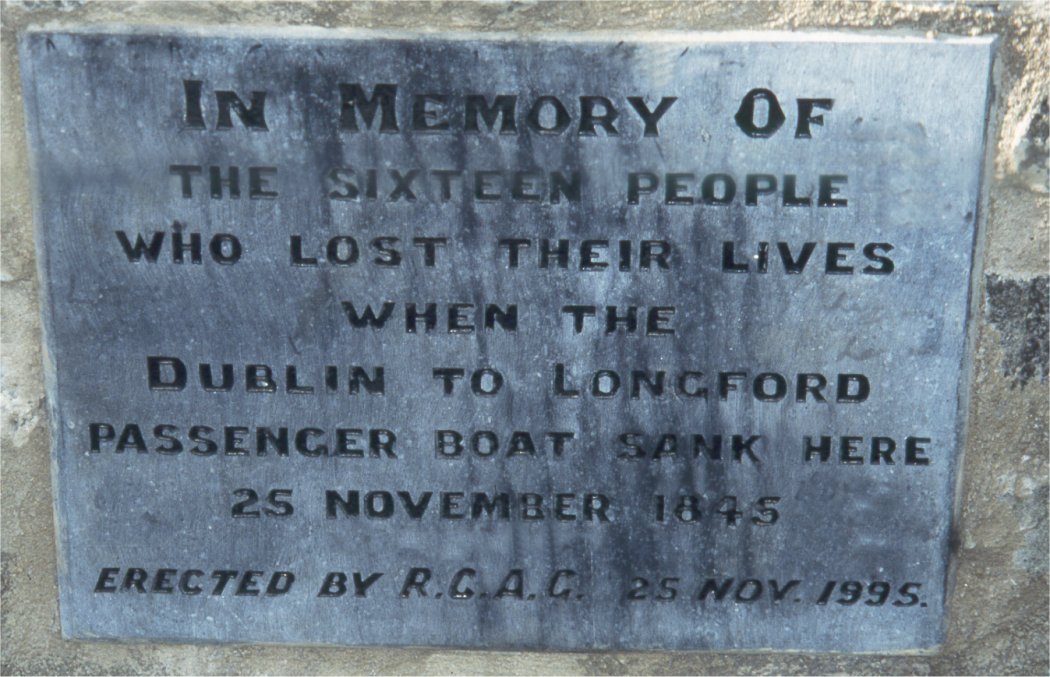
I said here that I did not know whether there was a plaque to commemorate the drowning of fifteen people on the Royal Canal in 1845. I am grateful to both Ewan Duffy and Niall Galway for telling me that there is a plaque and for sending photos of it. Ewan’s, which I show below, was taken in 1997.

Porterstown Plaque

The plaque in 1997 (copyright industrialheritageireland.info)

Niall has sent on a message from the Royal Canal Amenity Group chairman:

A Mass in memory of the 16 people who lost their lives on 25 November 1845, when a passenger boat sank on the Royal Canal at Clonsilla, will be
held in St Mochta’s Church, Porterstown Road, at 10.00 am on Friday next 27 November 2015. After the mass you are invited to Porterstown (Kennan) bridge to lay a wreath and afterwards to the Clonsilla Inn for a tea/coffee.

I know that Ruth Delany gives the figure of 16 deaths, but all the newspaper reports that I have read say that 15 people died: 7 men, 6 women and 2 children, all from the second-class cabin.

Addendum 23 November 2015: I have now read some more newspaper reports and I think the discrepancy arises because early press reports of the accident itself, notably that carried in the Freeman’s Journal, said that sixteen people had died, but reports of the inquest gave the number as fifteen. The pre-inquest reports were inaccurate in other respects too: the total numbers of passengers were wrong and the chain of events that led to the accident was not properly described.


Remember, remember the twenty-fifth of November

25 November 2015 will be the 170th anniversary of the sinking of the Royal Canal passage-boat Longford and the deaths of fifteen people.

This was not (pace Ruth Delany in Ireland’s Royal Canal 1789–2009 Lilliput Press, Dublin 2010) “the worst accident ever to happen on the Irish waterways”: that melancholy distinction belongs to the drowning at Carrick-on-Suir of about 111 people in 1799 [see “The cries at the bridge” on this page], while the second-worst was the drowning of twenty people on Lough Corrib in 1828, the event commemorated by Antoine Ó Raifteiri in his poem Eanach Dhúin.

But the 1845 accident, between Porterstown and Clonsilla Bridges, was the worst to occur on an Irish canal. Evidence at the inquest and subsequent trial suggests great laxity in the management of the Royal Canal Company’s affairs, even if the immediate cause was an act of insane irresponsibility on the part of the boat’s temporary steerer.

I do not know whether any plaque or other artefact commemorates the event.

Aw sheughs

On 6 November 2015 there was a meeting of the Inland Waterways flavour of the North South Ministerial Council, whereat the Minister for Fairytales (RoI) and the Minister for Marching Bands (NI), each with a sidekick, discussed waterways matters. The joint communiqué, artfully written to provide outsiders with as little information as possible, is available here [PDF], but here’s a summary:

  • WI’s “capital expenditure focused on infrastructure repairs”, presumably because it has no money for any improvements or extensions, except a bit of dredging in or near the constituency of the Minister for Fairytales
  • yes, that means the River Finn, Saunderson’s Sheugh, which we’re pretending is or was part of the Clones Sheugh or Ulster Canal
  • WI has managed to get “third party funding” of over €1 million for waterside developments, which is good: much better than transferring WI money to other bodies. WI is trying to nab euroloot but, as there were no announcements of success, we must assume that this is work in progress. Mind you, the ministers would probably claim the success (and the photoshoots) anyway
  • WI may sell some unspecified property
  • the important one:

LEGACY SCALE LINKAGES FOR NORTHERN BASED WATERWAYS IRELAND STAFF

The Council approved the determination made by Waterways Ireland regarding legacy scale linkages for northern based staff.

I knew you’d want to know about that. Whatever it means.

On 17 November 2015 the latest attempt to get the boys and girls of the Northern Ireland Assembly to be nice to other reached some sort of conclusion, which you can read about in the Irish Times (until it disappears behind a paywall) and the Manchester Guardian. But of course the important question is whether we southron loons have to buy sweeties (sheugher candies) for our northern brethren to persuade them to be polite. For that, gentle reader, you must turn to the inspiringly-titled A fresh start — the Stormont Agreement and implementation plan, available here [PDF].

You will not, of course, want to bother reading most of it, so we can skip straight to Section E Irish Government Financial Support on page 30. New readers may wish to know that, many NI disagreements ago, the Irish government, led at the time by a group of leprechauns who believed they possessed a pot of gold, resolved to impress the poor benighted northerners with a display of southern wealth and power. Accordingly, it promised to pay for all sorts of transport infrastructure, provided that it could be claimed to have some sort of cross-borderality and preferably looked iconic. Whether there was any point to any of the schemes was a matter omitted from consideration.

The three main proposals, IIRC, were

  • the A5, a road in Northern Ireland
  • the Narrow Water Bridge, which would cross the Newry River in the middle of nowhere (whereas a south-eastern bypass of Newry might actually be useful). And it would have an opening span for the many vessels that visit Newry by the Ship Canal
  • the Clones Sheugh, a short section of the Ulster Canal.

Unfortunately the hardheaded northerners have long memories and they keep looking for their three sweeties long after the Free State realised that it couldn’t afford them. So has this latest throwing of their toys out of the pram forced the Free Staters to give in and buy them the A5, the iconic bridge and the Clones Sheugh?

Up to a point, Lord Copper.

The Irish government says it’s all in favour of, er, “investing” in infrastructure “to support North-South co-operation to help unlock the full potential of the island economy”, where no doubt eighteenth century transport methods will prove to as important as they were in the time of Grattan’s Parliament. But with that, and all the other waffle and irrelevancies shoved in at the start of the section, it is clear that the Irish government is trying to big up a small contribution. It drags in the European Union, the Dublin to Belfast railway, flood relief, energy, communications and health, which have nothing to do with the case, but which between them fill almost the whole of the first page.

From there, though, it has to get specific, or at least look as if it’s doing so. Accordingly, each of the three white elephants gets a subsection to itself, with numbered paragraphs, from which we learn that:

  • the Free State government “remains supportive of the commitment under the St Andrews Agreement” to co-fund the A5. It’s going to pay more (I think): £25 million a year in the years 2017–2019, up from a total of £50 million
  • the Free State government “remains committed to the concept of the Narrow Water Bridge”, which has “potential to provide jobs” [how?]; it will review the plans with the NI Executive and think about it by June 2016. It says nothing about the disappearance of funding
  • the Free State government does not say that it “remains supportive of the commitment under the St Andrews Agreement” to fund the Clones Sheugh. Nor does it say that it “remains committed to the concept”. What it does say about the sheugh is that it is funding Saunderson’s Sheugh (see above), it will think about more cross-border greenways and blueways including the Ulster Canal and it and the NI Exec will identify “options for jointly developing future phases of the Ulster Canal restoration project”, which I take to mean that the southron taxpayer won’t be stuck with the entire bill. Oh, and it’s going to think about funding a bleeding sail training vessel, another exercise in pointlessness and nitwittery.

That’s almost it: there is something about a north-west thingie, senior officials will meet and there will be progress reports.

These documents are not necessarily constructed to provide information to outsiders, but my sense is that the Clones Sheugh danger to the southron taxpayer has receded for the moment, although the Narrow Water Bridge and the sail-training nitwittwery need to be blown out of the water (or into it). The A5 road is to go ahead: I don’t know much about it but it might be the least objectionable of the lot.


Placing Percy

Back in May 2013, I wondered whether 53 Percy Place, Dublin 4, which Waterways Ireland was being forced to sell to dig the Clones Sheugh, would still be on its hands in a year or two. And so it was, but in August 2015, I noted that the property was for sale to fund Saunderson’s Sheugh, which we’re all pretending is the Clones Sheugh (aka the Ulster Canal).

The interesting point was that Messrs CBRE wanted over €1.6 million for the site, which was the valuation put upon it in 2008. The 2012 valuation was €650,000 and the 2013 €800,000. I wrote:

On the basis of its asking price for Percy Place, WI seems to believe that the property collapse is over; perhaps it is even now in negotiation to develop Plot 8 and build a sheugh all the way to Clones. In the meantime, if it gets €1.6 million for Percy Place, that will help to alleviate the damage caused by the smash-and-grab raid carried out by the Department of Fairytales to pay for Saunderson’s Sheugh.

Well, it seems that the boom is back. According to the respectable people’s Sunday newspaper, the Sunday Business Post, of 18 October 2015, WI got over €2 million for the site. The SBP is paywalled and I can’t find online confirmation elsewhere, but it’s a high price.

I did note on the CBRE site that the Twelfth Lock Hotel, that haunt of Stakhanovite homoeroticism on the Royal Canal in Blanchardstown, is for sale again. I haven’t been there for some years, so I don’t know whether the mural is still extant.


Swimming in the Naller

On 22 September 2015 Eric Byrne [Labour, Dublin South Central] put a written question to the Minister for Fairytales:

To ask the Minister for Arts, Heritage and the Gaeltacht her plans to review the no swimming in locks and harbours under the by-law within the Canals Act by-laws of 1988 in view of the fact that there is no penalty for ignoring such signs; and if she will make a statement on the matter.

The minister replied:

I have been informed by Waterways Ireland that while it has not determined a need for an associated penalty with this by-law at this time, the matter is being kept under review. I am advised also that the locks, docks and harbours are manned and/or frequently visited by Waterways Ireland Operations and Inspectorate Authorised Officers. Where swimmers are encountered, they are made aware of the by-law provision and the dangers of swimming in or near canal infrastructure and they are requested to remove themselves from the navigation. Such requests are normally acceded to. In the event of persistent offender(s) unwilling to obey direction from Waterways Ireland Authorised Officers, the assistance of An Garda Síochána is sought to remedy the situation.

Sometimes I wonder whether politicians have any grasp on reality. Swimmers in the Naller are a force of nature and are as far beyond the control of Waterways Ireland, the police and indeed politicians as hurricanes, the economy or Mick Wallace. People have been swimming in the canals, in Dublin and no doubt elsewhere, for generations, and nothing or nobody has been able to stop them.

I suspect that more people have swum in the canals than have ever boated on them; swimming is therefore a legitimate topic for waterways studies. Here is a preliminary contribution to the field.

WI and the RoI budget for 2016

Budget documents [available here] include the Part IV Estimates for Public Services 2016 [PDF]. The Summary of Gross Expenditure (Capital and Current) by Ministerial Vote Group shows that the Department of Fairytales [aka Arts, Heritage and the Gaeltacht], RoI parent of Waterways Ireland, is to get an increase in its budget.

Its forecast outturn for 2015 matches its estimate for the year at €277,434,000, of which €215,854,000 is current and €61,580,000 is capital spending. However, the estimates for 2016 show €234,430,000 current + €76,000,000 capital = €310,430,000 total, an increase of €32,996,000. Current spending is up 8.6% and capital by 23.4%; total spending is up by 11.9%. Perhaps the extra €14,420,000 in capital spending is to extend Saunderson’s Sheugh to Clones?

Skipping the numerous tables that repeat more or less the same gen in different ways, and skipping too the unimportant government departments, we zoom forward to the details of the Department of Fairytales estimates.

But there we find, alas, that while the department as a whole has secured lots of extra lolly — and it’s going to be shovelling 18% more to the luvvies [Arts, Culture and Film], 11% more to heritage and 3% more to the BéalBochters — it intends to cut spending on North-South Cooperation, which is where Waterways Ireland gets its money.

The 2015 estimate for NSCoop current expenditure was €35,072,000; the 2016 estimate is €34,925,000, which is a cut of only about half of one per cent. But capital spending on NSCoop is down almost 20%, from €3,487,000 to €2,799,000, and total spending down 2% from €38,559,000 to €37,724,000.

The NSCoop figures are “subject to the North-South Ministerial Council”, which means that the (southern, Fine Gael) Minister for Fairytales has to persuade the (northern, Sinn Féin) Minister for Marching Bands that the cross-border language and waterways bodies aren’t getting any increase in their funding from the Free State, at least not while there is an election to be won. However, HM Devolved Administration didn’t seem too keen on allocating extra money to waterways last time I looked.

Regular readers will not need to be reminded that 85% of WI’s current budget is supplied by the RoI government and 15% by the NI administration, while capital expenditure is paid for by the state in which it occurs.

The estimates figures as shown don’t tell us the precise impact on Waterways Ireland’s current budget: the money is divided between WI and the language shamrock but the document doesn’t tell us which gets how much. [The last time a breakdown was given was in 2011, when WI got roughly 60% of the total.] However, most of the department’s NSCoop capital expenditure is undertaken by WI, and little or none of it by the language shamrock, so we can say that the 20% cut in NSCoop capital spending means a 20% cut in capital spending on waterways in the Free State.

The breakdown of the Multi-Annual Capital Investment Framework confirms that: in 2015 €3,368,000 of the €3,487,000 NSCoop capital budget (96.5%) went to WI, and in 2016 WI will get €2,680,000 of the €2,799,000 NSCoop capital budget (95.7%). I imagine that the language folk prefer sitting i dtóin an tí and don’t want fancy buildings.

WI’s capital budget for RoI is down from €11,000,000 in 2008.

According to the Multi-Annual Capital Investment Framework 2016 to 2021 (Table 1), the Department of Fairytales as a whole is getting an unusually large amount, €76,000,000, of Exchequer Capital Funding in 2016; the total is to fall back to €45 million in 2017 and €43 million in 2018, before rising to €46 million in each of the years 2018, 2020 and 2021. So, in a year in which the department is getting much more money for capital spending, NSCoop and, specifically, waterways are getting significantly less.

Looking at the breakdown (Table 2), it seems that the big changes in the department’s capital spending are:

  • a major cut in the grant-in-aid to the Crawford Gallery (€12,100,000 to €6,100,000)
  • cuts of €1,312,000 to the National Parks and Wildlife Service and €1,000,000 to Údarás na Gaeltachta
  • a cut of €688,000 to WI
  • an extra €1,150,000 for Teach an Phiarsaigh under the Decade of Centenaries heading
  • a new thing called Built Heritage Jobs Leverage Scheme gets €2,000,000
  • another new thing called Cork Event Centre gets €5,000,000
  • and, the biggest of the lot, Decade of Centenaries 1912–1922 gets an extra €15,270,000, to bring its capital budget to €28,800,000, by far the largest item in the budget.

There are a few other minor changes, but the increased allocation of €15,270,000 to the main Decade of Centenaries item has more than swallowed the extra €14,420,000 allocated to the department. Three other significant items — Teach an Phiarsaigh, the Cork Event Centre and the Built Heritage Jobs Leverage Scheme, which between them have been given an extra €8,150,000 — have been funded by the reduced allocations to the Crawford Gallery, the National Parks and Wildlife Service, Údarás na Gaeltachta and Waterways Ireland.

So there’s no money for Sinn Féin’s beloved Clones Sheugh.

Tidal passage boats on the Suir

So late as the year 1807 the mail bags between Waterford and Clonmel were carried in a common cart and there was no public mode of conveyance between Carrick-on-Suir and Waterford but passage boats, the chief of which is well remembered as Tom Morrissey’s boat. These dropped from one town to the other as the tide served, fare fourpence a head, distance twelve miles, time occupied seven hours.

George Lewis Smyth Ireland: Historical and Statistical Vol II Whittaker and Co, London 1847, Chapter 14

Ballinasloe again

Another account, this dated 1838, of a trip by Grand Canal Company passage-boat from Dublin to Ballinasloe.