
Category Archives: Steamers

Photographing the invisible

Waterways Ireland is having a photographic competition for which it is

seeking contributions from the public on what they think best fulfils the theme “Waterways Heritage”.

Details here. You can win an iPad Air, which I think is a sort of pocket calculator for chaps with ponytails.

I was in two minds about whether to publicise this competition. You see, many of the bits of “heritage” I’m interested in are invisible, having vanished since the late nineteenth century. So maybe they’re not heritage at all?

But I decided that it would probably be difficult for Waterways Ireland to judge a competition in which all the photographs were of invisible objects, so I should encourage the photographing of the visible.

I was asked recently by another respectable public sector body to say, for publication, why industrial heritage was important to me. Unfortunately my response was deemed to be unusable, because it was too controversial. I’ll write more about that soon.

River Suir

My spies tell me that the RTE television programme Nationwide, to be broadcast on Wednesday 13 May 2015 at 7.00pm, will include some material about the River Suir and perhaps some footage of a former tug-barge, the Knocknagow, that plied thereon.

Riverfest in Limerick

Riverfest is an annual, er, happening in Limerick. I don’t know much about it: I’ve never been because I dislike both crowds and festivals and it would take something remarkably interesting to outweigh my dislike and persuade me to attend any part of the thing. I took notice of this year’s event only because I wanted to find out what streets would be closed to traffic; the festival organisers did not, alas, think to provide a map showing the closures.

I have only two other comments on the event:

  • the brochure [PDF] mentions a workshop called “Craft a River” but doesn’t say what, or indeed where, it is
  • in a city whose history is so intertwined with that of the food industry, and which has, in the Milk Market, the best Irish market outside Cork, it seems ludicrous to import a “continental market” instead of showcasing local producers.

But I acknowledge that I am not really entitled to comment; Brian Leddin, on the other hand, has a better informed view.

Interesting information about the Ulster Canal …

… as distinct from ministerial reelection photo opportunities.

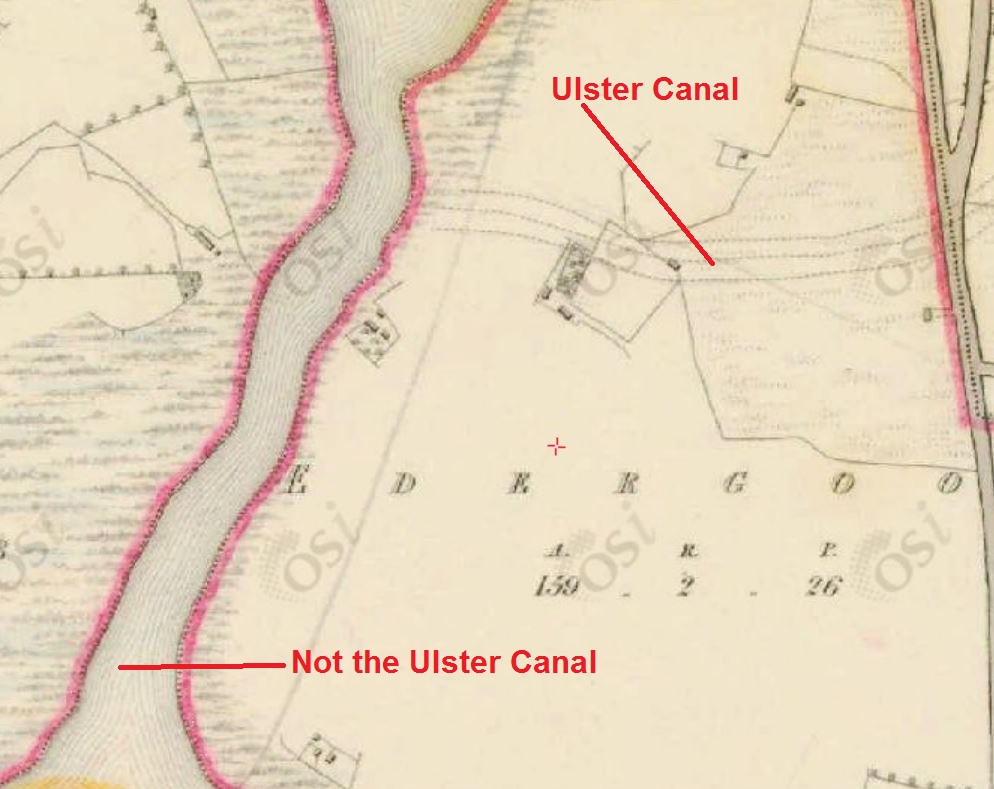
By the way, some folk get confused about the location of the Ulster Canal; this map may help:

Saunderson's Sheugh -v- the Ulster Canal (OSI ~1840)

Saunderson’s Sheugh -v- the Ulster Canal (OSI ~1840)

Anyway, for folk who are interested in weightier matters than ministers talking through portions of their anatomies that they can’t distinguish from their elbows, here is some speculation about opening bridges on the Ulster Canal.

That’s the Ulster Canal Ulster Canal, not the Saunderson’s Sheugh “Ulster Canal”, by the way.

My OSI logo and permit number for website


Waterside Belturbet

Here is a small amount of information about Belturbet and some of its industrial heritage. The photos were taken on a brief visit in July 2011.

Limerick flooded again

The waves covered the quays in some places to a depth of three and four feet, and rolled in to the adjoining streets with resistless fury. Shannon-street, Charlotte’s Quay, and the Mall were completely inundated, and in the corn stores on Honan’s-quay, Harvey’s quay, &c, the water reached a height of four feet in some instances.

I already had a page about the floods in Limerick in November 2009; here is an account of the floods in Limerick in 1850.

Shannon history

Folk interested in the history of the Shannon Navigation, and in particular in the work of the Shannon Commissioners in the 1840s, may like to get hold of an article “Steam, the Shannon and the Great British breakfast”, published in the Journal of the Railway & Canal Historical Society Vol 38 Part 4 No 222 March 2015.

Canals conference 7 March 2015

Information posted at the request of the organisers


Inland Navigations of Ireland Historical Society
in partnership with
The Heritage Boat Association

The Canals of Ireland

Saturday 7 March 2015

Hugh Lynch’s Function Room, Tullamore, Co Offaly

Programme

Memorial Slides Conor Nolan 09.30
Welcome Gerard Bayly 09.55
Session 1 Chairperson Judie Lambert
The Canals of Europe Mike & Rosaleen Miller 10.00
The Canals of Ireland Colin Becker 10.20
Coffee break 10.40
Saving the Royal Niall Galway 11.00
Fighting for the Grand Mick Kinahan 11.20
Living on a Canal Eric Kemp 11.40
Morning Question Time 12.00
Lunch break 12.30
Session 2 Chairperson Kristina Baker Kenny
Newry Canal Geraldine Foley 13.30
Limerick Navigation Raymie O’Halloran 13.50
John’s River Brian Simpson 14.10
Grand Canal Kilbeggan Branch James Scully 14.30
Boyne Navigation Seamus Costello 14.50
Coffee break 15.10
The Future Joe Treacy 15.25
The Future Brian J Goggin 15.45
The Future Nigel Russell 16.05
Evening Question Time 16.25


Details

Admission:                          €12
Breaks:                                Tea/coffee included
Lunch in room:                   Soup and sandwiches included
Music:                                 Live music session during lunch
HBA:                                   Merchandise for sale
IWAI:                                  Merchandise for sale
Authors:                              Books for sale

Directions

Hugh Lynch’s Pub, Kilbride Street, Tullamore, Co. Offaly

087 250 5422


The Corrib dredger

Drainage and Navigation Works: Construction of dredging machinery

The Commissioners having authorized the purchase of one of the iron dredgers used in the execution of the Shannon works, and then on that river at Athlone, the operation of removing her to Galway was commenced on 1st of March.

This was effected by first clearing her of all machinery, and then cutting up the hull or shell into pieces suited for carriage by land, in which manner every portion of her was removed to Galway.

In reconstructing this boat, considerable improvement and thorough repairs have been effected. A flat iron plate, three-fourths of an inch thick, has been substituted for the hollow iron keel, which lightens her draft of water five inches without any diminution of her steadiness, and an alteration of the position of the steam-pipes has been judiciously arranged. The keelsons were pieced, and whenever any materials were unsound they have been replaced.

The time occupied in the breaking up, transfer, and reconstruction of this dreder, weighing 200 tons, was five months and eleven days, and the whole work was executed at a cost of £803/8/11.

Four scows or decked barges have been constructed for the conveyance of the material raised by the dredger to spoil. Two of these boats are capable of carrying 30 tons, and the other two 45 tons.

Extract from the Annual Report of Mr S U Roberts CE, District Engineer for the year 1851 in Twentieth Report of the Commissioners of Public Works 1852

Killaloe Regatta

If you enjoyed the account of the 1851 cot race at Plassey, you might also like to read about the 1850 regatta at Killaloe.