Category Archives: Water sports activities

Three drowned on Lough Neagh

Most distressing accident on Lough Neagh — three young gentlemen drowned

It is with painful regret we have to announce a very afflicting calamity that occurred on Lough Neagh, on Friday, by which Mr Alexander Charters, son of our esteemed townsman, Mr John Charters, Mr Henry Nelson, son of Mr James Nelson, Ballinderry, and Mr Allen Bell, Glenavy-water-foot, have been consigned to an early grave.

They had that day gone on the lake on a pleasure excursion; and between three and four o’clock in the afternoon, when rounding Ram’s Island, the yacht in which they were capsized in a sudden and violent squall and sunk, when the three young men perished. Several persons on the shore witnessed the occurrence, but at the distance, and the wind blowing an unusually stiff gale from the north, no assistance could be afforded.

All the bodies have been recovered. Mr Alexander Charters, whose untimely death it is thus our melancholy duty to record, had been on a visit to his uncle, who resides near the shore of the lake.

The Dublin Monitor 3 May 1844, quoting the Northern Whig

Two men drowned on Lough Derg

A melancholy loss of life took place on the river Shannon, within five miles of Nenagh. Master Edmond Bourke (eldest son of John Bourke, of Tintrim, Esq, JP) in company with two men named Fahy and Conway, was on an excursion of pleasure in his father’s yacht. On entering Lough Derg with swelling sails a sudden squall bowed the vessel on her side and dipped the sails beneatht he surface of the water. The yacht recovered her upright posture, but being so full of water she went down gradually until completely hidden from view. The two boatmen perished, but Master Bourke clung to an oar and struggled with his fate. He was picked up in the last stage of exhaustion by some persons who had witnessed the melancholy scene from the shore, and had put out a boat to his assistance.

The Dublin Monitor 8 July 1841 quoting the Limerick Chronicle


The agency model

I have been told that, until recent years, travel agents in Germany and elsewhere would buy packages of weeks on Irish hire-boatsa and then sell them on to their own clients. I have also been told that this “agency model” ceased to be used [or became less used], perhaps because of the growth of internet booking. And it has been suggested that this was one of the factors in the decline of the Shannon hire-boat trade, to which I have repeatedly drawn attention [most recently here].

I do not know whether this phenomenon has been documented or formally studied. If it has, I would be grateful if any reader can point me to the documents or studies. I would also welcome other Comments on the proposition.

Packaging and marketing

I mention it now because, when launching the Shannon Blueway project, the waterways minister Heather Humphreys said:

The launch of the Blueway will allow local businesses [to] capitalise on an increase in demand for transport, equipment hire, accommodation and entertainment.

I think that the Blueway is an excellent idea, but I am concerned about whether small local companies will be able to package and market it effectively to overseas tourists. If the long-established cruiser-hire-firms were or are finding effective marketing difficult, why would (say) a canoe- or bicycle-hire-firm in Drumshanbo find it any easier?

Marketing to anglers

There was an interesting discussion at the Joint Oireachtas Committee on Transport and Communications about “Depletion of Inland Fish Stocks and Impact of Estuary Poaching: Inland Fisheries Ireland” on 22 October 2014. Note in particular the contributions of Dr Ciaran Byrne from 10:25 onwards about how Inland Fisheries Ireland markets Irish angling to overseas anglers.

What struck me was not that IFI uses any particularly magical marketing methods but that it is dealing with a well-defined interest group: people who are committed to a particular activity and have invested heavily in it (buying rods and stools and nets and umbrellas and maggots and whatever else anglers use).

Identifying potential customers

Anglers form one segment of the market for inland waterways holidays, but the task of selling to other segments is harder if they lack a single compelling interest. Hence, no doubt, those rather demented attempts by Fáilte Ireland or Tourism Ireland to categorise potential customers as ‘Sightseers and Culture Seekers’, ‘Family & Loved Ones’, ‘Relaxers’ and ‘Outdoor Actives’. None of their interests strikes me as being exactly compelling: there are several countries where you can relax, engage in outdoor activities or look at sights.

What you really need is obsessive customers: folk, with money to spare, who are really interested in one thing. Then you entice them to your area and take their money from them: not, as Brian Ború would have done, by hitting them over the head and stealing it, but by selling them overpriced goods and services.

Lough Derg

If you don’t have obsessive customers, who are compelled by their inner urges to dangle maggots in your waters (or whatever else turns them on), then you might try offering a compelling attraction: something that is so interesting that folk put it on their to-do lists. Unfortunately, as Fáilte Ireland’s Lakelands Lough Derg Roadmap [PDF, 6.7MB; well worth reading] admits,

Lough Derg does not have suffient key attractions that act as a draw to the area.

The same thought has often struck me. As you drive around the lake, you see signs pointing towards it. But suppose you’re a casual tourist who hasn’t already booked an activity. When you get to the lake, about the only thing you can do is look at the water (which becomes less interesting after a while) or at the jolly people enjoying themselves on boats (ditto).

You can, in some places, go to a pub or eatery, but you don’t need to come to Ireland to do that. Or you can paddle. If you fish, you can fish, but I’m trying to think of things for non-anglers. In Killaloe, you can take a boat trip; in Dromineer, you can hire a sailing boat; in Mountshannon, you can visit Holy Island. But there is nothing you would come to Ireland for: nothing you can’t do in other places.

Roadmap remedies

The Roadmap proposes these remedies:

The following three key tourism products are proposed:

  • A Discovery Point and Trailhead at the Portroe lookout
  • A Lough Derg Canoe/Kayak trail
  • An enhanced offering and facilities at University of Limerick Activities Centre (ULAC).

Two additional tourism products are proposed:

  • Portumna eco-park (masterplanning required)
  • Publications to promote and support active enjoyment of Lough Derg and surrounds.

There is, alas, another set of categories of potential visitors:

The three market segments identified with the best potential for delivering international visitors to Lough Derg have been identified as Curiously Cultural, Great Escapers and Nature Lovers.

Other, less exploitable, market segments are identified too, but I can’t bring myself even to name them.

Finding the punters

I’d hate it to be thought that I was a marketing expert, but it seems to me that this segmentalisation is coming at things from the wrong end. In effect, it’s saying “We have these things; what sort of person might be induced to buy them?” Then you give each of those sorts of person a category and say that you’ve found your market.

But compare that with what the fisheries folk do. They can identify magazines that anglers read, maybe (for aught I know) television programmes they watch, trade shows they visit. Identification is easy: the titles will include words like “fishing” or “angling”.

But what magazines — other than those on the top shelf — have “Curiously Cultural” or “Nature Lovers” in the title? How do you track down “Great Escapers”? It seems to me that these categories might help you to tailor a message that is broadcast to large audiences through mass media: in such cases it doesn’t matter if you appeal to only 1% of the audience, provided that that audience is large enough. However, that’s not an option available to those with small budgets: they need cheaper marketing through channels that will provide much higher returns.

Small operators

And that’s where we come back to the fact that most of the potential tourism operators around Lough Derg are pretty small. Who is going to put together packages of activities that will appeal to the curiously cultural? I’m interested only in filling my B&B and you’re interested in hiring out bicycles. I’m happy to refer customers to you and vice versa, but are we going to get together to provide packages and to share our marketing budgets? There is a Lough Derg Marketing and Strategy Group, but it seems to be dominated by representatives of public sector bodies, and there is a limit to what they can do.

To compete on a European scale, what’s really needed is a large commercial organisation. I suggest, therefore, that the best thing to do would be to get Goldman Sachs to advise on how Lough Derg might be privatised.

Second-best would be the formation of a tourism cooperative.



DCAL and water recreation

Noting that the NI Department of Culture, Arts and Leisure [DCAL] has a Water Recreation Development Programme, I emailed the department to find out more:

I would be grateful if you could let me have a copy of your 2013-14 Inland Waterways Water Recreation Development Programme and of any subsequent equivalent programmes, policies or documents. I have been unable to find anything on your website.

I am grateful for the reply, which read:

[…] we wish to advise you that we do not have a formal Water Recreation Development Programme document. How the Water Recreation Development Programme is operated is that we apply each year for capital funding. If successful, we then go out to local authorities seeking to work in partnership with them and other public bodies to co or match fund appropriate and inclusive capital projects. Such projects should provide water related access: for example riverside paths, canoe steps or other similar facilities on public owned land which is free for the public to access and use.

The process we follow is when we receive details of the projects from local authorities we complete an assessment of the project taking into account the following criteria

  1. Does the project provide water access
  2. Are there funding or delivery partners
  3. How the project links to the community
  4. How will the project be maintained in the future
  5. Does it enhance or improve disability access
  6. How does it promote social inclusion.

If DCAL is content that these criteria are met we would then consider funding for the project.

During the 13/14 year we had a capital fund and we were able to support six projects; however due to budget constraints we do not have a capital fund this year 14/15.

The Water Recreation Development Programme appears to be distinct from the Water Recreation Programme covered here and to apply to waterways other than those managed by Waterways Ireland.

This site has what purports to be the department’s business plan for 2013–4. I expected to find it here on the DCAL site but that page seems not to have been updated for some years. If anyone can point me to a link on the DCAL site, I would be grateful for guidance.

I cannot, therefore, be certain that the purported plan is actually DCAL’s plan, but I quote it anyway.

DCAL Inland Waterways

In partnership with local authorities and the voluntary and community sector, DCAL continued to manage canal towpaths in 2012-13. In addition, under the Inland Waterways Water Recreation Development Programme, in conjunction with local councils the Department grant aided 6 projects which included a canoe slalom, interpretative signage and the installation of an outdoor exercise ‘Trim Trail’. These facilities are free for everyone to use and it is a stipulation of the Programme that projects address social exclusion. The Water Recreation Programme is continuing in 2013-14. Funding was also made available to the Lough Neagh Partnership to engage with local rural communities around the lough to explore how they could develop the cultural and leisure tourist potential of the Lough.

In 2013-14, key challenges include work towards registration of assets on the Lagan Canal and investigations into the provision of a safe system of navigation markers for Lough Neagh. DCAL will also be considering the outcomes of a study into the potential for re-opening the former Lagan Navigation.

DCAL’s target for y/e 31 March 2014 was:

By 31 March 2014, to fund at least 5 water recreation projects which provide accessible opportunities for all and target those experiencing poverty and social exclusion.

Its “opening allocations” for 2013–4 were:

  • Inland Fisheries and Waterways: current £5.87m, capital £0.17m
  • North/South Body – Waterways Ireland: current £5.42m, capital £0.25m.


Urgent message for Athlone folk

If you’re anywhere near Athlone, hie thee to the Lough Ree Yacht Club at 8.00pm on Wednesday 22 October 2014 for the Old Athlone Society meeting. It features Paul Clements, who has just written a biography of Richard Hayward, author (amongst many other roles) of (amongst many other books) Where the River Shannon Flows, a book that should be in every Irish waterways person’s library.

The evening includes a showing of the film of the same name, which (though short) is highly evocative. WW2 was declared as the filming team reached Portumna. There is some very good footage of the Foynes flying-boats.

h/t gjb

Longford

Longford is a town about five miles from Clondra, the junction of the Royal Canal with the River Shannon near Tarmonbarry.

Some of the local cargo-cultists seem to believe that, if the Longford branch of the Royal Canal is restored, fleets of vessels (probably from Limerick) will bring untold prosperity to the town. And the unfortunates of Waterways Ireland have been told to produce a feasibility study on the matter. According to the minister for waterways, the study will be available on the Waterways Ireland at the end of October.

Irrespective of whether the restoration is feasible, the question is whether it would be sensible. I see two possibilities:

(a) some of the thousands of vessels already using the Royal Canal will be attracted to Longford, where the attractions of the night-life will entice them to spend more money than they would otherwise have spent in, say, Clondra. If they don’t spend more than they would otherwise have spent, the spending is simply displaced from one place (eg Clondra) to another (Longford). If that is so, it might be worth the while of the publicans of Longford to pay for the restoration, because they will benefit from it, but there is no benefit to the taxpayer in paying for it because the spending is simply moved from one place to another

(b) the attractions of Longford are so great that thousands of visitors who would not otherwise have visited the Royal Canal will now do so. Again, the displacement argument applies, so these thousands of visitors must come from overseas, attracted by the reputation of Longford for metropolitan sophistication. Or something. Now, if that reputation were enough to attract overseas tourists, they would already be visiting Longford in their droves. Are they?

I am sure that Longford has many attractions apart from the alternator repair shop.


Budget 2015

End of austerity?

Waterways Ireland’s southern money [85% of its current budget plus the full cost of capital work undertaken in the republic plus, according to this unicorn who has just dropped in, the full cost of the Clones Sheugh] comes from the Department of Arts, Heritage and the Gaeltacht under the heading of North-South Co-operation. The figures are subject to the approval of the North-South Ministerial Council.

Waterways Ireland accounts for the largest portion of the North-South Co-operation funding but the budget documents [PDF] don’t show the breakdown between WI and the languages body.

The 2014 estimate for current expenditure on NSCoop was €35,271,000; the 2015 figure is €34,870,000.

The 2014 estimate for capital expenditure (all but €119,000 for Waterways Ireland according to page 213) was €3,977,000; the 2015 figure is €3,487,000. Rather neatly, that’s 10% of the current expenditure figure. In 2008 WI got €11,000,000.

The total is 2% down on 2014.

The aim of the NSCoop programme

The aim of this Programme is to maintain, develop and foster North-South co-operation in the context of the implementation of the Good Friday Agreement and the St. Andrews’ Agreement.

Under this Programme, the allocation for 2015 will:

  • Through Foras na Gaeilge and the Ulster-Scots Agency, promote the Irish and UlsterScots language and culture; and

  • Through Waterways Ireland, maintain the waterways for some 15,000 registered boat users.

I noted last year that the department’s high-level programme activities were to include:

Development of inland waterways within the context of the implementation of the Good Friday and St Andrews Agreements.

I deduce, therefore, that development of inland waterways has been abandoned; the [more sensible] aim is now that of maintenance. Furthermore, I note that there is no mention of tourism or of non-boating waterways uses like those lauded by the minister the other day.

Capital “investment”

According to Table 1  Multi-Annual Capital Investment Framework 2015-2017 on page 211, Exchequer Capital Funding to the Department of Arts, Heritage and the Gaeltacht is to fall from €62 million in 2015 to €36 million in each of 2016 and 2017. The 2015 capital estimates are:

A – ARTS, CULTURE AND FILM €42,460,000
B – HERITAGE 6,916,000
C – IRISH LANGUAGE, GAELTACHT AND ISLANDS 8,717,000
D – NORTH-SOUTH CO-OPERATION 3,487,000

The allocations to the last three groups are small, so it looks as if the luvvies will be suffering the cuts. But the level of cuts is rather large; I wonder how that’s going to work.

A win for the luvvies

The departmental overview begins on page 45. On page It shows that Total Gross Voted Current Expenditure is to stay constant at €212 million in 2015, 2016 and 2017. Below that we read:

The multi-annual expenditure ceilings are binding and it will fall to the Department of Arts,Heritage and the Gaeltacht to deliver services within these agreed allocations for the period 2015-17. This includes responding to emerging expenditure pressures over that period without recourse to additional Exchequer allocations. To do so will involve commitment to ongoing reform and efficiency measures and reprioritisation of expenditure as appropriate.

And on page 46:

This funding will enable a significant level of services to be delivered in 2015. The funding provided reflects the Government’s commitment to the conservation, preservation, protection, development and presentation of Ireland’s heritage and culture and the promotion of the Irish language, support of the Gaeltacht and development of island communities.

No mention of waterways, or even of northsouthery, in that lot.

On page 47 we learn:

The 2015 current expenditure ceiling of €212m represents an increase of €4m over the REV 2014 allocation and €7m over the previously published expenditure ceiling.

The additional current expenditure funding in 2015 will be utilised to support existing services and fund initiatives to commemorate the foundation of the State.

So the previous talk of continuing savings has vanished; the department’s total budget is up by 4%, just under €10 million. What we are seeing is a reallocation within the department:

A – ARTS, CULTURE AND FILM up 11%
B – HERITAGE down 12%
C – IRISH LANGUAGE, GAELTACHT AND ISLANDS  up 1%
D – NORTH-SOUTH CO-OPERATION down 2%,

Why are the luvvies getting the loot?

All of this is from a quick perusal; more later as information emerges, in particular when the minister addresses the Dáil.

Shannon traffic figures to September 2014

I am grateful to Waterways Ireland for letting me have the Shannon traffic figures for September 2014.

Regular readers may wish to skip this section

All the usual caveats apply:

  • the underlying figures do not record total waterways usage (even for the Shannon) as, for instance, sailing, fishing or waterskiing on lakes or river stretches, which did not involve a passage through a lock or Portumna Bridge, would not be recorded
  • the passage records would not show, for instance, a change in the balance of types of activities from those in larger cruising boats to those in smaller (sailing, fishing, waterskiing) boats
  • figures like these will not necessarily be representative of those for the year as a whole. The winter months, January to March, see little traffic in any year; for April, May and June, the weather can have a large influence on the amount of activity especially, I suspect, in private boats.

On the other hand, the figures do include the Shannon’s most significant tourism activity, the cruiser hire business. And they are our only consistent long-term indicator of usage of the inland waterways.

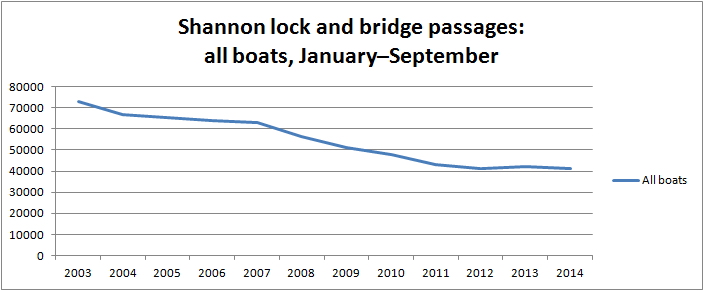
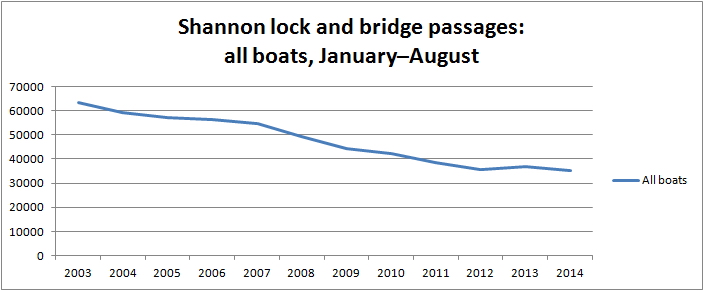
All boats

Total (private + hired) traffic for the first nine months of each year

Not a lot to say: slightly down on last year, but the numbers for the last three years have been fairly even.

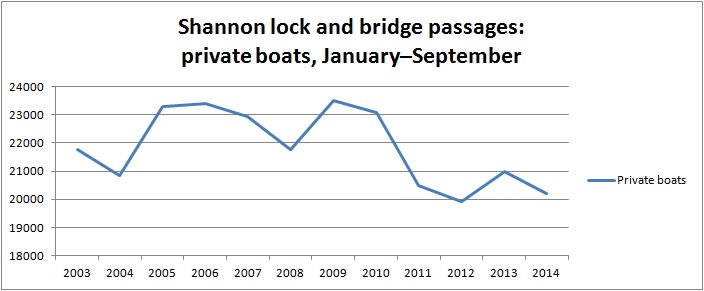
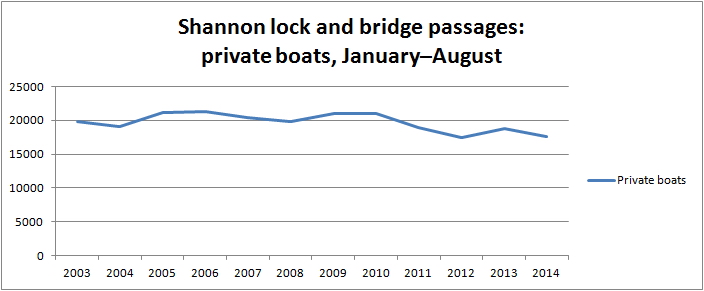
Private boats

Shannon traffic 1409 private

Private-boat traffic for the first nine months of each year

Note that the vertical scale is truncated, which exaggerates the scale of the changed. The good weather, especially in July and September, doesn’t seem to have resulted in a continuation of last year’s improvement.

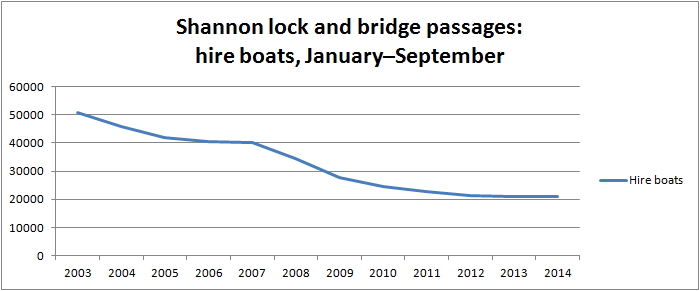
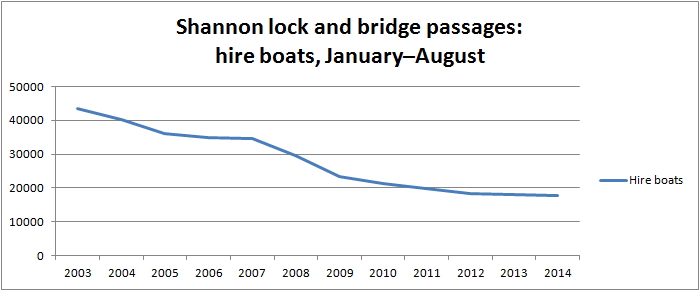
Hire boats

Shannon traffic 1409 hired

Hire-boat traffic for the first nine months of each year

Not much change from last year, but it’s the lowest nine-month figure in my records.

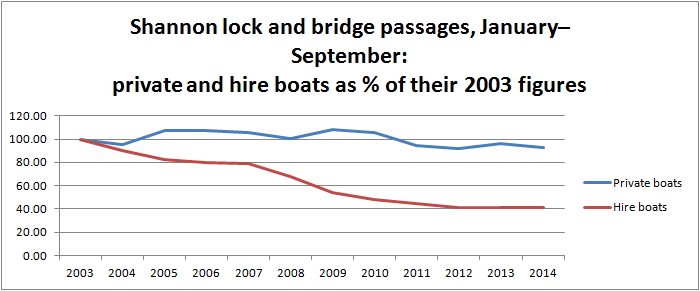
Percentages of 2003 levels

Shannon traffic 1409 -v- 2003

Percentages of 2003 levels

The nine-month figure for private boats is the second-lowest in my records (2012 was lowest) despite the good weather. The hire-boat figure is the lowest in my records, but the pace of decline seems to have levelled off.

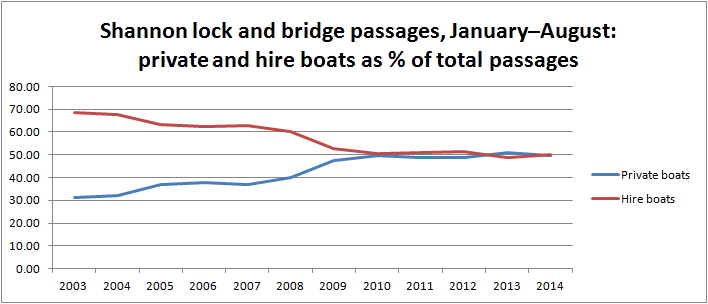
Private -v- hired

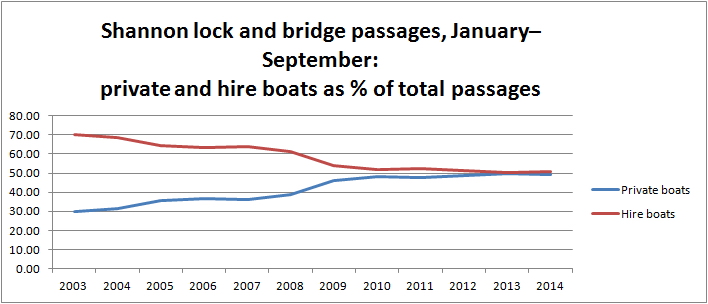
Shannon traffic 1409 private -v- hired

Still roughly 50/50

Nothing very encouraging there, alas.

Shannon traffic figures to August 2014

I am grateful to Waterways Ireland for letting me have the Shannon traffic figures for August 2014.

Regular readers may wish to skip this section

All the usual caveats apply:

  • the underlying figures do not record total waterways usage (even for the Shannon) as, for instance, sailing, fishing or waterskiing on lakes or river stretches, which did not involve a passage through a lock or Portumna Bridge, would not be recorded
  • the passage records would not show, for instance, a change in the balance of types of activities from those in larger cruising boats to those in smaller (sailing, fishing, waterskiing) boats
  • figures like these will not necessarily be representative of those for the year as a whole. The winter months, January to March, see little traffic in any year; for April, May and June, the weather can have a large influence on the amount of activity especially, I suspect, in private boats.

On the other hand, the figures do include the Shannon’s most significant tourism activity, the cruiser hire business. And they are our only consistent long-term indicator of usage of the inland waterways.

All boats

Shannon traffic all boats to August 2014

Total (private + hired) traffic for the first eight months of each year

I thought that the good weather in July might have brought more boaters out in August (when the weather was not so good), but it didn’t. This is the lowest eight-month figure in my series; traffic is just under 56% of what it was in 2003.

Private boats

Shannon traffic private boats to August 2014

Private-boat traffic for the first eight months of each year

Nothing much to cheer about there. Traffic was very slightly higher than in 2012.

Maybe lots of people have taken up sailing, and thus been confined to the lakes, instead of cruising. If, gentle reader, you can think of a way of measuring sailing usage, let me know.

Hire boats

Shannon traffic hire boats to August 2014

Hire-boat traffic for the first eight months of each year

As I said last month, the pace of decline seems to have slowed, but this is still the lowest figure in my series.

Percentages of 2003 levels

Shannon traffic private and hired as % of 2003 to August 2014

Changes since 2003: private and hired boats

The eight-month figures for private traffic are a bit worse than the seven-month, but perhaps September’s extraordinarily good weather will prompt an increase. There is no good news for the hire business, but perhaps the profitability of the remaining operators will be improved.

Private -v- hired

Shannon traffic private -v- hired to August 2014

Still roughly 50/50

What is the Shannon’s USP?


Jim Allister and WI’s business plans

I noted here that Jim Allister, Traditional Unionist Voice MLA, had been asking questions about the “regularity” and “legality” of certain amounts granted to Waterways Ireland and the cross-border Language Body by the NI Department of Culture, Arts and Leisure. His two questions to the Minister for Culture, Arts and Leisure were answered last week.

AQW 35466/11-15: To ask the Minister of Culture, Arts and Leisure, in light of the Comptroller and Auditor General qualifying her Department’s Resource Accounts for 2013/14, whether she accepts that grant payments of over £8m made by her Department’s North/South Bodies were irregular; and if she will seek approval from the Department of Finance and Personnel for all such payments in accordance with the statutory requirements of the North/South Co-operation (Implementation Bodies) (Northern Ireland) Order 1999. [Priority Written]

Answer: The accounts for both agencies of the North South Language Body and Waterways Ireland for the 2013 and 2014 years have not yet been completed and audited.

My Department’s Accounting Officer reported that during the 2013/14 year, DCAL incurred irregular spend in respect of grants to the Language Body and Waterways Ireland as the business plans for these respective periods have not been approved. Draft business plans were in place against which the performance and budget of the bodies were monitored, and Corporate Plans for the period 2011- 13 for Waterways Ireland and both agencies of the Language Body, which were approved by Sponsor Department Ministers; both Finance Ministers and the NSMC Ministers were in place.

That’s a lesson in how to avoid answering the questions you were asked.

AQW 35541/11-15: To ask the Minister of Culture, Arts and Leisure whether she will place into the Assembly Library, a copy of the documentation received from the Department of Finance and Personnel (DFP), or otherwise recording DFP approval, which verifies the claim by her Department’s Accounting Officer in the Resource Accounts 2013/14 that DFP approval of grants to North/South Bodies was given for the amount of the grant at estimates or efficiency stage negotiations. [Priority Written]

Answer: The 2013/14 Main Estimate is published on the Department of Finance and Personnel’s website (http://www.dfpni.gov.uk/main-estimates-2013-14.pdf). My Department included within the 2013/14 Main Estimate on specific lines entitled “Language Body” and “Waterways Ireland” an estimate of the grants (before any efficiency savings were applied) my Department intended to allocate to the North South Bodies during 2013/14.

Estimates are prepared by departments and examined by DFP Supply to ensure that they meet Assembly propriety requirements and are consistent with the Executive’s expenditure plans.

After approval by DFP Supply the Estimates are presented and recommended (as required by Section 63 of the Northern Ireland Act 1998) to the Assembly by the DFP Minister who moves the Supply Resolution/s summing up the requests for Supply for each body.

On the basis of legal advice, the Department considers that the process and published Main Estimate document shows approval by DFP for the grants allocated to the North South bodies. DFP did not approve the final business plan which has resulted in the grants being deemed irregular.

It would be nice to see that legal advice.

Last week’s Phoenix magazine had an article headed “Flanagan falls flat on face” [not online] about severe constipation in the business of the Northern Ireland Executive. It includes this paragraph:

The DUP have plunged the [NI] institutions into a blast freezer since May when unionist ultra Jim Allister, staunch opponent of the GFA [Good Friday Agreement], got 75000 votes in the Euro elections. His party won thirteen council seats the same day. That sent a high voltage chock through the party. They stopped doing business with Sinn Féin, fearful of losing votes in next year’s British election.

But the WI/Language Body business plans problem surely began before May 2014.