Category Archives: Water sports activities

A query

I have emailed this query to Waterways Ireland today:

I would be grateful if you could tell me

(a) which, if any, persons Waterways Ireland has appointed as authorised persons for the purposes of Part 2 of the Maritime Safety Act 2005

(b) which, if any, authorised persons have been provided with training and instruction in the exercise of the power of arrest, as provided for in Section 13 (2) (b), and have been issued with warrants as
provided for in Section 13 (2) (c).

I note in Section 17 that

(9) Every authorised person appointed under this section shall be furnished with a warrant of his or her appointment as an authorised person and when exercising any power conferred on him or her by this Part as an authorised person shall, unless in uniform, if requested by a person affected, produce the warrant or a copy thereof to that person.

I regret that I had not noticed those provisions earlier.

Maureen O’Sullivan asks sensible questions …

I am happy to report that Maureen O’Sullivan TD [Ind, Dublin Central] asked some sensible written questions in the Dáil on 15 January 2014.

Under the rather odd heading “Waterways Ireland Remit“, she asked Jimmy Deenihan [FG, Kerry North/West Limerick; Minister for the City of Culture]

[…] if he will include work on land maps to determine what land abutting the canals is owned privately, by Waterways Ireland, the Railway Procurement Agency, Iarnrod Éireann, Dublin City Council, Office of Public Works or other; and if he will make a statement on the matter.

The minister replied:

I am informed that Waterways Ireland already has an ongoing programme to modernise historic canal ownership maps and register navigation property in its ownership.

She put another question to Jimmy Deenihan under the same heading; you can see the link between the two questions:

[…] having regard to the prospective re-opening of the Royal Canal towpath at Portland Place in Summer 2014 further to the refurbishment of the collapsed wall at Portland Place and having regard also to the Spencer Dock Greenway Project and the re-lining works to be carried out at the sixth level, if he will direct Waterways Ireland to commission a strategic environment assessment for a new canal-side walkway along the south side of the sixth level of the Royal Canal at Phibsborough from Shandon Gardens to the railway bridge at the seventh lock with a new pedestrian crossing (details supplied); and if he will make a statement on the matter.

The only problem with this is that even getting an environmental assessment done is likely to strain WI’s budget at the moment, so it’s not a good time to be suggesting new expenditure. However, it didn’t matter in this case, as Jimmy Deenihan explained:

I am informed by Waterways Ireland that it does not own the lands on the southside of the Royal Canal between Shandon Gardens and the 7th lock, at Liffey Junction and therefore will not be commissioning a Strategic Environment Assessment for a new canalside walkway.

She also asked Alan Kelly [Labour, Tipperary North] about that:

[…] noting that it is the intention of the National Transport Authority to pursue a cycling and walking greenway along the Royal Canal in Dublin city, if he will ask Iarnród Eireann, the Railway Procurement Agency and Dublin City Council to assess the viability of opening a new walkway along the Royal Canal, 6th level, from Shandon Gardens to the 7th lock with a new footbridge at the 7th lock railway crossing linking to the existing Greenway route; if, in particular, this option will be explored alongside any re-lining work that might be undertaken by Waterways Ireland along that level.

He said:

The development of walking and cycling facilities within the Greater Dublin Area is a matter for the National Transport Authority (NTA) in conjunction with the relevant local authority, which is Dublin City Council in this case.

The NTA provides funding to local authorities for a range of schemes to benefit pedestrians, including new walkways, under the Sustainable Transport Management Grants Programme. Accordingly, I have sent your request to the NTA and have asked them to reply to you directly in relation to the above matter.

I’m all in favour of getting money from other people to pay for waterways.

Finally, under the heading of Inland Waterways Development, she had another question for Jimmy Deenihan:

[…] if he will explore all possible options within current fiscal constraints to advance and develop the potential of the Royal and Grand canal lines that pass through Dublin city; if he will establish an inter-agency group on the Dublin City reaches of the Royal and Grand canals; if he will explore ways to advance their development, examining funding options, including existing funding streams and the leveraging of funding from other sources and the possibility of EU funding which may be available.

I might say at this stage that I don’t see why TDs are asking ministers about stuff that they could find out themselves by asking WI directly. It’s not as though they’re going to get a lot of favourable publicity by doing so: this isn’t the PAC grilling a hospital or charity board and the meeja aren’t really interested.

Anyway, Jimmy Deenihan replied:

As the Deputy may be aware, the Dublin City Canals Study [PDF] was launched on 20th July 2010. This was prepared by consultants on behalf of Waterways Ireland, Fáilte Ireland, Dublin Docklands Development Authority and Dublin City Council. The study examined the existing activities on the Royal and Grand Canals and identified an overall vision for the development of the City Canals within the M50. I am advised that following on from the study an Operations Liaison Group plus two sub-groups (one for the Royal Canal and one for the Grand Canal) were established and continue to meet to deliver the recommendations identified, within the current fiscal constraints.

I am informed that to complement the above study, Waterways Ireland engaged additional consultants to carry out a detailed study of Grand Canal Dock and Spencer Dock with the objective of producing a Master Plan, currently at draft stage, that realises their potential as a recreational amenity and a living, vibrant part of Dublin and its Docklands. Waterways Ireland will continue to work collaboratively to unlock the pivotal role of these two major docks and to attract funding to develop a maritime quarter within the city of Dublin.

I wasn’t very impressed by the Dublin City Canals Study, which didn’t seem to me to be rooted in actual conditions in Dublin. I will look forward to seeing the master plan for the two dock areas.

Anyway, that was a more sensible set of questions from Maureen O’Sullivan, and it kept her off the subject of Effin Bridge.

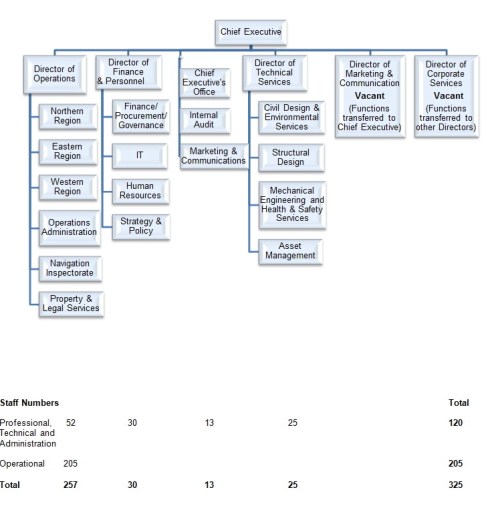
Waterways Ireland organisation chart

Here, courtesy of Waterways Ireland, is an organisation chart, revised on 13 November 2013, showing the numbers of employees in each division. Click on the chart to expand it.

Waterways Ireland organisation chart November 2013

Waterways Ireland organisation chart November 2013

Dublin dockyards 1852

Hunt’s Universal Yacht List for 1852 has a small ad from Henry Teall.

Henry Teall,
Ship Builder,
Brunswick Dock Yard and Patent Slip, Dublin

Established 1841

H Teall, begs respectfully to inform the Owners of Yachts, that his Establishment maintains superior facilities for the Building and Repairing of Yachts to any other establishment in Dublin, having always an extensive supply of every requisite in the trade, and employing the best workmen in the port.

It lists these yachts built by Teall:

Brilliant, 8 tons
Rover, 18 tons
Marina, 20 tons
Fairy Queen, 12 tons
Belle, 60 tons
Circe, 20 tons
Trio, 53 tons.

A note on Marina says

This Yacht is of novel construction, the bow being extended sufficiently to set the jib without the bowsprit, giving a much finer entrance as well as allowing more beam.

Our yachting correspondent tells us that Yachts without bowsprits are now becoming common.

Hunt also lists yachts built by George Marchall, Ringsend, Dublin:

Atalanta, 27 tons
Foam, 17 tons
Eagle, 15 tons
Halcyon, 10 tons
Lord of the Isles, 14 tons
Spray, 14 tons
Daring, 17 tons
Kelpie, 18 tons
Swallow, 16 tons
Banshee, 10 tons
Emerald, 10 tons
Water Wyvern, 45 tons
Gipsy, 10 tons
Priestess, 12 tons
Syren, 16 tons
Cormorant, 15 tons
Avenger, 10 tons
Irish Lily, 80 tons

Où est la plume de ma tante?

21 February 2018: voici une mise à jour.

Post originally written in January 2014 follows

Où sont les neiges d’antan? [That’s French for “Where is Anto’s stash of heroin?”] Où est l’étoile d’émeraude?

I remarked in August, on sighting le grand bateau de Monsieur Thibault in Athlone, that it carried the Le Boat brand, not that of Emerald Star. Emerald Star is now one speck within Le Boat, which is one of the activities within the Marine Division of the Specialist & Activity Sector of TUI Travel, which employs 54000 people.

Le le Boat bateau

Le le Boat bateau

I wrote to Messrs TUI Travel’s “corporate communications” department at the time to ask whether the Emerald Star name was being phased out, but answer came there none: no doubt all 54000 employees were busy at the time. But I noticed today that a hapless seeker after truth, searching for “emerald star”, ended up here, so I had a look myself. There is no emeraldstar.ie website (and emeraldstar.com is unrelated) but the UK Le Boat site has a little badge on the top left of the page saying “Emerald Star from le Boat”. I wonder whether that appears if the site detects that you’re accessing it from outside Ireland. I could find no other mention of Emerald Star, so I suspect the brand is doing a Cheshire Cat.

I was glad to find that Messrs Le Boat have found Google Translate useful. At least, I assume that’s how they produced this paragraph under their “Useful info” tab:

Useful Info for the Ireland

The Irish coast rises tallish from the sea, and yet the terrain drops farther inland, creating a sort of cup where the water gathers. One fifth of the water drains inward to the Shannon River, Ireland’s largest at 360 kilometres (224 miles). The fall on the navigable middle section of the river is slight at only 9 metres (29 feet), which means the water moves slowly. A Shannon River map also reveals the large number of lakes in the Shannon system, a real plus for canal boat cruising!

No, I’ve checked: it’s not Ulster Scots.

Then there’s this:

Feel the irresistible lure of the Shannon-Erne

The Shannon River gives Ireland’s central reaches their character. It’s an obvious feature if you study a Shannon River map. At a glance, it’s clear that the waters influence the land. The fishing is superb and golf is extremely popular! The towpath is level, so you’re in cycling heaven! […]

You learn something every day: I never knew that the Shannon had a towpath. I wonder where it is.

But that’s not the only puzzle. Messrs Le Boat list some suggested cruises, eg:

The Celtic Cruise Ireland
Oneway: Portumna to Carrick-on-Shannon

[…]

The golf course calls! The fishing itch must be scratched! Castles loom tall! Feel the warm embrace of Celtic charm!

Who writes this rubbish? But this is the puzzling one:

The Northern Shannon Cruise Ireland
Return Trip: Carrick-on-Shannon, via Belturbet

[…]

Travelling in the thousand lakes area takes you from the Lake Niegocin to the Lake Sztynorckie, with plenty to see on the way!

Well, I admit I don’t know the north Shannon as well as I do Lough Derg [“Lough Derg, an angler’s paradise, casts an Irish spell of contentment to keep you fishing and having too much fun!”], but I can’t find either of those lakes on any Shannon or Erne map. Où sont les mille lacs de M. Thibault? Où sont les Niegocins, Antoin? Ils sont dans le jardin avec la plume de ma tante.

The amazing success of Harbour Flights

I have written before about Harbour Flights, which operated a seaplane (floatplane) at Mountshannon on Lough Derg and conducted trial flights hither and yon. I was a little confused about whether Harbour Flights was “fully operational” but its redesigned web page (there were once several pages) carries the impressive news that the company has been so successful that it has ceased operations, at least temporarily.

But it will be back, and instead of operating a single aircraft, which was actually owned by somebody else, it will have a veritable fleet “operating from [sic] destinations nationwide” and will be “fully operational again”, which suggests that it was fully operational before. I wonder how many of the “50 new Irish jobs” were created when it reached that point.


Levels

Folk who have boats tied to fixed jetties on Lough Derg might like to check their ropes: the water level has risen quite a bit and some ropes are bar-taut.

Another tour-Limerick-by-water idea …

… but this one, unlike the rest, might actually make financial sense: it uses existing infrastructure, it probably has a low capital requirement (as the firm presumably already owns the kayaks) and it seems to offer the prospect of extra income, without much extra cost, in the off-season, with low fixed costs. Furthermore, it covers the more scenic parts of the city: the Park Canal is not, alas, one of them when seen from water level, because the banks are so high you can see nothing else.

The Limerick Post covered the venture here.

Waterways Ireland’s purpose in life

Waterways Ireland is currently (I presume) implementing its Corporate Plan 2011–2013 [PDF], which still has a month to run. That plan set out, inter alia, a mission:

Our mission is to provide a high quality recreational environment centred on the inland waterways in our care, for the benefit of our customers.

It also had core values, which is nice, and a vision:

Our long term vision is to create an interrelated waterways network which will provide accessible recreational benefits and opportunities for all.

We wish to create facilities and services which will attract and impress visitors from home and aboard, supporting and encouraging the tourism and recreational industries in Northern Ireland and Ireland and promoting sustainable economic growth across the island of Ireland. We seek to protect and enhance the natural environment in and along our waterways for the enjoyment of future generations.

For the period of this plan we intend to focus on the consolidation, improvement and promotion of existing waterways in order to maximise their use. We will progress toward our long term vision by focusing development on the Ulster Canal.

And it had strategic objectives:

To deliver the benefits and opportunities the waterways can provide across a range of areas, Waterways Ireland has identified 6 strategic objectives which will drive the delivery of our Mission and Vision and the objectives set out in this Corporate Plan. These Strategic Objectives are to:

1. Manage and maintain a reliable and high quality waterways network.
2. Develop and restore the waterways network.
3. Enhance the existing waterways network to widen its appeal to users.
4. Promote increased use of our waterways resource principally for recreational purposes.
5. Assess, manage and develop the assets of Waterways Ireland.
6. Develop an organisation of excellence.

Reading that lot, it seems to me that the focus was inward rather than outward, perhaps more in line with traditional engineering-led waterways management than with the new and exciting marketing-led organisation of the future.

The mission is de haut en bas, with waterways coming before customers, and the first sentence of the vision continues the theme. The second sentence does mention economic affairs, but “supporting and encouraging the tourism and recreational industries” suggests that tourism and recreation are something that other people do, not something that WI does: it does not seem to see itself as part of the “tourism and recreational industries”.

The intro to the strategic objectives is pure management gobbledegook, but the really revealing bit is the list of objectives. The last two are inward-looking, but note the ordering of the first four and what the balance of elements says about the corporate focus: WI is going to

  • manage and maintain the waterways network
  • develop and restore the waterways network
  • enhance the waterways network
  • and after that promote increased use.

This is what used to be called a sales model: design and build your widgets first; then go and flog them to the punters. There is an alternative approach: start by finding out what the potential punters might want and then design and build your widgets to meet their needs. In reality, of course, you do something in between, because you’re not starting with a blank slate: your factory can make one particular kind of widget, not all possible kinds. And, similarly, WI’s main asset is a collection of waterways, not of (say) amusement parks or bookshops.

But a marketing focus could help an organisation to think about how its widgets are to be used. The result doesn’t have to be as crude as adding the word “solutions” to everything; it can be used to shape how the organisation presents its widgets and to whom it presents them. And, in my view, WI needs to do that because, according to the only reliable (and admittedly inadequate) measure we have, the Shannon traffic figures, waterways usage has been declining for at least ten years. [I know that there are other waterways, and many other types of activities thereon, but I don’t know of any published statistics about the extent of usage.] WI needs to reimagine the waterways.

When Jimmy Deenihan spoke in the Dáil on 16 October 2013, he said:

The [budgetary] provision will enable Waterways Ireland to deliver on its core activities and targets, which include keeping the waterways open for navigation during the main boating season and promoting increased use of the waterways resource for recreational purposes. This expenditure should also assist in developing and promoting the waterways, attracting increased numbers of overseas visitors and stimulating business and regeneration in these areas. Capital funding of almost €4 million will be made available to Waterways Ireland to facilitate the ongoing maintenance and restoration of Ireland’s inland waterways, thereby increasing recreational access along the routes of waterways.

My attention was attracted by the phrase about keeping waterways open “during the main boating season”, which suggests a new, restrictive policy. However, the rest of the list is pretty much in line with the existing objectives. I hope that something more radical will come out of the corporate planning process in which WI tells me it is currently engaged.

By the way, note that there was no mention of either heritage, which was the excuse for nicking the waterways from the OPW, or northsouthery.

Setback for Sheugh

The likelihood that limitless wealth will result from the construction of the Clones Sheugh was reduced recently with the closure of the cruiser-hire base closest to the Ulster Canal: the Emerald Star (Le Boat) operation at Belturbet.

Perhaps, though, it reflects a wider decline in the hire business rather than disappointment at the delay in the canal’s reconstruction.