
Category Archives: Waterways management

Sliabh Aughty Furnace Festival

I don’t know how many people are aware that there were once extensive ironworks [which used water transport] along the lower western shore of Lough Derg and in the foothills of Sliabh Aughty. The existence of a townland called Furnace, near Whitegate, might be a clue, I suppose. Ger Madden had an article on “The Iron Works of Sliabh Aughty” in Sliabh Aughty: East Clare Heritage Journal No 7 [1997]; he told me the other day that the works burned an acre of oak every day during the season. That bears out what J H Andrews said in “Notes on the Historical Geography of the Irish Iron Industry” [Irish Geography: bulletin of the Geographical Society of Ireland Vol III No 3 1956]:

[…] the Irish woods were exploited [for charcoal] with an extravagant disregard for the future supply position, although at first the conversion of woodland to permanent pasture could have been justified in many cases as a rational long-term economic decision. […] [Cpppicing was] never adopted in Ireland, even by such enlightened land owners as Sir William Petty, so that even a small forge or furnace could despoil its woods at an alarming rate.

Ger and others in Mountshannon have now organised the Sliabh Aughty Furnace Festival, to be held in Mountshannon on 20 and 21 September 2013. The leaflet says:

In the 17th and 18th century, the western shores of Lough Derg were the setting for an intensive iron industry. Although little known, it has left many traces in the landscape and various archives.

The Sliabh Aughty Furnace Project is hoping to safeguard these monuments for the future, research the history and develop the story as a touristic attraction. […]

The festival caters both for those with a deep interest in the subject and for those who might like a lighter approach. For the first group, there is a series of talks in the Mountshannon Hotel, running from 1030 to 1630 (with an hour for lunch):

1030 Paul Rondelez “Iron production in the Sliabh Aughty mountains”
1100 Mary Sleeman “Heritage and the law”
1200 Gerard Madden “The Emmerton Papers” [an archive with valuable
information about the Clare ironworks]
1230 Professor Audrey Horning “Archaeology and early industry in Ireland and
the Americas” [yes, there is a direct link]
1400 Dr Colin Rynne “Industry on the Shannon”
1430 Dr Christy Cuniffe “An elusive foundry in the Slieve Aughty foothills: the
work of T Clarke”
1530 Sean Spellissy “Expanding on Slieve Aughty”
1600 Ewelina Rondelez “The Sliabh Aughty Furnace Project”

The Aistear Iniscealtra Park [the maze] will have events including blacksmithing, charcoal production, a living history tent, sword-fighting demonstrations, 17th century games, a knitting demonstration, an exhibition on the ironworks, stalls with local produce and a barbecue.

All of that for €10 (adult rate; under-16s €5, toddlers free).

On the Sunday there is a guided tour of the remaining furnaces, leaving the harbour at 10.30am: free if you use your own transport, €20 by bus.

There is a website here with full details including information about accommodation in the area.
 

Waterways Ireland news

Lots of info pouring from Waterways Ireland at the moment: July Shannon traffic stats, which will take me some time to analyse, serviced moorings in Sallins, digital navigation thingies for the Erne and Lower Bann and an online survey.

Here’s the press release for navigation thingies. I’ll cover the online survey in a separate message.

Waterways Ireland Pilots Digital Navigation Guides to the Inland Waterways

Waterways Ireland has developed an Online Navigation Guide for the Lower Bann for use on computers, tablets and mobile phones. In a major step change in the presentation of navigation guides for Ireland’s Inland Waterways, Waterways Ireland has, in consultation with user groups, developed, tested and now launched, pilot Online Navigation Guides, designed to provide a convenient alternative to printed navigation guides.

The online guide to navigation has been developed internally within Waterways Ireland using ArcGIS online. This interactive web mapping application details navigation features such as Locks, Moorings, Weirs, Navigation Markers and other facilities along the waterway. These data layers are then overlaid using ArcGIS online web maps. GPS surveys or digitising onscreen using Ordnance Survey Maps have been used to capture the location of features. The application enables the public to pan around the map, identify features, print maps, switch between base mapping & satellite view and switch on and off layers. The Lower Bann Guide is complete and available for free on our website and can be viewed on a PC, Tablet or Smartphone.

Waterways Ireland will update the maps on an ongoing basis so that the latest navigational information is always available online. Ongoing feedback is welcomed from users to keep the mapping information accurate.

With both the Lower Bann and the Erne System Navigation Guides presently available online, Waterways Ireland is commencing work with user groups on the Shannon and will subsequently cover the remaining waterways.

The maps are available on www.waterwaysireland.org by choosing the waterway and then selected the map tab. To directly access the Lower Bann & Lough Erne Online Navigation Guides, click [this] .

In the initial pilot period, broadband access or a wifi link will be required to use the online navigation guides for the Lower Bann and Erne Systems. Progress is being made on an offline/cached version which will be made available as soon as possible.
It is also planned that the next phase of the Online Navigation Guides will have additional layers of information for waterway & waterside recreational and tourism activity which the user can turn on and off.

In this transition period Waterways Ireland continues to offer a paper product to Waterway users. A comprehensive navigation guide for the Erne System, Shannon-Erne Waterway and Shannon Navigation is for sale at www.shopwaterwaysireland.org for €15/£12.60 and the Lower Bann Guide is also available.


Luddite loons

I have commented from time to time on the reluctance of some Irish folk to move beyond the technologies of the eighteenth century. Thus we find Shinners wanting canals all over the place and folk in Leitrim determined that, if Ireland has oil and gas, they must never be used. [That’s the Leitrim that had both a coal and an iron industry, by the way, as well as hydroelectricity, railways, a brickworks and a dockyard, to name but a few industries that come to mind.]

The latest target of the ire of the Luddites is that newfangled invention, the bicycle. Waterways Ireland might like to provide for folk to cycle along the trackway on the Barrow Navigation; some folk want to keep the dreaded bicycle, and presumably its Lycra-clad users, away from the trackway along which they like to walk.

Happily, some sane folk have written letters to the blatts and IndustrialHeritageIreland has a sensible comment.

I presume that the Luddites insist that the grass be cut using scythes, thus creating much local employment.

Salmon at Ardnacrusha

Might a salmon cannon work?

Where do correct ideas come from?

Where do correct ideas come from? Do they drop from the skies? No. Are they innate in the mind? No. They come from social practice, and from it alone; they come from three kinds of social practice, the struggle for production, the class struggle and scientific experiment.

Readers will not, I am sure, need to be reminded that those are the words of the late Comrade Mao Tse-tung [or Mao Zedong, as the younger comrades say] in the Draft Decision of the Central Committee of the Chinese Communist Party on Certain Problems in Our Present Rural Work of May 1963.

Maurice Semple, in By the Corribside [self-published, 1981], lists writers who, from 1868 onwards, agreed with the view of the Cong Canal expressed by Sir William Wilde:

[…] for it was discovered, that like many other undertakings, the great canal at Cong “would not hold water.”

Those writers’ view is echoed by local people, and even by engineers, to the present day. Their case is, in effect, that the Board of Works engineers did not know what they were doing or did not properly survey the ground and were therefore surprised to find, on admitting water to the bed of the canal, that it vanished into sinkholes or swallow-holes in the karst.

One oddity about that belief is that the Cong Canal does actually hold water: it is full in winter, as the photos on this page, taken in February 2013, clearly show. It is empty in summer, but that is because water is unable to get in at the upper end, not (I suggest) because it flows out through the bottom.

What interests me at the moment is that I can find no evidence to support Wilde’s contention. Samuel Roberts, the engineer in charge of the work, knew that the work would be difficult but there is no hint in any of his annual reports that he feared that the difficulties might be insuperable. Furthermore, it is clear from his own reports and from other evidence that he was ordered to cease work on the navigation aspects of the canal before it was finished: there was never a moment when water was admitted to a completed navigation canal.

I have not been able to find any report from the 1850s in the Freeman’s Journal, the Cork Examiner, the Dublin Evening Mail or the Belfast News-Letter, or in any British newspaper, that supports William Wilde’s account of events. What, then, is its basis?

Of course my inability to find evidence does not mean that it doesn’t exist, but I would be grateful if anyone could point me towards it. I should say that I do not regard later accounts, like Wilde’s, as valid unless they include some evidence from 1854, the year of which Roberts wrote

The masonry in the Cong lock was commenced in March, and was progressing rapidly when I received instructions from the Board, in April, to suspend the execution of all navigation works in this division of the district, and complete only such as were necessary for the regulation of the waters of Lough Mask, for drainage purposes.

What I am looking for is an eyewitness, an official or some other reliable account, from 1854, that says “the canal was completed; water was let in; it vanished, to the surprise of the engineers”. If no such account exists, I may be forced to conclude that Wilde’s style of work is opposed to the fundamental spirit of Marxism-Leninism. As the Great Helmsman put it in the Little Red Book:

To behave like “a blindfolded man catching sparrows”, or “a blind man groping for fish”, to be crude and careless, to indulge in verbiage, to rest content with a smattering of knowledge — such is the extremely bad style of work that still exists among many comrades in our Party, a style utterly opposed to the fundamental spirit of Marxism-Leninism. Marx, Engels, Lenin and Stalin have taught us that it is necessary to study conditions conscientiously and to proceed from objective reality and not from subjective wishes; but many of our comrades act in direct violation of this truth.


Archives workshop: a reminder

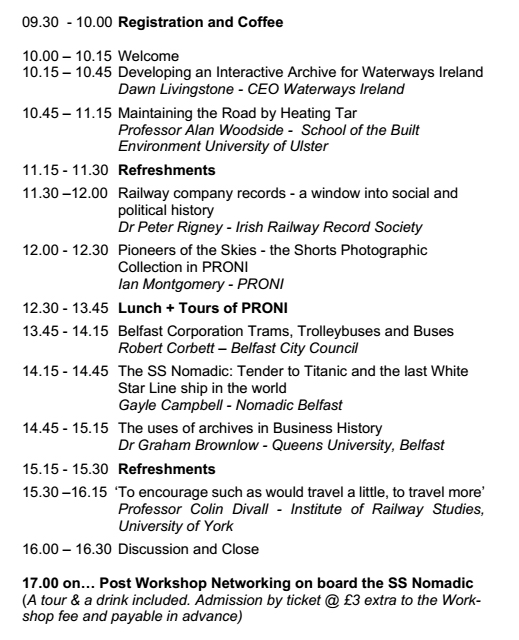
I mentioned, back in April, that an interesting-looking workshop is scheduled for Belfast on 8 September 2014. It’s being held in the Public Record Office of Northern Ireland [PRONI] in the Titanic Quarter and there’s an optional extra tour and reception on the SS Nomadic afterwards. This post is a reminder.

The programme covers waterways, roads, railways and flight. For this site, the opening session is of great interest: Dawn Livingstone, CEO of Waterways Ireland, is to talk about an interactive archive for Waterways Ireland.

By air, sea and land

By air, sea and land

The workshop is being organised for PRONI by A²SN, the Archives and Artefacts Study Network, supported by the Historical Model Railway Society, the Business Archives Council and the Postal History Society.

The [two-page PDF] brochure is downloadable here PRONI transport archives workshop. The workshop fee is £20/€25 with an extra £3/€3.50 for the SS Nomadic visit. Sterling cheques are accepted; there is provision for paying in euro by online banking.


Did you know …

… that Pollboy Lock, on the River Suck, can be filled in one minute and fifty-eight seconds?

Pollboy

Pollboy

Berkhamsted

Waterways Ireland, please don’t copy.

Ballinasloe footbridge

Here is a new page with a brief account of the Ballinasloe Line of the Grand Canal and some photos of a footbridge that seems to have been built across it in the twentieth century.

Salmon

In my youth, I tried angling once or twice, but with no success: the only time I ever caught fish was with mackerel feathers. So, despite having read Isaak Walton (several times), angling doesn’t really interest me. But it’s hard to read this without accepting that Something Must Be Done, whatever it is. Note, in particular, Dudley Mallett’s comment.