Tag Archives: Barrow

Rural nitwits and retirement communities

I’ve just been writing elsewhere to the effect that national politicians are a pack of nitwits. I was cheered therefore, in a sense, to note that local politicians, at least in Co Mayo, are (if possible) even more thick-headed than their national counterparts.

However, I am happy to be able to offer a solution, one that kills two birds with one stone. There are, it seems, many English pensioners living in poverty on boats on the canals and unable (or at least unwilling) to pay for the privilege. I had intended to suggest that Waterways Ireland should provide them with moorings away from the honeypot areas.

WI could then charge more for berths at, say, Hazelhatch, Sallins, Blanchardstown and Lowtown, catering for those in work who could afford a couple of thousand a year, while the pensioners, who don’t need to be within commuting distance of Dublin, could be accommodated in rural areas where their small additional spending would make a difference. That would help to increase those community and economic benefits to which the subsidy-seeking boat-owners draw our attention, bringing spending to deprived rural areas.

I was thinking of Pollagh, for instance: it has a pub, a shop, a church and a visiting burger van, and easy access to supplies of turf.

But the Mayo problem reminds me that Mayo too has lakes. So why not ship the boats to Mayo? As the canals byelaws provide that boats should not discharge any water other than from engine-cooling, these boats must be fitted with holding tanks or other non-discharging loos, so there would be no pollution problem. In fact Mayo could advertise itself to the world as offering floating retirement communities at modest cost, thus renewing its own population while solving a problem for boat-owners. I thnk this is a winner.

Shannon traffic 2013

Some weeks ago Waterways Ireland kindly supplied me with the Shannon traffic figures for the final three months of 2013 and I have just now had a chance to add them to my spreadsheets and produce some graphs.

The usual caveats apply: the underlying figures do not record total waterways usage (even for the Shannon) as, for instance, sailing, fishing or waterskiing on lakes or river stretches, which did not involve a passage through a lock or Portumna Bridge, would not be recorded. The passage records are our only consistent long-term indicator of usage of the Shannon but they would not show, for instance, a change in the balance of types of activities from those in larger cruising boats to those in smaller (sailing, fishing, waterskiing) boats. On the other hand, they do include the Shannon’s most significant tourism activity, the cruiser hire business.

It is good to note, incidentally, that, in its draft Corporate Plan 2014–2016, Waterways Ireland says that it intends to

Develop and implement a research programme to measure waterway usage and inform planning and development.

It won’t be easy to do, but we need much better measures of all types of activities on all seven of the waterways managed by WI.

The final outcome for 2013 won’t greatly surprise anyone who has read earlier bulletins on this subject, like this covering the figures to end-September 2013. All the illustrations are based on information supplied by Waterways Ireland, with some minor adjustments by me to eliminate anomalies, but the interpretation and comments are mine own.

All boats full year

Total Shannon traffic 2003–2013, private and hired

The decline in traffic since 2003 seems to have been halted …

All boats full year %

Total Shannon traffic as a percentage of 2003 traffic

… but it is 40% below what it was in 2003.

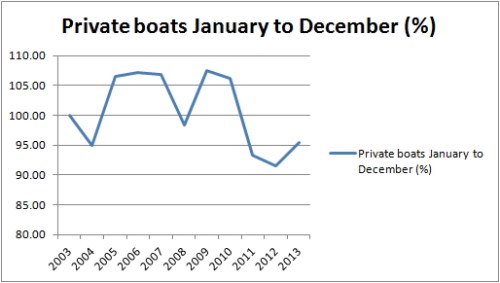
Private boats full year %

Private-boat traffic 2003–2013 as a percentage of 2003 traffic

Traffic in private boats seems to be recovering, but what is perhaps more significant is that it never went more than 10% above or below the 2003 figure. It has been remarkably stable over the period, despite the economic crash and despite the anecdotal evidence of boats being sold to overseas owners and trucked out of the country. Perhaps larger boats were replaced by smaller? Perhaps only boats bought in the boom were sold in the bust? Unfortunately the deficiencies of the registration system make it very difficult to determine what has been happening.

Hire boats full year %

Hire-boat traffic 2003–2013 as a percentage of 2003 traffic

But if private-boat traffic has been remarkably stable since 2003, the same cannot be said of hire-boat traffic. The best that can be said of 2013 is that the figures didn’t get [much] worse, but a 60% decline since 2003 is really, really dreadful.

WI’s draft Corporate Plan, which does not explicitly mention the hire industry, talks of

… unlocking opportunities to achieve recreational growth, and economic and social development.

I don’t know whether that omission means that WI sees little prospect of a rejuvenated hire-boat industry. And I note that, other than in the titles of organisations, the draft plan rarely mentions tourism or tourists. Are the waterways only for natives? If so, is that a deliberate policy decision? Or is there something that could be done, cheaply, to help to revive waterways tourism?

Emma Kennedy, writing in the Sunday Business Post on 23 February 2014, wrote about Fáilte Ireland’s latest brainwave, which is to “target” three groups:

  • social energisers, which are gangs of young people interested in “new and vibrant destinations”, which I take to mean Temple Bar
  • culturally curious folk aged 50 or over, with money, who are interested in “exploring new landscapes, history and culture”
  • great escapers, who like energetic rural holidays with their partners.

No families with kids, I see, although “Families & Loved Ones” (the latter term, by the way, nowadays seems to mean either dead people or their relicts) were one of the two “primary target customer segments” identified in Fáilte Ireland’s Inland Cruising Market Development Strategy. (Fat lot of good that strategy did, but we mustn’t be bitter.)

Anyway, without having done any market studies (though WI has funded lots of them), it seems to me that there is scope for more tourism on the waterways, but it might not be on traditional cruisers. It might involve outdoor activities like cycling and walking along the canals and Barrow: WI’s plan discusses them, but without adverting to an overseas market. And it might involve small-boat activities — canoeing, touring rowing, small-boat sailing, camping — on Shannon, Erne and SEW: WI says it will support micro-enterprises, and those providing outdoor activity holidays may need expertise and assistance rather than hard cash.

I admit to having little evidence on this, but it seems to me to be too early to give up on the tourism potential of the waterways. And the decline of the cruiser hire business does not necessarily mean that all waterway tourism is doomed.

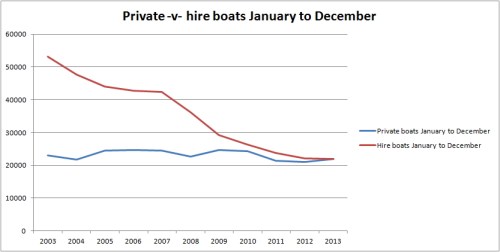
Private -v- hire full year

Private boats overtake hire boats

That said, 2013 was the year when, for the first time since Noah was an Able Seaman, the number of passages by private boats exceeded that by hire boats.

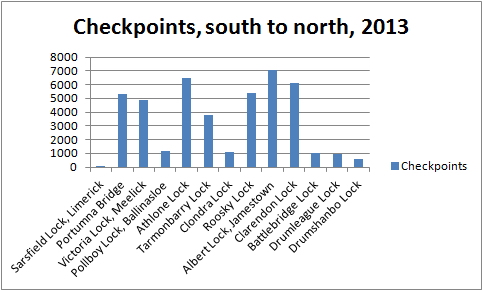
Checkpoints 2013

The points at which numbers were recorded

Finally, this chart suggests that any structures that were not built by the Shannon Commissioners in the 1840s will not attract many visitors. The extensions off the main stem of the Shannon — south to Limerick, west to Ballinasloe, east through Clondra, north to Lough Allen — are much less used than the main line from Lough Derg to Lough Key. It seems unlikely that any further extensions, especially to small towns that it would take three hours (at canal speed) to get to, are likely to be any more successful in attracting traffic.

More Pathé

A train ferry, claimed to be in service on the Liffey

Fishing at Ringsend the hard way

Turf by canal

Launching the Irish Elm in Cork

A Boyne regatta

Making and using a Boyne currach in 1921 (you can learn the art yourself here)

A non-watery film: Irish Aviation Day 1936


Canal tourists or canal pensioners?

The Village at Lyons 265_resize

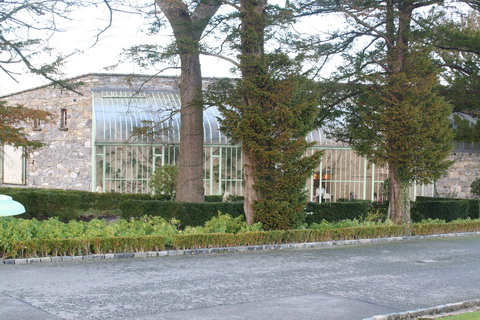
La Serre

Nibbling yesterday on a morsel of cured salmon, with fennel and apple salad, lemon crème fraiche and lavender jelly, at the excellent La Serre restaurant at the Village at Lyons, I looked forward to walking outside afterwards, on to the canal bank, to view the many boats that would undoubtedly be moored there, above the thirteenth lock, as their owners lunched at La Serre’s sister institution, the Canal Café.

The thirteenth lock (and its wonderful O)

The thirteenth lock (and its wonderful O)

Judge of my surprise, then, when I found not a single boat outside. I realised, though, that boaters probably walked from nearby Hazelhatch and even from Sallins. For we know, do we not, that boaters are vital to tourism? Even Joe Higgins of the Socialist Party tells us so, which means that they must be out and about along the canals, spending money (and where better to spend it than at the Canal Café?).

The Canal Café, mere feet from the canal bank

The Canal Café, mere feet from the canal bank

But a difficulty has struck me. Mr Higgins’s position is that boaters have money available for discretionary expenditure, but Senator John Kelly tells us that most boaters are “retired couples from England who are receiving small English pensions”. So one politician tells us that boaters have disposable incomes and that they should not pay money to Waterways Ireland because they spend money in pubs and restaurants along the canals; another politician tells us that boaters should not pay money to Waterways Ireland because they have none to spare.

I find it difficult to reconcile these two positions.


Snails

Snails may save us from restoring the Longford Branch of the Royal. Industrialheritageireland has the story.

Might be an idea to start breeding these snails for judicious use elsewhere.

Shinners losing patience over sheugh

Caoimhghín Ó Caoláin [SF, Cavan-Monaghan] in the Dáil on 5 February 2014:

There is no excuse for either the British or the Irish Governments to stand over any delay in advancing with key cross-Border infrastructural projects such as the Carlingford Narrow Water bridge and the Ulster Canal. With regard to the Ulster Canal, I have been in touch with the office of the Northern Ireland Minister for Culture, Arts and Leisure, Carál Ní Chuilín MLA, my party colleague. She assures me that both she and her counterpart here, the Minister for Arts, Heritage and the Gaeltacht, Deputy Jimmy Deenihan, are fully committed to this project, and I welcome that affirmation. As I pointed out in the debate on the Six Counties last year, the North-South Ministerial Council agreed to proceed with the Ulster Canal project in 2007. In the intervening period, we have seen the economic collapse in this State and a parallel contraction in the North. Despite this, the Ulster Canal project was kept alive.

Permission was granted last year for the Northern section by Environment Minister, Alex Atwood, and by Clones Town Council and Monaghan County Council for the section in this jurisdiction.

The Minister for Arts, Heritage and the Gaeltacht, Deputy Jimmy Deenihan, has advised that the earliest the contract could be awarded would be late 2014 with a completion date in spring 2017. I urge the Minister to do all in his power to expedite this process and to encourage his colleagues to do so. I also urge him to maximise the possible EU funding for the project from the Peace IV programme.

The Ulster Canal project is about greatly enhancing one of the finest landscapes in Ireland for locals and tourists alike, regenerating rural areas that have long been neglected and delivering a tangible peace dividend to Border communities that were neglected for far too long. It is time to get the work on the ground under way.

Yes …. Sinn Féin’s faith in the economic potential of canals is touching, if slightly worrying for anyone who believes that the world economy has changed since the late eighteenth century.

But wait: as far as I can see, SF is one of the few groups that has not asked Jimmy Deenihan about Waterways Ireland’s proposed new byelaws, which might force boaters to pay slightly more of the cost of their hobby. Perhaps SF is secretly hoping that user charges on the Clones Sheugh will be high enough to pay at least the interest on the construction cost? That would be nice.


English pensioners

How useful it is to have such well-informed politicians as John Kelly, a Labour Party senator from Co Roscommon. He was able to tell us that there are 300–400 people “moored on our canals and waterways”, which is rather fewer than WI thinks, what with there being over 8000 boats registered on the Shannon. The learned Senator Kelly was also able to tell us that, of those 300–400 people,

Most of them are retired couples from England who are receiving small English pensions. This proposal will drive them off the water and back to England. They are contributing hugely to local economies throughout this country.

Most of them? For, I presume, certain values of most — and certain values of 300–400.

Maybe whoever is briefing politicians could make sure they can read their briefs properly …. It was almost a relief to turn to the more conventional Trottery from Joe Higgins. I imagine that his intervention will certainly sway Fine Gael.

Addendum: Senator Kelly did it again next day, but at least he had changed most to many.

Approximately 400 families in this country currently paying only €126 per year in respect of mooring will if these by-laws are introduced now be faced with charges of €3,500 per annum. Many of the people concerned are retired English couples and families who cannot afford housing.

The concept of a range of prices seems to be unfamiliar to the good senator, so he takes the top rate, for the largest size of boat in the best location with the highest level of services, and says that that applies to all. And he seems to be unaware that many boats are parked by people who do not live on them.

Had the good senator had able to read Waterways Ireland’s document, he would have seen that proposed mooring fees range upwards from €160 for non-residential moorings (many boats are not lived on) and €1250 for residential. Claiming that the highest value is the only one is seriously misleading.


Relationships: guest post by Adele Picard

I invited Adele Picard to write a piece explaining why canal-based boaters are distrustful of Waterways Ireland. I am very grateful to her for agreeing to do so. The post’s appearance here does not mean that Adele and I agree on all the issues, but we are agreed that relationships are important and that the relationship between WI and canal-based boaters needs to be improved.

The Comments facility has been switched off. bjg

Relationships between WI and canal boaters

I have been asked to write this piece to explore a range of issues faced by canal users in recent years.

I set up home in 2003 when my partner and I bought our first narrow boat Chimwemwe. We lived in Lowtown and were enjoying life so much that we bought a wide-beam barge Rigmarole in 2005. We moved ashore in 2007 and soon after got married and started a family. Fortunately my two little boys are just as mad about the boat as we are and we enjoy cruising all over Ireland on the inland waterways.

In this piece I will be talking about issues that I have witnessed myself as well as first-hand accounts that have been related to me by others. I would like to point out at this stage that what follows is my personal opinion and is in no way claimed to be representative of views that may be held by any Irish boating organisations I may be a member of.

Lack of regulation and enforcement of bye-laws has always been a contributing factor to the issues experienced by users of the canals and River Barrow. In the current times as Waterways Ireland (WI) attempts to throw down the gauntlet and assert some kind of control over the navigations, a deepening of these issues is inevitable.

Control = a means of limiting or regulating something in order to mitigate any inherent risk that may occur.

At the moment Waterways Ireland’s reputational risk among the boaters on the canals has been realised but can this risk now be mitigated?

Taking control of the electricity

During my time as a liveaboard in Lowtown, a lot of boaters availed of the precious electricity supply, regardless of distance from their vessel to the power points. This resulted in long leads being run down the towpaths. When the clampdown started on this sort of thing by WI in 2006, a warning was shot across the bows and soon after the electricity was removed. In some cases this action resulted in vulnerable people being left without shore power. People felt that this situation could have been handled better by WI. On the other hand, everybody knew that, underneath it all, this situation represented a serious health and safety violation. This for me was the first indication that WI was putting controls in place to minimise their exposure to risk.

The Lowtown fiasco

In early 2012, after WI pulled out of a deal with Robert Few and Vita Marine on the expansion of Lowtown Marina, a meeting was held with the residents, a representative from WI and the management of Vita Marine. What came out of that meeting was that everybody moored there had to leave within the following 30 days due to health and safety concerns.

This is where we as a boating community started to engage with WI on the issues, mostly through the Property and Legal section. The frustration of going back and forth with emails and letters with no clear answers forthcoming from WI was disheartening. Furthermore the action led to the desolation and abandonment of Lowtown. This is when we started to open our eyes to the lack of willingness from WI to engage with the boating community. Legal proceedings began shortly afterwards, and we got very little information after that.

Rollout of new permits

The introduction of new permits in 2012 was at first to me a positive step, as one of the main issues on the canal is the number of sunken vessels; there was a real need to implement controls where every vessel is registered so owners can be contacted.

Then you go a little deeper and realise that these permits come with new issues. I would like to make it very clear that I have no problem paying for permits, but the following issues have not been dealt with to my satisfaction:

  • the legality of the new indemnity clause
  • the lack of an appeals process when and if there is action taken
  • the need for a deposit
  • the lack of a dispute resolution mechanism.

Although WI will say that they are within their rights to introduce reasonable changes to the terms and conditions of their permits, in my opinion these changes are not reasonable. Furthermore, the complaints procedure is frustrating due to a weak corporate governance structure.

Extended Mooring Permit (EMP)

It was after I had given up the liveaboard lifestyle, although still using the boat regularly, that I noticed that far fewer of the usual gang were travelling by boat to attend social gatherings along the waterways. I subsequently found out that the commonly accepted gentlemen’s agreement that many liveaboards have in relation to their spots had been broken. A boater returning from a rally had their spot taken. This kind of behaviour added to the already problematic lack of movement of some boats which has raised debate before. People were afraid to move!

The addition of the EMP, I felt, could stop this situation, but friends of mine bought one in 2013 to find that when they went out for the day their spot was occupied on their return. A WI official said nothing could be done. The EMP is now not fit for the purpose intended.

Also for those of us who like to move around the system there seemed to be no options: we didn’t really need an EMP as we would be in many different locations over the season and one location in the winter.

Then the stickering started in selected areas on the canal for those in breach of the five-day rule. In one instance boats were being stickered for the breach in Lowtown, while less than a mile down the road in Robertstown boats that hadn’t moved for years were not stickered.

Furthermore boats that wanted to move on the Royal were encountering their own problems in relation to low water levels, canal closures and the difficulties lifting Newcomen bridge.

Of course a barrage of correspondence ensued from boaters with WI on all these issues only to be met with what was becoming the standard with WI: more emails and unclear answers. It’s hard to explain this frustration but what it feels like is someone just shrugging their shoulders at you and saying “I don’t know”. Not a good way to treat your customer base in these times of expected transparency and professional standards in public service.

Liveaboards

I think on the whole liveaboards in general would welcome regulation on mooring as long as the terms and conditions are not too harsh and the price is right. I think the terms and conditions that are currently on offer at this present time are too stringent and could be improved with some consultation with the users.

For example during the planning process on the proposal to build jetties in Sallins Harbour submissions were made to Kildare County Council in August 2012 asking that Sallins should not go down the same road as the jetties in Shannon Harbour and Grand Canal Dock, which were lying empty at the time.

Following this WI did actively consult with the boating community and a deal was struck. This shows how a positive approach and engagement can make a real difference to our waterways and the communities on and around them.

The Sallins lockout

This positive development now has a shadow lying over it. Subsequent to the start of the consultation period on the 2014 proposed bye-law amendments, a campaign was launched on social media by concerned boaters and support grew rapidly. A peaceful protest was planned for Sallins on 25 January 2014. What follows are a series of actions by WI:

  • on Friday 24 January a Marine Notice issued stating that the canal at Sallins would be closed from Monday 27 January
  • on the Friday morning WI blocked the western entrance to the harbour and removed the racks from lock 14 on the eastern side, stranding 6 boats between locks 13 and 14
  • a Marine Notice issued after the fact stating that WI were now closing the canal on 24 January.

There was a serious risk to those stranded boats not only from a health and safety viewpoint but also because most of them were too big to turn around on that stretch of canal.

Conclusion

My opinion on the events of the recent past is that WI has a lot to do in order to improve communication with canal boaters. If the true purpose of these bye-law amendments is to …

develop the canals as a vibrant recreational waterway for all users by enhancing Waterways Ireland’s ability to manage the investment in infrastructure and facilities on the canals for both the navigational and recreational user

… the only way forward is for WI to actively engage with the communities both on and around the waterways.

© Adele Picard 2014

Quick work

Since some time yesterday (after 3.00pm, I presume) WI’s website has said:

Waterways Ireland ​undertakes Public Consultations as required under the legislation.
There is currently one consultation open:
1) Waterways Ireland Draft Corporate Plan 2014-2016 […]

Verb sap.

A sense of proportion

Waterways Ireland’s funding comes from Ireland [RoI] and Northern Ireland [NI] in the ratio 85:15. I understand that the ratio reflects the length of WI-run waterway in each jurisdiction, although I am not sure how length is measured on lakes.

The proportions of boats in the two jurisdictions are not 85:15. As of December 2013 there were 5570 boats on the Erne Register and 8816 on the Shannon Register. These numbers may or may not reflect the numbers of boats on the waterways as (a) there may be unregistered boats and (b) folk may not always deregister boats that have moved off the navigation. I do not know how many boats there are on the Lower Bann; boats on the Shannon–Erne Waterway should be on either the Erne or the Shannon Register.

Waterways Ireland reckoned that there were 520 boats on the Grand, Royal and Barrow at the end of 2013. Adding them to the Shannon number gives us

  • RoI 9336
  • NI (excl Lr Bann) 5570.

The ratio is RoI 63, NI 37.

On programme costs, though, matters are otherwise. Granted that the 2011 figures, the most recent available, may not be representative of long-term average costs: the Royal has not been reopened long enough for us to get such a long-term average, and the 2011 figure may be unusually high.

The other difficulty is with the allocation of the costs of the Shannon–Erne Waterway. I have arbitrarily divided it 50/50 between the two jurisdictions, although they probably exaggerates the proportion attributable to NI.

Shannon + Royal + Grand + Barrow + ½ SEW = €7275000

Erne + Lower Bann + ½ SEW = €807000

The ratio is RoI 90%, NI 10%.

So:

  • funding: NI 15%
  • number of boats: NI 37%
  • spending: NI 10%.

All subject to caveats.

No particular point: I just thought it was interesting.