Tag Archives: bridge

Shannon traffic figures to September 2013

The current (November 2013) issue of the British magazine Waterways World (available online only to subscribers) has an interview with Dawn Livingstone, new CEO of Waterways Ireland. There was a question about visitor numbers:

How are boating visitor numbers holding up in the recession?

The type of boating is changing — more sports boats for example, and numbers, after an initial decline, have held steady in the cruiser hire and private boat fleets. But more customers are investing in active recreation — canoeing, sailing, rowing, and these clubs and holiday types are growing rapidly.

My sense of the types of boating is the same, but I do not know of any source of reliable data. I think it would be useful if Waterways Ireland were (somehow) to collect and then to publish data on these activities and their economic costs and benefits.

But I was amused by the statement that …

[…] numbers, after an initial decline, have held steady in the cruiser hire and private boat fleets.

I’m not sure what useful data there are for the Lower Bann, Shannon–Erne Waterway, Grand, Royal and Barrow, though perhaps enhanced enforcement of the regulations will improve the data for the last three of those waterways. For the Shannon and Erne, the numbers in the fleets are, I presume, derived from the numbers of registered vessels, but there is no annual re-registration and I am not clear how many boats that are removed from the navigation are removed from the registers.

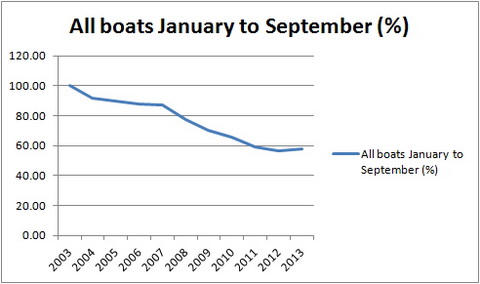
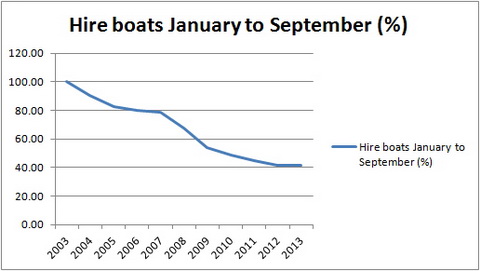
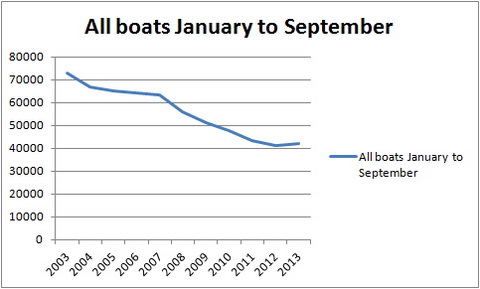
The other, indirect, measure, which applies only to the Shannon, is of passages through locks and moveable bridges. And, for hire boats, the “initial decline” has been 60% since 2003. If the numbers are now holding steady, it is at a very much lower level than ten years ago.

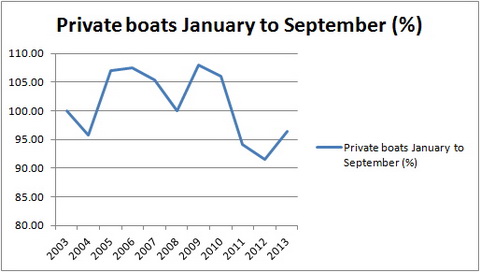
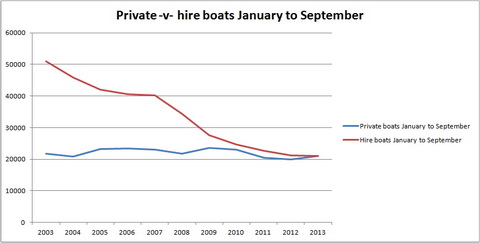
I was able to report in August that the better weather in July seemed to have led to an increase in the number of passages by private boats [the usual caveats apply]. Furthermore, for the first time that I knew of, the number of passages by private boats in the first seven months of the year exceeded the number of passages by hire boats in the same period.

I now have the figures for two more months, August and September, kindly supplied by Waterways Ireland, who are not to blame for my delay in getting the information up here.

All boats JanSept nos_resize

Look! An increase!

All boats JanSept percent_resize

Total passages are now almost back up to 60% of the levels of ten years ago

Hire boats JanSept percent_resize

Hire boat numbers are down by only a tiny amount

Private boats JanSept percent_resize

Private boat numbers are up

Private -v- hire JanSept nos_resize

Hire boat numbers are slightly above private boat numbers

Private boat numbers are ahead of hire in the three main summer holiday months of June, July and August and, although the numbers are tiny, in the winter months as well; hirers are ahead in spring and autumn.


Effin stats

I wrote here about Maureen O’Sullivan’s questioning of ministers about Effin Bridge, the lifting railway bridge below Newcomen Bridge on the Royal Canal in Dublin. It seems that she would like a drop-lock to replace the bridge, thus enabling boats to pass under the railway at any time without interfering with the operation of the trains. Which would be very nice, but that it would cost over €5 million and cause significant disruption to the railway during construction.

I was distressed by Ms O’Sullivan’s failure to make any sort of economic case for the drop-lock or for any other measure that might allow for free movement of boats on that section of the Royal Canal. I said:

As the expenditure on reopening the Royal Canal is a sunk cost, I am all in favour of making its use easier — provided that it can be demonstrated that (a) there is a demand for increased use, (b) such increased use will have benefits that outweigh the costs of any improvements and (c) no alternative investment offers better returns. As far as I can see, Ms O’Sullivan has demonstrated none of the three: indeed I see no evidence that she has even considered them.

Ms O’Sullivan’s position might be described as favouring an increase in the supply of possible passages along that section of the canal, but I thought it might be interesting to know what the demand for such passages was, so I asked Waterways Ireland how many boats had passed under Effin Bridge in 2013.

I was wrong about the number of days on which the bridge was lifted: nine lifts were available altogether. Six were on Tuesdays, two on Saturdays and one on a Sunday (to facilitate the Dublin boat rally):

Tuesday 16 April 2013:           0 boats
Tuesday 30 April 2013:         10 boats
Sunday 5 May 2013:            24 boats
Tuesday 21 May 2013:           0 boats
Saturday 1 June 2013:           8 boats
Tuesday 18 June 2013:           2 boats
Saturday 20 July 2013:          3 boats
Tuesday 13 August 2013:       7 boats
Tuesday 17 September 2013:  4 boats

So that’s 58 boats in a year.

I asked what the cost was: I was told that Irish Rail charges €1200 per weekday lift and €2000 per weekend lift. I presume that Waterways Ireland itself incurs other costs, perhaps overtime at weekends, but I don’t know what they are. The cost per boat for each lift was:

Tuesday 16 April 2013:           0 boats: lift cancelled as no boats wanted it
Tuesday 30 April 2013:         10 boats: €120.00 per boat
Sunday 5 May 2013:            24 boats: €83.33 per boat
Tuesday 21 May 2013:           0 boats: lift cancelled as no boats wanted it
Saturday 1 June 2013:           8 boats: €250.00 per boat
Tuesday 18 June 2013:           2 boats: €600.00 per boat
Saturday 20 July 2013:          3 boats: €666.67 per boat
Tuesday 13 August 2013:       7 boats: €171.43 per boat
Tuesday 17 September 2013:  4 boats: €300.00 per boat

The total charged to Waterways Ireland (not to the boaters) by Irish Rail was €10800.00.

Suppose that a drop-lock had been built for €5000000. Would it be worth investing that amount to save an annual expenditure of €10800? I suspect not, although I am open to correction by anyone capable of calculating NPVs or other relevant measures.

It seems to me, though, that the case for any capital expenditure is weak while demand for passages is lower than supply. Perhaps Royal Canal enthusiasts might work on attracting more boats to the Dublin end, whether from the Shannon end or from the Grand and Liffey.


SEUPBer

SEUPB, the Special European Union Programmes Body, has withdrawn its offer of funding for the Narrowwater bridge about which I wrote here and here.

Perhaps the scheme’s proponents might now consider a Newry Southern Relief Road instead. It might not be iconic, but it would be considerably more useful.

And I really don’t think it needs an opening span to cater for a couple of yachts going up the Newry Ship Canal.

It seems that the SEUPB wants to reallocate the money to a project that could be completed by December 2015. A cross-border sheugh, maybe?

Levels

On 9 October 2013 minister Brian Hayes spoke in the Dáil about Shannon water levels, saying:

A meeting between the ESB, Waterways Ireland and the Office of Public Works to review the interim operating regime is due to take place shortly.

On 17 and 18 October 2013, in correspondence with Waterways Ireland, I learned that the meeting had not then taken place and that no date had been set. I have now sent WI another note asking whether the meeting has been held and, if it has, requesting a report on the proceedings and outcome.

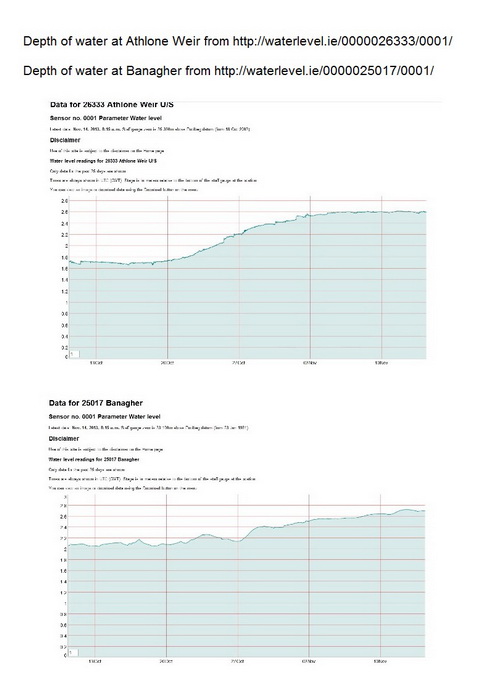
In the meantime, I have put together two charts nicked from waterlevel.ie for Banagher and Athlone:

Athlone and Banagher water levels

Athlone and Banagher water levels

Both of them show the levels for the last 35 days. I’m sure that more data and much more sophisticated analysis would be required to reach any reliable conclusion, but my untutored impression is that, in what has been a fairly dry autumn, keeping Lough Ree low didn’t do much to keep Banagher low. If that is so, and if I’m right in thinking that this autumn was dry (see below), the outcome would not show whether lowering Lough Ree would help in a very wet season; it may be necessary to repeat the experiment next year while performing rain dances. I would be glad, though, to have comments from more erudite folk and, if I get any information from TPTB, I’ll publish it here. In the meantime, this CFRAM PDF provides background reading.

On the dryness: Met Éireann’s monthly report for September 2013 is headed “Dry everywhere; warm and dull in most places” while that for October says “Rainfall was above average except in parts of the West, Northwest and North”. Its report doesn’t, AFAIK, specify any stations in the Shannon catchment (apart from Shannon Airport), but those to the west were generally below average while whose to the east were above; it may be that the Shannon rainfall was moderate.

Ticking all the boxes

Sometimes an idea comes along that is just so good, so right, so advantageous on all counts that it is simply irresistible. This idea comes from the Americas, from the US Coast Guard. Adapted to the Irish inland waterways, and specifically to the Shannon, it could:

  • help to promote industry in recession-hit rural areas
  • create direct employment
  • help to stimulate indirect employment
  • promote Irish energy independence by reducing reliance on imported hydrocarbons
  • counter pollution of water-courses
  • reduce the number of heavy trucks using remote rural roads
  • use environmentally-friendly water transport, by barge along the Shannon
  • honour and promote the industrial heritage of Co Leitrim and the transport heritage of the Shannon
  • help to defray the costs of maintaining the Shannon Navigation
  • solve Dublin’s water supply problem, at least for non-potable water.

How could anybody resist?

The US Coast Guard has proposed that wastewater from fracking [PDF] should be transported by barge, rather than by truck or railway train, from the fracking sites to remote storage or treatment facilities. So, when fracking begins around Lough Allen, the wastewater could be carried down the Shannon by barge and, if necessary, pumped to Dublin.

It sounds like a winner to me.

No Newry is bad news

In October I wrote about a Northern Ireland Assembly debate on a proposed Newry Southern Relief Road. I said:

… the debate was remarkable for its demonstration of cross-party agreement: not so much on the desirability of public works (a desideratum of Irish politicians since the eighteenth century) as on the irrelevance of the Narrowwater bridge.

[…]

It must surely be unlikely that there will be two crossings of Carlingford or the Newry River [and canal] within a few miles of each other. But if one option, the Newry Southern Relief Road, helps to relieve Newry and Warrenpoint traffic and the other, the Narrowwater bridge, doesn’t do so, then the first option would seem to be the rational choice.

Yesterday, 12 November 2013, Martin McGuinness [SF, Mid Ulster] reported to the Northern Ireland Assembly on the recent plenary meeting of the North/South Ministerial Council. He and others expressed support for the Narrowwater project. This question is revealing:

Caitriona Ruane [SF, South Down]: Go raibh maith agat agus go raibh maith agat don LeasChéad-Aire as an ráiteas sin. I welcome the statement from the deputy First Minister. Does he agree that the Narrow Water bridge project is a very good project for everyone in the Louth/Down area, that the chambers of commerce are representing every single community — Kilkeel, Warrenpoint and Rostrevor — and that the project went through a very rigorous process in relation to the SEUPB and came out at the top of the competitive process?

She made no mention of Newry; nor did any other contributor to the debate.


Bolshevism, boats and bridges

The balance bridge crossing the canal, near Newcomen-bridge, as designed and erected under the superintendence of Mr Bindon Stoney, engineer of the Dublin Port and Docks Board, has been completed, and adds considerably to the facilities for carrying on the traffic. This bridge has been erected in substitution of a lift-bridge, constructed in 1872, but to which an unfortunate accident occurred in February, 1878.

Ralph S Cusack, Chairman, in the report of the Directors of the Midland Great Western Railway, 19 February 1879, quoted in the Freeman’s Journal 27 February 1879

In mid-October I mentioned that Maureen O’Sullivan [Ind, Dublin Central] had asked the unfortunate Jimmy Deenihan [FG, Kerry North/West Limerick, and minister for waterways] about Effin Bridge, the lifting railway bridge below Newcomen Bridge on the Royal Canal in Dublin. The bridge is lifted, to allow boats through, on [IIRC] one Saturday each month in the summer, making five lifts a year. Waterways Ireland says on its website [click Bridges if necessary]

The Newcomen Lift Bridge in Spencer Dock is owned and operated by Irish Rail, and requires a rail possession to be lifted. It can only be lifted for boats at limited prearranged times organised with Waterways Ireland. For details of opening times and to arrange passage contact the Eastern Regional Office on 01 868 0148.

Maureen O’Sullivan wanted

… a meeting of interests concerned with the operation of the lifting bridge with a view to devising a management and operational system that is less hostile to the use of the waterway as currently it is an impediment and discouragement to navigation on the Royal Canal and an obstacle to navigation-communication between the Royal Canal and River Liffey and between Royal Canal and Grand Canal at their eastern reaches […].

Jimmy Deenihan said

The bridge is operated by Irish Rail staff on a request basis at Waterways Ireland’s expense.

However, he wasn’t giving any hostages to fortune by making rash promises or even by commenting on whether the bridge was an impediment to navigation. But Ms O’Sullivan was undeterred: she returned to the topic with two written questions on 5 November 2013 and a priority question, no less, on 7 November 2013 [for certain values of “priority”]. On 5 November she asked two questions of Jimmy Deenihan

To ask the Minister for Arts, Heritage and the Gaeltacht further to Parliamentary Question No. 59 of 16 October 2013, the extent of railway track that needs to be closed by Irish Rail in order for a vessel on the Royal Canal, Dublin, to be given access between the First and Sea Levels of the Royal Canal; if there has been an assessment of whether the extent of track closure could be reduced to facilitate greater ease of navigation on the Royal canal; and if he will make a statement on the matter.

To ask the Minister for Arts, Heritage and the Gaeltacht further to Parliamentary Question No. 59 of 16 October 2013, if the option of a introducing a drop lock to replace the need of the lifting bridge has been considered since the establishment of Waterways Ireland or if that assessment was made by Waterways Ireland’s predecessors; the level of use of the sea level assumed in relation to the assessment; if the impact of the Spencer Dock Greenway was taken into account and vice versa, was account taken of the impact on the Greenway were the sea level to be made accessible to navigation by replacing the lifting bridge; if the assessment includes analysis of whether the effective re-opening of the sea level of the Royal Canal to meaningful levels of year-round traffic would be consistent with the EU’s commitment to the ‘protection and preservation of cultural heritage, in view of the fact that Dublin’s waterway’s heritage is part of the cultural infrastructure of Europe, contributing to economic attractiveness, job opportunities and quality of life; and if he will make a statement on the matter.

The ever-patient Mr Deenihan replied:

I am advised that the option of constructing a drop lock to replace the need for the lifting bridge at the location in question has been considered by Waterways Ireland but it was not deemed viable due to the estimated costs involved, given that the minimum cost for a drop lock to replace the bridge would be of the order of €5m. Work to install a drop lock at this location would also involve considerable temporary works, the extent of which would be unknown until ground conditions were assessed in detail.

I am also advised that there have been no assessments or analyses undertaken by Waterways Ireland in respect of the level of use or impact on the Spencer Dock Greenway.

I can inform the Deputy that the length of railway track disconnected from the rest of the loop line from the station when the bridge is in the ‘up’ position is approximately 16 metres. However, as the control and operation of the railway line in the vicinity of the lifting bridge lies entirely with Irish Rail, only it can indicate the extent of the permanent rail line that needs to be closed when the bridge is opened.

He might also have pointed out that €5m is more than WI’s entire capital budget, which is under €4m for all southern waterways for 2014. And if he were an argumentative chap, he might have pointed out that there is no evidence of a demand for

… the effective re-opening of the sea level of the Royal Canal to meaningful levels of year-round traffic …

and no evidence that it would be of any economic benefit to anyone, least of all the residents of Dublin Central, even if boats were travelling that way every day of the week.

He might, if he were an impatient sort of chap, have pointed to the idiocy of the “cultural heritage” argument: with one or two minor exceptions, pleasure craft were not part of the “cultural heritage” of the Royal but, even if they were, such “heritage” wouldn’t be worth millions that might be spent instead on bringing soup to the deserving poor of Dublin Central.

Ms O’Sullivan was back with more on 7 November, this time trying to get Leo Varadkar [FG, Dublin West] to get the National Transport Authority to include Effin Bridge and the Sheriff Street non-lifting bridge (not a Scherzer) included in a National Transport Authority study of “the management and movement of people and goods to, from and within Dublin city centre”. Ms O’Sullivan’s rather confused and confusing case seemed to be that there was a greenway, and there were walking and cycling routes along the canal, so a road bridge (that works perfectly well for carrying a road) and a railway bridge (that works perfectly well for carrying a railway) should be included  in the study because the canal has navigational potential.

Or something. She even managed to bring water polo [does she mean canoe polo?] into the argument.

As far as I can see, walking, cycling, road travel and rail travel — and even water polo — are not in any way adversely affected by the current arrangements, while the canal is of negligible importance in the movement of people and goods. Boating on the canal is a leisure activity for a small number of people who are sufficiently well heeled to own pleasure-boats; I am rather surprised to find that their interests are a matter of such concern.

As the expenditure on reopening the Royal Canal is a sunk cost, I am all in favour of making its use easier — provided that it can be demonstrated that (a) there is a demand for increased use, (b) such increased use will have benefits that outweigh the costs of any improvements and (c) no alternative investment offers better returns. As far as I can see, Ms O’Sullivan has demonstrated none of the three: indeed I see no evidence that she has even considered them.

What’s depressing here is the absence of any indication of a rational approach to capital spending on waterways. They’re still cargo: a magical source of wealth, that will bring peace and prosperity as long as we all believe in fairies and avoid facts, thinking and analysis.

No wonder the country is in a state of chassis.

Update 15 November 2013: some information about demand for passage under Effin Bridge.

Northsouthery and sheughery

The North South Ministerial Council secretariat has been remarkably quick to publish the joint communiqué from today’s plenary meeting. They must have adopted the Quaker practice of agreeing the minutes before the meeting ends (as opposed to the diplomatic practice of agreeing them before the meeting starts). The short version is that nothing happened; the only excitement was another brainfart from Our Glorious Leader, which occurred before the NSMC meeting.

Cavan-Monaghan FF TD Brendan Smith has been wasting civil service time again, asking about the Clones Sheugh:

Brendan Smith [FF Cavan-Monaghan]: To ask the Minister for Arts, Heritage and the Gaeltacht if he will indicate the current stage of the proposed restoration of the Ulster Canal; and if he will make a statement on the matter.

Jimmy Deenihan [FG Kerry North/West Limerick]: As the Deputy will be aware, in July 2007 the North/South Ministerial Council (NSMC) agreed to proceed with the restoration of the section of the Ulster Canal between Clones and Upper Lough Erne. The then Government agreed to cover the full capital costs of the project, which were estimated at that time to be of the order of €35m.

It was always the intention that the Ulster Canal project would be funded from the Waterways Ireland annual allocations, as agreed through the annual estimates processes in this jurisdiction, as well as the deliberations of NSMC in relation to annual budgets. It was a key consideration throughout the process that the Ulster Canal project would be supported by a significant level of projected income from the commercialisation of certain Waterways Ireland assets. However, the economic downturn has had a negative impact on those plans.

In the meantime, the Ulster Canal project is progressing on an incremental basis. Planning approvals have now been secured for the project in both jurisdictions. I welcome these developments, which, I am sure the Deputy will agree, are a significant milestone for the project.

I am continuing to explore all possible options to advance this project within the current fiscal constraints. In this regard, an Inter-Agency Group on the Ulster Canal has been established to explore and examine ways to advance the project and to examine possible funding options for it, including existing funding streams and the leveraging of funding from other sources, including EU funding options.

What news of the Inter-Agency Group? Has it found a rainbow with a pot of gold buried beneath it?

I do not find the minister’s statement that …

It was always the intention that the Ulster Canal project would be funded from the Waterways Ireland annual allocations, as agreed through the annual estimates processes in this jurisdiction […].

… to be entirely consistent with the historical record or even with his further statement that …

It was a key consideration throughout the process that the Ulster Canal project would be supported by a significant level of projected income from the commercialisation of certain Waterways Ireland assets. However, the economic downturn has had a negative impact on those plans.

The plan seemed to be to sell the WI assets, thus using capital to fund what might laughingly be described as a capital asset (as opposed to a millstone around WI’s neck), rather than to rely on income from the use of its surplus assets. Maybe allowing the Corpo to run the Dublin “docklands” [Irish Times report, which will disappear behind a paywall at some stage; the Corpo’s website doesn’t yet cover this] will restore the overvaluations of the recent bubble and allow WI to flog off its three sites and splurge on the Clones Sheugh.

That seems to be what ThemUns in the Northern Ireland Assembly are expecting, if we are to judge by the discussion held on 21 October 2013, when several shinners, and a few others too, enthused about the “potential” of canals:

Phil Flanagan [SF] asked the Minister of Culture, Arts and Leisure [SF] for an update on the current funding position on the re-opening of the Ulster canal.

Carál Ní Chuilín [SF]: I thank the Member for his question. Work by Waterways Ireland on the restoration of the Ulster Canal has been solely focused on the section from Upper Lough Erne to Clones. The project will be advanced in line with available resources. The Ulster canal interagency group has been tasked to examine all possible options for financing the project. DCAL economists are reviewing the business case to update the estimated costs and identify social as well as economic benefits for the first section of the canal. The Ulster canal interagency group is exploring funding options with the Special EU Programmes Body.

Phil Flanagan [SF]: Go raibh maith agat, a LeasCheann Comhairle. Gabhaim buíochas leis an Aire as ucht a fhreagra. I thank the Minister for her answer. I welcome the Minister’s continuing commitment to the Ulster canal, particularly the section from Upper Lough Erne to Clones. However, one of the difficulties that it faces is an absence of funding. Will the Minister provide more information on potential funding options for completing the work on that section of the canal?

Carál Ní Chuilín [SF]: The work of the interagency group is focused not just on funding options but on what we can do with current available funding. It is really important that we look at the Ulster canal with a view to how we can open up waterways to improve tourism and the local economy. It is important that we get started on the restoration of the Ulster canal in that area because it has experienced a lack of investment for decades.

We are looking not just towards the Irish Government, within DCAL and towards Europe but at other opportunities, possibly through the Lottery Heritage Fund and many others to see whether we can get this started by looking at options to bring the work forward, rather than waiting until all the money is in. We can do that only on the basis of secured funding. Once that happens, I will be happy to make a statement to the House that will be a bit of good news that the Member and other Members for that area have been waiting to hear for a long time.

I suspect that “what we can do with current available funding” is “buy a shovel”, there being no large amounts available from the Free State. But perhaps the reason that the Clones area “has experienced a lack of investment for decades” is that it is not possible to make any adequate (legal) return on investment there; a policy of assisted emigration might be best. But it is gratifying to learn that SF is trying to get the Free State government off the hook of its rash promise to pay for the sheugh and is hoping to raise the money from within HM Realm.

There was a hint of a sensible question from the UUP.

Tom Elliott [UUP]: I thank the Minister for that update. Will she tell us how much the overall project was estimated to cost, based on the business case, and what income it projected?

Carál Ní Chuilín [SF]: Overall, it goes into tens of millions of pounds. I believe that the business case needs to be updated, and that will be part of discussions involving me, Minister Deenihan, and Minister McGinley. Some of the work that is being done by DCAL economists is bringing a fresh approach to the economic appraisal. We are sharing that with our Irish Government colleagues and the interagency group. That is because I believe that, rather than waiting for all the money to be secured at once, we need to look at the potential for phased approaches. It is good news that we now have full planning permission across all the councils and from our Planning Service here.

We now need to look at what capital moneys are available, what we can do and our plan to secure additional funds for that area. As I said to Phil Flanagan, it is really important — I am sure that the Member is more aware of this than I am — that we get parts of that canal opened and try to get some construction work done on it.

Unfortunately Mr Elliott did not insist on getting an answer to his question about the projected income, which I expect to be nil.

Joe Byrne [SDLP]: Can this issue be raised at the next meeting of the North/South Ministerial Council? What potential does she expect could accrue to the areas of Fermanagh and Tyrone in future tourism?

Carál Ní Chuilín [SF]: The Member should take comfort in knowing that this is always raised at the North/South Ministerial Council. Certainly, within the waterways sectoral aspect of DCAL’s North/South arrangements, it is constantly brought up. The key here is to look at what we can do now for rural communities and what moneys are available. I appreciate that, when the Irish Government said that they would fully fund the project, they were in different economic circumstances. However, they still remain committed to doing something.

In DCAL, I am looking at a new economic appraisal to see what the real costs are and what parts of the work I could try to start, possibly in conjunction with Ministers Deenihan and McGinley. There is a lot of expectation around the project, and rightly so, no more so than among the people who live and work in the surrounding area and those who are waiting for work on the restoration of the canal.

Anna Lo [Alliance]: Parts of the UK and many other countries have reinvented canals as tourist facilities and attractions. What lessons does the Minister intend to adopt from other people’s experiences?

Carál Ní Chuilín [SF]: Certainly, we regularly receive reports from Waterways Ireland about tourist potential. The royal canal has brought great potential. There are festivals across all the canals and waterways the length and breadth of this island. Unfortunately, those are some of the very few opportunities that people who live in rural communities near waterways have of generating a local economy. So the tourist potential is absolutely huge. Not only is it huge for people who live on this island; it is huge for those who want to visit here and travel. There is big interest, particularly in Europe, in canals and waterways. It is incumbent on us to do what we can to get the project financed. We need to make a start on it. We do not have all the funds yet, but it is time to make a start on it rather than sit and wait on free money coming. People who are looking for tourists and have a tourist product to offer and people who are willing and able to work look to us for opportunities to get this moving. I think that is what it could do.

Ms Lo’s question should be enough to deter people from voting Alliance. Note that Ms Ní Chuilín’s answer was all about potential: we have no cost-benefit analysis of the restoration of the Royal Canal and indeed no idea what the restoration cost, but I do not believe that the economic benefits will be significant. And while it may be that …

There is big interest, particularly in Europe, in canals and waterways.

… the prospect of travelling to Clones by water is not significantly more enticing than that of travelling there by road.



Like the Mary Ellen Carter …

rise againJust a few weeks ago the depth was around 1.7m at Athlone weir, about 7″ above the navigational minimum. But today the depth is over 2.4m and, with staff gauge zero at 35.360m above Poolbeg datum, the water level is 37.760 m above Poolbeg datum.

DUKWs

In June 2013 I reported on the sinking of a DUKW in Liverpool, the second of the year, and in September on the fire aboard a DUKW in London. Oddly enough, it seems that the two accidents had a common element: the foam added inside the hulls to improve buoyancy.

The UK’s Marine Accident Investigation Branch has found that the DUKWs in the Liverpool fleet had not been fitted with enough foam to provide 110% buoyancy, enough to keep the vessel afloat when flooded. MAIB’s tests on the Liverpool vessels

… raised serious questions about whether the operators of DUKWs could fit sufficient foam internally to comply with the current requirement for 110% buoyancy without compromising the safe operation and the practical day to day maintenance of these vehicles.

The “safe operation” part affected the London vessels. In July 2013, a DUKW had to be towed in after a drive shaft universal coupling failed when it overheated and ran dry of lubrication: engine bay temperatures were too high because of the volume of foam inserted. And a report commissioned by the London Fire Brigade into the September fire concluded that:

… the most likely cause of fire was the action of the rotating drive shaft (or other moving parts) on the oil contaminated surfaces of the buoyancy foam blocks.

MAIB has issued a safety bulletin [four-page PDF] with this conclusion:

The MAIB identified significant difficulties in fitting a DUKW with the volume of foam required to meet the buoyancy standards set out in MSN 1699 (M). Further, the nature of these old amphibious vessels, specifically their weight in relation to their size and the complexity of their propulsion arrangements, makes it difficult for operators to comply with the standards applicable to more conventional craft by solely using internal foam buoyancy. An alternative standard, ensuring that DUKWs have the necessary level of damage survivability, therefore needs to be established if they are to be operated safely.

It has recommended that the Maritime and Coastguard Agency should

… ensure that the means used by DUKW operators to achieve the required standard of buoyancy and stability for their vessels does not adversely impact on their safe operation. Furthermore, these vessels should not be permitted to operate until satisfactory levels of safety can be assured under all feasible operating conditions.

The Maritime and Coastguard Agency’s website doesn’t seem to be working, but there is a BBC report here quoting an MCA person as saying

We will not be permitting the vessels to operate until we are satisfied that the necessary safety measures have been achieved.

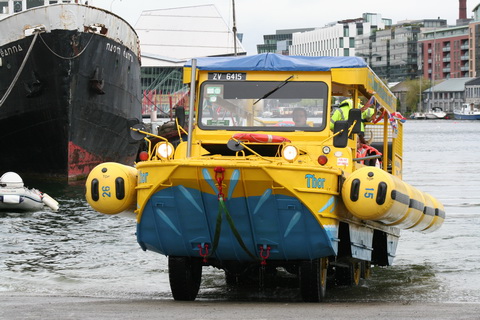
VikingSplash DUKW in Dublin

VikingSplash DUKW in Dublin

All of this may help to explain why the VikingSplash DUKWs operating in Dublin are fitted with additional external buoyancy.