Tag Archives: Grand Canal

Dublin canal murders

At an early hour yesterday morning, in consequence of a dispute between the people belonging to some of the turf boats on the Grand Canal, two young men, citizens, and one of a couple of the military who went to their assistance from the Canal Guard, were murdered, having been thrown into the Canal. Several persons have been taken up and committed to prison.

Saunders’s News-Letter 15 May 1804. From the British Newspaper Archive run by Findmypast Newspaper Archive Limited, in partnership with the British Library.

The Daly news

In 1849 the Grand Canal Company decided to begin operating a cargo-carrying service on its own canal, initially from Dublin to Naas and from Dublin to Kilbeggan, both destinations on branch lines. According to Ruth Delany, Naas was included because

[…] Daly of Sallins, the only trader to Naas, had announced his intention of withdrawing the service which he was operating at a considerable loss.[1]

It may be the same Daly of Sallins who had leased the Grand Canal Company’s hotel in Sallins after the lease to the Great Southern & Western Railway ended in 1847. Delany says that the Daly family

[…] looked after the maintenance of sections of the banks and trackways for the company under contract and later became the horse contractors for the company’s trade boats.[2]

By 1870, however, the Grand Canal Company had ended that arrangement:

The haulage of the boats by their own horses had been a great success. It had been done at a much less rate, and more efficiently, than was done before by contract.[3]

It is possible that the company used contractors for some of its work some of the time, perhaps to supplement its own resources in busy seasons. A report to the company’s half-yearly meeting in August 1888 included these items>

[…] £103 for a new roof to their stables at Shannon Harbour. […] their horsing account for 52 horses at £669. They had during the last half year replaced several horses worn out in the service by new purchases. Their stud was never in a better condition than at present. […] They had succeeded in obtaining savings in new haulage contracts […].[4]

In February 1890, a new company chairman, Mr William F De V Kane JP, reported that Mr T J Daly, of Sallins, had been appointed inspector and clerk of works to the company engineer, Mr Mulvany, at a salary of £150 a year and travelling expenses;

[…] and the directors were confident that by this appointment an improvement in the management of horses in the country as well as economy would be secured.[5]

Perhaps that Daly was related to the other Dalys. I would welcome further information about the Daly family of Sallins.

Sources

[1] Ruth Delany The Grand Canal of Ireland David & Charles, Newton Abbot 1973

[2] ibid

[3] Report to Grand Canal Company half-yearly meeting 26 February 1870 in Dublin Evening Mail 26 February 1870

[4] Freeman’s Journal 20 August 1888

[5] ibid

Grand Canal Coaches

In order to accommodate Ladies and Gentlemen who travel in the Grand Canal Passage Boats, there are established two elegant Coaches to convey passengers to and from their respective houses in Dublin to and from the Grand Canal Harbour, near St James’s-street.

The Coaches will set out from Goulding’s-lane, Anne-street, (South) at four and seven o’clock every morning, on and after Saturday the 16th of April next, and will call at the houses of such Ladies and Gentlemen as have previously taken and paid for their places at Mr Harrison’s Office, No 32, Dawson-street, which will be open from nine o’clock in the morning till eight at night for that purpose. Fare forfeited if the Coach is detained more than five minutes at any one house.

The Coaches will attend every day at the arrival of the Naas and Monasterevan Passage-boats, to convey the Passengers to their respective houses in Dublin.

Those who take places in the Coach will be secure of a passage in the Boats: — no large parcel can be admitted into the coach, it is therefore recommended to such as may have parcels to send them to the Grand Canal Harbour the evening before the boat sails.

RATES

From any part of the town to the Grand Canal Harbour.

1s 7½d for one passenger, from one house.
2s 8½d for two                              ditto
3s 3d for three                               ditto, and
1s 1d for any other passenger from said house.

Three Men Servants may be accommodated with places behind the coach, for which Half Fair will be required, proportioned as above.

A Guard attends the early coaches throughout the year.

The Passengers are requested to communicate to the Director of the Grand Canal the misconduct of any person or persons entrusted with the management of this department.

Dublin Evening Post 29 March 1796. From the British Newspaper Archive run by Findmypast Newspaper Archive Limited, in partnership with the British Library.


A Grand Canal mystery

Passenger boat over lock1

Boat at Lowtown

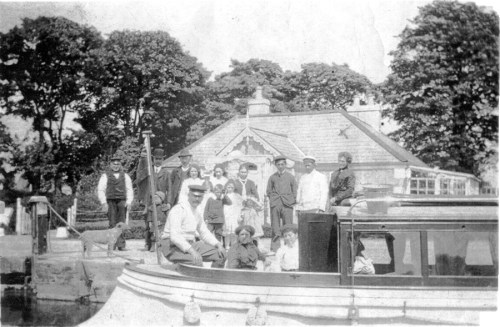
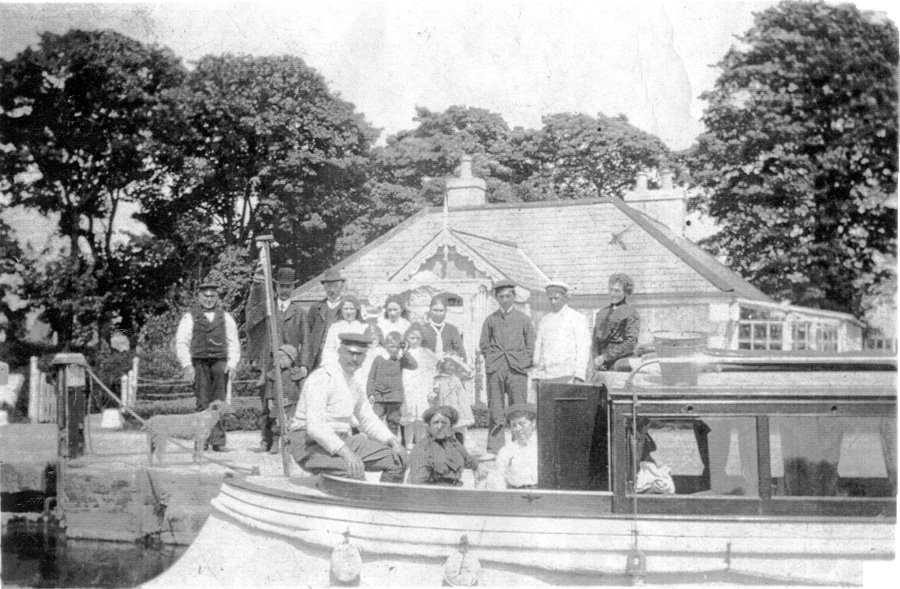
Alan Lindley has very kindly sent me, and permitted me to publish, this photograph.

It was taken at Lowtown lock, on the Grand Canal, in 1911 or 1912.

Alan says that the man on the left of the group — with cap, waistcoat and watch-chain, and with a dog standing in front of him — is the lock keeper, Murtagh Murphy, the great-grandfather of the present incumbent, James (Jimmy) Conroy. Murtagh was born in Ballycowan, near Tullamore, Co Offaly, in 1849 and, after working on a Grand Canal Company boat, married a Kildare girl and took the job at Lowtown.

The boat had been described as a passenger flyboat but, as the Grand Canal Company had ceased carrying passengers in 1852, that seems unlikely. And the boat looks much more like a pleasure vessel than a working boat.

If the Grand Canal Company had an inspection launch, this might be it, but I have found nothing to indicate that it did. The boat does, though, seem to have been designed for canal travel: it seems (from the twenty feet or so we can see) to have straight sides and to be well equipped with fenders. It might therefore have been designed to travel on the canals (as well as on other waters).

At least one director of the Grand Canal Company, Henry Samuel (aka Harry Samuel) Sankey, of Fort Frederic, Virginia, Cavan and of 64 Wellington Road, Dublin, did have a launch or pleasure craft on the canal, the Aja, which you can read about here. Incidentally Mr Sankey, who died on 5 December 1925, directed “that no Roman Catholic shall take any benefit” under his will.

Further information about the boat and the people shown in the photograph, and about Mr Sankey’s launch, would be very welcome; please leave a Comment below.

A canal caterpillar?

Robertson’s chain propeller system on the Bridgewater and Grand Canals in 1859 and 1860.

Grand Canal Company 1861

Sailing of the company’s trade boats,
commencing Saturday, 1st June, 1861

The Company’s Swift Trade Boats start with the strictest punctuality daily to the following stations, viz: — Athlone, Ballinasloe, Limerick, Tullamore, Kilbeggan, Mountmellick, Philipstown, Monasterevan, Portumna, Dromineer, Williamstown, Killaloe, Shannon Harbour and Banagher, Belmount, Naas, Corbally, Sallins, Portarlington, Rathangan.

Sailing Bills containing all particulars may be had upon application at the Company’s Offices, JAMES’S-STREET HARBOUR or WILLIAM STREET.

The Company’s Boats do not trade to Carrick-on-Shannon or Lanesborough.

By Order, John M’Mullen, Grand Canal House, 29th May, 1861

Freeman’s Journal 1 June 1861. From the British Newspaper Archive run by Findmypast Newspaper Archive Limited, in partnership with the British Library.


Transhipment

At the Grand Canal Company’s half-yearly meeting on 22 February 1890, a Mr Geoghegan

[…] said he had heard from a gentleman interested in the trade between Dublin and Limerick that it often took six days for Guinness’s porter to be carried by canal from the former of these cities to the latter. The cause of this he believed was the necessity for trans-shipment at Shannon Harbour.

The Chairman disagreed:

As to the delays at Shannon Harbour there had been some, but he believed these had been caused by floods and storms in the river.[1]

The company had commissioned Mr E Lloyd, engineer and general manager to the Warwick and Birmingham Canal Company, to inspect the Grand Canal and to advise the board. It was estimated that his survey would cost between £100 and £120. The chairman accepted that there were

[…] many matters […] which demanded immediate steps, and these entailed considerable outlay. It has been evidenced that before the property of the company could be stated to be in a thoroughly satisfactory condition some further exceptional outlay would be advisable from time to time.[2]

At the next half-yearly meeting, held on 23 August 1890, the chairman said that the company was considering investing in a more rapid transhipment system “from our barges to the Shannon steamers” at Shannon Harbour, in accordance with Mr Lloyd’s suggestion.[3]

Shannon Harbour June 2008 02_resize

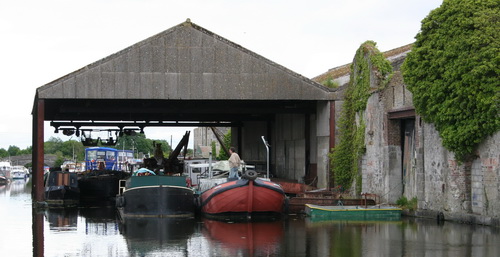
The transhipment shed at Shannon Harbour in June 2008, before its canopy was removed

I do not know whether the transhipment shed at Shannon harbour, and the gantry mechanism on which goods could be loaded and unloaded under cover, was built on Mr Lloyd’s suggestion. It would be interesting to know more of the building’s history.

Sources


[1] The Freeman’s Journal 24 February 1890

[2] ibid

[3] The Freeman’s Journal 25 August 1890

From the British Newspaper Archive run by Findmypast Newspaper Archive Limited, in partnership with the British Library.

Trade boats

Relatively little has been published about the horse-drawn cargo-carrying trade boats used by the Grand Canal Company in the latter half of the nineteenth century, before it adopted semi-diesel engines. Here is some information and some speculation about the subject, but there is much that is not clear.

Placing Percy

Back in May 2013, I wondered whether 53 Percy Place, Dublin 4, which Waterways Ireland was being forced to sell to dig the Clones Sheugh, would still be on its hands in a year or two. And so it was, but in August 2015, I noted that the property was for sale to fund Saunderson’s Sheugh, which we’re all pretending is the Clones Sheugh (aka the Ulster Canal).

The interesting point was that Messrs CBRE wanted over €1.6 million for the site, which was the valuation put upon it in 2008. The 2012 valuation was €650,000 and the 2013 €800,000. I wrote:

On the basis of its asking price for Percy Place, WI seems to believe that the property collapse is over; perhaps it is even now in negotiation to develop Plot 8 and build a sheugh all the way to Clones. In the meantime, if it gets €1.6 million for Percy Place, that will help to alleviate the damage caused by the smash-and-grab raid carried out by the Department of Fairytales to pay for Saunderson’s Sheugh.

Well, it seems that the boom is back. According to the respectable people’s Sunday newspaper, the Sunday Business Post, of 18 October 2015, WI got over €2 million for the site. The SBP is paywalled and I can’t find online confirmation elsewhere, but it’s a high price.

I did note on the CBRE site that the Twelfth Lock Hotel, that haunt of Stakhanovite homoeroticism on the Royal Canal in Blanchardstown, is for sale again. I haven’t been there for some years, so I don’t know whether the mural is still extant.


Swimming in the Naller

On 22 September 2015 Eric Byrne [Labour, Dublin South Central] put a written question to the Minister for Fairytales:

To ask the Minister for Arts, Heritage and the Gaeltacht her plans to review the no swimming in locks and harbours under the by-law within the Canals Act by-laws of 1988 in view of the fact that there is no penalty for ignoring such signs; and if she will make a statement on the matter.

The minister replied:

I have been informed by Waterways Ireland that while it has not determined a need for an associated penalty with this by-law at this time, the matter is being kept under review. I am advised also that the locks, docks and harbours are manned and/or frequently visited by Waterways Ireland Operations and Inspectorate Authorised Officers. Where swimmers are encountered, they are made aware of the by-law provision and the dangers of swimming in or near canal infrastructure and they are requested to remove themselves from the navigation. Such requests are normally acceded to. In the event of persistent offender(s) unwilling to obey direction from Waterways Ireland Authorised Officers, the assistance of An Garda Síochána is sought to remedy the situation.

Sometimes I wonder whether politicians have any grasp on reality. Swimmers in the Naller are a force of nature and are as far beyond the control of Waterways Ireland, the police and indeed politicians as hurricanes, the economy or Mick Wallace. People have been swimming in the canals, in Dublin and no doubt elsewhere, for generations, and nothing or nobody has been able to stop them.

I suspect that more people have swum in the canals than have ever boated on them; swimming is therefore a legitimate topic for waterways studies. Here is a preliminary contribution to the field.